Microblading and powder brows can both create beautiful permanent eyebrows, but they build the brow in fundamentally different ways.
The simplest way to understand the difference is this:
Microblading creates lines.
Powder brows, ombré brows and microshading create tiny points of shading.
Microblading uses a manual hand tool to create individual hair-like pigment strokes. There is intentional space between those strokes because that separation is what allows them to read visually as individual eyebrow hairs.
Powder brows and microshading use a permanent makeup machine to build tiny deposits of pigment throughout the brow. Those points work together to create soft fill and visual density rather than a collection of individual lines.
One creates texture through hairstrokes.
The other creates density through shading.
Neither technique has to be bold, and neither technique automatically owns the word natural.
At BrowBeat Studio Dallas, the useful question is not simply, “Which is better, microblading or powder brows?”
It is:
Which type of permanent eyebrow actually matches your skin, natural brow hair and the result you want to see?
The fundamental difference between microblading and powder brows is how pigment is used to construct the eyebrow.
Microblading creates individual manual hairstrokes. Each line represents one small piece of hair-like detail, with visible space and natural eyebrow hair between the permanent marks.
Powder brows use machine shading to distribute small points of pigment throughout a larger portion of the eyebrow. Those points visually join together to create soft color, fullness and shape.
Think of it as lines versus dots.
A line creates the impression of a hair.
Many tiny points of pigment create the impression of soft fill.
That difference affects appearance, density, skin suitability, longevity and the way each technique is maintained over time.
It does not mean one must look natural while the other looks made up.
Both can be extremely soft.
The difference of what microblading is, is hairstroke texture versus shaded density.

Microblading uses a manual hand tool to create individual hair-like lines within the eyebrow. Each stroke is placed separately, leaving intentional space between the strokes. That is the fundamental difference from powder brows and microshading: microblading builds the brow through lines and texture, while shading builds it through tiny points of pigment and density.
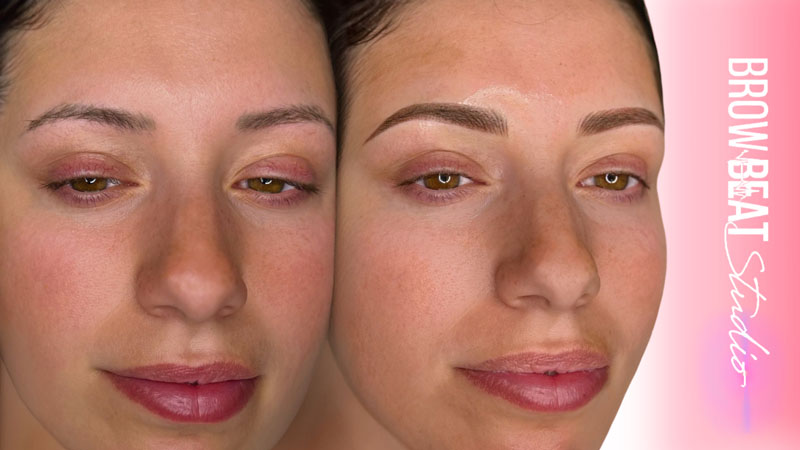
As the microblading procedure progresses, the artist continues developing the brow through individual manual strokes rather than filling the entire shape with pigment. Natural eyebrow hair and visible skin remain part of the design. Compared with powder brows, this creates more separation throughout the eyebrow—the characteristic that gives microblading its distinctly hair-like appearance.


Further into the procedure, the relationship between the permanent hairstrokes becomes easier to see. The objective is not to eliminate every space within the eyebrow. Those spaces help individual strokes remain visually recognizable as hairs. Powder shading approaches fullness differently by placing pigment throughout more of that space, which is why the two techniques can create very different levels of density.
Once the microblading pattern is complete, the eyebrow is still fundamentally a collection of individual permanent hairstrokes working with the client’s natural hair. There is definition without continuous pigment throughout every part of the brow. For clients comparing microblading vs powder brows, this is the clearest visual distinction: microblading preserves hairstroke texture and intentional space rather than creating shaded fill.

These terms can overlap considerably within permanent makeup.
At BrowBeat, we think of shading as the broader technique family.
Powder brows, ombré brows and microshading all use small deposits of pigment to create shaded brow density rather than relying exclusively on individual manual hairstrokes.
The terminology can describe differences in finish or application style.
Powder brows commonly describe the soft powdered appearance of the eyebrow.
Ombré brows typically describe shading with intentional variation in intensity, often including a softer front and greater definition through other areas.
Microshading can describe particularly fine or soft machine shading and, depending on how an artist uses the terminology, may overlap considerably with powder brows.
For someone choosing between these techniques and microblading, the most important distinction is simpler than the terminology.
Microblading belongs to the hairstroke family.
Powder, ombré and microshading belong to the shading family.
Space is essential to microblading.
One hairstroke.
Space.
Another hairstroke.
More space.
Without separation, the strokes would stop reading as individual hairs.
This is one reason microblading can work particularly well when fine natural eyebrow hair already provides texture and density throughout the brow. The permanent strokes can participate with the real hair rather than being responsible for creating every part of the eyebrow.
If there is considerably more visible space and less natural hair, however, individual permanent hairstrokes are being asked to provide much more of the brow’s visual structure.
That is where the difference between hairstrokes and shading becomes particularly important.
Microblading is not failing because it leaves space.
It is doing exactly what a hairstroke technique is designed to do.
Powder brows approach the eyebrow differently.
Instead of creating individual lines, machine shading places tiny points of pigment throughout the brow.
Those points gradually create a soft visual foundation underneath and between the client’s natural eyebrow hairs.
Because the technique does not depend on preserving visible space between individual permanent strokes, it can create greater overall density.
The amount of density is adjustable.
A powder brow can be extremely sheer and understated, or it can be built with greater definition when the client prefers a more polished result.
Powder does not automatically mean dark.
It means shaded.
That distinction is important because modern machine shading can create considerably more softness than many clients imagine when they first hear the words “powder brows.”
When the client has suitable skin, fine natural eyebrow hair with useful spacing and genuinely wants visible hair-like detail, microblading can do something shading does not.
It creates permanent marks that visually imitate individual eyebrow hairs.
Powder brows can create beautiful softness, fullness and shape, but shaded pigment does not become a collection of individual hairstrokes.
For a client who values texture and wants permanent makeup to participate with an existing natural brow rather than create continuous fill, that distinction can make microblading the stronger choice.
This is where microblading shines.
The natural eyebrow provides the framework.
The permanent hairstrokes add the missing detail.
It can, but the terminology is not standardized enough to assume every artist uses “microshading” and “powder brows” to describe completely different services.
For some artists, microshading describes an especially light or finely shaded result.
For others, it is another term within the powder-brow family.
What matters more than the label is the actual finish being created.
How sheer should the shading be?
How much density does the client want?
How soft should the front appear?
How clearly should the overall brow shape read?
Those questions tell us considerably more than choosing between two overlapping names.

Either can look natural when the technique, color and amount of pigment make sense for the person wearing it.
Microblading can look natural because it creates individual hair-like marks.
A soft powder brow can look natural because the shading can be sheer, balanced and appropriate for the client’s face.
After years of talking with permanent makeup clients, we have learned that the word “natural” can describe several different preferences.
Some clients genuinely mean, “I want to see individual hairs and visible skin between them.”
Others mean soft, polished and believable.
They may already fill their brows with makeup every morning and actually prefer that level of fullness—they simply do not want their permanent makeup to look overly strong.
Natural does not belong exclusively to one technique.
The more useful distinction is whether you prefer hair-like texture or soft shaded fullness.
If fullness is one of the client’s primary goals, we first need to define what kind of fullness she wants.
Microblading can make an eyebrow appear fuller by adding individual hairstrokes through gaps and sparse areas.
Those strokes still need visible separation.
Powder brows create fullness by adding shaded density throughout more of the eyebrow.
For someone who wants a more continuously filled brow, that difference can be significant.
Microblading says, “Here are additional hairs.”
Powder shading says, “Here is additional brow density.”
Neither is universally better.
They solve different visual problems.
Natural eyebrow hair becomes particularly important when comparing hairstrokes with shading.
Real brow hair provides three-dimensional texture and helps visually support the intentional spaces between microblading strokes.
As natural hair becomes more limited, individual permanent hairstrokes are asked to create more of the eyebrow by themselves.
Shading does not depend on the same natural-hair support to create fullness because the pigment can provide a soft foundation throughout the brow.
This does not mean every sparse eyebrow automatically needs powder brows.
It means the amount and distribution of natural hair belong in the comparison.
If significant natural brow loss is the defining concern, the decision moves beyond this general comparison and into the broader eyebrow-restoration conversation.
Dallas Microblading showed many clients that permanent eyebrows could be refined, detailed and far removed from older ideas about eyebrow tattooing.
As modern permanent makeup developed, machine shading gave artists another way to construct the brow.
Instead of building primarily with separated lines, shading allowed us to build controlled density from tiny points of pigment.
That expanded the possibilities.
Clients could choose soft fullness without requiring individual permanent hairstrokes.
Artists could work with different skin characteristics and different amounts of natural brow hair.
And the permanent brow decision could become less about forcing one popular technique to fit everyone.
More options did not make microblading obsolete.
They made technique selection more individualized.
Permanent makeup trends change.
The eyebrow still has to make sense on the client’s face after the trend moves on.
If individual hair-like texture is the priority and the skin and natural brow framework support that approach, microblading may be an excellent fit.
If the client wants greater density, soft fill or a technique that does not rely on maintaining individual stroke separation, powder or microshading may deserve stronger consideration.
At BrowBeat Studio Dallas, we do not need one technique to win the comparison.
We need the differences to be clear enough that the client and artist can make a better decision.
The strongest choice is the one whose strengths match the eyebrow, skin and result in front of us.
Skin characteristics can make the difference between simply liking a technique and choosing the technique that makes the most sense for the person wearing it.
Microblading depends on individual hairstrokes maintaining enough separation to continue reading as hairs.
On particularly oily skin, those fine manual strokes can heal wider and lose some of the delicate definition that makes microblading attractive.
Powder brows work differently.
Because machine shading is built from tiny points of pigment rather than individual lines, the result does not depend on preserving the same hairstroke separation.
For this reason, at BrowBeat Studio Dallas we often favor powder or microshading for clients with particularly oily skin.
The client still gets beautiful permanent brow definition.
We are simply choosing a technique that works more naturally with the skin characteristics in front of us.

Powder brows and microshading use a permanent makeup machine rather than the manual microblading tool. The machine creates tiny deposits of pigment that begin building soft shading within the eyebrow. Instead of creating one line to represent one hair, these small points work collectively to create color. This is the foundation of the comparison: microblading creates lines; powder brows create shading from dots.
As the powder-brow procedure continues, additional tiny pigment deposits begin creating greater visual density throughout the eyebrow. The artist can keep the shading extremely soft or gradually strengthen selected areas. Unlike microblading, the technique does not need to preserve visible space between every stroke because the objective is not to make each deposit look like an individual hair.


Further into the shading process, the artist can vary the amount of pigment throughout different portions of the eyebrow. Some areas can remain sheer while others receive greater density and definition. This is where powder and ombré techniques offer considerable flexibility. Microblading controls the brow through the placement of individual hairstrokes; powder brows control it through the distribution and intensity of shading.
Once the shading is complete, thousands of tiny pigment deposits work together visually as one soft brow foundation. Natural eyebrow hair remains visible above that shading and continues providing real three-dimensional texture. Compared with microblading, the permanent pigment itself is doing a different job: microblading adds individual hair-like lines, while powder brows and microshading add soft, continuous density.


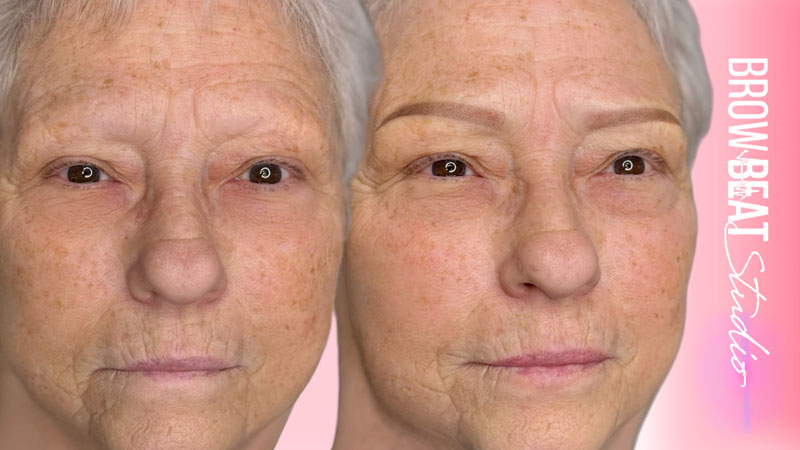
This powder-brow before-and-after demonstrates that natural-looking permanent brows do not require individual hairstrokes. Tiny machine-applied points of pigment create a soft foundation of color underneath the client’s natural eyebrow hair. Compared with microblading, powder brows occupy more of the visual space within the eyebrow. Microblading creates natural-looking texture; powder shading can create natural-looking fullness.
For a client who normally fills her eyebrows with makeup, a natural result may look more like soft, complete density than visible individual hairstrokes. Powder shading can recreate that familiar fullness without requiring a heavy result. This is why microblading vs powder brows should not be reduced to natural versus makeup-looking. Microblading imitates additional hairs; powder brows create a soft field of color beneath the natural brow hair. Both can appear natural.

Thicker or more textured skin creates a similar comparison.
A microblading stroke begins as a fine manual line, and the visual success of the technique depends on those lines continuing to read individually.
On thicker skin, hairstrokes can become visually wider and may lose some of their delicate separation.
Powder shading does not need each pigment deposit to remain visible as an individual mark.
The tiny points work collectively to create color, density and shape.
For skin that is less favorable for fine hairstrokes, that can make shading the stronger choice.
This is not about good skin versus bad skin.
It is about matching lines or shading to the skin that will actually carry them.
Healthy, relatively balanced or drier skin can provide a favorable environment for individual microblading hairstrokes.
If the client also has fine natural eyebrow hair with useful spacing and wants visible hair-like texture, microblading may have a particularly strong starting point.
But favorable microblading skin does not mean the client should automatically choose hairstrokes.
She may simply prefer the fullness and shape created by soft shading.
This is an important part of the comparison.
Skin can tell us which techniques are technically well suited.
Preference tells us which suitable result the client actually wants.
When comparing microblading with microshading for skin type, we are essentially comparing how the skin supports lines versus shading.
Microblading asks the skin to support distinct individual hairstrokes.
Microshading uses machine-applied points of pigment that work together as soft density.
On skin that supports clean hairstrokes well, either approach may be considered depending on the desired result.
On particularly oily or thicker skin, BrowBeat may lean more strongly toward microshading or powder brows because the result does not depend on maintaining the same collection of fine manual lines.
The skin helps narrow the choices.
The desired brow helps finish the decision.
For many clients, powder brows can provide greater visible longevity than microblading.
The reason becomes easier to understand when we return to lines versus dots.
Microblading is made from individual hairstrokes with intentional space between them. As those strokes gradually soften, the loss of definition can become noticeable because every line has its own visual job.
Powder brows distribute pigment throughout more of the eyebrow.
The shaded result therefore has a broader field of pigment contributing to its shape and density.
At BrowBeat, many microblading clients can reasonably expect useful visible definition around the one-year to 18-month range. Powder and microshading can often provide a longer maintenance cycle for appropriate clients, although skin, pigment, skincare, UV exposure and individual retention still influence both techniques.
If microblading longevity is a major priority, shading deserves serious consideration.
A microbladed eyebrow is visually constructed from many individual hairstrokes.
Each line contributes something to the overall brow.
As those separate strokes gradually soften, the definition of selected areas can change.
A powder brow does not depend on a series of individual lines to maintain the same visual framework.
Many tiny points of pigment work together to establish the shape.
That broader distribution can allow a shaded brow to retain a more consistent visual structure for some clients as the pigment changes over time.
For someone who values a clearly maintained brow shape, this can be an important difference between microblading and powder brows.
Both techniques fade.
What differs is the structure that is fading.
Microblading consists of separate hairstrokes, and those individual lines do not necessarily soften at exactly the same rate. One area can remain more visible while another becomes quieter.
Powder brows distribute pigment more continuously throughout the eyebrow, so the visual change can appear more uniform for many clients.
This does not make one type of fading good and the other bad.
It reflects the fundamental construction of the techniques.
Lines change as individual lines.
Shading changes as a broader field of pigment.

The construction of each technique also influences how we think about future maintenance.
With microblading, the existing hairstrokes matter before additional lines are introduced. We want enough space and natural regression to preserve the hair-like character of the technique rather than continually stacking new strokes over strongly retained pigment.
Powder brows are maintained as shading rather than as a collection of individual hairs.
That gives the artist a different foundation to work with when the result eventually needs more density or definition.
Neither technique should be maintained simply because a date appears on the calendar.
But for clients thinking several appointments ahead, the difference between maintaining hairstrokes and maintaining shading is worth understanding from the beginning.
Both microblading and powder brows involve treated skin and an initial recovery period, but the appearance of that process can differ because the pigment begins in different visual forms.
Microblading begins as individual manual hairstrokes.
Powder brows begin as an area of machine shading.
As the skin recovers, clients are therefore watching either individual lines or shaded density move through their respective healing processes.
Neither technique should be chosen solely because someone expects one healing experience to be universally easier.
Aftercare also needs to follow the protocol provided for the actual procedure performed.
The detailed healing journey belongs to each technique’s dedicated healing information; for comparison purposes, the important point is that lines and shading do not necessarily look identical while the skin recovers.
Discomfort is individual, and we do not promise that every client will find one technique easier than the other.
The procedures also create different sensations.
Microblading uses a manual hand tool to create individual hairstrokes.
Powder brows use a PMU machine to gradually build areas of shading.
Some clients may be more aware of the manual sensation of microblading, while others notice the repetitive machine work involved in shading.
Numbing is part of the permanent makeup experience, but sensitivity still varies from person to person.
For us, the better technique decision comes from the skin and desired result rather than trying to predict which procedure one client will personally find more comfortable.
The tools make the difference between these techniques particularly easy to understand.
Microblading uses a manual hand tool to create lines.
Powder brows and microshading use a permanent makeup machine to create points of shading.
The manual tool allows the artist to place and direct each individual hairstroke.
The machine allows the artist to gradually build density through repeated tiny pigment deposits.
Clients do not need to understand technical needle configurations or machine settings to understand the comparison.
Manual lines create hairstrokes.
Machine-applied points create shading.
Cost is a reasonable part of the comparison, but we do not recommend choosing a permanent brow technique simply because one service has a lower price.
The first question should be which technique is appropriate for the client’s skin, natural eyebrow hair and desired result.
A small price difference has very little value if the client chooses a technique that does not create the kind of eyebrow she actually wants.
At BrowBeat Studio Dallas, current service pricing is maintained separately so it can remain accurate as prices change.
For this comparison, the important point is that both are permanent makeup investments.
Technique should come before price.
Longevity can influence the decision, but it should not make the entire decision.
If a client genuinely loves visible individual hairstrokes and has skin and natural brow hair that strongly support microblading, she may happily accept a shorter maintenance cycle in exchange for the texture she prefers.
Another client may prioritize greater density, more consistent shape and longer visible retention.
For her, powder brows may align more closely with those priorities.
This is why there is no universal winner.
The comparison becomes useful when the client understands what she gains from each technique and decides which advantages matter most to her.

Softness is possible with both techniques.
Microblading creates softness through fine individual hairstrokes working with natural eyebrow hair and the visible skin between them.
Powder brows create softness differently. Machine shading can be applied very lightly, producing a sheer wash of pigment rather than a heavily filled eyebrow.
So when a client tells us she wants something soft, we need to understand what kind of softness she means.
Does she want soft hairstroke texture?
Or does she want soft shaded fullness?
Both can be subtle.
The visual structure underneath that softness is what separates them.
Definition can also mean different things.
Microblading creates precise definition through individual hair-like marks. A sparse tail can become more visible. Small gaps can gain continuity. Fine natural brows can receive additional texture.
Powder shading can define the eyebrow more continuously because pigment is distributed throughout the shape rather than concentrated into separate lines.
For a client who wants to continue seeing individual permanent hairstrokes, microblading may provide the kind of definition she values.
For someone who wants the complete brow shape to read more clearly, shaded density may be closer to what she is describing.
Precision and fullness are not the same thing.
One of the most useful things a client can show us is how she already likes to wear her eyebrows.
If she normally draws a few missing hairs, extends a sparse tail or adds small amounts of pencil through gaps, she may already be recreating the kind of detail microblading provides.
If she routinely fills most of the eyebrow with pencil, powder or another brow cosmetic, she may actually prefer more continuous density.
That can make powder or microshading feel surprisingly familiar.
A client may describe her preferred look as natural while still loving the polished fullness she creates with makeup every morning.
The makeup routine often tells us more than the word natural ever could.
The fundamental distinction remains hairstrokes versus shading.
Microblading uses a manual tool to create individual hair-like lines.
Ombré brows belong to the machine-shading family and use tiny pigment deposits to create density with intentional variation in intensity.
An ombré design may be particularly soft through the front of the brow and gradually carry greater definition elsewhere.
That gradient is what gives the technique its ombré character.
For the client, the decision is still easier when we remove the terminology.
Do you want the permanent makeup to read primarily as individual hairs?
Or do you want soft shaded density with controlled variation throughout the brow?
Microblading creates manual hairstrokes.
Microshading creates small points of machine-applied shading.
The word “micro” can make the services sound closely related, but the way the eyebrow is constructed is fundamentally different.
Microblading builds texture from lines.
Microshading builds density from tiny pigment deposits.
Depending on the terminology an artist uses, microshading may describe an especially soft shaded result or overlap substantially with powder-brow terminology.
At BrowBeat, the useful distinction is whether the client is choosing hairstrokes or shading, not arguing over overlapping names.
Ombré powder brows are part of the powder-shading family.
The ombré element describes how the intensity of that shading is distributed throughout the eyebrow.
Microblading maintains intentional space between individual hairstrokes.
Ombré powder brows can create more continuous density while allowing selected areas to remain especially soft.
This makes ombré shading appealing to clients who want a filled brow without wanting identical pigment strength from the front through the tail.
It is another example of why powder does not have to mean heavy.
There is no universal winner.
There can, however, be a stronger choice for a particular client.
Microblading may have the advantage when suitable skin, fine natural brow hair and a genuine preference for individual hairstrokes come together.
Powder brows may deserve stronger consideration when the client wants greater density, regularly fills much of her eyebrow with makeup, has particularly oily or thicker skin, or places greater importance on longer visible retention and shape consistency.
The word “better” only becomes useful when we finish the sentence.
Better for which skin?
Better for which starting brow?
Better for which visual result?
Better for which long-term priorities?
If your priority is seeing individual permanent hair-like detail, microblading may align more closely with your goal.
If you want soft fill and greater density throughout the eyebrow, microshading may be closer to what you are picturing.
Then we consider the skin and natural brow framework.
A client may love hairstrokes but have skin that favors shading.
Another may have excellent microblading skin but simply prefer a powder-like finish.
Technique selection works best when appearance and suitability point in the same direction.
Choose between them by looking at what you want the permanent pigment to contribute.
Microblading contributes individual hair-like texture.
Ombré brows contribute shaded density with variation in softness and definition.
Both approaches can be refined and understated.
The question is whether you want the permanent makeup itself to resemble hairs or to create a soft foundation of color throughout the eyebrow.

Microblading uses a manual hand tool to create individual hair-like lines within the eyebrow. Each stroke is placed separately, leaving intentional space between the permanent strokes. Compared with powder brows and microshading, this is the fundamental technical distinction: microblading builds texture from lines, while machine shading builds density from tiny points of pigment.
Powder brows and microshading use a permanent makeup machine to create tiny deposits of pigment throughout the eyebrow. Rather than creating one line to imitate one hair, those small points begin working collectively as shading. Compared with microblading’s manual hairstrokes, powder brows build density from dots rather than texture from lines, which can work well with clients that have no hair.


As machine shading progresses, additional pigment points gradually increase the visual density of the eyebrow. The artist can keep the effect extremely sheer or strengthen selected areas. Unlike microblading, microshading does not need each permanent stroke to remain visually recognizable on its own because the points are intended to work together as soft fill.
Powder shading allows the artist to vary pigment density throughout different areas of the eyebrow. Some portions can remain especially sheer while others receive greater definition. Microblading controls the result through the placement and direction of individual lines. Powder brows control it through the distribution and intensity of shading.


Thousands of tiny pigment deposits work together visually to create the powder-brow result, great for providing coverage where no eyebrow hair is present. Compared with microblading, the permanent pigment itself has a different job. Microblading adds the appearance of individual hairs; powder brows and microshading add soft, continuous density.
Either technique can potentially improve thin or sparse eyebrows, but the amount and distribution of natural hair matter.
Fine, evenly distributed natural brow hair with selected gaps can provide an excellent framework for microblading because the permanent hairstrokes have natural texture surrounding them.
When the eyebrow needs substantially more overall density, powder shading can provide visual support throughout more of the shape.
A few gaps and significant natural brow loss are not the same starting point.
If brow loss itself becomes the defining concern, the decision belongs within the broader restoration conversation rather than this general technique comparison.
Microblading maintenance involves working with the individual hairstrokes already present in the skin.
Some strokes may remain stronger than others, and the artist needs to consider the existing pattern and available space before introducing additional lines.
Powder brows are maintained as an area of shading rather than as a collection of individual hairs.
That gives the artist a different type of foundation when the brow eventually needs more density or definition.
For some clients, this can create a more consistent long-term maintenance experience.
It is one practical reason shading has become increasingly appealing to clients who are thinking beyond their first permanent brow appointment.
A permanent brow technique creates a foundation.
That foundation matters later.
At BrowBeat Studio Dallas, we do not only ask what a technique can create today.
We also consider what we may be maintaining through future appointments.
Microblading can be an excellent foundation when the client has the right skin, natural brow support and a genuine preference for individual hairstrokes.
Powder brows can create a different long-term foundation for clients whose priorities lean toward density, shape consistency and shading.
Thinking ahead does not mean choosing powder brows automatically.
It means recognizing that the first technique becomes part of the future eyebrow too.
For many clients, microblading can require maintenance sooner because the result depends on individual hairstrokes continuing to provide visible definition.
As those strokes gradually soften, the client may begin noticing that a tail needs more help or that selected areas no longer have the same hair-like structure.
Powder brows distribute pigment throughout more of the eyebrow, so the shaded density can continue contributing to the overall result even as the color gradually becomes softer.
That can create a longer maintenance cycle for many clients.
Neither technique should be maintained simply because a certain number of months has passed.
The existing pigment and what the client wants from her brows should still guide the decision.
Both microblading and powder brows fade.
The difference is what is fading.
Microblading is constructed from individual lines, and those separate hairstrokes do not necessarily soften at exactly the same rate. One portion of the brow may retain more visible detail while another becomes lighter sooner.
Powder brows distribute pigment throughout a broader shaded area. Because the result is not dependent on each individual mark remaining visible, the overall change can appear more uniform for many clients.
Neither type of fading is inherently wrong.
Lines change as individual lines.
Shading changes as a field of pigment.
That structural difference helps explain why the two techniques can look different over time.
The visible shape of a microbladed eyebrow is created by many individual hairstrokes working together.
As those strokes gradually change, selected areas can lose definition at different times.
Powder brows establish the shape through a broader distribution of shading.
Thousands of tiny pigment deposits contribute collectively rather than asking individual lines to maintain the complete framework.
For many clients, that can help the overall brow shape remain visually more consistent as the permanent makeup changes over time.
If shape stability is particularly important to the client, that can be a meaningful advantage of shading.
No.
Powder describes the shaded technique, not a requirement for a dark or solid result.
Machine shading can be built gradually. The pigment can remain sheer in selected areas, the front can be kept soft and the overall density can be adjusted according to the client.
This is one of the biggest differences between modern powder brows and the heavy eyebrow tattoo many people imagine when they first hear the word shading.
Density is available.
It does not have to be maximized.

Absolutely.
The client’s natural eyebrow hair remains three-dimensional above the skin while the powder shading creates soft density underneath it.
Those two elements can work beautifully together.
Natural hair supplies texture.
Shading supplies the background foundation.
This is another reason the comparison should not be reduced to “microblading looks natural and powder brows look like makeup.”
A softly shaded brow with natural hair running through it can look extremely understated and believable.
Yes. This is one of microblading’s clearest visual strengths.
The permanent makeup itself is made from individual hair-like lines, so visible hairstroke texture is built directly into the technique.
Powder brows create shaded density rather than permanent hair-like marks. Their three-dimensional texture comes primarily from the client’s natural eyebrow hair sitting above the shading.
If seeing individual permanent hairstrokes is particularly important to the client, microblading offers something powder shading is not designed to imitate.
They can, particularly when the client defines polished as having consistent density and a clearly readable eyebrow shape.
Microblading intentionally preserves space between the individual hairstrokes.
Powder shading can occupy more of that visual space while still remaining soft.
For clients who already fill much of their eyebrows with makeup, that can make a shaded result feel especially familiar.
They are not necessarily looking for a heavier brow.
They may simply prefer a more complete one.
Then you may be describing two different visual goals at the same time.
Hairstrokes create texture.
Shading creates density.
If both are important, asking microblading alone to provide a shaded level of fullness may not be necessary.
A technique that combines hairstrokes with shading can allow each method to do the job it does best.
That decision belongs within the dedicated combination-brow comparison, but recognizing the desire for both is useful here.
Wanting texture and density is different from choosing between texture and density.
Look at what you currently add with makeup.
If you primarily draw several missing hairs, strengthen a sparse tail or fill small gaps, microblading may recreate the kind of detail you are already adding.
If you routinely fill most of the eyebrow to create greater density and a more complete shape, powder shading may more closely reproduce the result you are trying to stop creating every morning.
Your current brow routine can therefore be surprisingly useful when choosing permanent makeup.
Sometimes the eyebrow you draw every day has already shown us what you prefer.
Both techniques can reduce daily brow makeup, but they replace different parts of the routine.
Microblading can replace some of the individual hair-like marks a client normally draws through sparse areas.
Powder brows can provide more of the overall density and shape she normally creates with pencil or powder.
If the goal is reducing as much daily filling as possible, the amount of permanent density the client wants becomes particularly important.
This is why we ask what she currently does to her eyebrows rather than assuming the technique from the word “natural.”
Either technique can look beautiful on a bare face when the color, density and design are appropriate for the client.
Microblading can provide hair-like detail among the natural eyebrow hairs.
A soft powder brow can provide more complete density while remaining subtle enough to sit comfortably on a face without other makeup.
The better bare-face result is not determined by the technique name.
It comes from choosing an appropriate amount and style of permanent makeup for the person wearing it.
Start with four things.
Your skin. Does it provide a favorable environment for delicate individual hairstrokes, or does it point more strongly toward shading?
Your natural eyebrow hair. Is there enough fine natural texture to support separated permanent strokes, or does the brow need more continuous density?
Your preferred appearance. Do you genuinely want visible hair-like detail, or do you prefer soft, polished fullness?
Your long-term priorities. How important are longevity, shape consistency and maintenance compared with having permanent hairstroke texture?
Those four questions tell us considerably more than asking which technique is universally better.
At BrowBeat Studio Dallas, we perform both hairstroke and shading techniques because different eyebrows need different things.
Microblading creates individual lines with intentional space.
Powder, ombré and microshading create tiny points of pigment that build density.
That simple distinction affects appearance, skin suitability, fullness, longevity and long-term maintenance.
We do not need microblading to lose for powder brows to be a good choice.
And we do not need powder brows to be wrong for microblading to be beautiful.
If suitable skin, fine natural brow hair and a genuine preference for individual hairstrokes come together, microblading can have a clear advantage.
If the client wants greater density, has skin that favors shading or places more importance on longevity and shape consistency, powder or microshading may be the stronger fit.
The purpose of understanding the difference is not to declare a winner.
It is to make the first permanent brow decision with better information.
Lines create texture.
Dots create density.
The strongest technique is the one whose strengths match the client.

The simplest difference is lines versus dots. Microblading uses a manual tool to create individual hair-like lines with intentional space between them. Powder brows use a permanent makeup machine to create tiny points of pigment that build soft shaded density. Microblading primarily creates texture; powder brows primarily create fill and density.
They can overlap considerably. At BrowBeat Studio Dallas, we think of shading as the broader family. Powder brows and microshading both use small machine-applied pigment deposits to build shaded density rather than manual hairstrokes. Some artists use microshading to describe a particularly soft style of shading, while others use the terms almost interchangeably.
Ombré brows belong to the powder-shading family. The term usually describes how the shading changes in intensity throughout the eyebrow, often with a softer front and greater definition elsewhere. It is still fundamentally a machine-shaded brow. Microblading, by comparison, creates separate manual hairstrokes rather than a field of shading.
Microblading creates individual hair-like lines with a manual hand tool. Microshading creates tiny points of pigment with a permanent makeup machine, allowing those points to build soft density throughout the eyebrow. Think of microblading as texture through lines and microshading as density through shading.
Microblading creates individual hairstrokes with visible space between them. Ombré brows create shaded density using a machine, with intentional variation in how soft or defined different areas appear. Both can be subtle, but the visual structure is different: microblading imitates hairs, while ombré brows create a soft field of color.
Either can look natural when designed appropriately. Microblading can look natural because the permanent pigment resembles individual hairs. Powder brows can look natural because the shading can be extremely soft, sheer and balanced. At BrowBeat, we first clarify what the client means by natural: visible hairstrokes, soft fullness, a polished brow or simply a result that does not look overly strong.
They can create a makeup-like effect when greater density and definition are intentionally built, but powder brows do not have to look heavily made up. Machine shading can be extremely sheer. For clients who already softly fill their eyebrows every day, a powder result may actually resemble the brow they already consider natural on themselves.
They do not have to. Modern powder shading can be built gradually, allowing the front, edges and selected areas to remain soft. Powder describes the way pigment is shaded throughout the brow; it does not mean the artist must create one dark block of color. Density is adjustable.
Microblading can have a clear advantage when the client has suitable skin, fine natural eyebrow hair with useful spacing and genuinely wants permanent hair-like detail. The technique can create individual pigment marks that visually imitate eyebrow hairs. Powder shading can create beautiful density, but it is not designed to turn shaded pigment into individual hairstrokes.
Powder brows may have an advantage when the client wants greater overall density, regularly fills much of her eyebrow with makeup, has particularly oily or thicker skin, or places greater importance on longer visible retention and shape consistency. The advantage depends on the client’s priorities rather than powder being universally better than microblading.
At BrowBeat, we often favor powder or microshading for particularly oily skin. Microblading relies on fine individual strokes maintaining enough separation to continue reading as hairs, and oily skin can make that delicate definition more difficult to maintain. Shading does not depend on preserving individual hairstroke lines in the same way.
They can be a stronger technique choice. On thicker skin, fine microblading strokes can become visually wider and lose some of their delicate separation. Powder shading is built from tiny pigment deposits working collectively, so the result does not require each mark to remain visible as an individual hair-like line.
Healthy, relatively balanced or drier skin can provide a favorable environment for microblading hairstrokes, particularly when fine natural brow hair supports the result. That does not automatically make microblading better. A client with excellent microblading skin may still prefer the density and finish of powder brows. Skin suitability and aesthetic preference both matter.
It depends on the type of thin brow. Fine natural hair with selected gaps can provide an excellent framework for microblading hairstrokes. If the eyebrow needs considerably more overall density, powder shading may provide more continuous visual support. When significant natural brow loss is the main issue, the decision belongs within a broader eyebrow-restoration strategy.
Microblading can work beautifully when natural brow hair remains and the goal is adding hair-like detail through selected sparse areas. Microshading can provide more density when the client wants greater visual coverage throughout the brow. The amount and distribution of natural hair are more useful than the word sparse by itself.
Microblading has the clearer advantage when the specific goal is for the permanent pigment itself to resemble individual eyebrow hairs. Each manual stroke is designed as a hair-like mark. Powder brows create shaded density instead. Natural eyebrow hair still provides texture over powder shading, but the permanent pigment itself is not constructed as individual hairs.
Yes. Powder shading sits within the skin while the client’s natural eyebrow hair remains above it. The natural hair continues providing three-dimensional texture while the shading adds background density. The two can work together to create a soft, complete eyebrow rather than the shading hiding the natural hair.
Powder brows can generally create more continuous visual density because shading fills more of the space throughout the eyebrow. Microblading can make brows appear fuller by adding individual hairstrokes, but those strokes intentionally retain space between them. The choice depends on whether the client wants additional hairs or additional overall density.
That usually means you are describing two different goals: texture and density. Microblading creates hair-like texture, while shading creates density. A technique combining hairstrokes and shading may deserve consideration when both are important. The full comparison between microblading and combination or hybrid brows belongs to the dedicated combination-brow discussion.
For many clients, powder brows can provide greater visible longevity. Microblading relies on separate hairstrokes, while powder brows distribute pigment through a broader shaded area. At BrowBeat, many microblading clients can reasonably expect useful definition around one year to 18 months, while shading can often provide a longer maintenance cycle depending on skin, pigment, skincare, UV exposure and individual retention.
They can for many clients because the pigment is distributed across a broader shaded area. Microblading consists of separate lines, and individual strokes may soften at different rates. Powder shading changes as a field of pigment rather than as isolated hairstrokes. Both techniques fade; the structure of that fading is simply different.
Microblading creates the visible brow shape from many individual hairstrokes. As selected strokes soften, portions of the shape can become less defined. Powder brows create shape through a broader distribution of tiny pigment deposits, so the overall framework does not depend on every individual line remaining equally visible.
Microblading can require maintenance sooner for many clients because the result depends on individual hairstrokes continuing to provide useful definition. Powder shading can maintain broader density for longer in appropriate clients. Neither technique should be refreshed simply because a calendar date arrives; the existing pigment and the client’s desired result should guide maintenance.
Microblading maintenance must consider the individual hairstrokes already present and the space available for future strokes. Powder brows are maintained as an area of shading rather than a collection of individual lines. That gives each technique a different long-term foundation and is one reason the first permanent brow choice matters beyond the initial appointment.
There is no universal answer for every client. Microblading and powder brows create pigment differently, so their visual recovery can differ. Microblading begins as individual manual hairstrokes, while powder brows begin as machine shading. Skin characteristics also matter. Detailed aftercare and healing expectations should follow the specific technique the client actually receives.
Discomfort is individual. Microblading creates hairstrokes with a manual hand tool, while powder brows use repetitive machine work to build shading. Clients can experience those sensations differently, and numbing is used as part of the permanent makeup process. BrowBeat would not choose a technique primarily by trying to predict which one a particular client will find less uncomfortable.
Pricing can vary by studio, artist and treatment structure, so cost should be compared using current service pricing rather than assuming one technique is always more expensive. At BrowBeat Studio Dallas, detailed pricing is maintained separately so it stays current. For technique selection, skin, desired result and long-term priorities should come before a small price difference.
It is worth considering. If you routinely fill most of your eyebrow to create density and a polished shape, powder shading may reproduce more of what you already like about your daily brows. If you mainly draw a few missing hairs or strengthen selected gaps, microblading may align more closely with your existing routine.
Either can work beautifully on a bare face. Microblading may appeal to someone who wants visible hair-like detail among her natural brow hairs. A softly shaded powder brow can provide more complete density while remaining understated. The amount of pigment and the design matter more than assuming one technique automatically looks better without makeup.
Start with the basic distinction. Microblading creates individual manual hairstrokes. Powder, ombré and microshading belong to the machine-shading family and create density from tiny pigment deposits. Then consider your skin, natural brow hair, preferred amount of fullness and long-term priorities. At BrowBeat Studio Dallas, the goal is not to declare one technique the winner—it is to choose the technique whose strengths match the client.