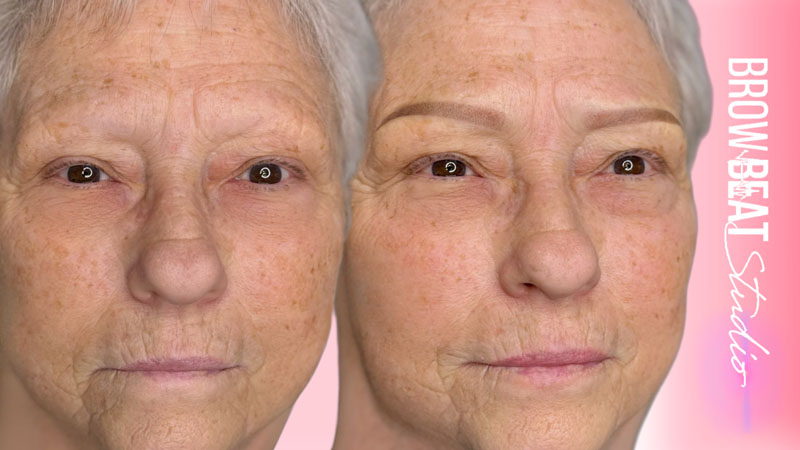
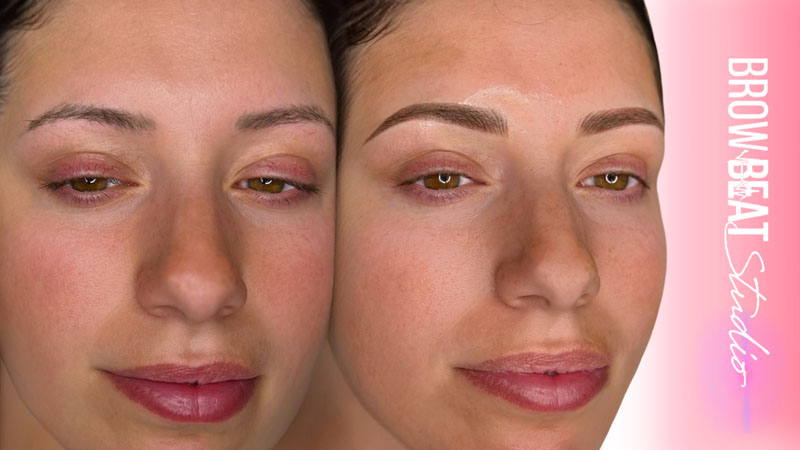
Your Combo Brows are finished. You sit up and see two kinds of permanent detail working inside the same eyebrow.
Manual hairstrokes.
Machine shading.
Both are fresh. The hairstrokes can look particularly crisp. The shading can look stronger and more filled. The complete shape can feel more defined than the eyebrow you will eventually wear once everything has healed.
Then the skin begins recovering. And this is where Combo Brow healing becomes a little more interesting than healing a brow created with only one type of permanent detail.
The hairstrokes and shading do not always appear to change at exactly the same visual pace. For a few days, one may attract your attention more than the other.
The brow can look darker. Then drier. Then flaky.
The shading may temporarily look lighter. Some hairstrokes may become surprisingly difficult to see. And eventually the two components begin settling back into the complete combination you chose.
A healing Combo Brow is a result in transition, not a finished eyebrow waiting to be graded.
A BrowBeat Combo Brow contains manual microblading hairstrokes and machine shading within the same permanent eyebrow. Read combo & hybrid brow vs microblading and combo & hybrid brow vs shading for more information on the differences between PMU services.
Those two components create different kinds of visual information. Hairstrokes are fine, individual lines. Shading is a broader field of permanent color and density.
When everything is healed, the client tends to see the complete eyebrow. During healing, however, the differences between those components can temporarily become much easier to notice.
A few hairstrokes may look faint while the shaded background still looks strong. Another area may look more shaded because the fine stroke detail has become harder to see. One section may begin flaking before another. That temporary imbalance is one of the most important things to understand about Combo and Hybrid Brow healing.
You are not healing a microbladed eyebrow and a powder eyebrow independently. You are healing one permanent eyebrow that contains both forms of detail. The same skin is recovering across the complete treatment area.
What changes is how visible each component may appear while that recovery is happening. That is why BrowBeat wants clients to look at the progression as a whole rather than trying to decide halfway through healing which individual strokes or shaded areas have retained.
Fresh Combo Brows generally look stronger than healed Combo Brows.
The hairstrokes have just been created. The machine shading has just been placed. The color is fresh. The mapped shape can look particularly crisp.
And depending on the individual client’s skin response, there may also be some temporary redness or tenderness around the treated area. That first mirror check is the beginning of healing—not a preview of the exact intensity the brows will maintain once healed.

A client with naturally blonde eyebrow hair may begin with a very delicate permanent color. Immediately after treatment, the new hairstrokes and shading can look noticeably stronger against light skin and hair. As healing progresses, that contrast softens, sometimes making the permanent detail appear much lighter than expected. Because the original design was intentionally subtle, changes in visibility may be especially noticeable. The important question isn’t whether the brow matches its fresh appearance but how the complete combination looks after the skin has recovered.
A blonde Hybrid Brow begins with lighter permanent pigment and often restrained shading density. When the surface begins shedding, that already-delicate color may temporarily become difficult to see. The client may wonder whether the hairstrokes and shading disappeared altogether. But a lighter-looking healing stage isn’t a reliable measure of final pigment retention. Blonde combination eyebrows should be evaluated after recovery, when the permanent detail can be viewed without the changing surface. The goal is a soft eyebrow that remains appropriate for the client’s natural coloring, not an unnecessarily dark result simply to avoid temporary lightness.


Dark natural eyebrow hair can continue providing substantial visual structure even when permanent hairstrokes and shading become temporarily lighter. A brunette client may therefore feel that her eyebrow shape remains recognizable throughout recovery, despite noticeable changes in the tattooed pigment. The natural hair is still contributing to the complete brow. That distinction matters because the apparent fullness of an eyebrow isn’t determined by permanent makeup alone. Combo Brow healing should be evaluated with the client’s natural hair in mind rather than treating every visible change as pigment loss.
Medium-brown permanent pigment can appear especially noticeable immediately after a Hybrid Brow procedure because the color has just been placed and the surrounding skin is fresh. The hairstrokes may look sharply defined, while machine shading provides a stronger background than the client expects to see later. As healing progresses, the overall contrast can soften. The exact amount of change varies, and the final appearance depends on the individual client and original design. Fresh color should therefore be understood as the beginning of recovery rather than a fixed representation of the finished eyebrow.


A client with medium-melanin skin may notice that the manual hairstrokes and machine-shaded areas look different as the treated skin recovers. The appearance can also be influenced by natural eyebrow hair, pigment depth and the amount of shading originally placed. One section may look stronger while another becomes temporarily lighter. Those observations need to be interpreted within the healing process rather than treated as permanent results. At BrowBeat Studio Dallas, the complete eyebrow is evaluated after recovery, with attention to the individual client’s skin and original design.
Combo Brow healing isn’t limited to one complexion or natural eyebrow color. On high-melanin skin, freshly placed permanent hairstrokes and shading can also appear stronger before the treated surface recovers. Dryness, flaking and temporary changes in visibility may occur, although individual experiences vary. Pigment depth and natural brow hair influence how the complete result appears. The artist should consider the actual skin response rather than assume every client within a particular complexion range will follow an identical timeline.

Because you are looking at newly created permanent hairstrokes through freshly treated skin. They can appear darker, sharper and more obvious than the hair-like detail you will eventually see once the eyebrow settles.
You are also probably looking at them from approximately three inches away. That is not how you normally experience your eyebrows.
Close up, the individual lines are easy to inspect. From normal viewing distance, they begin contributing to the complete brow.
The machine-shaded component is fresh too. Even a Dallas Combo Brow designed with soft background shading can therefore look more filled immediately after treatment. That can be particularly noticeable if you began with very light natural brows or normally wear little brow makeup.
Your face has changed within a few hours. Some of what feels dramatic is fresh pigment. Some of it is simply your eyes adjusting to seeing a complete permanent eyebrow where there was less visible color before.
Immediately after treatment, clients can sometimes mentally separate the components.
There are the hairstrokes. There is the shading. There is the natural hair.
Everything is visually new and both permanent components are at fresh intensity. That can make the combination feel less effortless than it will once the skin has healed and the permanent detail has softened.
This is important. Clients choose Combo or Hybrid Brows because they want hairstroke texture and shaded density to belong within the same eyebrow. But “blended” does not mean those elements must already look as soft and settled on the first afternoon as they will weeks later.
The hairstrokes can look particularly crisp. The shading can look particularly visible.
The contrast between them can therefore be easier to see while everything is fresh. Healing changes that relationship.
The dimensional appearance of a 3D Brow comes from seeing different kinds of visual information together.
Natural eyebrow hair. Permanent hairstrokes. Shaded density. Visible skin.
During healing, all of those elements are being viewed through skin that is changing. The hairstrokes begin softening. The shaded background begins settling. The surface can become dry or flaky.
That means the dimensional effect may temporarily look different before the complete brow reaches its healed appearance.
It is useful to talk about Combo Brow healing by days because clients want to know what may happen next. But real skin does not follow an infographic perfectly.
One client may begin seeing dryness earlier. Another may start flaking later. One eyebrow may even appear slightly ahead of the other. Some clients notice very little visible shedding at all.
So the timeline below is a general progression—not a promise that every eyebrow will perform the same change on the same morning.
During the first day or two, the procedure is still very recent. The hairstrokes may look crisp and dark. The shading may look full. The complete shape can feel particularly defined.
The skin may also show some temporary redness or tenderness. This is the stage when BrowBeat’s early aftercare begins, because freshly treated skin can release lymph onto the surface.
Lymph is part of the body’s normal response after the skin has been worked. Freshly treated brows can release clear or slightly yellowish fluid during those early hours.
The concern is not simply that lymph exists. It is what happens when repeated surface fluid is allowed to sit and dry into heavier buildup. That can contribute to thicker crusting and scab formation.
BrowBeat’s Day 1 cleansing routine is designed to manage that surface early.

On Day 1, BrowBeat clients wash their brows four times at one-hour intervals.
You wash them. Then leave them alone for an hour.
During that break, the freshly treated skin has time to release additional lymph. Then you wash again. The process is repeated until the four washes are complete.
The purpose is not to continuously scrub freshly treated eyebrows. It is to gently manage what reaches the surface before repeated lymph dries into heavier buildup.
This concern makes sense. You just spent hours having permanent hairstrokes and shading created, and now BrowBeat is telling you to wash your eyebrows. It can feel counterintuitive.
But the permanent pigment has been placed within the skin. The Day 1 cleansing routine is caring for the surface according to BrowBeat’s aftercare protocol. You do not need to preserve dried lymph on top of the brow in order to preserve the permanent makeup underneath it.
Washing does not mean scrubbing. This is freshly treated skin. Follow the BrowBeat cleansing instructions gently.
Do not scratch. Do not pick. Do not decide that something attached to the healing surface needs your help coming away.
The purpose is surface care—not forcing the healing process forward.
As the first few days pass, the eyebrows begin moving away from their freshly treated appearance. The skin can feel drier. The surface texture can begin changing.
The permanent work may still look strong, but it can look different from Day 1 simply because the skin over it is changing. This is often when clients become more aware that their brows are healing.
Dryness can make the permanent detail appear particularly crisp. The hairstrokes may still look obvious. The boundaries of the brow can feel stronger. The shading can continue carrying substantial color.
If you requested a soft Combo Brow, you may wonder where the softness went. It has not gone anywhere. You are still looking at healing permanent makeup.
This is the stage many clients expect to be dramatic. It does not have to be.
The treated surface may become dry and begin releasing small flakes or a thin surface layer. One area may begin before another. One brow may appear slightly ahead of the other. Some clients notice surprisingly little.
The BrowBeat Day 1 washing routine is designed to reduce the heavy surface buildup that can contribute to larger crusting later.
No. The goal is not to create a large scab and then wait for it to fall from the eyebrow. BrowBeat manages early surface lymph specifically because we would rather see clients move through a lighter shedding stage than deal with unnecessary heavy buildup.
Healing still happens. The surface can still become dry. Flaking can still occur. It simply does not need to become a brow emergency.
A tiny lifted edge can become incredibly tempting when it is sitting above your eye all day. Leave it alone. If part of the healing surface is still attached, let the skin decide when it is ready to release.
Do not pull. Do not scratch. Do not “help” the flaking finish faster.
Your fingernails do not improve the healing timeline.
Because different areas of the healing surface do not necessarily release at exactly the same time. One section may have shed while the area beside it has not. Now you are looking at permanent makeup through two different stages of healing skin inside the same eyebrow.
The shading can appear uneven. The hairstrokes can appear easier to see in one area than another. That temporary patchiness should not be treated as the final healed result.
This is the most Combo-specific part of the healing journey. Sometimes the shading becomes difficult to see while several hairstrokes remain obvious. The brow can temporarily look more like Microblading.
At another point, fine hairstroke detail may become difficult to see while the shaded background remains more visible. The brow can temporarily look more like a Powder Brow. Neither snapshot tells you what the final balance between the two components will be.
Hairstrokes are fine details. When the skin over them is dry, flaking, newly shed or still settling, small changes in visibility can feel enormous. A stroke that looked extremely obvious when fresh may suddenly become difficult to find.
That does not make the middle of healing the correct time to perform a stroke-by-stroke retention audit. Let the skin recover before deciding what the healed hairstroke detail looks like.
The shaded component can go through the same visual surprise. Fresh shading looked full. Then the surface changed.
Suddenly one section appears much lighter. The client who worried about having too much color three days ago may now wonder where the color went.
That temporary lightness can be part of healing. The permanent shading still needs time to settle before it can be evaluated fairly.

Not every healing combination eyebrow develops thick, dramatic scabs. Some clients experience light flaking, while others notice a thin surface layer or relatively little visible shedding. BrowBeat’s Day 1 washing routine is intended to manage lymph before repeated drying contributes to heavier buildup. Individual skin responses still vary, and no aftercare method guarantees an identical healing appearance. A client whose brows experience only light dryness shouldn’t assume something is missing simply because another person’s healing photographs showed more obvious crusting.
Fresh Hybrid Brows can appear considerably more defined than the softer permanent result expected after healing. Newly created hairstrokes may look particularly crisp, while the machine-shaded areas can carry stronger color. Temporary skin redness or tenderness may also be present. These immediate changes don’t determine how much permanent pigment will remain visible after recovery. Hybrid Brow healing begins with freshly treated skin, and the appearance gradually changes as the surface recovers. The complete relationship between texture and shading becomes easier to assess once the healing process has progressed.


The breaks between BrowBeat’s first-day washes have a purpose. Freshly treated skin may continue releasing lymph after the previous cleansing. Waiting approximately one hour allows additional fluid to reach the surface before the next gentle wash. The routine isn’t continuous washing or repeated rubbing. It’s a series of four controlled cleansing steps with time between them. For clients healing Combo or Hybrid Brows, the same surface-care instructions apply across both the hairstroke and shaded portions of the eyebrow.
Once more of the surface layer has released, some clients enter a stage where the complete eyebrow appears much softer than expected. This can happen to the hairstrokes. It can happen to the shading. Or one can look much lighter than the other.
You spent the first part of healing waiting for the brows to soften. Then they soften and suddenly you want some of the color back. That swing from “too dark” to “too light” is exactly why neither stage should be judged as the final result.
“Ghosting” is a term sometimes used for the lighter-looking stage when permanent pigment becomes surprisingly difficult to see during healing. With Combo Brows, clients may notice that effect in the hairstrokes, the shading or both.
The name sounds more dramatic than the principle. The skin is still recovering, and what is visible at that moment should not automatically be treated as final pigment retention.
Permanent detail that looked surprisingly faint can become easier to see as the skin continues settling. That does not mean the eyebrow returns to its exact fresh intensity.
Fresh intensity is not the goal. It means the brow needs enough healing time before the final visible relationship between hairstrokes and shading can be assessed.
Do not decide the hairstrokes failed because they look faint today. Do not decide the shading is uneven because one section has just shed. Do not decide the brows are too dark because the pigment is fresh. And do not decide the two techniques do not blend while the skin over both of them is still changing.
A Combo Brow needs time for the hairstrokes, shading and healing skin to settle together.
The first day asks the most from you. You have completed the four washes at one-hour intervals and managed the early lymph while the treatment was at its freshest.
Now the job changes. You are no longer repeatedly cleansing the brows. You are supporting the healing skin while leaving it alone enough to recover.
At BrowBeat Studio Dallas, that means using the recommended ointment as directed through Day 11, protecting the treatment area and resisting the temptation to interfere every time the brows look different. Most of the work from here belongs to your skin.
After the Day 1 washing routine is complete, continue using the BrowBeat aftercare ointment as directed through Day 11. You do not need to invent additional products because the brows feel dry.
You do not need to add more ointment because one hairstroke looks light. And you do not need to change the routine because the shading looks different from yesterday. Follow the protocol consistently and let the healing process continue.
The purpose of aftercare is not to keep the eyebrows coated as heavily as possible. Use the amount BrowBeat instructed you to use.
Adding extra creams, oils, balms or skincare products does not give the skin extra credit for healing. It simply introduces things that were not part of the aftercare plan.
Healing skin can feel dry. That does not automatically mean something is wrong.
And it does not mean you should start applying whatever moisturizer happens to be sitting in your bathroom. Continue with the BrowBeat ointment as directed rather than trying to eliminate every sensation or visible sign of healing.
Permanent makeup aftercare advice online can become confusing very quickly.
One artist says wash. Another says never wash. One recommends a particular product. Another tells clients to avoid it completely.
If BrowBeat performed your Combo or Hybrid Brows, follow the BrowBeat protocol provided for your treatment. Combining pieces of several unrelated aftercare systems does not create a better one.
Yes—BrowBeat’s protocol already includes intentional washing on Day 1. So our aftercare should not be confused with blanket advice that says permanent eyebrows must never encounter water.
There is, however, a difference between controlled cleansing and unnecessarily soaking healing skin. Once the Day 1 washing routine is complete, protect the treatment area from prolonged water exposure while continuing the rest of BrowBeat’s aftercare.
Yes. You still need to shower while your eyebrows are healing.
The practical goal is simply to avoid prolonged direct water, heat and steam over the freshly treated brow area. A normal shower does not need to become ten minutes of hot water hitting your new eyebrows. Be conscious of the healing area without becoming afraid of every accidental droplet.
You can continue caring for the rest of your face. Work around the healing brows carefully and avoid turning your normal face-washing routine into rubbing, scrubbing or exfoliating across the treated skin.
Your eyebrows have temporarily become a special treatment area. The rest of your face has not.

Permanent makeup aftercare requires care, not panic. The fact that prolonged soaking should be avoided does not mean one accidental drop of water will erase your Combo Brows.
BrowBeat intentionally had you wash the treatment on Day 1. The goal after that is sensible protection while the skin continues healing.
Let them flake. If one little edge begins lifting, leave it alone. If a dry section looks as though it is almost ready to release, leave it alone. If you can see something hanging there and it is annoying you, still leave it alone.
The skin underneath gets to decide when that surface layer is finished. Your fingernails do not get a vote.
Dryness can make you much more aware of the treatment area. That does not make scratching appropriate.
Use the ointment according to BrowBeat’s instructions and let the surface move through healing naturally. Scratching does not make the skin recover faster.
If some of the fine hairstroke detail becomes difficult to see during healing, leave it alone. Do not rub the area.
Do not exfoliate it. Do not repeatedly clean it because you think something is sitting over the strokes. And do not add brow pencil over healing skin to recreate the lines you remember seeing fresh.
The hairstrokes need time—not intervention.
The same rule applies if one area of shading looks lighter. Do not use makeup to fill the spot while the skin is still healing.
Do not add more ointment because you think the area needs help. And do not begin touching the brow repeatedly to investigate what happened.
A temporary light area during healing is not something you need to cosmetically repair.
Keep conventional makeup off the actively healing treatment area. The brows may temporarily look lighter, darker or less even than you would prefer on a particular day.
That is still not a reason to put brow pencil, powder, pomade, foundation or concealer directly over healing skin. Let the treatment area recover before treating it like ordinary skin again.
You can still wear makeup elsewhere on your face. Just be conscious of where the healing treatment area begins.
Foundation, concealer and makeup-removal products do not need to be dragged through freshly treated eyebrows simply because the rest of your face is back in its normal routine. Give the brows their space.
Not directly over actively healing permanent makeup. Your normal skincare may contain ingredients designed to exfoliate, resurface, renew or actively treat the skin.
Those goals are very different from what we are trying to accomplish while manual hairstrokes and machine shading are healing. Keep the brow area simple and follow the BrowBeat aftercare provided for your treatment.
Retinoids, exfoliating acids and other active products should not be used directly across freshly treated Combo Brows during healing. The skin is already recovering from a procedure.
This is not the time to encourage additional exfoliation because you want the dry stage to finish faster. Allow the treatment area to heal before returning to your normal active-skincare routine around the brows.
If the surface looks dry, the answer is not a scrub. If the brows are flaking, the answer is not an acid. If a hairstroke looks hidden beneath healing skin, the answer is not exfoliation.
The surface is changing because the skin is recovering. Let it finish.
During the healing period, strenuous exercise can introduce sweat, heat and repeated moisture around the forehead and eyebrows. It can also lead to something people do almost automatically: wiping their face.
Follow BrowBeat’s temporary exercise restrictions and avoid high-sweat activity while the treatment area is actively healing.
Sweat is not part of BrowBeat’s controlled Day 1 cleansing routine. A hard workout can leave the eyebrow area repeatedly wet while the skin is recovering.
Then the client wipes the forehead. Touches the brows. Wipes again.
During healing, we would rather keep that treatment area calm.

Light activity is different from a workout that leaves sweat running down your forehead. The practical question is not whether your body moved.
It is whether the activity created substantial heat, sweat or friction around the healing brows. You do not need to become completely inactive because you had permanent makeup.
Hot yoga combines two things healing Combo Brows do not particularly need: heat and substantial perspiration.
Wait until the temporary healing restrictions have passed before returning to activities that predictably leave the brow area wet with sweat.
Swimming is different from intentionally washing freshly treated brows according to BrowBeat’s Day 1 protocol. A pool, hot tub, lake or other body of water means prolonged exposure while the treatment area is still recovering. Allow the brows to complete the restricted healing period before returning to swimming.
Give them a temporary break. Prolonged heat, steam and moisture are unnecessary while the brow area is healing. These are temporary restrictions—not permanent rules for living with Combo Brows.
Freshly treated skin should be protected from unnecessary direct sun exposure during healing. Right now, the issue is the treatment area itself. The skin has recently undergone permanent makeup and is recovering.
Once the brows have healed, sun exposure becomes a different conversation because repeated UV exposure can influence how permanent pigment changes over the longer term.
During active healing, follow BrowBeat’s aftercare rather than automatically applying every product from your normal skincare routine directly over the treated area. Once the brows have healed and normal skincare resumes, sun protection becomes part of sensible long-term skin and permanent makeup care.
You do not need to sleep sitting upright like a statue. But if you normally sleep with one side of your face firmly pressed into the pillow, be conscious that you have freshly treated skin above your eyes. Try to avoid unnecessary rubbing and pressure against the brows during the active healing period.
People touch their faces far more than they realize.
You check whether the brows feel dry. You run a finger over a flaky section. You investigate a tiny edge. You try to work out whether a hairstroke is still there.
Try not to turn your eyebrows into a hobby for the week. Touch them when the BrowBeat aftercare requires it, and otherwise let the skin recover.
Continue using the ointment as directed through Day 11. Even if the brows appear much calmer before then, stay with the protocol rather than deciding the healing routine is finished because the obvious flaking has stopped.
The routine has an endpoint. You do not need to invent an earlier one.
This is the easy milestone to remember.
Morning of Day 12: back to normal.
The special BrowBeat ointment routine is complete. You have done the Day 1 washes. You have allowed dryness or flaking to release naturally. You have used the ointment through Day 11.
Now you can stop treating your eyebrows like a special project.
This distinction matters. Returning to your normal routine and evaluating the final healed permanent makeup are not necessarily the exact same milestone. The obvious surface-healing period may be behind you while the color and fine permanent detail continue becoming easier to read.
So do not wake up on Day 12 and immediately conduct a final inventory of every hairstroke. Give the brows time to settle.

Fine blonde hairstrokes can appear surprisingly prominent immediately after treatment because the pigment is newly placed. As the skin recovers, those lines may become much softer and less individually noticeable. When the original Combo Brow was intentionally designed with light pigment and restrained shading, even modest changes in contrast can feel significant. That doesn’t automatically mean the permanent detail has disappeared. The final result needs to be assessed after recovery, with attention to the client’s natural eyebrow hair and the subtle finish originally intended.
During the first days after treatment, clients may notice every detail: the strong pigment, the changing surface, the flakes and the different visibility of hairstrokes and shading. As recovery progresses, those temporary distractions begin fading from attention. Natural eyebrow hair becomes part of the complete appearance again, and the permanent detail can feel less newly created. The purpose of Combo and Hybrid Brow healing isn’t to preserve the treatment-day intensity indefinitely. It’s to allow the skin to recover so the client can appreciate the intended eyebrow as a whole.


Fresh machine shading can appear especially noticeable because the pigment has just been placed and the skin is newly treated. As the brow heals, the background color often becomes visually softer. Natural hair and manual hairstrokes can then contribute more prominently to the complete appearance. For clients who chose a delicate combination result, this change can make the eyebrow feel less obviously filled. The shaded pigment is still serving its purpose by supporting the shape and adding density, but it may no longer attract attention as a separate element.
A combination eyebrow can pass through several different appearances before the skin has recovered. The hairstrokes may initially look sharp, the shading may appear strong, and temporary dryness or flaking can change how those components are seen. Later, the complete eyebrow becomes easier to evaluate without the distraction of actively healing skin. At BrowBeat Studio Dallas, the purpose of aftercare is to support that recovery—not to make every intermediate stage look perfect. The meaningful result is the relationship between natural eyebrow hair, permanent hairstrokes and machine shading after healing.

As the surface recovery passes, something important happens visually. The hairstrokes stop feeling so newly drawn. The shading stops feeling like fresh procedure color.
Your natural eyebrow hair becomes visually dominant again. And the permanent components begin sitting more quietly inside the complete eyebrow. This is where the combination starts making more sense again.
Fresh shading can demand attention. Healed shading can become much quieter. Instead of thinking, “There is the shading,” the client may simply notice that the eyebrow has more density.
The natural hair has color behind it. The body feels more connected. The tail has greater presence.
The shading is doing its job without needing to announce itself.
The same thing happens to the hairstrokes. Fresh lines can be easy to inspect individually. Once healed, the client is less likely to stand at the mirror mentally cataloging every stroke.
The permanent detail begins working visually with the natural eyebrow hair. You see texture rather than a collection of newly created lines.
Natural hair has real texture. Healed hairstrokes add hair-like permanent detail. Softened shading provides background density. And visible skin remains part of the complete eyebrow.
Once the fresh intensity has settled, those different visual elements can begin creating dimension without each one competing for attention.
Healed Combo Brows are softer than fresh Combo Brows. The treatment-day intensity has settled. The hairstrokes are no longer sitting within freshly treated skin.
The shading has softened into the background. Natural eyebrow hair and permanent detail begin reading together again. And the complete result can finally be evaluated as the combination it was designed to become.
A fresh Combo Brow may look darker, sharper and more obviously separated into individual permanent details. A healed Combo Brow can look softer, quieter and more integrated with the client’s natural eyebrow hair. That difference is not evidence that the procedure failed to remain exactly as it looked on treatment day.
It is evidence that treatment-day permanent makeup became healed permanent makeup.
After the brows have had time to heal and settle. Not while they are flaking. Not during the temporary light stage. Not because one line looks faint on Day 8.
Fine permanent detail needs recovered skin over it before it can be evaluated meaningfully.
The same principle applies. Do not judge permanent density while different sections of the brow are still at different stages of surface healing. Wait until the skin has settled enough for the complete shaded result to be viewed on equal terms.
After both components have had time to settle. A Combo Brow can temporarily look stroke-heavy. It can temporarily look shading-heavy. It can temporarily look less dimensional.
Those moments are part of healing. The healed relationship between texture and density is what matters.
Day 1: wash the brows four times at one-hour intervals, allowing time between washes for additional lymph to reach the surface.
After Day 1 through Day 11: use the BrowBeat ointment as directed, protect the healing treatment area and leave dryness or flaking alone.
During healing: expect visual changes. Hairstrokes and shading may temporarily become lighter, less even or easier to see at different times.

By the morning of Day 12, BrowBeat’s special healing routine is complete. You can return to your normal routine. But there is an important distinction: being finished with active aftercare does not mean you need to judge every piece of permanent pigment that morning.
The surface has moved through the most obvious part of healing. The permanent hairstrokes and shading can still continue settling visually underneath recovered skin.
Give them time. The end of BrowBeat’s active aftercare routine is not a deadline requiring every hairstroke and every area of shading to have reached its final visible appearance.
Some permanent detail may become easier to see as the skin continues settling. The complete brow is more useful to evaluate after the early healing changes are behind you.
That can happen. A Combo Brow is not a collection of identical lines placed into identical skin. The client’s natural hair changes throughout the eyebrow.
Stroke placement changes. The amount of shading around those strokes changes. And individual areas of skin can heal somewhat differently.
What matters is how the hairstroke detail contributes to the complete healed eyebrow—not whether every line has identical visual strength.
Again, look at the complete healed result rather than isolating one tiny section too early. Natural hair can make one area appear visually denser. The shading itself may have been intentionally lighter in another. And areas that looked inconsistent during active healing can become much easier to interpret once the skin has fully settled.
This is especially important with a combined technique.
The front may intentionally remain softer. The body may carry more background density. The tail may have greater definition. Hairstroke texture may be more noticeable in one area than another.
A healed Hybrid Brow can contain all of those differences and still look beautifully balanced as one eyebrow.
Natural eyebrow hairs do not all have identical thickness, visibility or spacing. Permanent hairstroke detail does not need to become a row of perfectly matching lines either. The purpose of the strokes is to contribute believable texture within the brow. The complete visual effect matters more than counting or comparing individual lines.
The same principle applies to the machine-shaded component. A Combo Brow can contain lighter and denser areas intentionally. More shading through the body or tail can give the eyebrow structure. Less density elsewhere can preserve softness and allow hairstroke detail to remain visible.
Uniformity is not automatically the goal. Balance is.
A softer combination result may show plenty of natural eyebrow hair and visible hairstroke texture with quiet permanent shading underneath. The shading provides enough background color to support the shape without becoming the dominant feature.
The tail can still be visible. The body can still feel connected. But the complete eyebrow remains light and textured.
A more defined Combo Brow carries greater permanent density. The body may look fuller. The tail may have stronger presence. The complete shape may feel more polished without conventional brow makeup.
Hairstroke detail can still contribute texture within that stronger result. The difference is not whether one brow is truly Combo and the other is not. It is how the two permanent components were balanced for the client.
A healed 3D Brow gets its dimension from the relationship between different visual elements.
Natural eyebrow hair.
Healed permanent hairstrokes.
Softened shaded density.
Areas where skin remains visible.
Changes in texture and visual weight through the eyebrow.
The result can feel dimensional without needing to look dramatic.

Because the fresh procedure is no longer dominating what you see. The skin has recovered. The permanent color has softened.
The hairstrokes are no longer at their treatment-day crispness. The shading is no longer freshly saturated.
Natural eyebrow hair begins visually sharing the brow with the permanent work again. The complete result feels less newly created and more like an eyebrow.
A fresh photograph shows the permanent work immediately after BrowBeat created it. You can see treatment-day shape, hairstroke detail and shading.
A healed photograph shows what those same components look like after the skin has recovered and the initial intensity has settled. Both photographs are useful. They simply represent different stages.
Combination brows depend on a relationship between texture and density. That relationship can look particularly strong while everything is fresh.
Healed photographs show whether the permanent hairstrokes and shading continue making sense together after the skin has settled. For a client researching Combo or Hybrid Brows, that can be more informative than looking only at treatment-day close-ups.
If something about the treatment area concerns you, appears meaningfully outside the healing expectations BrowBeat provided or you are unsure whether what you are seeing is normal for your stage of healing, contact the studio. We know what procedure you received and can consider the timing of your healing rather than asking you to diagnose the brows from internet photographs.
If you have symptoms that require medical assessment, seek appropriate medical care rather than relying on cosmetic tattoo information for diagnosis.
This comparison causes unnecessary worry. You are looking at your eyebrow halfway through healing. Then you open a photograph of another client’s beautifully settled Combo Brows and wonder why yours do not look the same.
They are not at the same stage. Compare healed with healed. Give your skin enough time to reach that point first.
The entire point of healing is that the eyebrow changes. Day 1 may have stronger shading and extremely crisp hairstrokes. A later healing day may look much softer.
That does not mean the procedure is moving backward. It means the fresh result is becoming a healed result.
Healing is not a beauty transformation where each morning produces a slightly more perfect eyebrow. Some stages are simply awkward.
The brows can look darker. Then dry. Then flaky. Then surprisingly light. Then increasingly settled.
The direction matters more than whether Tuesday happened to photograph better than Wednesday.
At the beginning, clients can see everything.
The new lines.
The shaded background.
The crisp shape.
The treatment-day color.
As the brows heal, those individual ingredients become less visually demanding. The client begins seeing the eyebrow first. That is where the combination starts doing what it was designed to do.

Fresh hairstrokes.
Fresh shading.
Early cleansing.
Dryness.
Possible flaking.
Temporary changes in visibility.
A lighter stage for some clients.
Increasingly settled color.
Hairstrokes and shading becoming visually related again.
Then the healed combination.
Not every client experiences each stage with the same intensity, but the larger progression remains useful.
The Day 1 washing ends. The ointment period ends. The special shower considerations end. The exercise restrictions end.
You stop watching every little flake. You stop wondering whether one hairstroke is lighter than another. And eventually you stop thinking about healing altogether.
The eyebrows simply become part of your face.
Healing explains what happens while freshly treated skin recovers and the permanent work settles. Longevity begins after that.
Once the brows are healed, the question becomes how the permanent hairstrokes and shading gradually change over the longer term. Skin characteristics, pigment, sun exposure, skincare and individual retention can all become relevant to that longer timeline. Those changes should not be confused with the temporary darkness, flaking or lightness seen during healing.
Once the healing period is behind you, you have a settled combination brow.
The hairstrokes contribute texture. The shading contributes density. Your natural eyebrow hair moves through both.
From that point forward, the permanent makeup begins its longer-term life in the skin. It gradually softens rather than remaining frozen at one exact healed intensity. How that happens is the next part of the Combo Brow story.
Once healed, Combo Brows begin changing on a much slower timeline. The manual hairstrokes and machine shading can soften differently because they are different forms of permanent detail. Natural brow hair, skin characteristics, pigment color, sun exposure, skincare and individual retention can all influence what remains visible over time.
Our How Long Do Combo, Hybrid & 3D Brows Last? guide explains that longer-term progression in depth.
For the first several days, the eyebrows can feel like a project.
You are washing. Applying ointment. Watching the surface. Avoiding picking. Thinking about showers, sweat and skincare.
But that is temporary. The reason you had permanent makeup was not to spend your life caring for freshly treated eyebrows. It was to get through the short healing period and arrive at the brow you can simply wear.
Fresh → healing → settled.
That is the Combo Brow healing journey.

Combo Brows move through their most visible surface-healing changes during the first couple of weeks, but the permanent hairstrokes and shading can continue settling after the obvious dryness or flaking has passed. BrowBeat’s active aftercare routine ends on the morning of Day 12.
Hybrid Brows follow the same general healing process as Combo Brows at BrowBeat because both contain manual hairstrokes and machine shading. The early surface changes occur first, followed by additional settling of the permanent color and detail.
Fresh Combo Brows generally look darker, sharper and more defined than the healed result. The manual hairstrokes can appear particularly crisp, while the freshly placed machine shading can look stronger and more filled.
Yes. Fresh Combo Brows generally soften as the skin heals. Both the hairstroke detail and machine-shaded density can become less intense than they appeared immediately after the procedure.
Combo Brows can look dark at first because both the hairstrokes and machine shading are freshly created. The treatment area has also just been worked on, so treatment-day intensity should not be confused with the eventual healed appearance.
They can. Fresh pigment may look strong during the earliest stage before the brows begin becoming drier, softer and eventually lighter as healing progresses.
Dryness, flaking and different areas of skin progressing at slightly different rates can temporarily make Combo Brows look patchy. The hairstrokes and shading may also become more or less visible at different moments, so healing-stage patchiness should not be judged as the final result.
Fine hairstrokes can become surprisingly difficult to see while the skin is healing and settling. Their visibility during this temporary stage is not a reliable measurement of what the healed hairstroke detail will ultimately look like.
Machine shading can temporarily appear much lighter after the surface begins flaking or shedding. Give the skin time to recover before deciding how much shaded density remains in the healed result.
Ghosting is a term commonly used for a temporary stage when permanent pigment appears unusually faint during healing. With Combo Brows, the lighter appearance may affect the hairstrokes, the shading or both.
Permanent detail that looked surprisingly faint can become easier to see as the skin continues settling. That does not mean the brows return to their original fresh intensity; it means the healed result should not be judged during the temporary light stage.
If the shaded background becomes difficult to see while the manual hairstrokes remain more visible, a healing Combo Brow can temporarily look more stroke-led. That does not mean the shading has necessarily disappeared from the healed result.
If some of the fine hairstroke detail becomes difficult to see while the machine shading remains more visible, a healing Combo Brow can temporarily appear more powdery. The final balance should be evaluated after both components have settled.
Yes, light dryness or flaking can occur while Combo Brows heal. The amount varies between clients, and BrowBeat’s early cleansing protocol is designed to manage surface buildup rather than encourage heavy crusting.
No. Large scabs are not a required part of Combo Brow healing. BrowBeat’s early aftercare includes Day 1 cleansing to manage lymph and reduce the heavy surface buildup that can contribute to thicker crusting.
No. Allow dry or flaking skin to release naturally. Picking, peeling or scratching can interfere with the healing surface and should not be used to speed up the process.
BrowBeat clients wash their brows four times on Day 1 at one-hour intervals. The breaks allow additional lymph to reach the surface before the next gentle cleanse.
Freshly treated skin can release lymph after permanent makeup. BrowBeat’s Day 1 washing routine helps manage that surface fluid before repeated buildup dries into heavier crusting.
Following BrowBeat’s gentle Day 1 cleansing protocol does not mean washing the permanent makeup away. The pigment has been placed within the skin; the washing routine is intended to care for the healing surface.
BrowBeat clients use the recommended ointment as directed through Day 11. The special aftercare routine ends on the morning of Day 12.
Under BrowBeat’s aftercare protocol, clients return to their normal routine on the morning of Day 12. The permanent color and fine detail may still continue settling visually after the active aftercare period ends.
BrowBeat intentionally cleanses Combo Brows on Day 1, so the protocol is not based on avoiding every drop of water. Controlled cleansing is different from prolonged soaking or unnecessary water exposure while the skin is healing.
Yes. Shower normally while avoiding prolonged direct hot water and steam over the healing eyebrow area. Continue following BrowBeat’s specific aftercare instructions for the treated brows.
Keep conventional brow makeup and other cosmetics off the actively healing treatment area. Temporary darkness, lightness or unevenness should be allowed to progress rather than being covered with products while the skin recovers.
Do not use retinoids, exfoliating acids or other strong active skincare directly across freshly treated Combo Brows during healing. Allow the treatment area to recover before returning to active skincare around the brows.
High-sweat exercise should be avoided during BrowBeat’s restricted healing period because it introduces heat, moisture and repeated perspiration around freshly treated skin. Light activity that does not produce substantial facial sweating is different from an intense workout.
Swimming should wait until the restricted healing period has passed. Pools, hot tubs, lakes and other swimming environments involve prolonged water exposure while the treatment area is recovering.
Avoid saunas and steam rooms during the restricted healing period. Heat, steam and heavy perspiration are unnecessary around freshly treated Combo or Hybrid Brows.
Combo Brows generally begin looking more visually integrated as the fresh intensity softens and the skin settles. The hairstrokes become less treatment-day crisp, the shading becomes quieter and the natural eyebrow hair begins visually blending with both.
Fully healed Combo Brows are generally softer and more integrated than fresh brows. Manual hairstrokes contribute hair-like texture, machine shading provides background density and the client’s natural eyebrow hair works visually with both components to create one finished eyebrow.