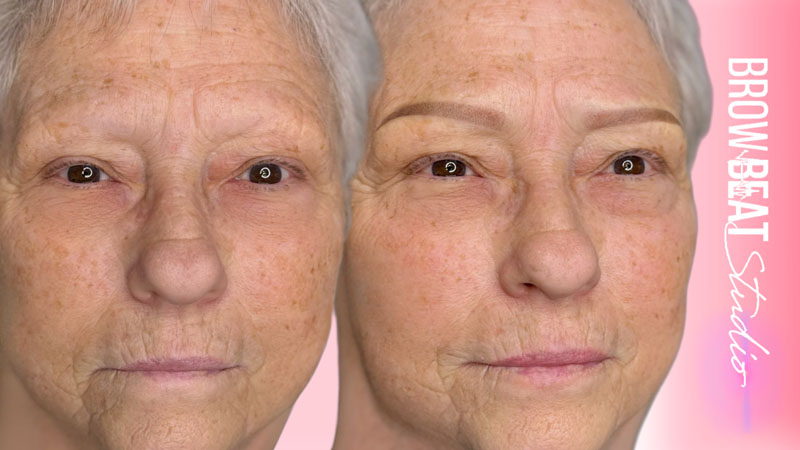
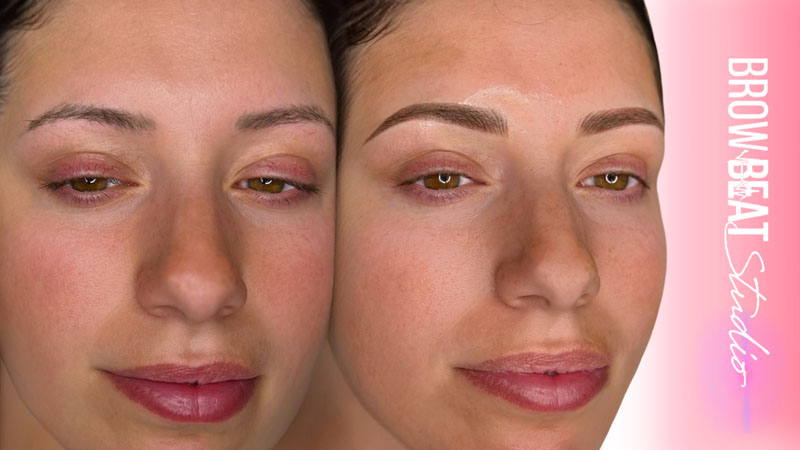
Once Combo or Hybrid Brows have completely healed, the next question is usually simple: How long will they last? At BrowBeat Studio Dallas, we commonly see deeper permanent brow colors remain visibly defined for around 18 months or longer in some clients, while very light blonde results may become noticeably softer before the 18-month point.
But a Combo Brow has another layer to its longevity story. It contains two different kinds of permanent detail. There are fine manual hairstrokes. And there is machine shading. Those two components do not necessarily remain visually identical for the same amount of time.
So when we talk about how long Combo Brows last, we are really talking about how the relationship between the hairstrokes and shading changes over time.
Combo Brows can remain visibly useful for well over a year, but there is no universal lifespan that applies identically to every client. Deeper results may remain clearly visible around 18 months or longer in some BrowBeat clients. Very light blonde results may become noticeably softer sooner.
Skin characteristics, pigment color, the original amount of shading, natural eyebrow hair, sun exposure, skincare and individual retention can all influence what the client sees over time. That is why BrowBeat uses realistic ranges rather than promising an exact expiration date.
Hybrid Brows follow the same longevity story because, at BrowBeat, Hybrid and Combo describe the same combined-brow family. Manual hairstrokes provide hair-like texture. Machine shading provides broader density.
After healing, both remain part of the permanent eyebrow and both gradually soften over time. The exact amount of each component that remains visually noticeable varies from client to client.
3D Brows do not operate on a separate longevity clock. The term describes the dimensional appearance created when natural eyebrow hair, permanent hairstrokes and shaded density work together. As the permanent components gradually soften, that dimensional effect can become softer too. The brow may remain clearly visible even when the contrast between the hairstrokes and shading is no longer as strong as it was when the result was newly healed.
Permanent makeup does not reach a particular month and suddenly switch off. There is no morning when a Combo Brow is officially present and the next morning it has expired.
Instead, the permanent result changes gradually. The color becomes softer. The hairstrokes lose some of their original definition. The shaded background becomes lighter. The tail may become less crisp.
Natural eyebrow hair and skin become increasingly visible through the permanent work. And the complete eyebrow gradually becomes a softer version of the result the client started with.

When a client begins with thin natural eyebrows, the permanent hairstrokes and shading may create much of the visible shape. As the pigment gradually softens, that change can become more apparent because fewer natural hairs remain to support the overall result. The brow may still contain permanent color, but the client can notice reduced density sooner than someone with naturally full eyebrows. This distinction is important when evaluating Combo Brow longevity. The apparent difference may reflect how much visual work the permanent makeup was originally doing.
Dry skin may be compatible with strong permanent pigment retention, but it does not create a guaranteed timeline. Two clients with dry skin can receive similar Hybrid Brow designs and still experience different amounts of softening after a year. The original pigment depth, natural eyebrow density, sun exposure and skincare habits all contribute to what remains visible. A dry-skin label alone cannot tell an artist exactly how long manual hairstrokes or machine shading will retain their definition. The actual long-term eyebrow provides more meaningful information.


A deeper complexion should not be treated as a shortcut for predicting Combo Brow retention. High-melanin skin can be dry, normal, combination or oily, and each client brings different natural eyebrow hair and pigment requirements. The visual contrast between permanent color and surrounding skin also influences how noticeable the result remains. At BrowBeat Studio Dallas, long-term Hybrid Brow expectations are based on the individual client’s design and skin rather than assuming that melanin level determines how quickly hairstrokes or shading will fade.
Combination skin makes long-term permanent makeup predictions more individual. A client may experience greater oil production through her forehead while other facial areas remain relatively dry. For Combo Brow longevity, the characteristics of the actual eyebrow area matter more than a broad description of the entire face. Fine hairstrokes and shaded density may also remain visually noticeable in different ways. The complete result depends on the original design, pigment color and individual retention rather than a single skin-type label.

This question is more complicated than it sounds. Does lasting mean that any permanent pigment is still visible? Does it mean the overall eyebrow shape can still be seen? Does it mean the shading still provides useful background color? Does it mean every individual hairstroke remains easy to identify? Or does it mean the complete brow still looks as defined as it did when newly healed?
Those are different thresholds. A Combo Brow can lose some of its original hairstroke definition and still provide substantial permanent shape and density. The brow can change without being gone.
Clients sometimes think about permanent makeup longevity as two states:
there
or
gone.
There is a very large period in between. The eyebrow can still contain permanent color while looking noticeably softer than it did six months earlier.
The shape may still be easy to see. The shaded background may still provide useful coverage. The tail may still be present. But the individual hairstroke detail may no longer look as crisp.
That brow has not disappeared. It has aged.
This is what makes combination-brow longevity different enough to deserve its own explanation. A hairstroke is a fine line. Shading is a broader field of permanent color. The eye reads those two things differently.
A hairstroke depends on the line remaining sufficiently distinct for the eye to recognize it as hair-like detail. Shading can lose a considerable amount of intensity and still continue reading as background density. That means the two permanent components can become less visually prominent in different ways.
A newly healed microblading stroke is fine and distinct. Over time, that line does not remain frozen forever at exactly the same width, sharpness and color.
The visual definition gradually softens. Individual strokes can become lighter. The edges can become less distinct. And some strokes can become harder to separate visually from the permanent color and natural hair around them. That is part of the long-term behavior of fine permanent detail in skin.
Part of what makes a newly healed hairstroke easy to see is the space around it. The eye can see one line, then skin, then another line.
As permanent hairstrokes age, that separation can become less obvious. Instead of noticing every stroke as an individual hair-like mark, the client may begin seeing a softer area of permanent texture and color.
The strokes have not necessarily disappeared. Their visual character has changed.
The word merge can sound more dramatic than the actual visual change. It does not mean every hairstroke suddenly joins into one solid block. It means the fine separation that originally made each individual line easy to distinguish can gradually become softer.
The eye may stop reading every stroke independently. The permanent detail begins contributing more collectively to the eyebrow. That is different from the crisp, separated hairstroke pattern visible when the result was newer.

This is one of the simplest ways to understand hairstroke longevity. If a very fine permanent line becomes slightly softer, lighter or less sharply defined, the character of that individual detail can change noticeably. Fine detail has less visual room for change before the eye begins reading it differently. That is why a client may notice her hairstrokes becoming softer even while substantial permanent pigment remains elsewhere in the eyebrow.
This is where Combo Brow longevity becomes different from thinking about hairstrokes alone. The strokes are only one component of the permanent eyebrow. There is shaded support behind and around them.
As the fine detail gradually becomes softer, the shading can continue providing visible shape, color and density. The client may therefore lose some of the original hairstroke definition while still having a very useful permanent brow. Learn more about the differences between combo / hybrid brows and microblading strokes alone.
A client may look closely and realize she cannot distinguish the original hairstroke pattern as easily as she once could. But step farther away.
The eyebrow may still be clearly there. The body still has color. The tail still has definition. The natural eyebrow hair still has permanent density sitting underneath it.
The fine texture changed first. The broader structure continued working. The texture can soften before the structure disappears.
The shading fades too. It does not remain at one permanent intensity simply because it occupies a broader area.
Over time, the background color becomes softer. The density becomes lighter. More natural skin may become visible through the eyebrow.
The body can feel less filled. A strongly defined tail can become gentler. The permanent background gradually asks the client’s natural eyebrow hair to do more of the visual work again.
This is an important distinction. There can be a long period when the shading is clearly no longer as strong as it once was but is still contributing something useful.
The client may not describe her brows as freshly defined anymore. But she may still have enough permanent color that the shape remains visible.
There may still be background color underneath the natural hair. The tail may still have a foundation. The body may still look more connected than it did before permanent makeup. That middle stage is part of how long Combo Brows last.
Think about what happens when a fine line becomes softer. If that line is the only permanent detail in the area, its change can have a large effect on what the client sees.
In a Combo Brow, that line exists inside an eyebrow that also contains broader shaded color. The shading does not depend on every individual hairstroke remaining perfectly distinct in order to continue contributing to the brow. That broader density can continue supporting the shape while the stroke component changes.
They can become visually less distinct sooner because the two components depend on different kinds of visual information. A hairstroke needs enough definition for the eye to continue recognizing a relatively fine line. Shading occupies a broader area and can remain useful even after it has softened considerably.
That does not create a universal rule that every hairstroke on every client will always fade before every shaded area. It explains why the two components can appear to age differently.
Yes.
There is no universal order in which every permanent component must become less visible. Individual retention varies. Pigment color matters. The original amount of shading matters.
Natural eyebrow hair matters. Skin characteristics matter. So some clients may continue seeing individual hairstroke detail while the broader background has become noticeably softer.

Fine manual hairstrokes are designed to resemble individual eyebrow hairs, so their appearance depends on the eye recognizing relatively narrow lines. Over the months, permanent pigment can become softer and the original stroke boundaries may appear less distinct. A small visual change can be noticeable because the detail began so fine. In a Combo Brow, this does not necessarily compromise the complete eyebrow. The machine-shaded component can continue supplying background color while the natural brow hair helps maintain texture.
A Combo Brow does not rely entirely on its manual hairstrokes to maintain visible shape. Machine shading places pigment across broader sections of the eyebrow, creating density that can remain recognizable even when fine strokes become softer. The body may still look connected, and the tail may retain a defined finish. This is why some clients continue enjoying their permanent eyebrows long after the original hairstroke pattern has become less obvious. The shading provides another layer of visual support within the same design.


The central body of a Hybrid Brow often carries much of the permanent background density. As pigment fades, that area may become more transparent while still visually connecting natural eyebrow hairs. The brow can look softer without appearing completely empty. This is particularly noticeable when the client’s natural hair grows in different directions or leaves small spaces through the body. Remaining shading can help those areas read as one complete eyebrow. The visual benefit may continue even after the original density has decreased substantially.
A Combo Brow refresh begins with an existing permanent eyebrow, not untreated skin. The artist must consider the pigment that remains, its visible tone and how much density is already present. Adding new brown pigment over a strongly retained shaded body may create a different appearance from adding color where the existing result is very soft. Natural eyebrow hair also contributes to the finished color. At BrowBeat Studio Dallas, the remaining pigment is part of the decision because the goal is an appropriate long-term result rather than simply selecting the same color used years earlier.

The client may first notice that the tiny hair-like details are not quite as sharp as they once were. Later, she may notice the complete eyebrow becoming softer.
The tail may carry less definition. The body may not feel as filled. The overall color may become lighter.
Those changes do not necessarily arrive together. The brow can lose some fine detail before it loses the broader visual structure created by shading.
When Combo Brows are newly healed, the client may see obvious hairstroke texture against a shaded background. Months later, the fine detail may become less distinct while the background remains useful. The brow can begin reading as softer and more shading-led overall.
Later still, the shading itself can become light enough that natural eyebrow hair contributes much more of what the eye sees. Combo Brow aging is therefore not always one identical eyebrow simply becoming more transparent. The relationship between the permanent components can change.
Visually, they can become more shading-led if the fine hairstroke definition softens while broader shaded pigment remains easier to see. That does not mean the original Combo Brow has technically transformed into a Powder Brow. No new procedure occurred. The visual balance of the original combination simply changed as its two permanent components aged.
The dimensional effect can become softer too. Dimension depends partly on contrast.
Natural eyebrow hair.
Fine permanent hairstrokes.
Shaded background color.
Visible skin.
When the permanent strokes lose some definition and the shading becomes lighter, there is less contrast between those elements. The brow can therefore remain clearly visible while looking less distinctly 3D than it did when newly healed.
A client may no longer see the same crisp dimensional detail she saw when the result was newer and still have substantial permanent support in the eyebrow. The body may remain filled. The tail may still be visible. The overall shape may still be present.
What changed first was the character of the fine detail. The complete permanent brow can continue doing useful work.
Newly healed.
Slightly softer.
Less distinct in the hairstrokes.
More shading-led.
Lighter through the complete eyebrow.
Increasingly dependent on natural brow hair.
Very subtle permanent color.
Those stages do not occur on an identical schedule for every client. But they show why Combo Brow longevity cannot be reduced to one date.

An older Combo Brow may not have the same crispness it had when it was new. That does not mean it has stopped contributing.
There may still be enough color to make the shape easier to see. The tail may still be present. The body may still have permanent background density.
The client may still use considerably less conventional brow makeup than she did before the procedure. The brow does not need to look new in order to still be doing its job.
One year is a useful point for understanding Combo Brow longevity because enough time has passed for long-term softening to become visible without assuming the permanent result should be nearing the end of its life. But there is no universal one-year Combo Brow.
One client may still have substantial shaded density. Another may have a much softer result.
Some hairstrokes may remain easy to identify. Others may have become considerably less distinct.
A deeper brunette result may still look strongly defined. A very light blonde result may look much quieter.
One year tells us how old the permanent makeup is. It does not tell us exactly what the eyebrow should look like.
Twelve months does not automatically mean the brow should look faded. Some clients retain substantial permanent shading through the body and tail.
The overall shape may remain easy to see. Natural eyebrow hair may still have plenty of permanent color sitting underneath it. The client may barely think about filling her brows. The result can be older without looking particularly faint.
This is where the two-component structure of Combo Brows becomes especially noticeable. The client may still have excellent overall eyebrow density but realize that the tiny hairstroke details are not as crisp as they once were.
She can still see texture. She can still see permanent color. But she may not be able to identify every original stroke individually. The shading can continue carrying the broader structure of the eyebrow while the fine detail becomes softer.
Do not compare a one-year-old eyebrow with a close-up photograph taken when the result was newly healed and expect every permanent detail to look identical. Instead, look at what the permanent makeup is still doing.
Is the shape visible? Is there background color? Does the body still feel connected? Is the tail still present? Can you still see some hairstroke texture? How much of the visible eyebrow is coming from permanent makeup, and how much is now coming from natural hair?
Those questions tell us much more about longevity than expecting a one-year result to reproduce a new one.
A very light blonde Combo Brow begins with less visual depth. A deeper brunette result begins with more.
If both have softened over the same period, the blonde result may appear considerably lighter simply because there was less contrast available from the beginning. The brunette result can lose some intensity and still remain very easy to see. The differences in candidacy for combo brows becomes increasingly important as permanent makeup ages.
Around 18 months, the range between clients can become even more obvious. At BrowBeat Studio Dallas, we commonly see deeper permanent brow colors remain visibly defined around this point or longer in some clients.
Very light blonde results may be considerably softer. The hairstroke component may have lost more of its original separation.
The shaded background may still provide useful shape and density. Or the complete eyebrow may have become noticeably more subtle.
Again, the number of months gives us context. It does not create one guaranteed appearance.
This needs to be especially clear because permanent makeup longevity is often described with a number and very little explanation. If somebody says a brow lasts around 18 months, it is easy to imagine the permanent makeup reaching month eighteen and disappearing. That is not how the process works.
A client can still have substantial permanent pigment after 18 months. The brow may simply be softer than it was earlier.
The hairstrokes may be less distinct. The shading may be lighter. But visible permanent shape and color can remain.

Deeper permanent brow colors have more visual depth to soften through. A dark brown result can lose some of its original intensity and still remain clearly visible against the skin.
The tail can still have presence. The body can still contain useful background density. The eyebrow may look older without looking faint. This is why BrowBeat sometimes sees deeper results remain visibly defined beyond the 18-month point.
A blonde result starts from a different place. The permanent color was intentionally selected to sit appropriately beside lighter natural brow hair and the client’s overall coloring. There was less visual depth from the beginning.
As that color gradually softens, the difference can become noticeable sooner. The eyebrow may still contain permanent pigment while looking considerably more delicate than a deeper result of the same age.
By two years, many clients can expect the permanent result to look substantially softer than it did when newly healed. But there is still no single two-year appearance.
Fine hairstroke separation may be considerably reduced. The shaded background may be lighter but still visible. The tail may be softer.
Natural eyebrow hair may now contribute much more of the visual density. And residual permanent color can continue defining parts of the eyebrow.
This is an important permanent makeup expectation. A client may describe her brows as extremely faded because they no longer look anything like the result she remembers from the first year.
But that does not necessarily mean there is no permanent pigment remaining. Look closely and there may still be a soft background. There may still be visible shape. There may still be color through the body or tail.
The permanent makeup can be very subtle without the skin returning to its completely untreated appearance.
Years later, the original combination may be much quieter. The fine hairstroke pattern may be difficult to distinguish. The shading may look more like a soft shadow than the fuller density visible when the brows were newer.
Natural eyebrow hair can become the dominant visual feature again. And residual permanent color may remain underneath it. The exact amount varies enormously between clients.
Permanent makeup should not be described as though it is guaranteed to disappear without a trace. Some clients may eventually have very little visible color. Others may continue carrying a soft permanent background for considerably longer.
The original hairstroke pattern may no longer be clearly readable. The shading may be faint. But pigment can still remain visible within the skin.
They can become extremely soft, but BrowBeat does not promise that every client’s Combo Brows will completely disappear. Permanent makeup fades and changes. It does not come with a guaranteed date when every trace of pigment leaves the skin. That is one reason we describe Combo Brows as permanent makeup rather than treating them like a temporary eyebrow tint.
A client may say: “My Combo Brows are gone.” What she may actually mean is: “They no longer give me the definition I remember.” Those are different statements.
The brow can feel gone to the client because the original visual impact has softened dramatically while permanent pigment remains clearly visible when the eyebrow is examined. Fading describes a reduction in the visible result. It does not automatically mean complete disappearance.
One of the most characteristic long-term changes is a shift in the balance between the two permanent components. When the brow was newer, the client may have clearly seen hairstrokes sitting against shaded density.
Years later, the individual stroke pattern may be much less obvious while a softer field of shading remains. The eyebrow can therefore look less textured and more shadowed. That is a visual evolution of the original combination.

A Hybrid Brow contains manual hairstrokes and machine shading, so maintenance decisions require more than checking whether the eyebrow looks lighter. The fine lines may have softened considerably while the shaded background remains strong. Alternatively, the shading may be faint while some individual strokes are still visible. These are different starting points. Before additional pigment is considered, the artist should examine the existing texture, density and overall shape. Understanding what remains helps avoid treating the entire eyebrow as though both components aged identically.
Before considering additional permanent pigment, the artist needs to understand what color remains within the eyebrow. An older Combo Brow may have a soft brown background that still works beautifully with natural hair. Another may have stronger residual pigment through the body or tail. Those starting points matter because adding new color changes the permanent result rather than simply restoring an imaginary blank canvas. At BrowBeat Studio Dallas, thoughtful maintenance begins with evaluating the existing eyebrow and the client’s current goals.


When permanent eyebrows begin looking lighter, the immediate temptation can be to request a stronger result. But a refresh does not need to become an opportunity to make the entire eyebrow darker or fuller than the original design. The remaining pigment matters. So does the client’s current preference. A carefully considered maintenance appointment should evaluate what is already present before deciding whether additional permanent color is appropriate. The goal is not maximum saturation. It is preserving an eyebrow that continues making sense on the client’s face.
A permanent eyebrow is going to be worn on the client’s face, not displayed on a color chart. Choosing an unnecessarily dark pigment simply to make the result remain visible longer can compromise the appearance the client actually wanted. A blonde client may need a delicate permanent color, while another client may naturally suit deeper brunette shading. At BrowBeat Studio Dallas, pigment selection considers natural eyebrow hair, complexion and intended density. Longevity matters, but it should never become a reason to create a brow that feels too dark or heavy for the person wearing it.

Not every line disappears from view on the same schedule. Some clients may continue seeing individual hairstroke detail long after other strokes have become difficult to distinguish. Natural hair, pigment color, the surrounding shading and individual retention can all influence what the eye continues to notice. This is another reason BrowBeat looks at the complete eyebrow rather than trying to assign every hairstroke the same lifespan.
The front, body and tail do not necessarily begin with identical amounts of permanent detail. The front may have more visible skin and hairstroke texture. The body may contain greater shaded density. The tail may have stronger definition.
Natural hair varies throughout the eyebrow too. As the permanent makeup softens, those original differences can influence which changes the client notices first.
The front may simply have started softer.
There may have been less machine shading.
More visible skin.
More emphasis on fine hairstroke texture.
That gives the front less permanent visual weight to lose before the client notices that it has become very delicate.
The tail may remain much easier to see because it began with greater density. Read about the difference between combo and hybrid brows vs ombre and powder brows to understand why this happens.
A tail that began with stronger shaded definition has more permanent visual depth available to soften through. It can lose some intensity and still remain recognizable. Lose more and still provide structure.
That does not mean every tail will always outlast every front. It explains why different starting densities can create different-looking aging patterns within the same eyebrow.
That would be a convenient way to imagine permanent makeup aging.
Everything begins at 100 percent.
Then the entire eyebrow becomes 80 percent.
Then 60 percent.
Then 40 percent.
Real Combo Brows are more complicated. The hairstrokes and shading are different kinds of detail.
The front, body and tail can begin at different densities. Natural eyebrow hair varies. And individual skin can influence what remains visible. So the complete result can change character as well as intensity.
The permanent makeup does not need to remain strong for the original shape to continue helping the eyebrow. A soft tail can still tell the eye where the brow finishes. A faint shaded body can still connect natural hairs. Residual color can still reinforce the lower portion of the eyebrow.
Those contributions may become subtle, but subtle does not mean meaningless.
When the Combo Brow is newer, the permanent work can contribute a large amount of what the eye sees. As the pigment becomes softer, the client’s natural eyebrow hair begins carrying more of the visual result again.
For a client with substantial natural hair, the transition can feel very gradual. For someone with less natural density, the reduction in permanent color can become much more obvious.
Imagine two clients whose permanent shading has softened by a similar amount. One has substantial dark natural eyebrow hair. The other has finer, lighter and less dense natural growth.
The first client’s eyebrow may still look quite full because her natural hair contributes so much visual information. The second client may notice the loss of permanent density much more clearly. The pigment can have changed similarly while the complete eyebrows look very different.
A stroke-forward Combo Brow begins with a different balance from a strongly shaded Hybrid Brow. A very soft blonde combination begins with a different visual reserve from a deeper brunette result. A client with full natural eyebrows begins with a different foundation from someone whose permanent makeup contributes more of the visible brow. Those starting differences continue influencing the result long after the procedure itself is over.
They are useful. They help clients understand that permanent makeup changes over a long period rather than over a few weeks. But they should never be turned into three guaranteed photographs.
A one-year brow can still be strongly defined. An 18-month brow can still contain substantial permanent color. A two-year brow can still show residual shape and shading. Or each of those results can be considerably softer on another client.
The calendar tells us how much time has passed. The eyebrow tells us what remains.

A fresh photograph shows the result at the appointment. A healed photograph shows what happened after the skin recovered. A photograph of that same client a year or two later answers a different question.
What remained? What softened? How distinct are the hairstrokes? How much shaded density is still visible? How much is the natural eyebrow contributing now?
Those progression images give clients a much more realistic understanding of longevity than comparing unrelated brows photographed at unrelated stages.
That sounds obvious, but it is important. The goal of longevity is not to freeze permanent makeup in time.
An eyebrow that has been living in skin for two years should not be expected to reproduce every feature of a newly healed result.
The fine detail can be softer. The density can be lighter. The shape can be gentler. And the brow can still be providing something useful.
Now that the long-term progression is clear, we can look at the factors behind it.
Why does one client still have substantial Combo Brow color while another has become much softer? Why can blonde and brunette results look so different at the same age? How do original density and natural eyebrow hair change the picture? What role does skin play? And why should low- to high-melanin skin not be confused with oily, dry or combination skin?
Those factors explain why Combo Brow longevity is individual even when the same permanent makeup family was performed.
Two clients can receive beautiful Combo Brows and look noticeably different a year or 18 months later. That does not automatically mean one procedure was performed better than the other.
Permanent makeup lives in individual skin. The original pigment color matters. The amount of shaded density matters. The client’s natural eyebrow hair matters.
Skin characteristics matter. Sun exposure and skincare can matter over time. And some clients simply retain visible permanent pigment differently from others.
Combo Brow longevity comes from the relationship between all of those factors rather than one characteristic controlling the entire result.
Sometimes two clients can have similar permanent brow colors, similar amounts of shading and similar natural eyebrows and still retain the result differently. One client’s permanent color remains very easy to see. Another client’s result becomes softer sooner.
That individual variation is part of working in human skin. We can identify factors that influence longevity. We cannot turn every one of them into an exact prediction.
Once Combo Brows have healed, the skin continues being the environment in which the permanent pigment exists.
Oil production.
Texture.
Turnover.
Individual skin behavior.
Those characteristics can influence how the permanent result continues to appear over time. And because Combo Brows contain both fine hairstrokes and broader shading, the client may notice those influences differently across the two components.
A hairstroke depends on the eye continuing to recognize a relatively fine line. Small changes therefore matter.
If that line becomes lighter, softer or less distinct, the client can notice the difference even while pigment remains visible. Broader shading does not depend on one individual line remaining sharply separated. That difference helps explain why skin characteristics can become especially noticeable in the hairstroke portion of an older Combo Brow.
Oilier skin can influence the way permanent makeup remains visually defined over time, particularly when we are talking about fine hairstroke detail. But oily skin is not one condition with one guaranteed outcome.
One client may have mild oil production through the brow area. Another may be considerably oilier. Skin texture can differ too.
So BrowBeat does not take the word “oily” and assign one Combo Brow lifespan to everyone who uses it.
A client may notice that the fine hairstroke detail becomes less distinct while the broader shaded background continues giving the eyebrow useful density. That is one of the reasons Combo Brows have a different longevity story from hairstrokes alone.
The shading gives the brow another form of permanent visual support. It does not prevent the hairstrokes from changing. It means the complete eyebrow is not relying entirely on fine lines.
Dry skin does not create a guaranteed lifespan either. Some clients with drier skin retain permanent brow detail very visibly. Others still experience substantial softening over time.
Pigment color, original density, natural eyebrow hair, sun exposure, skincare and individual retention continue to matter. No skin-type label is strong enough to predict the complete long-term result by itself.

Combination skin is a good example of why broad labels only tell us so much. A client may be oilier through the forehead and drier elsewhere. She may experience different skin behavior seasonally.
What matters to permanent brows is what is happening in and around the eyebrow area. The client’s complete skin pattern matters more than simply checking one box.
This distinction is important when discussing permanent makeup longevity. Skin tone describes complexion and melanin level. Skin type describes characteristics such as oiliness, dryness or combination behavior.
A client can have low-melanin skin and oily skin.
Low-melanin skin and dry skin.
High-melanin skin and oily skin.
High-melanin skin and dry skin.
Those are different pieces of information.
Yes. Combo and Hybrid Brows can remain visible across low- to high-melanin skin.
Melanin level does not create one permanent-makeup lifespan. The pigment color, original density, natural eyebrow hair, skin characteristics, sun exposure, skincare and individual retention still influence what the client sees over time.
Melanin level is part of the client’s complexion. It should not be used as a substitute for understanding how her skin actually behaves.
Those characteristics should not be collapsed into one assumption. A high-melanin client can have dry, normal, combination or oily skin. The same is true for a low-melanin client. For longevity, BrowBeat is interested in the complete skin environment rather than assuming complexion predicts every other characteristic.
A permanent eyebrow is not simply an amount of pigment. It is an amount of pigment carrying a particular color. That matters because different color depths begin with different levels of visual contrast. A very light blonde result and a deep brunette result can both soften substantially and still look very different at the same point in time.
Because they begin softer.
A very light blonde permanent brow has less visual contrast between the pigment, natural hair and surrounding skin. As that color loses intensity, it takes a smaller visual change before the client notices that the eyebrow has become considerably lighter.
That does not automatically mean the client’s skin retained less pigment. It means the color had less visual depth to lose.
This distinction is important. Visible intensity and technical pigment presence are not exactly the same thing. A pale permanent color can become difficult to see from normal viewing distance while some pigment remains within the skin. That is one reason a light Combo Brow can appear substantially more faded than a deeper result of the same age.
A deeper brown begins with more visual depth. It can lose some intensity and still remain easy to see. Then soften further and continue providing useful background color.
The body can remain readable. The tail can remain present.
That larger visual range helps explain why BrowBeat can see deeper results remain clearly defined around 18 months or longer in some clients.
Longevity does not get to choose the client’s eyebrow color. If the client needs a soft blonde result, making her unnecessarily dark simply because deeper pigment may remain visually obvious for longer would miss the point of the service.
The permanent eyebrow needs to make sense while she is wearing it. Color should belong to the client first. Its long-term visual behavior is something we understand alongside that choice.
A very softly shaded Combo Brow begins with less permanent background color. A more defined Hybrid Brow begins with more. If both gradually lose intensity, the softer result has less visual distance to travel before the difference becomes noticeable. The more defined result can lose some density and still continue looking filled.
This is not a disadvantage. It is part of choosing a softer permanent result.
The client may specifically want plenty of visible skin, prominent hairstroke texture and restrained background shading. That result can be beautiful. But because it began with less shaded density, a relatively small reduction can make the complete eyebrow feel noticeably lighter.
A fuller result begins with greater background color. That means some fading can occur while the eyebrow continues looking clearly filled. More softening can happen and useful density can still remain.
The client may therefore experience a longer period in which the permanent brow feels strongly present. Again, that does not make greater density universally better. It describes a different starting point.

A light color used very softly begins with relatively little visual weight. A light color built with more density has greater presence.
A deeper color used lightly can still create a restrained permanent result. A deeper color with greater density creates substantially more visual depth.
Those combinations will not necessarily look equally strong as they age. This is why “How long will my Combo Brows last?” cannot be answered completely by knowing the pigment color alone.
Permanent makeup is being viewed through and around the client’s natural eyebrow hair. A client with substantial natural hair may continue seeing a very complete eyebrow even after the permanent shading has softened.
The hair itself provides texture and density. The permanent makeup is supporting it.
Another client may rely on the permanent work for a much larger portion of the visible eyebrow. For her, the same amount of pigment softening can be much more obvious.
Imagine a client with substantial dark eyebrow hair. Her Combo Brows originally added background density and some additional hairstroke detail. As the permanent work softens, her natural eyebrow remains. She can therefore continue seeing a strong brow even though the permanent component underneath it is lighter than before.
Now imagine a client whose permanent makeup contributes much more of the visible body or tail. As that permanent density becomes softer, there is less natural hair available to visually replace what is fading.
The change can therefore feel much larger. The pigment did not necessarily fade at a dramatically different rate. The eyebrow depended on it differently.
The permanent pigment is not the only part of the eyebrow that can change over several years. Natural hair density can change. Hair color can change.
Individual hairs can become finer or coarser. Grooming habits can change. Those changes can alter how the remaining permanent makeup appears even if the pigment itself did not suddenly change.
A stroke-forward Combo Brow and a strongly shaded Hybrid Brow are not beginning with the same visual structure. If the first client chose the service primarily because she loved visible hairstroke texture, she may notice the loss of fine detail relatively early. The second client may care more about the shaded coverage and remain very satisfied while the background density is still strong. The permanent components can age similarly while the clients experience that aging differently.
Some clients notice texture. They remember the individual hair-like detail and immediately see when it becomes softer.
Other clients notice coverage. They are less concerned about identifying individual strokes as long as the body and tail remain filled.
Another client notices overall color. Her first observation is simply that the entire eyebrow looks lighter.
Those are different ways of experiencing the same long-term process.
None of these factors exists alone. An oily client can have deep pigment and substantial natural hair.
A dry-skin client can have an extremely light blonde result and very little natural tail. A high-melanin client can have restrained shading and dense natural brows.
A low-melanin client can have a strongly defined brunette result. The combinations are almost endless. That is why one characteristic cannot responsibly predict the entire lifespan of a Combo Brow.
The brow does not spend the next two years protected inside the studio. It goes into the client’s everyday life.
Dallas sun.
UV exposure.
Skincare.
Retinoids.
Exfoliation.
Professional skin treatments.
Changing routines.
Those factors do not create one guaranteed fading outcome either. But they become part of the environment in which permanent pigment continues aging.
That is the next part of the longevity story.
Once Combo and Hybrid Brows have completely healed, sun exposure becomes a long-term longevity question rather than an immediate aftercare question. The skin is no longer recovering from the procedure.
Now we are looking at what happens to permanent pigment through months and years of ordinary life. Repeated ultraviolet exposure can contribute to the way tattoo pigment changes and becomes less visually prominent over time. For permanent eyebrows, that means sun habits become one of several factors that can influence how long the result remains clearly visible.

North Texas is not short on sunshine.
Clients drive.
Walk outside.
Sit on patios.
Spend time around pools.
Travel.
Exercise outdoors.
And simply move through everyday life with their faces exposed to daylight.
You do not need to hide indoors because you have permanent eyebrows. But years of UV exposure are part of the environment those brows live in.
These two stages should not be confused. Immediately after a Combo Brow procedure, the skin is healing and BrowBeat’s aftercare instructions control how the area should be handled.
Once the brows are fully healed, we are no longer talking about freshly treated skin. We are talking about protecting a permanent cosmetic result that is expected to live in the skin for a long time.
The subject is still sun. The reason we are discussing it has changed.
The permanent hairstrokes and machine shading both contain pigment within the skin. UV exposure does not affect only the shaded component or only the fine lines. Both are part of the same long-term permanent result.
But because hairstrokes and shading look different to the eye, the client may experience their softening differently. A small loss of definition can be particularly noticeable in a fine stroke. The same amount of visual softening across a broader shaded area may still leave useful background density.
Once the brows are completely healed and normal topical products can be used again, sensible sun protection around the eyebrow area can become part of caring for the long-term result. This does not mean permanent makeup requires an elaborate new lifestyle. It means the brows exist within skin that is exposed to the same environment as the rest of the face. Protecting that skin from unnecessary UV exposure makes sense for reasons that extend well beyond permanent makeup.
This is important. A client can be very careful with sun exposure and still see her permanent makeup gradually change.
Combo Brows are not designed to remain at one exact intensity indefinitely. Sun is one longevity factor. It is not the only factor.
Skin characteristics, pigment color, original density, natural brow hair and individual retention continue to matter.
Permanent eyebrows sit inside an area of the face where clients often use active skincare. Modern skincare is designed to create change.
Exfoliate.
Resurface.
Increase turnover.
Improve texture.
Address pigmentation.
Those can all be desirable skincare goals. But they also mean the client’s skincare routine belongs in the conversation when we are trying to understand how permanent brow pigment changes over time.
Retinoids are commonly used to increase skin-cell turnover and improve the appearance and texture of skin. When active skincare is regularly used through or very close to the permanent brow area, it becomes one of the factors worth considering when discussing long-term pigment visibility.
That does not mean one application of retinol makes Combo Brows disappear. It means repeated skincare habits become part of the long-term environment in which the permanent makeup exists.
A client cannot take the name of one skincare ingredient and use it to calculate exactly how many months her permanent brows will remain visible.
How frequently is the product used? Where is it applied? What other products are in the routine? What permanent color and density did the client begin with? How does her skin retain pigment generally?
Those differences prevent one active ingredient from becoming a universal longevity formula.
Exfoliating acids and resurfacing products belong to the same broader conversation. If a product is deliberately being used to influence the skin through the eyebrow area, it is reasonable to consider that routine when thinking about the long-term appearance of permanent makeup.
The client does not need to become afraid of effective skincare. She simply needs to understand that the permanent brows and the skin surrounding them are not living in separate environments.
Long-term skincare does not happen only at home. Clients may receive professional peels, resurfacing treatments, lasers or other procedures involving areas of the face close to permanent eyebrows.
Those treatments vary enormously, so they should not all be treated as though they have one identical relationship with permanent makeup.
If a professional skin treatment involves the forehead or brow area, tell the provider that permanent cosmetic pigment is present. That gives the provider relevant information before treating the area.

The products you use today may not be the products you use next year.
You may begin retinol.
Increase exfoliation.
Start professional treatments.
Change products because your skin changes.
That is another reason the exact future appearance of a Combo Brow cannot be predicted perfectly on treatment day. The environment around the permanent makeup can change after the procedure.
Aftercare belongs to the healing period immediately following the procedure. Long-term skincare belongs to life after the brows have completely healed. Those are two different timelines.
During healing, clients follow BrowBeat’s specific instructions for recently treated skin. After healing, the question becomes how ordinary repeated skincare habits may contribute to the way permanent pigment changes over months and years.
Clients sometimes want one simple explanation for why their brows became softer. Often there is not one.
Skin characteristics.
Pigment color.
Original density.
Natural eyebrow hair.
Sun exposure.
Skincare.
Professional skin treatments.
Individual pigment retention.
The complete long-term result can reflect several of those influences at once.
Your friend’s Combo Brows may be the same age as yours and look considerably stronger.
But she may have started with a deeper pigment.
More shaded density.
Different natural eyebrow hair.
Different skin characteristics.
Different sun exposure.
A different skincare routine.
And different individual retention.
The fact that both procedures happened 18 months ago does not make the two eyebrows equivalent comparisons.
Permanent makeup is affected by too many variables to turn longevity into a precise equation. The goal is not to predict the exact day when a particular hairstroke becomes difficult to see. It is to understand the broad factors that influence the result and set realistic expectations for how permanent makeup behaves over time.
There is no single trick that guarantees maximum longevity. The permanent result begins with an appropriate pigment color and an appropriate amount of density for the client.
The brows move through healing. Then skin characteristics, natural brow hair, UV exposure, skincare and individual retention continue influencing what remains visible.
Long-term sun protection and thoughtful skincare around the brow area can support the goal of preserving the visible result, but they cannot create an exact guaranteed lifespan.
If longevity became the only goal, the obvious temptation would be:
darker pigment,
more density,
more permanent color.
But the longest-looking brow is not automatically the best-looking brow. A very light blonde client may genuinely need a soft blonde result.
A client who wants visible hairstroke texture may genuinely prefer less shading. The eyebrow has to make sense on the client’s face while she is wearing it.
Longevity is one consideration—not permission to overpower the original design.
BrowBeat would rather create an appropriate permanent color and explain honestly how that lighter result may age than give a client an unnecessarily deep eyebrow simply because it may remain visually obvious for longer. The same applies to density.
A client should not receive more shading than she wants simply to create a larger reserve of permanent color. The result has to be right before longevity can be considered successful.
There is no prize for having the darkest brow at two years. There is no prize for retaining every visible hairstroke longer than somebody else. And a softer permanent result is not automatically evidence that the procedure was inferior. The relevant question is what happened to the eyebrow that was intentionally created for that particular client.
This is why long-term progression photographs are so useful. A newly healed photograph establishes the starting point.
A later photograph shows what changed. Now we can compare the same pigment color.
The same original density.
The same natural eyebrow.
The same client.
That is much more informative than comparing one person’s two-year result with another person’s newly healed brow.

Look beyond whether the brow is simply lighter.
Can you still distinguish hairstroke texture? How much shaded density remains? Is the tail still visible? How much natural eyebrow hair is contributing? Has the result become more shading-led? How much of the original shape remains easy to read?
Those details show how the combination evolved rather than reducing longevity to one before-and-after color difference.
A fresh photograph shows what BrowBeat created during the appointment. A healed photograph shows how that work settled after the skin recovered. A long-term photograph shows how the healed permanent result changed over months or years.
Those stages should not be collapsed into one another. This page begins after healing precisely because long-term fading is a different process from the changes clients see during the first few weeks.
If a Combo Brow becomes lighter a year after the procedure, the client is not still healing. The skin recovered long ago.
We are now observing the long-term behavior of permanent pigment within skin. That distinction keeps the healing journey and longevity journey clear.
Permanent makeup is expected to change. The hairstrokes are expected to become softer. The shading is expected to lose some intensity.
The complete eyebrow is expected to look older than it did when newly healed. Fading by itself is not evidence that a Combo Brow has failed.
Does lasting mean you can still see any permanent pigment? Does it mean the shape remains visible? Does it mean the shading still gives your natural hair a useful background? Does it mean you can still see individual hairstrokes? Or does it mean the eyebrow still looks close to the way it did when newly healed?
Those are different standards. A Combo Brow can meet some of them long after it stops meeting others.
This is perhaps the clearest example. The client may no longer see every little line she once loved.
But she can still have a clearly visible permanent eyebrow. The shaded background can still provide color. The tail can still have structure. Natural eyebrow hair can still sit against a permanent foundation.
The original texture changed. The permanent brow did not disappear with it.
Later, the broader density can become lighter too. But even a faint field of permanent color can continue helping the eye read the eyebrow.
The shape may still be easier to see than it was before permanent makeup. The tail may still have a soft foundation. The body may still appear more connected.
Again, the result can remain useful without remaining strong.
After enough time, both components may be much quieter. The hairstrokes can be difficult to distinguish. The shading can be faint.
Natural eyebrow hair can once again dominate the appearance. Residual pigment may still remain. That extremely soft stage is still part of the long-term permanent makeup story.
If you mean:
How long will they look newly healed? That is one question.
How long will the individual hairstrokes remain clearly separated? That is another.
How long will the shading continue providing visible density? Another.
How long can some permanent pigment remain? Another again.
The complete answer requires understanding all of those layers.
Rather than asking whether every individual component remains unchanged, look at the permanent eyebrow as a whole.
How much shape remains? How much texture remains? How much shaded density remains? How much permanent color is still contributing alongside the natural hair?
That gives a much more realistic picture of what the Combo Brow is still doing over time.
That is the central longevity principle. Fine detail becomes softer. Broader density becomes lighter.
The 3D contrast becomes less obvious. Natural hair contributes more. Residual permanent color can remain.
And throughout much of that progression, the eyebrow can still be visibly different from the natural starting point.
Combo, Hybrid and 3D Brows do not need one. They have a progression.
Newly healed and defined.
Gradually softer in the fine detail.
Increasingly shading-led for some clients.
Lighter through the complete eyebrow.
More dependent on natural brow hair.
Eventually extremely subtle, with residual permanent pigment potentially remaining.
That progression explains Combo Brow longevity far more accurately than a single number ever could.

Combo Brows begin with something a single-technique brow does not have: two different kinds of permanent detail contributing to the same eyebrow.
The hairstrokes provide fine hair-like texture. The machine shading provides broader color and density.
Once healed, both begin their long-term life in the skin. But they do not need to remain equally visible for the complete eyebrow to continue working.
This is one of the most important expectations to carry away from this page. Fine hairstroke detail can gradually become softer and less individually readable.
That does not automatically remove the eyebrow’s shape. The machine shading can continue providing background density. The natural eyebrow hair continues contributing texture. And the complete brow can remain clearly visible even though one of its original visual features has changed.
Eventually the shading becomes lighter too. More skin becomes visible. The body feels less filled. The tail becomes gentler.
Natural brow hair begins contributing more of what the eye sees. But that progression is gradual. There can be a long period where the permanent shading is softer than it once was while still providing useful structure underneath the natural eyebrow.
That is a much more accurate way to understand longevity. The newly healed result does not remain frozen.
The fine texture changes. The background density changes. The dimensional contrast changes.
The complete eyebrow becomes quieter. And the amount of visible permanent makeup gradually decreases. There is no single moment when that evolution becomes an expiration.
At BrowBeat Studio Dallas, we commonly see deeper permanent brow colors remain visibly defined for around 18 months or longer in some clients. Very light blonde results can become noticeably softer before the 18-month point because they begin with less visual depth.
Those observations are useful expectations, not guarantees. The original color and density, natural eyebrow hair, skin characteristics, sun exposure, skincare and individual pigment retention all influence what remains visible.
One client may still have a clearly shaded body and tail. Another may have a much softer permanent background.
One may retain visible hairstroke texture. Another may have become more shading-led.
A deeper brunette result may still look quite defined while a very light blonde result appears considerably more delicate. All of those brows can be the same age.
Comparing your Combo Brows with somebody else’s can only tell you so much. Your permanent color may be different. Your original density may be different.
Your natural eyebrow hair may be different. Your skin may behave differently. Your sun exposure and skincare may be different.
Your own brow over time is the more meaningful comparison.
It is easy to become focused on the finest detail because hairstrokes are one of the features that make Combo Brows distinctive. But longevity should not be reduced to counting how many individual lines can still be identified.
Look at the eyebrow.
Does the shape remain visible? Is there still permanent background color? Does the natural hair still have useful density underneath it? Can you still see some texture?
Those questions describe the complete long-term result much better.
Permanent makeup does not need to remain strong to remain useful. A soft field of shading can still support natural eyebrow hair. A gentler tail can still define where the eyebrow ends.
Residual hairstroke texture can still add visual detail. The permanent result can become considerably more subtle while continuing to contribute to the face.
If you mean how long the brows remain at newly healed intensity, that period is shorter than the complete lifespan of the permanent pigment. If you mean how long every hairstroke remains perfectly separated, that is different again. If you mean how long the shading continues giving the eyebrow visible density, the answer can extend beyond the period of strongest hairstroke definition. And if you mean how long some residual permanent pigment can remain in the skin, there is no responsible universal disappearance date.
The simple answer is that BrowBeat commonly sees deeper Combo and Hybrid Brow results remain visibly defined for around 18 months or longer in some clients, while very light blonde results may become noticeably softer sooner. The complete answer is that Combo Brow longevity is not one countdown. It is the gradual aging of hairstrokes, shading and the complete permanent eyebrow around the client’s natural hair.
The hairstrokes can soften before the structure disappears. The shading can become lighter while the shape remains useful. And the permanent brow can continue contributing long after it stops looking newly healed.

Combo Brows can remain visibly useful for well over a year, but there is no universal lifespan for every client. At BrowBeat Studio Dallas, we commonly see deeper permanent brow colors remain visibly defined for around 18 months or longer in some clients, while very light blonde results may become noticeably softer sooner.
Hybrid Brows follow the same general longevity pattern because BrowBeat uses Hybrid and Combo to describe the same combined-brow family. The manual hairstrokes and machine shading both gradually soften over time, although they may not remain equally visible for exactly the same period.
3D Brows do not have a separate lifespan. The term describes the dimensional appearance created when natural eyebrow hair, permanent hairstrokes and shaded density work together. As the permanent components soften, that dimensional effect can become more subtle while the eyebrow itself remains visible.
They can. Around 18 months is a useful reference point, but it should not be treated as an expiration date. Some BrowBeat clients with deeper colors still have clearly visible permanent brows at 18 months or longer, while lighter results can look considerably softer before then.
Yes. Permanent pigment can remain visibly present beyond 18 months. How noticeable the brow remains depends on factors including the original color and density, natural eyebrow hair, skin characteristics, sun exposure, skincare and individual pigment retention.
Yes. Permanent makeup gradually changes after healing rather than waiting until a particular month to begin fading. Very light colors and extremely soft original density can become noticeably quieter sooner because they begin with less visual depth.
Not necessarily. A Combo Brow contains fine hairstrokes, broader machine shading, different densities through the front, body and tail, and varying amounts of natural eyebrow hair. Those differences can make some areas or details appear softer sooner than others.
Permanent hairstrokes are very fine details within skin. Over time, their color and definition gradually soften, and individual lines can become less distinctly separated. They should not be expected to remain frozen at their newly healed sharpness indefinitely.
They can become visually less distinct sooner because a small change is much easier to notice in a fine line. Broader shading can lose intensity and still continue reading as background density. Individual retention varies, so there is no universal order that applies to every client.
Individual hairstrokes can become less distinctly separated over time. This does not necessarily mean they turn into one solid area of pigment. It means the fine spaces and crisp definition that originally allowed the eye to identify each line can gradually become softer.
The hairstroke detail can become difficult to distinguish while the broader shading remains clearly visible. That is one reason an older Combo Brow can continue providing useful shape and density after some of its original fine texture has softened.
Yes. There is no fixed sequence in which the two components must fade. Some clients may continue seeing individual hairstroke detail while the shaded background has become noticeably lighter.
Yes. Machine shading gradually becomes lighter and less dense. As it softens, more natural skin and eyebrow hair can become visible through the permanent result, and areas such as the body and tail may lose some of their original definition.
They can become more shading-led visually if the fine hairstroke definition softens while broader shaded pigment remains easier to see. The Combo Brow has not technically changed into a Powder Brow; the visual balance of the original permanent work has simply evolved.
It can become softer. The dimensional effect depends partly on contrast among natural eyebrow hair, permanent hairstrokes, shaded density and visible skin. As the hairstrokes and shading soften, that contrast can become less obvious.
Some one-year-old Combo Brows still have substantial color, shape and shaded density, although the hairstrokes may be softer than when newly healed. Other clients may have a more delicate result. One year describes the age of the permanent makeup, not one guaranteed appearance.
At 18 months, some clients still have clearly visible shading and shape, while others have much softer permanent brows. Deeper colors can remain visually prominent through more softening, while very light blonde results may appear considerably more delicate.
By two years, many Combo Brows are considerably softer than when newly healed. Fine hairstroke separation may be reduced, the shading may be lighter and natural eyebrow hair may contribute more of the visible brow. Residual permanent pigment can still remain.
Years later, the original hairstroke pattern may be much less distinct and the shading may look more like a soft background than a strongly filled brow. Some clients retain visible residual color for a long time, while others become considerably lighter.
They can become extremely soft, but BrowBeat does not promise that every client’s permanent makeup will completely disappear. Some clients may eventually have very little visible color, while others can retain residual pigment for considerably longer.
Combo Brows are permanent makeup, so residual pigment can remain even after the original result has softened substantially. The hairstrokes may no longer look individually crisp and the shading may be faint, but permanent color can still be visible within the skin.
Very light blonde results begin with less visual depth and contrast. A relatively small reduction in visible intensity can therefore become noticeable sooner than it would in a deeper brunette result.
Deeper brow colors can remain visually noticeable through more softening because they begin with greater visual depth. That does not mean every darker brow biologically retains pigment longer, and BrowBeat does not choose an unnecessarily dark color simply to make a brow remain more obvious.
Yes. A very softly shaded Combo Brow begins with less permanent background density, so the client may notice fading sooner. A more defined result has more visual density available to soften while still looking clearly present.
Yes. A client with substantial natural eyebrow hair may continue seeing a full-looking brow even as the permanent pigment becomes softer. Someone whose permanent makeup contributes more of the visible eyebrow may notice the same amount of fading much more clearly.
Oilier skin can influence how permanent makeup remains visually defined over time, particularly fine hairstroke detail. Oil production varies considerably between clients, however, so oily skin does not create one guaranteed Combo Brow lifespan.
Yes. Dry skin can retain Combo Brow pigment visibly, but dry skin does not guarantee a particular number of months. Pigment color, density, natural eyebrow hair and individual retention still influence the result.
Yes. Combo and Hybrid Brows can remain visible across low- to high-melanin skin. Melanin level is not the same thing as oily, dry or combination skin, and it does not create one predictable longevity timeline.
Long-term UV exposure can contribute to the way permanent makeup pigment changes and becomes less visually prominent over time. Once the brows are fully healed, sensible sun protection can become part of long-term permanent brow care.
Retinoids influence skin-cell turnover, so repeated use through or close to the permanent brow area can be relevant to long-term pigment visibility. Retinol alone does not determine exactly how long a Combo Brow will remain visible.
Regular exfoliating or resurfacing products used through the eyebrow area can become part of the long-term environment in which permanent pigment exists. Skincare is one factor among several that can influence how the visible result changes over time.
The front may have been intentionally created with less shading, more visible skin and greater emphasis on fine hairstroke texture. Because it began softer, it has less visual density to lose before the change becomes noticeable.
It can. A tail that began with greater shaded density or deeper definition has more permanent visual color available to soften while remaining recognizable.
You may have different pigment colors, original densities, natural eyebrow hair, skin characteristics, sun exposure, skincare routines and individual pigment retention. Two Combo Brows being the same age does not mean they should look the same.
Combo Brows are permanent makeup. The term semi-permanent is often used because cosmetic tattoo pigment gradually softens and fades, but it should not be interpreted as a promise that every trace of pigment will disappear after a particular amount of time.
Yes. This is one of the advantages of having two visual components in the eyebrow. The shading can continue providing shape, color and density even after the original hairstroke detail has become less distinct.
Not necessarily. Fading describes the permanent result becoming softer and less visually prominent. A brow can lose some hairstroke definition and shaded intensity while still retaining visible shape, color and residual permanent pigment.
Combo Brows contain two different kinds of permanent detail, and those details can change differently over time. Hairstrokes can lose definition while shading continues supporting the eyebrow, and the shading can later become softer while residual shape and color remain. Combo Brows evolve gradually rather than reaching one expiration date and suddenly disappearing.