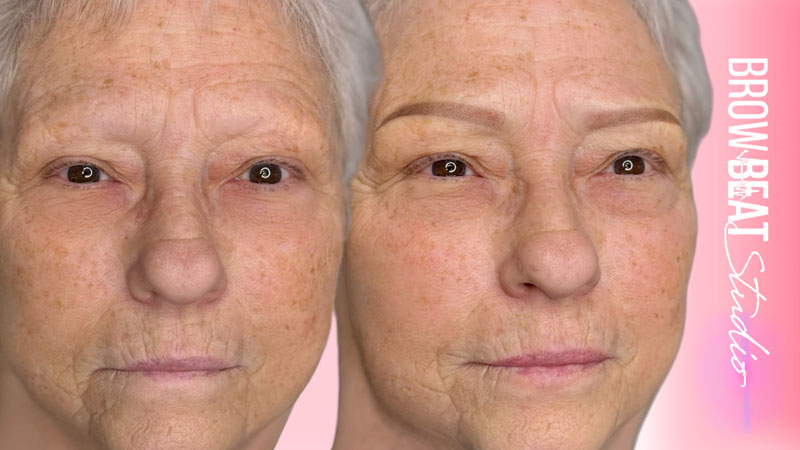
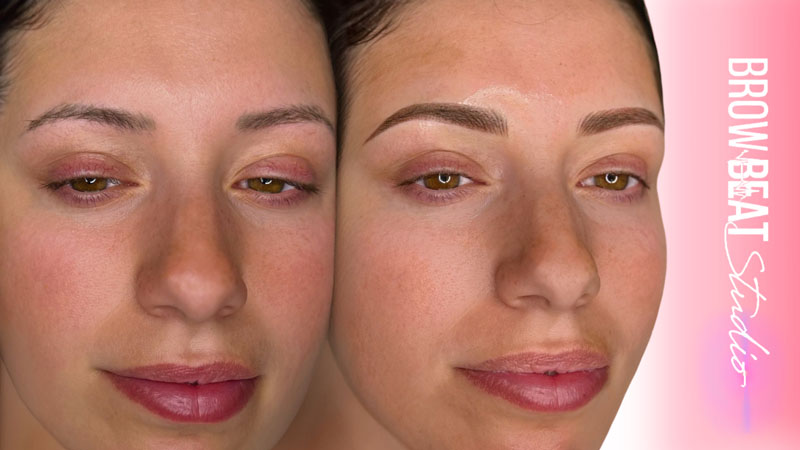
Microblading healing is a process, not a single moment. The brows you see immediately after your appointment are fresh permanent makeup. Over the days and weeks that follow, the skin recovers, the initial intensity begins to soften, and the individual hairstrokes move toward their healed appearance.
For clients, that physical process often comes with an emotional one.
You have just spent several hours making decisions about your eyebrows, and suddenly you are looking at them every time you pass a mirror. They may feel darker, sharper or more noticeable to you simply because they are new.
That does not mean everyone around you is seeing your brows with the same intensity you are.
After 10 years of working with microblading in Dallas and permanent makeup clients at BrowBeat Studio Dallas, we have seen this reaction many times. Clients can be very aware of their fresh brows during those first days while the people around them may simply see a more defined eyebrow.
Most clients do not need to take time off work simply because they have had microblading. The brows are visible while healing, but this is generally a process clients move through while continuing with ordinary daily life—with some temporary changes to how they care for the brow area.
The important thing to remember is that fresh brows are not healed brows. What you see on one particular day is only one stage of the process.
Microblading creates individual pigment hairstrokes within the skin, so the body responds by beginning its normal healing process.
Immediately afterward, the brows are fresh. A small amount of pinpoint bleeding or clear lymphatic fluid can occur as part of the immediate response to the procedure. The skin then begins closing and recovering while the appearance of the microblading changes along with it.
During the first several days, the brows can appear more vibrant and defined than they ultimately will. As the surface continues healing, some clients experience dryness, light flaking or small areas of skin shedding. The individual strokes can also look different as the skin changes over them.
Later, the brows may appear softer, lighter or temporarily less even before the healed result becomes easier to evaluate.
This progression is why microblading healing is better understood as a series of stages rather than a perfectly straight line from dark to light.
The most visible portion of microblading healing happens during approximately the first week and a half, but the skin continues healing beyond what can be seen on the surface.
At BrowBeat, our specific aftercare period continues through day 11. On the morning of day 12, clients can return to normal face washing.
That does not mean the brows suddenly become fully healed internally on day 12.
The surface may appear substantially recovered earlier—often around the one-week point—but surface closure is only one stage of healing. The skin continues settling underneath, and we allow approximately a month for the broader healing cycle.
This distinction is important because “When can I wash my brows normally again?” and “When are my microbladed eyebrows fully healed?” are not the same question.
Day 12 marks the return to normal face washing in BrowBeat’s protocol. The deeper settling process continues beyond that point.

Blonde microblading can show one of the biggest visual changes between fresh and healed brows. Immediately after the procedure, fresh pigment combined with the skin’s response can make very light hairstrokes feel surprisingly bold to the client. As the skin heals, that intensity settles and the lighter pigment begins working much more quietly with the natural blonde brow hair. This is often the stage when the client sees what the process was working toward: defined, complete brows that have softened into a result that feels natural on her face.
Medium brown microblading has enough depth to remain clearly visible while still undergoing the softening that happens through healing. Fresh strokes can initially look very precise and defined, but the healed result becomes more integrated with the client’s natural eyebrow hair. By this stage, the client is usually no longer examining every individual hairstroke. She sees the eyebrow as a whole—more complete, more polished and increasingly familiar on her face.


Light brunette microblading still changes noticeably as it heals, although the greater pigment depth can make the transition feel less dramatic than it does with very blonde brows. Fresh hairstrokes begin crisp and more visually present before gradually softening as the skin recovers. Once healed, the permanent strokes sit more naturally among the existing brow hair, giving the client definition without the intensity she may have noticed during those first several days.
Dark brown microblading may not have the same dramatic color shift experienced with very light blonde pigment, but healing still changes the character of the brow. The freshly created hairstrokes soften, the initial crispness relaxes and the deeper pigment begins working more naturally with the client’s existing brow hair. The healed result retains the stronger definition appropriate for deeper coloring while losing the unmistakably fresh appearance of the first stage.


Deeper brown microblading begins with naturally stronger visual depth, so the healing journey is less about a dramatic change in color and more about refinement. As the skin recovers, the crisp fresh strokes soften and the eyebrow begins feeling less newly performed. The deeper pigment continues providing the definition the client wanted, but the healed result feels more integrated with her natural brow hair and features. It becomes less about seeing permanent makeup and more about seeing a finished eyebrow.
As microblading heals on high melanin skin, the sharpness of the freshly created strokes gives way to a softer, more settled appearance. The permanent hairstrokes begin visually sharing the brow with the client’s natural hair instead of attracting attention on their own. This is often an important emotional point in healing. The brows stop feeling like something new she is constantly checking and begin feeling like part of her face—just with the shape and definition she wanted.

A healing timeline is useful, but it should not be treated as a promise that every eyebrow will look exactly the same on day three, day seven or day ten.
Some clients experience more visible flaking. Others have very little. Some notice a stronger contrast between the fresh color and the softer stages that follow, while others move through the process with relatively subtle visual changes.
The amount of natural brow hair can also affect what you notice. Someone who is a good candidate for microblading and has substantial natural eyebrow hair may see the healing skin differently from a client whose permanent hairstrokes are more exposed visually.
This is why we explain microblading healing in stages rather than creating a rigid day-by-day expectation.
Your brows do not need to match someone else’s photograph on a particular morning to be following their own healing progression.
One of the most common reactions immediately after microblading is, “They look dark.”
Fresh pigment is more visually present, the hairstrokes are newly created and the skin has just been through the procedure. For approximately the first five to eight days, the brows can feel particularly vibrant to the person wearing them.
The word feel is intentional.
You know exactly what your eyebrows looked like before the appointment. You may now be examining them from inches away several times a day. A relatively modest change can therefore feel enormous to you.
Someone else looking at your complete face may simply see defined brows.
We prepare clients for that difference in perspective because it can make the early healing stage much easier emotionally.
The initial intensity begins to soften as the brows progress through healing and move away from their freshly completed appearance.
Yes. Fresh microblading and healed microblading do not look identical.
The color and individual hairstrokes generally soften as the skin heals and the brows settle. This short-term change is part of healing and is different from the long-term fading that happens over the lifespan of permanent makeup.
The change may not look perfectly linear.
The brows can begin very defined, move through a dry or flaky stage and then appear surprisingly light in places as the surface skin changes. Individual hairstrokes may temporarily seem less obvious than they were immediately after the appointment.
That variation is one reason a healing progression can look more dramatic than clients expect.
The settled result becomes easier to assess once the skin has had time to complete the broader healing cycle.
Microblading aftercare is commonly discussed in terms of wet healing and dry healing.
Dry healing generally refers to allowing the brow area to heal without maintaining an ointment barrier. Wet healing uses a very thin layer of aftercare ointment to maintain controlled surface moisture and provide a light barrier during the early healing period.
At BrowBeat Studio Dallas, we use a controlled wet-healing approach.
After 10 years of seeing clients move through permanent makeup healing, this is the protocol we have found works well for our clients and is easier for many clients to follow. The light ointment barrier also helps us manage excessive dryness and flaking as part of our aftercare approach.
The amount of ointment matters.
Wet healing does not mean covering the eyebrows in a thick layer of product or repeatedly soaking them with water.
We want a sheer layer of ointment—just enough to create controlled surface moisture.

Very little.
For BrowBeat’s aftercare protocol, think approximately the total amount of two grains of rice for the brows.
The objective is a sheer, light layer over the treated area. The eyebrows should not look as though they have been coated heavily in ointment.
More is not better.
A small amount spreads farther than many clients expect, and using too much can interfere with the controlled approach we are trying to create.
The ointment provides light surface moisture and coverage while the brows progress through the early healing period.
When in doubt, think thin.
There is more than one aftercare philosophy in permanent makeup, which can become confusing when clients compare instructions from different artists online.
One studio may recommend dry healing. Another may use an ointment protocol. Both terms describe different approaches to managing the treated skin during its early recovery.
At BrowBeat, our experience has led us to controlled wet healing.
We use a very thin ointment barrier to maintain surface moisture while keeping the brows away from unnecessary water after the first-day cleansing period.
That distinction is important.
Wet healing does not mean repeatedly washing, soaking or keeping the eyebrows visibly wet.
Our protocol combines purposeful cleansing on the first day with a sheer ointment barrier afterward.
We also do not ask clients to combine our instructions with several different aftercare methods found online.
We give you one BrowBeat protocol, the products needed to follow it and written instructions to take home.
The first day has a specific purpose in BrowBeat’s aftercare protocol: gently removing lymphatic fluid and residue associated with the skin’s immediate response to the procedure.
Clients wash the brows four times on the first day, with approximately one hour between washes.
Immediately after microblading, a small amount of pinpoint bleeding and lymphatic fluid can occur as part of the body’s normal response. Our scheduled first-day cleansing removes that material from the surface rather than allowing it to accumulate there.
After the four scheduled washes are complete, the routine changes.
The brows are no longer repeatedly washed during the following days. Instead, they are kept away from unnecessary water while the very thin aftercare ointment is used according to the provided instructions through day 11.
We do not want clients leaving the studio trying to remember a long verbal list of products they need to find on the way home.
BrowBeat clients leave with an aftercare kit containing the products needed for the healing period, along with printed instructions.
That matters more than it might sound.
You have just completed a permanent makeup appointment, looked at your new brows and absorbed a considerable amount of information. We do not expect you to remember every aftercare detail from memory.
The products are provided.
The instructions are written down.
The routine has already been organized.
Healing requires care, but it should not require guesswork.
Microblading healing is easier to understand when you think of it as a series of stages rather than expecting the brows to move neatly from “fresh” to “healed.”
During the first several days, the brows are typically at their most vibrant. The shape can feel very defined, the color may appear stronger and the individual hairstrokes can look particularly crisp.
As the surface begins recovering, the appearance starts changing.
Dryness or light flaking may develop. Small areas can soften at different rates. Later, portions of the brows may look lighter than expected, and some hairstrokes can temporarily become more difficult to see.
Then the brows continue settling.
This is the part we want clients to remember when they find themselves inspecting one eyebrow under bright bathroom lighting on day seven.
You are looking at a healing brow, not the final result.
During the earliest stage, microblading can look more defined than the result you will ultimately wear.
The color is fresh. The individual hairstrokes have just been created. The surrounding skin may also show some temporary redness or sensitivity from the procedure.
For many clients, this is when the brows feel the most noticeable.
It can be exciting and slightly confronting at the same time.
You may love the shape but wonder whether the color will remain that strong. You may suddenly be aware of every hairstroke because you know exactly where to look.
This early intensity is one stage of microblading healing, not the settled color.
At BrowBeat, we prepare clients for that before they leave because knowing what to expect makes those first few days much easier to understand.

The color seen during the first few days of microblading is not the color decision viewed at its final destination. We select pigment knowing that freshly treated brows will initially have more visual intensity and that the hairstrokes will soften as the skin recovers. This is particularly important with lighter brow colors, where the contrast between fresh and healed can feel significant to the client. The product choice begins the process, but the healed eyebrow is what we are ultimately designing for.
A pigment bottle represents the beginning of a color decision, not the finished appearance of the eyebrow. Once that pigment becomes part of individual microblading hairstrokes, it is viewed through freshly treated skin and then through each stage of healing that follows. The intensity changes, the strokes soften and the natural eyebrow begins visually participating with the permanent makeup differently. That journey is why healed microblading gives us much more meaningful information than judging pigment solely by how it appears when fresh.


The products involved in microblading have different roles at different points in the experience. Pigments support the color of the individual hairstrokes during the procedure, while aftercare products support the treated skin during the initial healing period. They are connected by the same objective: creating a result that is considered beyond the moment the client leaves the studio. At BrowBeat Studio Dallas, we think about the fresh procedure and the healed result as parts of the same process.
One of the most important things about BrowBeat’s wet-healing protocol is how little ointment is actually required. Approximately two grains of rice total can provide the sheer coverage we want across the brows. The goal is not to see a thick layer of product sitting on the skin. We want controlled surface moisture while the microblading heals. This is one of those situations where using the product correctly matters much more than using more of it.

Around the first week, many clients begin noticing the brows moving away from their freshly completed appearance.
The skin is progressing through surface healing, and the color can begin appearing softer. Depending on the individual, there may be dryness, light flaking or areas that appear to be changing faster than others.
This is also around the period when the surface may appear substantially sealed for many people.
But looking closed on the surface does not mean the complete healing process is finished underneath.
That distinction is one reason BrowBeat continues the prescribed aftercare through day 11 rather than asking clients to decide for themselves whether their brows look healed enough after a week.
The practical aftercare period gives the surface additional time while the broader healing process continues underneath.
Some microbladed brows can become dry or flaky as the surface skin heals.
The amount varies.
One client may notice very little dryness. Another may see more obvious small flakes or areas of shedding.
Our controlled wet-healing protocol maintains a very light ointment barrier during this period rather than allowing the brow area to become unnecessarily dry.
That does not mean every client will avoid flaking completely.
If flaking occurs, allow the healing skin to release naturally rather than trying to speed up the process.
Do not pick, scratch or pull away the flakes.
Healing brows need patience more than assistance.
Clients often use the words flaking, peeling, scabbing and crusting interchangeably when describing healing brows.
The appearance varies, and not every client develops obvious scabbing.
BrowBeat’s first-day cleansing protocol removes lymphatic fluid and residue from the surface during the immediate post-procedure period. The very thin ointment barrier used afterward helps maintain controlled moisture as the surface continues recovering.
Even with consistent aftercare, individual healing responses differ.
If small areas of dried or shedding skin develop, leave them alone and allow them to release naturally.
The goal is not to make healing look perfectly neat every day.
It is to care for the area consistently while allowing the skin to do its job.
A healing eyebrow can temporarily look less even than it did immediately after the appointment.
Different areas of the surface skin may progress at slightly different rates. As dryness or flaking occurs, some portions of the pigment can appear softer sooner than others. Individual hairstrokes that were extremely visible when fresh may also become less obvious for a period of time.
This can create a patchy appearance that understandably makes clients nervous.
Temporary patchiness during the healing cycle is different from evaluating a healed microblading result.
What you are seeing is an eyebrow in transition.
“Ghosting” is a term commonly used online to describe a period when microblading appears surprisingly light or some hairstrokes seem to have temporarily disappeared after the earlier surface changes.
The name sounds dramatic.
The experience can feel dramatic too if nobody warned you about it.
A client may go from seeing very crisp, dark hairstrokes immediately after the procedure to wondering why some of them suddenly seem difficult to find.
During healing, the skin is changing over the pigment and the appearance of the strokes can fluctuate as that recovery continues.
A hairstroke being difficult to see during this stage does not automatically tell you what the final healed stroke will look like.
Microblading has a particularly interesting healing progression because the result is made up of individual hairstrokes.
That means clients often notice changes stroke by stroke.
Fresh hairstrokes may initially look crisp, dark or slightly more substantial than expected. As the surface changes, the strokes begin softening. During periods of flaking or surface renewal, some may temporarily appear lighter or less distinct.
Later, the healed hairstroke pattern becomes easier to evaluate as the skin settles.
This is one of the things that makes microblading healing different from simply watching one uniform area of color change.
You are watching the appearance of individual hair-like pigment marks change as the skin recovers over them.
Microblading color does not necessarily move in one perfectly straight line from darker to lighter.
Fresh brows begin with greater visual intensity. As the surface heals, the pigment starts appearing softer. During certain stages, portions of the brow may even look lighter than expected before the settled appearance becomes easier to see.
This is why photographs labeled “fresh” and “healed” can look noticeably different even though they show the same eyebrows.
The skin between those two photographs has gone through an entire recovery process.
The fresh result was never intended to remain visually frozen.

A sudden change in visible color can be alarming, particularly after flaking or surface shedding.
The first thing to consider is where you are in the healing timeline.
During the days and early weeks after microblading, the skin is still changing over the pigment. Some areas may look unexpectedly light, individual hairstrokes may become difficult to see and the contrast with the earlier dark stage can make that change feel even greater.
This short-term healing appearance is different from long-term microblading fading over months and beyond.
If the brows are still within the healing cycle, their appearance is still developing.
The healed result gives us a much more useful point from which to evaluate what actually settled.
For BrowBeat clients, the morning of day 12 marks an important practical transition.
The prescribed ointment period is complete, and you can return to washing your face normally.
Until then, after the four scheduled first-day washes, the brows themselves are kept away from unnecessary water while the very thin ointment barrier is maintained according to the provided instructions.
Day 12 does not mean every part of the deeper healing process suddenly ends overnight.
It means the initial BrowBeat aftercare period has been completed and normal face washing can resume.
The brows continue settling beyond that point as they move toward their healed appearance.
Once the four scheduled first-day washes are complete, BrowBeat’s microblading aftercare becomes intentionally simple.
The brows are kept away from unnecessary water, and a very thin layer of the provided aftercare ointment is used through day 11.
You are not repeatedly washing the brows during this period.
You are also not dry healing them.
The thin ointment layer maintains controlled surface moisture while the brows remain otherwise protected from unnecessary water.
That distinction matters because clients sometimes hear “keep your brows dry” and assume nothing should be placed on them at all.
That is not BrowBeat’s protocol.
After the first-day cleansing is complete, keep the brows dry from unnecessary water while continuing the sheer ointment barrier according to your provided instructions.
Under BrowBeat’s aftercare protocol, the brows are intentionally washed during the four scheduled first-day cleanses.
After that initial lymph-removal period, we want the brow area kept away from unnecessary water through day 11 while the thin ointment barrier is maintained.
This means being thoughtful when washing the rest of your face and when showering.
You do not need to become afraid of being near water. The objective is simply to avoid repeatedly soaking or directly washing the healing eyebrows during this stage.
On the morning of day 12, normal face washing can resume.
On the first day, the brows themselves are washed according to BrowBeat’s four-wash schedule, with approximately one hour between washes.
After those washes are complete, the brow area is treated differently from the rest of the face through day 11.
You can continue caring for the rest of your face while avoiding unnecessary water directly over the healing eyebrows.
The goal is not to stop normal hygiene.
It is to prevent routine face cleansing from becoming repeated soaking of the treated area.
Then, on day 12, you can return to washing your face normally.
Your printed BrowBeat aftercare instructions give you the complete routine so you do not have to reconstruct it from memory once you get home.
Yes. Having microblading does not mean you cannot shower.
During the initial aftercare period, however, be conscious of the healing brow area. Avoid allowing the shower stream to repeatedly hit or soak the fresh microblading.
The objective is controlled aftercare, not making ordinary life unnecessarily difficult.
After the first-day cleansing schedule, the brows are kept away from unnecessary water while the sheer ointment barrier is maintained through day 11.
Normal face washing resumes on day 12.
No.
If the brows become flaky or small areas of healing skin begin shedding, allow them to release naturally.
It can be tempting to help a tiny piece along when it looks almost ready to come away.
Leave it alone.
Picking, scratching or deliberately pulling at healing skin can disturb the area underneath before it is ready.
This is one of those moments when doing less is part of good microblading aftercare.
Use the provided ointment as instructed, protect the brows and let the skin control the timing.

The freshly treated eyebrow area needs to be treated differently from ordinary intact skin while it is healing.
During BrowBeat’s initial aftercare period, we do not want cosmetics applied directly over the healing microblading.
You can still wear makeup elsewhere and continue looking like yourself. The important distinction is giving the treated brow area space to recover rather than covering it with brow cosmetics or other makeup products.
The initial aftercare period is temporary.
By day 12, normal face washing resumes, although the brows themselves continue settling beyond that point.
Healing microblading is not the time to experiment with additional products directly over the eyebrows.
BrowBeat provides the aftercare products and instructions we want used during the initial healing period, which keeps the routine deliberately uncomplicated.
Products intended to exfoliate or accelerate skin turnover, including retinoid and exfoliating skincare products, should not be introduced onto the healing brow area while the skin is recovering.
The objective is not to make the brows heal faster.
It is to give the treated skin an appropriate environment in which to recover.
When thinking about exercise after microblading, the important considerations are sweat, heat and what is happening around the healing eyebrows.
During the early healing period, avoid repeatedly saturating the brow area with sweat or exposing the fresh procedure to excessive heat and moisture.
That may mean modifying a particularly intense workout while the brows are in the initial healing stage.
The goal is not to make normal movement off-limits.
It is to protect the treated skin while it recovers.
Swimming, saunas, steam rooms and hot yoga can combine prolonged moisture, heat, sweat or direct water exposure around the healing brows.
Those conditions are different from ordinary daily activities.
During the initial healing period, we want the brow area protected from unnecessary exposure to those environments while the skin is recovering.
The aftercare period is temporary.
Giving the brows that protected time allows you to focus on following one consistent healing routine rather than repeatedly challenging the treated area.
Freshly microbladed brows should be protected from deliberate tanning and excessive sun exposure while the skin is healing.
During this stage, the treated area is still recovering and should not be treated exactly like ordinary skin.
This is specifically about sun exposure during the healing period.
How UV exposure relates to permanent makeup over the longer term is a different question from immediate microblading aftercare.
While the brows are actively healing, keep the focus on protecting the treated area and following the provided instructions.
Most BrowBeat clients do not need to take time off work simply because they have had microblading.
The brows will be fresh and may feel particularly noticeable to you during the first several days, but microblading healing does not normally mean disappearing from public life.
You may be acutely aware of the color because you know exactly what changed.
Everyone else is looking at your complete face.
For many clients, the bigger adjustment is remembering the temporary aftercare routine rather than managing a dramatic outward recovery.
You can continue with ordinary daily activities while being mindful of the healing brow area.
No.
There may be days when you personally feel more aware of your brows. They can look vibrant at first. Later, dryness or light flaking may make you examine them more closely than anyone else ever would.
That self-awareness is understandable.
But a healing eyebrow does not need to look perfect every day in order for you to continue living your life.
The stages are temporary.
You do not need to apologize for your brows while the skin is doing exactly what it needs to do: heal.
One of the easiest ways to make microblading aftercare confusing is to leave your appointment and immediately start combining advice from several different artists online.
You will find dry-healing instructions.
You will find wet-healing instructions.
You will find different washing schedules, different product recommendations and different opinions about almost every part of the process.
Different studios can use different protocols.
BrowBeat clients receive the products and printed instructions for the protocol we use so there is one clear system to follow.
If you have a question about your BrowBeat aftercare, ask us rather than trying to average several conflicting sets of instructions together.
Your healing routine should be consistent, not crowdsourced.

Fresh microblading strokes begin with strong definition, but the way those strokes settle can vary with the skin. This illustration shows how thinner skin may retain a crisper hairstroke appearance, while oilier or thicker skin may heal with progressively softer definition. Aftercare also plays an important role during this stage, helping protect the treated area while the pigment settles into the skin.
Oilier skin can change the way individual microblading hairstrokes appear once healing is complete. As illustrated here, strokes that begin fine and distinct may heal with slightly softer edges and less separation than they would on thinner skin. Following microblading aftercare carefully helps create the best environment for healing, although the final result is also influenced by the client’s individual skin characteristics.


On thicker skin, freshly created microblading strokes may not retain the same crisp appearance once the brows have fully healed. This example illustrates how individual hairstrokes can become softer and more diffused through the healing process. Understanding these differences is important when choosing a brow technique, because skin type can influence both the healed appearance and how clearly individual strokes remain visible over time.
Healed microblading should be evaluated differently from fresh microblading.
Immediately after the procedure, the pigment is visually stronger and the individual hairstrokes can appear particularly crisp. During healing, those same brows move through changes in color, surface texture and stroke visibility.
Once the skin has had time to recover and settle, the hairstrokes generally appear softer than they did on the day of the procedure.
This is the point when we can begin looking at the result rather than the healing stage.
At BrowBeat Studio Dallas, we want the healed hairstrokes to work with the client’s natural eyebrow hair rather than remain as visually dominant as they may have appeared when fresh.
The transition from fresh to healed is part of microblading.
Softening does not automatically mean something has gone wrong.
Fresh and healed microblading are two different moments in the same result.
Fresh brows tend to have greater visual intensity. The color is newly placed, the individual hairstrokes are easy to see and the overall shape can feel particularly defined.
Healed microblading has moved through the skin’s recovery process.
The initial intensity has softened, the surface is no longer in the active early healing stage and the hairstrokes can be evaluated in relation to the client’s natural eyebrow hair.
This is why seeing both fresh and healed microblading can be so useful.
A photograph taken immediately after an appointment demonstrates the completed procedure.
A healed photograph shows how that work settled.
Both are valuable. They simply represent different stages.
Although the most obvious surface healing happens much earlier, we allow approximately a month for the broader microblading healing process.
This is different from BrowBeat’s day-11 aftercare period.
By day 12, clients can return to normal face washing because the initial aftercare phase has been completed. The skin, however, continues settling beyond what is immediately visible on the surface.
Healing happens in layers.
The practical restrictions end before every part of the settling process does.
Giving the brows additional time creates a much better point from which to evaluate the healed result.
The most useful evaluation happens after the brows have had time to move through the broader healing cycle.
A peeling brow, a lighter hairstroke during the first week or a temporary patch of uneven color does not give us the same information as healed skin.
Once the brows have settled, we can look much more meaningfully at the color, individual hairstrokes and overall result.
That is when we have information we can actually use.
Individual hairstrokes do not always settle with perfectly identical visual strength.
Microblading is performed in skin, and skin is not a sheet of paper.
Once the healing cycle has progressed far enough to evaluate the result, some areas may appear softer than others or a particular section may benefit from additional definition.
That is one reason BrowBeat treats microblading as a two-step treatment.
The first procedure creates the foundation.
Then we allow the skin to heal.
Only after that can we look at what actually settled and make informed decisions about what, if anything, should be strengthened during the second appointment.
At BrowBeat Studio Dallas, microblading is a two-step treatment for every client.
No exceptions.
The first appointment establishes the brow design, color direction and initial manual hairstroke result.
Then the brows heal.
The second appointment allows us to work from the healed result rather than trying to predict every detail while the microblading is still fresh.
By then, we have new information.
We can see how the individual hairstrokes settled and how the overall definition healed. Just as importantly, the client has had time to live with her brows.
She may love the softness exactly as it is. She may want a little more definition through one area. She may have a specific thought about the tail or another part of the brow after seeing it every day for several weeks.
The second treatment gives us an opportunity to respond to the actual healed result rather than an assumption about what it might become.
As the brows move through the healing process, the pigment softens and settles into the skin, but healing is only the beginning of the longer-term result. How long does microblading last? explores what happens after the brows are fully healed, including how gradually the hairstrokes fade and the factors that can influence pigment longevity.

BrowBeat clients return for their second microblading appointment as early as approximately four weeks and as late as 12 weeks after the initial procedure.
That window allows the first treatment time to heal before we evaluate the result and move into the second stage.
We do not want to make refinement decisions while the eyebrows are still actively moving through early healing.
By the second appointment, we are working from a much more meaningful starting point.
The brows have settled.
The client has lived with them.
And we can have a useful conversation about what she wants from the next stage.
The second appointment begins with the healed brows.
We look at how the hairstrokes settled and talk with the client about her experience wearing the result.
This feedback is different from responding to a mapped design or looking at fresh brows immediately after the first procedure.
She has now seen them every day.
She knows how they look when she wakes up. She knows how they work with her usual makeup. She knows whether the overall softness feels right or whether there is an area where she would enjoy a little more presence.
We combine that feedback with what we see in the healed result and determine what refinement is appropriate.
The goal is not automatically to make everything darker or add more everywhere.
The goal is to use the second treatment intentionally.
There is a difference between imagining what you want and living with it.
During the first appointment, we spend time understanding your preferences and allowing you to see the proposed shape before the permanent application begins.
Several weeks of actually wearing the brows gives you another kind of perspective.
You may discover that the amount of definition feels perfect. You may decide you would enjoy a little more presence through one particular area. Something you initially worried would feel bold may now feel completely natural on your face.
The second appointment allows us to use that real experience.
For us, that is much more useful than assuming the fresh result should answer every question on day one.
Temporary unevenness during healing should not immediately be interpreted as a problem with the finished result.
One area may be flaking while another is not. Some hairstrokes may temporarily appear lighter. The surface can change at slightly different rates across the eyebrow.
That is different from evaluating previously healed permanent makeup that genuinely requires correction.
Timing matters.
While your BrowBeat brows are still within their healing cycle, continue following the aftercare instructions and allow the process to progress.
Healed skin gives us a much better basis for determining what actually settled.
There is a physical timeline to microblading healing, but there is also a very recognizable emotional one.
At first, you may be excited and intensely aware of the brows at the same time.
Then you may think they look darker than you expected.
A few days later, you begin getting used to them.
Then a little flaking appears and suddenly you are examining them again.
Later, they may look lighter and you wonder whether too much disappeared.
Then the skin continues settling. The brows begin looking increasingly normal on your face, and the urge to inspect them every hour starts disappearing too.
After 10 years of watching clients move through this process, very little about that emotional progression surprises us.
One healing day does not tell you the ending.
Ask us.
Your BrowBeat aftercare kit and printed instructions are designed to answer the routine questions, but that does not mean you are expected to figure everything out alone if something concerns you.
It is much more useful for us to know where you are in the healing timeline and what you are seeing than for you to search through dozens of unrelated photographs online and try to decide which one looks most like your eyebrows.
If something falls outside the expected healing changes described in your aftercare information, contact BrowBeat for guidance. Symptoms that may require medical evaluation should be assessed by an appropriate healthcare professional.

Healing does not need to look beautiful every day to be progressing.
The brows may begin vibrant. They may become dry. They may flake lightly. They can appear softer or temporarily uneven. Individual hairstrokes may seem more or less visible at different points.
Your job is not to control every visual change.
Your job is to follow the aftercare instructions and allow the skin to recover.
At BrowBeat Studio Dallas, we provide the products, written protocol and a clear routine because we want clients to know what they are responsible for—and what they can simply allow the body to do.
Four scheduled washes on the first day.
A sheer amount of ointment through day 11.
Keep the brows away from unnecessary water after the first-day washes.
Do not pick at healing skin.
Normal face washing returns on day 12.
Then give the brows time to continue settling.
The healing process changes the way microblading looks.
That is not a flaw in the process.
It is the process.
The fresh, highly defined hairstrokes you see immediately after the appointment are only the beginning. The skin recovers, the initial intensity softens and the brows gradually move toward the appearance we can meaningfully evaluate once healing has progressed.
That is why BrowBeat’s approach does not end with the first appointment.
We allow the brows to heal. We bring the client back. We look at the settled result together and listen to what she has learned from actually wearing her brows.
Then we refine where refinement is useful.
The first appointment creates the foundation.
Healing shows us how that foundation settled.
The second appointment allows us to finish the conversation.

The most visible microblading healing happens during approximately the first week and a half, but the skin continues settling after the surface looks recovered. BrowBeat’s initial aftercare protocol continues through day 11, with normal face washing returning on day 12. We allow approximately one month for the broader healing process before treating the brows as a meaningful healed result.
Microblading typically moves from a fresh, more vibrant appearance into a period where the brows begin softening. Some clients experience dryness, light flaking or surface shedding. The brows can then look lighter, patchy or temporarily less defined before the individual hairstrokes become easier to evaluate as the skin settles. The exact appearance and timing vary from client to client.
The obvious surface healing occurs earlier, but BrowBeat allows approximately one month for the broader healing and settling process. Normal face washing returns on day 12, but that practical milestone does not mean every part of healing underneath has finished. The brows become much more meaningful to evaluate after they have had additional time to settle.
Fresh pigment and newly created hairstrokes have greater visual intensity than healed microblading. You are also seeing a change to a face you know extremely well, so the brows can feel particularly noticeable during the first several days. At BrowBeat Studio Dallas, we prepare clients for that initial vibrancy because the fresh appearance is not the settled color they will ultimately wear.
Yes. Microblading generally softens as the skin heals and the pigment settles. The change does not necessarily happen in one perfectly predictable progression. Brows can begin very vibrant, become softer, look unexpectedly light during certain healing stages and then become easier to evaluate once the broader healing cycle has progressed.
Wet healing uses a very thin aftercare ointment barrier to maintain controlled surface moisture while the treated skin heals. BrowBeat uses a controlled wet-healing protocol. After the scheduled first-day cleansing, the brows are kept away from unnecessary water while a sheer amount of the provided ointment is used through day 11. Wet healing does not mean repeatedly soaking or washing the brows.
Dry healing generally refers to healing without maintaining an ointment barrier, while wet healing uses a controlled amount of ointment to maintain light surface moisture. BrowBeat uses a wet-healing approach that we have found works well for our clients. Different studios may provide different protocols, so follow the aftercare instructions given by the studio that performed your procedure rather than combining several methods.
BrowBeat’s first-day protocol uses four gentle washes, approximately one hour apart, to remove lymphatic fluid and residue associated with the skin’s immediate response to microblading. After those scheduled washes are complete, the routine changes. The brows are then kept away from unnecessary water while the thin aftercare ointment is maintained according to the provided instructions.
BrowBeat clients use only a very small amount—approximately the total amount of two grains of rice for both brows. The layer should be sheer rather than thick or visibly heavy. More ointment is not better. The purpose is to maintain controlled surface moisture and a light barrier while the brows move through the initial healing period.
Under BrowBeat’s protocol, the brows are intentionally cleansed during the four scheduled washes on the first day. After that, they are kept away from unnecessary water through day 11 while the sheer ointment barrier is maintained. On the morning of day 12, normal face washing can resume.
For BrowBeat clients, normal face washing resumes on the morning of day 12. Before then, the brows receive their four scheduled first-day washes and are subsequently kept away from unnecessary water while the recommended thin ointment barrier is maintained. Day 12 marks the end of this initial aftercare phase, not the end of the broader healing process.
Yes. You can shower after microblading, but avoid repeatedly soaking the treated eyebrows or allowing the shower stream to directly saturate them during BrowBeat’s initial aftercare period. Follow the scheduled first-day cleansing routine and then keep unnecessary water away from the brows through day 11.
Yes. Some clients experience light flaking, dryness or surface peeling as microbladed skin heals, while others experience very little. The amount varies from person to person. If flakes or peeling develop, allow the skin to release naturally rather than picking, scratching or pulling it away.
Healing appearances vary, and not every client develops obvious scabbing. Clients may use words such as flaking, peeling, crusting or scabbing to describe different surface changes. BrowBeat’s first-day cleansing is followed by controlled wet healing. Any dried or shedding skin that develops should be allowed to release naturally.
No. Do not pick, scratch or pull at healing skin on the microbladed eyebrows. Even when a small flake looks almost ready to come away, allow it to release on its own. Deliberately removing healing skin can disturb the treated area underneath. Follow the aftercare protocol and allow the skin to progress naturally.
Yes. Different portions of the brow can move through surface healing at slightly different rates. One area may be flaky while another is not, and individual hairstrokes can temporarily appear lighter or less distinct. Temporary patchiness or unevenness during healing should not be confused with the final settled microblading result.
“Ghosting” is a common term for a period when microblading can appear unexpectedly light or some hairstrokes seem temporarily difficult to see. The treated skin is still recovering and changing in appearance during this stage. A stroke looking faint during healing does not necessarily tell you how it will appear once the broader settling process is complete.
The contrast between very dark fresh brows and the lighter stages that can follow surface shedding may feel dramatic. Some hairstrokes can temporarily become much more difficult to see while the treated skin continues recovering. Allow the brows to progress through the broader healing cycle before deciding what pigment actually remained.
Because microblading is made up of individual hairstrokes, healing changes can sometimes be noticed stroke by stroke. Fresh strokes may look crisp and prominent, while some can temporarily appear softer, lighter or less distinct as the skin changes. The complete hairstroke pattern becomes more meaningful to evaluate after adequate healing time.
The brows are often at their most visually intense during the first several days. BrowBeat clients commonly notice that the initial vibrancy begins softening around the first week as the skin moves through surface healing. The exact progression varies, so there is not one particular day when every client’s brows suddenly become softer.
Do not place cosmetics directly over the freshly treated brow area during BrowBeat’s initial aftercare period. Makeup can still be worn elsewhere if desired. The important thing is to leave the healing microblading itself free from brow cosmetics and other unnecessary products while the treated skin is recovering.
During the initial healing period, use the BrowBeat aftercare products and instructions provided for the treated brow area rather than adding unrelated skincare products. Retinoids, exfoliating products and products intended to accelerate skin turnover should not be applied to actively healing microblading.
During early healing, avoid workouts that cause significant sweating around the treated eyebrows. Sweat, heat and repeated moisture are not conditions we want to introduce while the skin is recovering. Light daily activity is different from an intense workout that leaves the brow area wet with perspiration, so temporarily modify your exercise routine as needed while following BrowBeat’s aftercare instructions.
Avoid swimming during BrowBeat’s initial aftercare period because prolonged immersion repeatedly exposes the healing brows to water. The first-day cleansing routine is controlled and intentional; swimming is not the same type of exposure. Follow the aftercare instructions provided with your procedure before returning to swimming or other activities that immerse the brows.
Yes, during the initial healing period. Saunas, steam rooms and hot yoga can expose the treated eyebrows to significant heat, steam and perspiration. Give the skin time to progress through BrowBeat’s initial aftercare period rather than repeatedly introducing heavy moisture and heat while the brows are recovering.
Most BrowBeat clients do not need to take time off work because of microblading. The brows may feel particularly dark or noticeable to you during the first several days, but most clients continue their normal daily routine while following the temporary aftercare instructions.
Fresh microblading generally appears more vibrant, crisp and visually defined. Healed microblading has softened through the skin’s recovery process, allowing the individual hairstrokes to work more naturally with existing eyebrow hair. A fresh photograph shows the newly completed procedure; a healed photograph shows how the pigment and hairstrokes settled after recovery.
Early healing can temporarily change the apparent color, visibility and definition of individual hairstrokes. Evaluating the work too soon can therefore give an incomplete picture of what actually settled. BrowBeat allows approximately one month for the broader healing process before treating the brows as a meaningful healed result.
The first appointment creates the initial brow design, color direction and manual hairstroke result. The skin is then allowed to heal. At the second appointment, BrowBeat can evaluate what actually settled and combine that information with the client’s experience of wearing her brows. Refinement can then be based on the healed result rather than assumptions made while the brows are still fresh.
BrowBeat clients return for their second microblading treatment as early as approximately four weeks and as late as 12 weeks after the initial procedure. By then, the brows have had time to heal and the client has had time to live with the result. We can evaluate the healed hairstrokes, discuss what the client likes and determine where additional refinement may be useful.