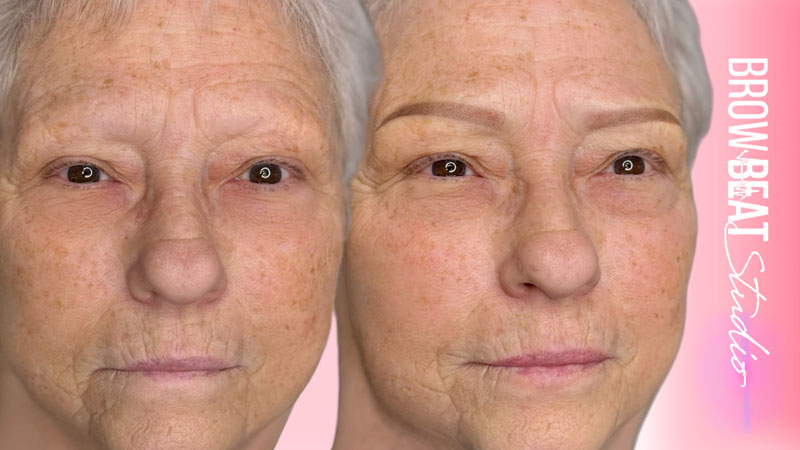
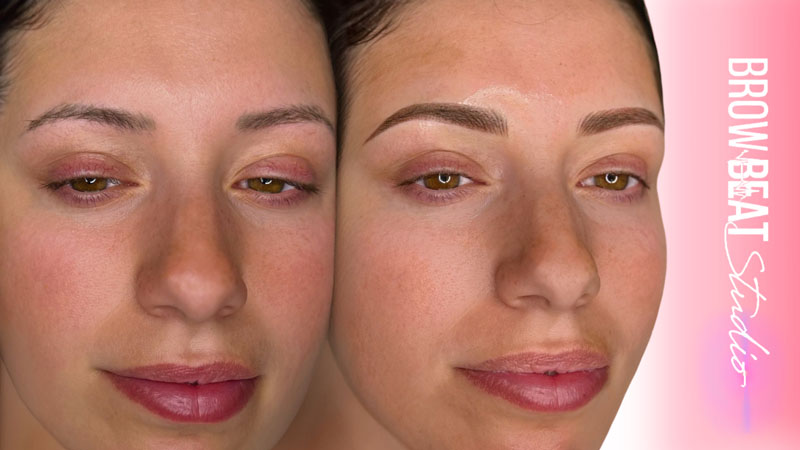
A good candidate for microblading in Dallas is someone whose skin, natural eyebrow hair and desired result work well with a manual hairstroke technique.
That sounds simple, but after 10 years of working with permanent makeup clients at BrowBeat Studio Dallas, we have learned that choosing the right brow technique deserves more thought than simply asking which service someone likes in photographs.
Microblading creates individual pigment hairstrokes with visible space between them.
One hairstroke. Space. Another hairstroke. More space.
That separation is what gives microblading its characteristic hair-like appearance. It is also why the natural eyebrow and the skin underneath it matter so much.
Some of our strongest microblading candidates have healthy skin, an existing framework of natural eyebrow hair and specific areas where additional hairstrokes can improve the brow. Perhaps the tail becomes sparse. There may be small gaps through otherwise healthy brow hair. Fine natural brows may simply need more continuity or definition.
In those situations, microblading has a very clear job.
It adds hair-like detail while allowing the client’s natural eyebrow to remain an important part of the finished result.
But microblading is not automatically the best first choice for every person who wants permanent brows.
Oilier or thicker skin, very limited natural brow hair, certain health considerations or a desire for substantially greater density can all change the technique conversation.
At BrowBeat, we are much more interested in making a strong first choice than making every client fit the technique she happened to search for first.
You may be a good candidate for microblading if you want an individual hairstroke result, your skin provides a favorable environment for those strokes and you have enough natural brow framework for the permanent makeup to work with visually.
You do not need naturally thick or perfect eyebrows.
Microblading is often chosen precisely because something about the natural brow feels incomplete.
A client with healthy natural hair through the front and body but a sparse tail may be particularly well suited to microblading. Someone with fine brows and several small gaps may also have a strong framework for additional hairstrokes.
The distinction is between adding hair-like detail to an eyebrow and asking individual pigment strokes to create almost all of the eyebrow’s density by themselves.
Those are different jobs.
Good microblading candidacy begins with understanding which job your brows actually need done.
Some of the best candidates for microblading have healthy skin, natural eyebrow hair to support the result and a desire for visible hair-like texture rather than a more densely filled brow.
The natural hair gives the permanent hairstrokes something to participate with.
Real eyebrow hair has dimension. It sits above the skin, changes direction and creates natural variations in density. Microblading contributes the visual impression of additional hair between and alongside what is already there.
When those elements work together, the permanent makeup does not have to create every part of the eyebrow by itself.
This is one reason we particularly like microblading for clients who already have a recognizable natural brow but want selective improvement.
We can strengthen what is missing without unnecessarily replacing what is already beautiful.

The amount and distribution of natural eyebrow hair can tell us a great deal about microblading suitability. During the client-artist discussion, we look at where real hair already provides density and where permanent hairstrokes would need to contribute. The strongest technique decision begins with understanding the eyebrow that already exists.
A good microblading candidate does not need thick eyebrows. Fine natural brows can provide plenty of framework when the hair is distributed well and the skin is suitable for a manual hairstroke technique. Here, microblading builds on what is already present, adding enough texture and definition to make the eyebrow feel more complete without asking permanent pigment to replace the natural brow.


Thin eyebrows are rarely identical. One side may have stronger hair growth, a more complete tail or slightly greater density than the other. When the skin and natural brow framework are suitable, individual microblading hairstrokes can contribute strategically to the weaker areas. The goal is not perfect mathematical symmetry—it is creating better visual balance while preserving the character of the client’s own brows.
This before-and-after shows the kind of foundation where microblading can really shine. Healthy skin provides a good environment for individual hairstrokes, while existing natural brow hair supplies texture and density around them. The microblading does not have to become the entire eyebrow. It can concentrate on adding hair-like detail where it improves the natural brow.


When a client has good natural brow hair through the front and body but loses definition toward the tail, microblading has a very specific job to do. Individual hairstrokes can extend the visual structure of the eyebrow while the client’s natural hair continues providing density elsewhere. This kind of selective enhancement is one of the situations where a hairstroke technique can make a meaningful difference without unnecessarily changing the complete brow.
Microblading depends on visible separation between individual hair-like strokes, which is why skin characteristics are part of candidacy. This before-and-after demonstrates the relationship we are looking for: suitable skin, natural brow support and a result that benefits from additional texture. When those pieces align, the artist can use microblading for what it does particularly well—creating controlled hair-like detail.

Microblading has space between the individual hairstrokes.
That space is intentional.
Without separation, the strokes would eventually stop reading visually as individual hairs and begin looking more like continuous pigment.
Natural eyebrow hair helps provide texture and density within those spaces. It gives the permanent hairstrokes a framework to participate in rather than asking pigment alone to create the entire visual weight of the brow.
This is why a small sparse area surrounded by natural hair can be very different from an eyebrow with almost no natural hair throughout the complete shape.
Both clients may be excellent candidates for permanent brows.
They may simply be stronger candidates for different techniques.
Microblading can work beautifully for thin or sparse eyebrows when there is enough natural brow framework for individual hairstrokes to create the amount of additional definition the client wants.
A fine natural brow may benefit from more texture. Small gaps can be visually connected. A weak tail can gain presence. An uneven distribution of natural hair may need only selective hairstroke support.
The important distinction is the degree of sparsity.
“Sparse brows” can mean a client has plenty of natural eyebrow hair with several incomplete areas.
It can also mean significant natural brow loss.
Those situations should not automatically receive the same technique.
For microblading candidacy, we want to know whether separated hairstrokes can create enough visual support without being asked to provide all of the density by themselves.
Very little natural eyebrow hair does not mean permanent brows are off the table.
It means technique selection becomes even more important.
Because microblading consists of separated hairstrokes, an eyebrow with almost no natural hair can sometimes lack the underlying density needed to make a hairstroke-only result feel complete.
This is where a shaded component can become valuable.
Soft shading can provide visual density underneath and between hair-like detail, creating more of the foundation the natural brow would otherwise contribute.
This is part of why combination or 3D brows developed as such a useful permanent brow option: hairstrokes provide texture while shading provides additional density.
At BrowBeat, we frame this positively.
The question is not, “Can this client have permanent brows?”
The question is, “Which approach gives her the strongest foundation for the brows she wants?”
When significant natural brow loss is the defining concern, that broader decision belongs within our restoration approach rather than forcing microblading alone to do every job.
The first technique you choose establishes a foundation that you may maintain for years.
That matters to us.
If a client has healthy skin, good natural brow support and wants selective hair-like definition, microblading can make excellent sense.
If she has very little natural hair, oilier or thicker skin, or needs substantially more visual density, we want to recognize those factors before simply creating an entire eyebrow from separated manual strokes.
Sometimes a shaded brow or a technique that incorporates shading creates a stronger starting point.
This is not about one technique being universally better than another.
It is about making the first choice with the future of the eyebrow in mind.
The goal is not to sell every client microblading.
The goal is to make a strong first choice.
It may be, particularly if what you mean by natural is visible hair-like texture.
Microblading is defined by individual manual hairstrokes, making it particularly appealing to clients who want permanent makeup to imitate the visual appearance of eyebrow hair.
But “natural” means different things to different people.
One client means, “I want to see individual hairs.”
Another means, “I want my brows to be extremely soft.”
Someone else means, “I don’t want people to immediately know I have permanent makeup.”
Those descriptions are useful because they tell us what the client is actually responding to.
Microblading does not own the word natural.
It owns a particular kind of result: individual hair-like detail.
Candidacy asks whether that result is the right match for your skin and your natural brows.

Healthy skin that can support clean, separated hairstrokes generally gives us the strongest starting point for microblading.
In our experience, younger, healthy skin with a good natural brow framework can be particularly favorable for the technique.
But we do not make the decision from age or a skin-type label alone.
Oil production, thickness, texture, sensitivity and the actual condition of the brow area all matter.
Someone may describe herself as having combination skin while the eyebrow area behaves very differently from the center of her face.
This is why we look at the skin where the microblading will actually be performed.
The goal is not to decide whether microblading can technically be placed into the skin.
It is to decide whether that skin provides a good environment for the kind of clean hairstroke result we want to create.
Oily or thicker skin is generally not our first choice for a microblading-only result.
Microblading depends on individual hairstrokes remaining visually separated and hair-like. On oilier or thicker skin, those strokes can sometimes heal wider and lose some of the delicate definition that makes the technique attractive in the first place.
For those clients, a powder or shaded brow can often provide a stronger technique choice because the result does not depend on maintaining the same individual stroke separation.
That does not mean someone with oily skin cannot have beautiful permanent brows.
Quite the opposite.
It means we want to choose a technique that works with the characteristics of the skin rather than asking the skin to behave differently for microblading.
How oily skin affects long-term pigment retention is a separate longevity conversation.
Here, we are deciding whether microblading itself is the strongest starting choice.
Yes. Healthy normal or drier skin can provide a favorable environment for microblading when the other candidacy pieces also align.
That does not mean a client becomes an ideal candidate simply because she describes her skin as dry or normal.
We still look at the actual brow area, natural eyebrow framework and desired result.
Healthy skin may give the hairstrokes a good environment.
The rest of the eyebrow still needs to give those strokes the right job to do.
Combination skin is a perfect example of why we do not make permanent brow decisions from one-word skin labels.
A client may experience oiliness through the center of her face while the skin around her eyebrows behaves very differently.
We look at the brow area itself.
If that skin is healthy and appropriate for individual hairstrokes, and the natural brow and desired result support microblading, combination skin does not automatically rule the technique out.
If the brow area is particularly oily or thick, however, we may have a different conversation about whether a shaded approach would give the client a stronger result.
Sensitive or delicate skin deserves individual evaluation rather than an automatic yes or no.
Clients use the word “sensitive” to describe many different things. Some become red easily. Some react to particular products. Others have active irritation or a diagnosed skin condition affecting the eyebrow area.
Those are not the same situation.
The condition of the actual skin matters.
If the skin is very delicate, if bleeding is a significant concern or if other health factors affect how we think about a manual hairstroke procedure, a shaded brow may sometimes provide a more appropriate technique direction.
That decision should come from screening the individual client rather than assuming every sensitive-skin client belongs in the same category.

Microblading creates individual hairstrokes by making controlled superficial openings in the skin, so the condition of that skin matters. Healthy skin gives the artist a better starting environment for creating clean, separated hairstrokes and for the skin to recover afterward.
This close view of the microblading shows why candidacy is about more than simply liking the appearance of hairstrokes. The artist is working directly with living skin, and every client’s skin responds differently. Skin thickness, sensitivity, bleeding and overall condition can influence how suitable the skin is for creating clean manual strokes.


Not every skin surface responds to a manual hairstroke technique in the same way. Thicker skin can make delicate stroke definition more difficult to maintain, which is why BrowBeat considers the actual characteristics of the brow area before recommending microblading.
Beautiful hairstrokes begin with more than a beautiful design. Suitable skin, an appropriate natural brow framework and controlled artist technique all contribute to the result. At BrowBeat Studio Dallas, candidacy is about making sure microblading has the right foundation before the first stroke is created.
Yes. Small gaps within an existing natural eyebrow can be one of the situations where microblading makes particularly good visual sense.
The permanent hairstrokes can contribute hair-like detail through the incomplete area while the client’s own eyebrow hair provides texture and density around them.
This is where natural hair support becomes such an advantage.
We are not asking pigment strokes to construct an entire eyebrow. We are using them selectively to connect areas of natural hair that already belong together.
The objective is not to fill every visible piece of skin.
It is to create enough continuity that the gap stops interrupting the eyebrow.
A sparse tail can be a particularly good reason to consider microblading when the rest of the natural eyebrow provides a strong framework.
Many clients have healthy natural density through the front and body but lose definition through the final third of the brow.
In that situation, individual hairstrokes can extend the visual structure of the eyebrow without requiring the entire brow to be rebuilt.
This is the kind of microblading we particularly like.
The permanent makeup has a very specific job.
Complete what is missing while leaving the natural brow to continue doing what it already does beautifully.
Microblading can create the appearance of additional fullness by introducing individual hair-like strokes where the natural eyebrow needs more visual support.
But fuller and denser are not necessarily the same thing.
If a client has fine natural brows with enough existing hair to support the permanent strokes, microblading can make the eyebrow appear more complete while retaining visible hair-like texture.
If the client wants substantially greater density throughout the entire brow, we need to ask whether separated hairstrokes alone are being given the right job.
Sometimes the answer is yes.
Sometimes the desired result tells us that shading deserves consideration.
Understanding the endpoint is part of deciding whether microblading is right for you.
Microblading can sometimes create greater visual balance when natural brow density differs from one side to the other.
Perhaps one tail is stronger. One brow may contain a small gap the other does not. Hair distribution can simply be different from side to side.
Individual hairstrokes can contribute where additional structure is useful.
But human faces are naturally asymmetrical, and permanent makeup should not be expected to make two sides of a face mathematically identical.
At BrowBeat Studio Dallas, we aim for visual balance rather than promising artificial perfection.
Possibly—if the type of definition you want comes from individual hairstrokes.
A client who wants to strengthen a tail, improve small sparse areas or give fine natural brows more visible structure may be describing exactly the kind of result microblading creates well.
A client who wants substantially greater density throughout the entire eyebrow may be describing a different visual goal.
Neither preference is better.
The important thing is recognizing the difference.
Microblading creates definition through hair-like detail.
Technique selection begins by deciding whether that is the kind of definition you actually want.

First, we need to understand what fuller means to you.
If you want your natural eyebrows to appear more complete because several areas lack hair-like detail, microblading may be an excellent option.
If you want significantly greater visual density across the entire brow, separated hairstrokes may not create all of the fullness you are picturing by themselves.
This is why we ask clients to describe the result rather than simply choose the service name.
“Fuller” is a goal.
Microblading is one possible way to reach it.
They are not automatically the same thing.
Microblading can contribute to a more defined eyebrow shape when additional hair-like detail is what the existing brow needs.
A weak tail can be strengthened. Small interruptions can be connected. Fine areas may gain enough structure for the complete shape to read more clearly.
But brow design begins with the face and the eyebrow already present.
We do not believe a good microblading candidate needs to abandon her natural brow simply because permanent makeup gives us the ability to create something different.
At BrowBeat, we prefer refinement.
If the natural eyebrow already contains something beautiful, we want to recognize that before deciding what permanent makeup should add.
It can be.
Clients who wear very little makeup often care deeply about how their eyebrows look when the rest of the face is completely bare.
Because microblading creates individual hairstrokes rather than relying on continuous brow density, it can be particularly appealing to someone who wants more visible structure without feeling heavily made up.
But aesthetic preference is only one part of candidacy.
The skin and natural brow framework still need to support the technique.
Loving the look of hairstrokes tells us what you are drawn to.
The rest of the candidacy discussion tells us whether microblading is the right way to create them.
No.
If you already had perfectly dense eyebrows everywhere, you probably would not be researching microblading.
What we are looking for is not necessarily thickness.
We are looking for framework.
A client can have fine natural eyebrows and still have enough hair distribution to support additional permanent hairstrokes beautifully.
She may have good natural density in one area and very little in another.
A good microblading candidate does not need perfect natural brows.
She needs a starting point that works with what the technique is designed to add.
Yes. Naturally light eyebrows can be excellent candidates for microblading when the skin, brow framework and desired result support the technique.
Color selection becomes particularly important because the permanent hairstrokes need enough presence to improve the eyebrow without overpowering very light natural hair.
Being blonde or having light brows does not make someone a poor candidate.
It simply becomes part of the individual design.
Candidacy tells us whether microblading makes sense.
Color selection allows us to adapt that technique to the person.
Absolutely.
Microblading is not defined by one hair color or complexion.
A brunette client with healthy skin, an existing natural brow framework and a desire for individual hair-like definition may be an excellent candidate.
Deeper natural brow hair simply changes the amount of pigment presence needed for the permanent hairstrokes to participate naturally with the eyebrow.
The candidacy principle remains the same.
Skin, natural brow support and desired result need to make sense together.
No. Skin tone alone does not determine microblading candidacy.
Clients across a wide range of complexions may be considered for the technique.
Melanin level and skin type are not interchangeable concepts.
A deeper complexion does not automatically mean oily or thick skin, just as a lighter complexion does not automatically mean ideal microblading skin.
We are much more interested in the characteristics and condition of the actual brow area, the natural eyebrow framework and what the client wants the finished result to look like.
The individual matters more than the category.

Very much.
A client can have healthy skin and a beautiful natural brow framework but still be asking microblading to create a result that is not really a hairstroke-only result.
This is why expectations are part of candidacy.
If you want visible individual hairs, selective definition and a brow that continues showing texture, microblading may align beautifully with that goal.
If you are describing substantially greater density or a more filled-in appearance throughout the complete eyebrow, we need to listen to that.
The technique should match the expectation.
Not the other way around.
Microblading is not automatically appropriate for every person who wants permanent eyebrows.
Sometimes the issue is temporary. The skin may not be in an appropriate condition to treat right now, or a health consideration, medication, pregnancy or breastfeeding status may affect whether or when the procedure can move forward.
In other situations, the client may still be an excellent permanent makeup candidate but simply not our strongest candidate for microblading specifically.
Oilier or thicker skin, significant bleeding considerations, very delicate skin or very little natural brow support can all change the technique conversation.
For some of these clients, a powder or shaded brow may provide a stronger approach because the result does not depend on maintaining the same clean separation between individual manual hairstrokes.
At BrowBeat Studio Dallas, we distinguish between two questions:
“Can this person have permanent makeup?”
and
“Is microblading the best technique for this person?”
Those are not always the same answer.
Microblading is performed in the skin, so the condition of the brow area matters before the first permanent hairstroke is created.
We want to work with healthy skin rather than trying to perform microblading through active irritation, inflammation or another condition affecting the treatment area.
This is separate from whether someone generally describes her skin as dry, oily, normal or sensitive.
A client can normally have favorable skin characteristics and still have something temporary happening around the eyebrows that makes the timing inappropriate.
This is why we look at the actual skin we would be working on.
Sometimes good candidacy simply means waiting until the skin is ready.
Microblading relies on creating clean individual hairstrokes, so factors that contribute to significant bleeding during a procedure can influence whether it is the strongest technique choice.
This is one reason health history and medications matter during screening.
For some clients with relevant medical or bleeding considerations, a powder or shaded brow may deserve consideration instead of relying on a manual hairstroke technique.
That does not mean we make medical decisions from an eyebrow appointment.
It means we take the information seriously.
If something in a client’s health history or medication use raises a question about whether a cosmetic procedure is appropriate, medical guidance should come from the healthcare professional responsible for that care.
Yes.
Relevant health history and medications should be disclosed during screening.
Taking medication or having a medical condition does not automatically mean someone cannot have permanent makeup.
But we cannot make an appropriate candidacy decision using information we do not have.
Some medications or health circumstances can influence bleeding, the condition of the skin or whether the timing of an elective cosmetic procedure is appropriate.
Clients should never stop, change or skip prescribed medication simply to qualify for microblading.
Your healthcare comes before your eyebrows.
These are exactly the kinds of circumstances that should be disclosed during screening rather than answered with a universal yes or no online.
The condition, medication, management and individual circumstances can all matter.
For BrowBeat, the important candidacy question is whether there is anything about the client’s health or bleeding response that makes a manual hairstroke procedure less appropriate or requires medical guidance before moving forward.
In some circumstances, microblading may not be our preferred brow technique even when another permanent makeup approach remains worth considering.
When medical clearance or individualized advice is needed, that guidance belongs with an appropriate healthcare professional.
Active skin concerns in the treatment area need to be disclosed before microblading.
Eczema, psoriasis, active dermatitis, significant irritation or an active breakout directly through the brow area can affect whether the skin is appropriate to treat at that time.
The location and current condition matter.
A blemish elsewhere on the face is not the same thing as active inflammation in the area where permanent hairstrokes would be created.
If something is happening around your eyebrows before your appointment, tell us.
There is no benefit in forcing an elective permanent makeup procedure through skin that needs time or appropriate care first.

Before choosing microblading, the artist needs to understand more than what brow shape the client likes. Skin characteristics, natural brow hair, medications, health considerations and the desired result all contribute to candidacy. At BrowBeat Studio Dallas, that conversation helps us decide whether individual manual hairstrokes are truly the right approach for the person in front of us.
A client brings years of experience looking at her own face, while the artist brings professional experience evaluating skin and permanent brow techniques. Good candidacy comes from putting those perspectives together. We want to understand what the client hopes to improve while also being clear about whether her skin and natural brow framework support microblading.


A client may arrive convinced she wants microblading because she loves hairstrokes. After looking at her skin, natural brow density and overall goals, we may agree completely—or another brow approach may deserve consideration. That is not a failed microblading consultation. It is individualized permanent makeup and an important part of choosing the technique well.
Pregnancy and breastfeeding status must be disclosed before scheduling or proceeding with microblading.
At BrowBeat, these circumstances are part of candidacy screening because permanent makeup is an elective procedure and timing matters.
We do not want clients relying on a generic internet answer when their current circumstances should be discussed directly with the studio.
If you are pregnant, breastfeeding or expect your status to change around your appointment, tell us before moving forward.
You must be 18 or older to receive microblading at BrowBeat Studio Dallas.
We do not perform microblading on anyone under 18, including with parental consent.
Once a client meets the age requirement, age alone still does not determine whether she is a good microblading candidate.
Skin characteristics, natural brow framework, desired result and health screening remain part of the decision.
Being old enough to receive the procedure establishes basic eligibility.
It does not automatically establish technique suitability.
Mature clients can absolutely be excellent candidates for permanent brows, but microblading itself should not be chosen from age alone.
As skin changes, characteristics such as thickness, delicacy and the way the tissue responds to a manual hairstroke technique become increasingly important to the decision.
Some mature clients may have skin that supports microblading well.
Others may be stronger candidates for powder or shading, particularly when a softer, more uniform technique provides a better long-term strategy for the skin in front of us.
Because mature-skin technique selection deserves more than a paragraph, BrowBeat treats that as its own permanent brow conversation rather than trying to make this page the authority for every client over a particular age.
When the defining concern is significant natural eyebrow loss, we move beyond ordinary microblading candidacy.
This can include very little natural brow hair or loss associated with circumstances such as alopecia, chemotherapy, long-term overplucking or scarring.
Those clients may still have beautiful permanent brow options.
But we do not want to reduce the decision to whether individual microblading strokes can physically be placed where hair is missing.
The amount of natural framework remaining, the density needed for a complete-looking eyebrow and the long-term strategy all deserve consideration.
Significant brow loss belongs within a broader restoration approach.
Existing permanent makeup changes the starting point.
If previous microblading, an eyebrow tattoo or other permanent brow pigment is already present, new hairstrokes would not be created on an untouched brow.
The existing color, density, shape and amount of pigment all matter.
That is different from deciding whether someone with untreated natural brows is a good candidate for first-time microblading.
Previously healed external permanent makeup needs its own evaluation rather than being automatically treated as a standard microblading candidacy question.
Lifestyle can be relevant, but it usually does not determine microblading candidacy by itself.
A client may spend significant time outdoors, have an intensive skincare routine or use products that influence how permanent makeup behaves over time.
Those factors are worth discussing because they can affect expectations.
But this page is asking whether microblading is a suitable technique for the client in the first place.
How lifestyle affects the lifespan and fading of healed hairstrokes belongs to the longer-term longevity conversation.
Keeping those questions separate helps us make a clearer technique decision.
That can happen.
A client may love the appearance of individual hairstrokes and still discover that another permanent brow approach makes more sense for her skin, natural eyebrow framework or desired amount of density.
We do not see that as talking someone out of microblading.
We see it as choosing the technique for the person rather than choosing the person for the technique.
If microblading is a strong fit, wonderful.
If another approach gives the client a stronger foundation for the brows she actually wants, that deserves consideration too.
At BrowBeat Studio Dallas, the service name is never more important than the result.
Microblading creates texture through individual hairstrokes with visible space between them.
That space is part of what makes the technique beautiful.
But some eyebrows need more than texture.
Oilier or thicker skin may not provide our preferred environment for delicate manual hairstrokes. A client with very little natural brow hair may need additional visual density. Someone whose health or bleeding considerations make a manual hairstroke procedure less desirable may also warrant a different technique conversation.
In those situations, shading can provide a more continuous foundation without depending on the same individual stroke separation.
This page does not need to decide the entire microblading-versus-powder question.
It simply needs to recognize when microblading may not be our strongest first choice.

Sometimes a client wants the texture of hairstrokes but needs more density than hairstrokes alone can comfortably provide.
That is where combining techniques can become useful.
Individual strokes can contribute hair-like detail while shading provides additional visual support through the brow.
This can be particularly relevant as the amount of natural brow hair decreases.
Rather than trying to place more and more microblading strokes into the available space, a combination approach allows two different techniques to do two different jobs.
Hairstrokes create texture.
Shading creates density.
The complete technique decision deserves its own comparison, but candidacy begins by recognizing when the eyebrow may benefit from both.
Because microblading has a specific visual language.
It creates separated manual hairstrokes.
That can work beautifully when the skin supports the technique, the natural eyebrow provides an appropriate framework and the client genuinely wants a hair-like result.
Those circumstances are not identical for everyone.
Ten years of permanent makeup has made us less interested in making one technique work for every client and more interested in recognizing what each starting brow needs.
Microblading should be chosen because it fits.
Not simply because it is familiar.
No.
“Healthy skin” does not mean flawless skin.
Real skin has texture. Clients can have occasional blemishes, areas of dryness, combination characteristics and normal variation.
What matters is whether the skin in the brow area provides an appropriate environment for a manual hairstroke procedure at the time it is performed.
We are not looking for perfection.
We are looking for suitability.
A preference for subtle brows can align beautifully with microblading when the natural eyebrow provides enough framework for selective hairstrokes to make a difference.
Subtle does not mean creating permanent makeup that contributes nothing.
It means identifying the areas that need help and avoiding unnecessary weight elsewhere.
A few strategically useful areas of hair-like definition can sometimes make an eyebrow feel considerably more complete.
For the right candidate, microblading does not need to dominate the brow in order to improve it.
Then we need to understand what “dramatic” means to you.
If you mean correcting several sparse areas while maintaining a visibly hair-like result, microblading may still contribute significantly to that transformation.
If you mean substantially greater density throughout the complete eyebrow, the conversation becomes broader.
Microblading has a particular strength: individual hairstroke texture.
We do not want to force a hairstroke-only technique to imitate a completely different type of brow simply because microblading was the service name the client initially knew.
It may be.
Untreated brows give us a clear view of the natural starting point. We can see the actual eyebrow hair, skin and areas where additional texture might be useful without previous permanent pigment influencing the decision.
But being a first-time permanent makeup client does not automatically make someone a microblading candidate.
We still ask the same questions.
What is the skin like?
How much natural brow framework is present?
What does the client actually want her eyebrows to look like?
Those answers matter more than whether this is her first permanent makeup appointment.
Cost is also part of deciding whether microblading is right for you. Pricing can vary depending on the artist’s experience, location, appointment time and what is included in the service, so comparing microblading by price alone does not always show what you are actually receiving.
If you are considering the treatment for the first time, understanding microblading cost and pricing can help you evaluate what goes into the appointment, what may be included and what you should consider before choosing an artist.

A good microblading candidate typically has healthy, suitable skin, enough natural eyebrow framework to support individual hairstrokes and a desire for hair-like definition. At BrowBeat Studio Dallas, we particularly like microblading when fine, evenly distributed natural brow hair gives the permanent strokes somewhere to participate. Candidacy is about the relationship between the skin, the natural brow and the result the client wants.
Start with what you want microblading to accomplish. If you want individual hair-like strokes to strengthen gaps, improve a sparse tail or add texture to fine natural brows, microblading may align beautifully with that goal. We then consider your skin characteristics, natural brow framework and screening information before deciding whether the manual hairstroke technique is a strong fit.
No. Microblading is not the strongest technique for every client. Skin condition, oiliness, thickness, natural brow hair, health history, medications and desired brow density can all influence candidacy. Sometimes the issue is simply timing; in other cases, a powder or shaded brow may provide a stronger technique choice.
Healthy skin that provides a good environment for clean, separated manual hairstrokes gives microblading a strong starting point. We do not determine candidacy from a dry, normal, combination or oily label alone. At BrowBeat, we look at the actual brow area, including skin texture, thickness, oil production, sensitivity and overall condition.
Oily skin is generally not our first choice for a microblading-only brow. Individual strokes can heal wider and may not maintain the delicate separation we want from a hairstroke technique. For many clients with particularly oily skin, BrowBeat may favor a powder or shaded approach because it can provide a stronger technique match for the skin.
Thicker skin can make delicate manual hairstrokes more difficult to maintain with the definition we want. That does not mean the client cannot have beautiful permanent brows. It means microblading may not be our first technique choice. Depending on the individual brow, a powder or shaded approach may make better use of the skin characteristics we are working with.
Healthy drier skin can provide a favorable environment for microblading when the natural brow framework and desired result also support the technique. Dry skin alone does not automatically make someone an ideal candidate. We still evaluate the condition of the brow area and whether individual hairstrokes are the right visual solution for that client’s eyebrows.
Yes. Healthy, relatively balanced skin can provide a strong environment for clean microblading hairstrokes. But skin is only one part of candidacy. We also want enough natural brow framework to support the permanent strokes and a client whose desired result actually aligns with the hair-like texture microblading creates.
Potentially. Combination skin does not behave identically across the entire face, so BrowBeat looks specifically at the eyebrow area. A client may be oily through the center of her face while having very different skin around her brows. The actual treatment area gives us more useful candidacy information than the general skin-type label.
Sensitive skin needs individual evaluation. Some clients simply become red easily, while others experience reactions, active irritation or diagnosed skin conditions. Those situations are not interchangeable. Tell us about skin sensitivity during screening so we can consider the actual condition of the brow area and whether a manual hairstroke technique is appropriate.
No. In fact, very robust, densely packed natural brow hair may already provide substantial three-dimensional texture. Microblading can be especially useful when natural hairs are finer and evenly distributed, leaving enough visual space for additional permanent hairstrokes to contribute. We are looking for useful natural brow framework—not simply the greatest possible amount of hair.
They can be excellent. Fine, evenly distributed natural eyebrow hair can provide texture and structure while leaving space for permanent hairstrokes to participate naturally. Microblading can then strengthen selected areas without competing with dense, heavy natural hair or being asked to construct the entire eyebrow by itself.
It depends on how sparse the brows are. Small gaps, fine brows or a sparse tail can be excellent situations for microblading when enough natural hair remains to support the hairstroke result. Significant natural brow loss is a different starting point and deserves a broader permanent brow strategy rather than automatically assuming microblading alone is the answer.
Yes. Small gaps surrounded by natural eyebrow hair can be particularly well suited to microblading. The artist can introduce individual hair-like strokes through the incomplete area while the client’s natural hair provides texture and density around them. This gives microblading a selective job rather than asking it to replace the complete eyebrow.
Often, yes. A client may have good natural brow hair through the front and body but lose definition toward the tail. Microblading can add individual hairstrokes through that weaker area while leaving the stronger natural portions alone. This is one of the starting points where a hairstroke technique can make a meaningful but restrained difference.
Yes, when fuller means adding hair-like detail and visual continuity. Microblading can make fine brows appear more complete by adding individual strokes through areas that need support. If the client wants substantially greater density throughout the entire eyebrow, however, hairstrokes alone may not provide the complete visual effect she is describing.
Permanent brows may absolutely still be an option, but microblading alone may not provide the strongest foundation. Microblading has visible space between individual strokes, and natural eyebrow hair normally helps provide density within those spaces. With very little natural hair, shading or a combination approach may provide additional visual support. Significant brow loss belongs within a broader restoration discussion.
Natural eyebrow hair provides real three-dimensional texture between permanent hairstrokes. Microblading creates the visual impression of additional hairs within the skin, while natural hair sits above it and contributes density, direction and dimension. When the two work together, the permanent strokes do not have to create every element of the eyebrow themselves.
Microblading can sometimes improve visual balance by adding hair-like definition where one natural brow is weaker than the other. The goal is not to make two human eyebrows mathematically identical. At BrowBeat Studio Dallas, we use permanent hairstrokes selectively to support balance while respecting the natural differences already present in the face.
It may be if your idea of natural includes visible hair-like texture. Microblading creates individual manual hairstrokes rather than continuous brow density. But “natural” can also mean soft, understated or simply not looking heavily made up. We first clarify what natural means to you and then decide whether microblading is the technique that best creates that result.
It depends on what you mean by full. If you want additional hair-like detail through fine or incomplete natural brows, microblading may work beautifully. If you want significantly greater density throughout the entire eyebrow, a shaded or combination approach may deserve consideration. Fuller is the goal; microblading is only one possible technique for reaching it.
Powder or shading can be a stronger choice when the skin or desired result does not depend on maintaining individual hairstroke separation. At BrowBeat, we may consider shading more strongly for particularly oily or thick skin, for clients needing greater brow density or in circumstances where a manual hairstroke technique is not our preferred approach. The broader technique comparison belongs to its own discussion.
A combination approach can be useful when a client wants hairstroke texture but also needs more visual density than separated strokes alone can provide. The hairstrokes contribute texture while shading provides additional support underneath and between them. This becomes increasingly relevant when the natural eyebrow does not provide enough density on its own.
Yes, relevant medications can be part of candidacy screening. Some may influence bleeding, skin response or other considerations surrounding an elective cosmetic skin procedure. Taking medication does not automatically disqualify someone, but it should be disclosed. Clients should never stop or alter prescribed medication simply to qualify for microblading.
Blood-thinning medication needs to be disclosed before microblading because bleeding considerations can affect a manual hairstroke procedure. BrowBeat does not advise clients to stop prescribed medication for their brows. If individualized medical guidance is required, that decision belongs with the healthcare professional responsible for the medication.
Active skin concerns directly in the treatment area can affect whether microblading should be performed at that time. Eczema, psoriasis, dermatitis, significant irritation or active acne through the brow area should be disclosed before the appointment. Sometimes good candidacy simply means allowing the skin to become suitable before performing an elective permanent makeup procedure.
Pregnancy and breastfeeding status should be disclosed before scheduling or proceeding with microblading. BrowBeat includes these circumstances in candidacy screening because permanent makeup is elective and timing can matter. Rather than relying on a general online answer, clients should discuss their current status with the studio before moving forward.
You must be 18 or older. BrowBeat Studio Dallas does not perform microblading on anyone under 18, including with parental consent. Meeting the age requirement establishes basic eligibility; skin characteristics, natural brow framework, desired result and health screening still determine whether microblading itself is an appropriate technique.
Existing permanent makeup changes the starting point. Previous microblading, eyebrow tattooing or other permanent brow pigment needs to be evaluated for its color, density, shape and amount of pigment before additional work is considered. That is different from first-time microblading candidacy and may belong within BrowBeat’s previous-PMU or correction evaluation process.
There is no single characteristic. The strongest candidates have a combination of suitable skin, an appropriate natural brow framework, a desire for individual hair-like definition and no screening issue that makes the procedure or timing inappropriate. At BrowBeat Studio Dallas, the question is not simply whether microblading can be done. It is whether microblading is the strongest choice for the person and the brows in front of us.