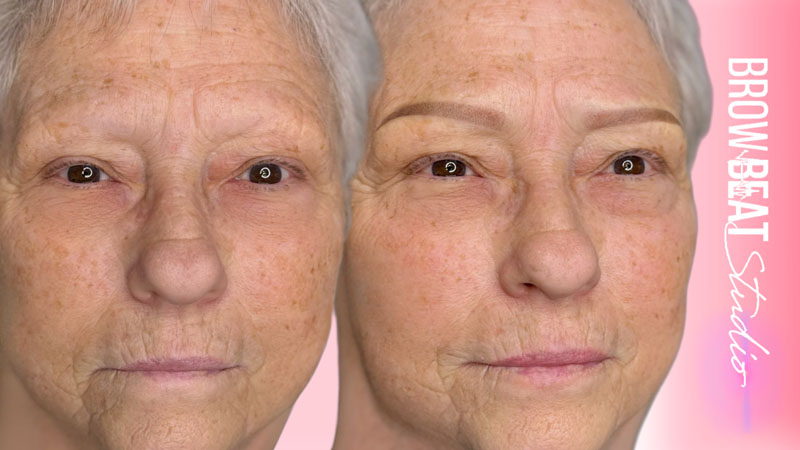
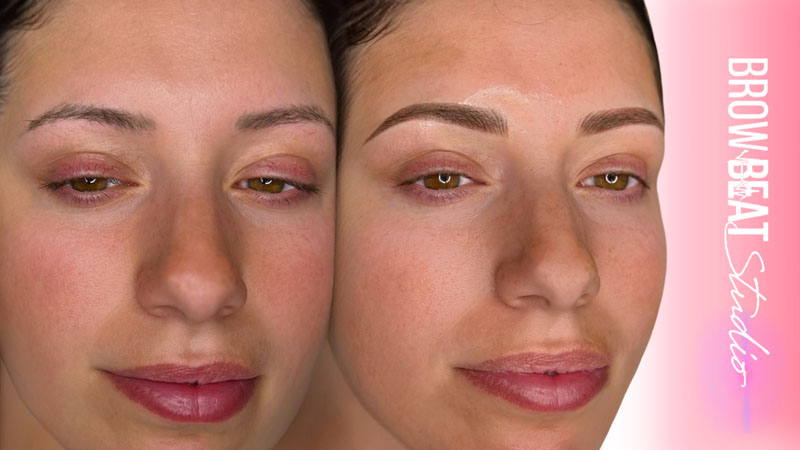
Your powder brows are finished. You look in the mirror and they are darker, sharper and more noticeable than the brows you walked in with.
That is the first thing to understand about healing: the brows you see immediately after your appointment are fresh brows, not healed brows.
Powder brows, ombré brows and microshading all begin with newly placed pigment and freshly treated skin. Over the days that follow, the skin recovers, the surface changes and the color begins settling into the softer permanent result underneath. There may be a few moments during that process when your brows look completely different from the day before.
Darker. Drier. A little shiny from ointment. Then flaky.
Maybe temporarily uneven while one area sheds before another. Then suddenly much lighter. And eventually softer and more settled.
None of those individual moments tells you what your healed brows will look like. You are watching a process, not a finished result.
Aftercare does not begin several days later when the brows start shedding. It begins while the skin is fresh.
During those first hours, freshly treated skin can release lymph. You may notice clear or slightly yellowish fluid on the surface of the brows. That is part of the body’s normal response after the skin has been worked.
What matters is what happens to that fluid while it is sitting on the surface. If lymph is repeatedly allowed to dry over freshly treated skin, it can contribute to crusting and thicker surface buildup.
That is why BrowBeat’s first-day aftercare includes washing. We are taking care of that surface activity while it is happening rather than waiting for dried material to accumulate and dealing with it several days later.
Because the skin does not finish releasing lymph the moment you wash it once. BrowBeat’s Day 1 protocol is four gentle washes at one-hour intervals.
You wash the brows. Then you leave them alone for an hour. During that break, the freshly treated skin has time to release additional fluid.
Then you wash again. And repeat. Those one-hour intervals are intentional.
The idea is not to stand at the sink continuously washing freshly treated eyebrows. It is to give the skin time between washes and then gently remove what has reached the surface before it repeatedly dries there.
Think of Day 1 as setting up the rest of the healing process. Take care of the lymph now so there is less drama later.
Lymph is part of the body’s normal response to treated skin. Seeing a little clear or slightly yellowish fluid after your appointment does not automatically mean something has gone wrong. The reason BrowBeat pays attention to it is simple: once that fluid dries, it can become part of the surface buildup that eventually has to shed. Managing it during those first hours can help keep the later healing stage lighter and easier to deal with.
This is one of the first concerns clients can have. You have just spent hours getting your eyebrows done, and now we are telling you to wash them. It can feel counterintuitive.
The pigment used to create your powder brows has been placed within the skin. BrowBeat’s washing protocol is intended to gently clean the surface. You do not need to preserve dried lymph on top of the eyebrow in order to preserve the permanent makeup underneath it.
Washing also does not mean scrubbing. This is freshly treated skin.
Be gentle. No scratching. No picking.
No aggressive rubbing. No trying to remove something that is still attached simply because you can see it.

If you have fair skin and naturally light eyebrow hair, freshly completed powder brows may look especially noticeable at first. The contrast between your complexion and newly placed pigment can make even a carefully planned soft brow feel surprisingly bold. This doesn’t automatically mean the color is too dark or the design is too strong. Your eyes are adjusting to a new appearance while the skin begins its recovery. The pigment will also go through visible changes as the treated surface settles. What matters is allowing the healing process to progress rather than judging the result by its first-day contrast.
Two mature clients can receive microshading and experience very different recovery patterns. One may notice relatively little visible flaking, while another experiences more dryness or temporary sensitivity. Skin condition, medications, treatment details and individual recovery all matter more than age alone. If you’re receiving machine-shaded brows later in life, don’t assume that your skin must follow a particular healing schedule simply because you’re over 50 or 60. Continue following the aftercare provided for your treatment and allow the skin to progress naturally. Unusual or worsening symptoms deserve individual assessment rather than being attributed automatically to age.


BrowBeat’s special aftercare routine ends on the morning of Day 12 when the skin is ready, but that doesn’t mean the permanent pigment must have reached its final appearance. The skin can continue recovering beyond the most visible surface changes, and the shading may appear softer or more consistent as that happens. This is why judging pigment retention immediately after peeling can be misleading. Give the treated area sufficient time before deciding how much permanent color remains. The aftercare schedule provides a practical milestone, while the appearance of the pigment follows an individual recovery process.
On medium-melanin skin, the appearance of fresh powder shading is influenced by natural skin coloring, existing eyebrow hair and the pigment selected for the treatment. Temporary redness may be visible in some areas and less noticeable in others. That doesn’t mean the underlying recovery process is fundamentally different from someone with a lighter complexion. Skin texture, sensitivity and individual response still matter. Avoid comparing your eyebrows with someone else’s healing photographs as though both should show identical color changes. The important consideration is whether your own recovery is progressing appropriately while you follow the recommended aftercare.


Fresh permanent eyebrow pigment doesn’t create identical visual contrast across every complexion. On deeper skin tones, the relationship between natural brow hair, skin coloring and selected pigment influences how the shading appears immediately after treatment. Redness may also be less visually obvious on some deeply pigmented skin, even when the tissue has undergone the same type of procedure. That doesn’t mean recovery is automatically faster or easier. Every client’s skin responds individually. The important thing is to follow the aftercare provided for your treatment rather than comparing your appearance with someone whose complexion and natural brows are very different.
You may find powder / ombre / microshading brows instructions online telling clients never to let their eyebrows get wet. That is not BrowBeat’s Day 1 protocol.
We intentionally have you wash the brows four times at one-hour intervals because we want to manage lymph while the freshly treated skin is releasing it.
Different permanent makeup artists can use different aftercare systems, which is exactly why combining instructions from several websites, social-media posts and artists can become confusing. After your BrowBeat appointment, follow the BrowBeat instructions provided for your treatment.
Fresh powder brows generally look stronger than they will once healed. Understanding what powder / ombre / microshading brows actually are helps with understanding how they look immediately after treatment.
The color is newly placed, the shape can look particularly crisp and the density may feel more noticeable. If you previously had light, sparse or less defined eyebrows, simply seeing a complete brow on your face can make the difference feel even larger.
That first mirror check is not a preview of exactly how dark or crisp your brows will remain. It is the beginning of healing.
Fresh pigment has more visual intensity than healed pigment, and you are also looking at freshly treated skin. This can be particularly surprising when you requested a very soft powder result.
You may look at the fresh eyebrow and think: “That is more brow than I expected.”
Give it time. Soft powder brows still begin as fresh powder brows.
Yes. The gradient has already been created, but the entire eyebrow is still fresh.
The front may contain less density than the body and tail while still looking stronger than it eventually will.
The delicacy of the healed gradient becomes easier to appreciate once the skin and pigment have settled.
It can. Fresh microshading is newly placed machine shading in freshly treated skin, so the early result can look stronger and more defined. That initial intensity softens as the treatment area heals.
Not every reaction to fresh permanent makeup is about pigment. Sometimes your brain is simply seeing your face differently.
If you spent years looking at a brow tail that disappeared, it is suddenly there. If one eyebrow was always lighter, both brows may now look much more balanced. If you rarely filled your eyebrows, there is suddenly permanent color where you are accustomed to seeing more skin.
Even a beautifully designed brow can feel surprisingly present during that first look. Give your eyes time to catch up with your eyebrows.
The skin around freshly treated brows may appear red or feel tender after the procedure. How noticeable that is varies.
One client may show very little visible redness. Another may show more. The area can also simply feel more noticeable than normal for a while. Individual skin does not respond identically just because the same type of permanent makeup was performed.
You can find permanent makeup healing charts online that make the process look incredibly precise. Day 3: this. Day 5: this. Day 7: this.
Real skin is less interested in following an infographic. One client may begin shedding earlier.
Another may hold onto a thin surface layer a little longer. One section of an eyebrow may begin changing before another. Even your two brows do not necessarily move through every stage in perfect synchronization.
There is a healing sequence. There is not one universal stopwatch.
Once you have completed BrowBeat’s four first-day washes, the active routine becomes much simpler. The skin now begins moving through the visible stages of recovery.
The brows may remain strong for a while. Then they can begin feeling drier. A thin surface layer may start changing. Flaking or shedding may appear.
And as that surface releases, the color underneath can suddenly look much lighter than you expected. These changes are connected. They are not a series of separate eyebrow emergencies.

After the Day 1 washing routine, BrowBeat clients continue with the recommended ointment through Day 11. Use it as directed and then leave the area alone.
You do not need to keep touching the brows to check them. You do not need to add more ointment to one section simply because it looks lighter. And you do not need to introduce new products every time the brows change.
Follow the aftercare you were given. Doing the simple things consistently is far more useful than doing ten extra things because the internet suggested them.
There is no single day that applies to every client. As the treated surface recovers, you may notice dryness, small flakes or a thin layer beginning to release.
One section may start before another. The entire eyebrow does not necessarily peel away in one neat sheet. Because the permanent shading sits beneath a changing surface, the brow can temporarily look uneven while this is happening.
This is one of the reasons BrowBeat pays so much attention to Day 1. When lymph is gently removed during those first four washes rather than repeatedly drying over the treated area, there can be less surface buildup waiting to shed later.
Many BrowBeat clients therefore experience lighter shedding than the dramatic permanent makeup healing photographs they may have seen online. Sometimes the brows become dry and lightly flaky. Sometimes there is a thin surface film. Sometimes there is surprisingly little visible drama at all.
The goal is not to stop the skin from healing. It is to support a cleaner healing experience.
Not every client experiences obvious dry peeling. Sometimes the surface looks softer or slightly gooey as a thin healing layer begins releasing.
That can look strange if you were expecting neat little flakes. Leave it alone. It is part of the changing surface, not something you need to manually clean away because it looks untidy.
This sounds obvious until there is one tiny lifted edge sitting directly above your eye all day. It can be tempting. Don’t.
A piece being loose at one edge does not necessarily mean the entire piece is ready to release. If it is ready to come away, it will. Your fingernails do not get a vote.
Do not scratch the brows because they feel dry either. Use the recommended ointment as directed and allow the skin to complete the process naturally.
Because the entire surface does not necessarily shed at exactly the same time. If one section has released its surface layer while the area beside it has not, you are looking at two different stages of healing inside the same eyebrow.
The newly revealed area can look lighter beside skin that is still covered by the remaining healing layer. That temporary contrast does not automatically mean the permanent shading underneath has healed patchy.
Your eyebrows may look like a pair, but biologically they are still two separate areas of living skin. One brow may begin shedding before the other.
One front may temporarily look lighter. One side may simply appear a little further along. Let it.
Do not pick at the slower eyebrow to make them match. A slightly different healing pace does not mean they cannot finish as a balanced pair.
This is one of the stages that can worry clients most. For several days, you have been waiting for the darker fresh color to soften.
Then it does. And suddenly you may think it softened far too much. The contrast can be startling because you are comparing newly revealed healing skin with the stronger fresh brow you became accustomed to seeing.
Do not immediately assume the pigment disappeared. The brow is still settling.
“Ghosting” is a term sometimes used for that lighter-looking stage after the stronger surface appearance has shed. The name sounds more dramatic than the experience needs to be.
The brow can temporarily appear much softer while the skin continues recovering. Give it time before deciding how much permanent color remained.
The front was intentionally created with less density. During the lighter-looking stages of healing, that section can therefore appear particularly faint.
That does not mean somebody forgot to shade the front. You are looking at the lightest part of a gradient while the entire eyebrow is still healing. Wait until the front, body and tail have all settled before judging how the gradient healed.
Microshading belongs to the same broader machine-shading family. The fresh color begins stronger, the surface changes, shedding may occur and the shading underneath can temporarily appear lighter. The complete result becomes much easier to assess once the skin settles.

You may have seen a powder brow healing chart claiming that every client peels on Day 4 or looks lighter on Day 7. Real skin isn’t that predictable. Some people experience early flaking, others notice a thin surface layer, and some have very little visible shedding. Even your two eyebrows may progress at slightly different speeds. A healing timeline is useful for understanding what might happen, but it isn’t a rigid schedule your skin must follow. At BrowBeat Studio Dallas, our aftercare instructions provide a consistent routine while allowing for normal differences in individual recovery.
Mild itching can occur as the treated eyebrow skin begins recovering, particularly when the surface becomes dry or starts flaking. It’s understandable to want to scratch, but fingernails can disturb the healing area and introduce unnecessary irritation. Follow your ointment instructions rather than applying random products or rubbing the brows for relief. Itching should not become an excuse to remove attached skin. If discomfort is severe, worsening or accompanied by unusual swelling, spreading redness or discharge, seek appropriate medical guidance. Normal recovery may be mildly uncomfortable, but concerning symptoms deserve attention.


Your eyebrows may go through several appearances during recovery: darker, drier, flaky, temporarily uneven and eventually softer. The changes can feel complicated, but BrowBeat Studio Dallas’s aftercare routine is intentionally straightforward. Complete four gentle washes at one-hour intervals on Day 1. Use your recommended ointment as directed through Day 11, and leave attached healing skin alone. On the morning of Day 12, return to your normal routine when the treatment area is ready. The goal isn’t to control every visible change. It’s to care for the skin appropriately and allow the permanent shading to settle.
On high-melanin skin, the signs of temporary irritation after microshading may not appear as bright pink redness. You might notice warmth, tenderness, swelling or a subtle change in the skin’s appearance instead. This is why the absence of obvious redness doesn’t automatically mean the treatment area is unaffected. Pay attention to how your skin feels as well as how it looks. Mild early sensitivity should improve, while increasing pain, spreading swelling or unusual discharge requires medical attention. Every complexion deserves the same careful aftercare, even when visible recovery signs appear different.

Permanent makeup photographs can make it feel as though eyebrows are supposed to look camera-ready at every stage. They are not.
There may be a few days when the texture is visible. One section may look lighter. There may be a little film over part of the shading. The ointment may make the brows look shiny.
You may have an event and wish the entire process would hurry up. Healing does not reorganize itself around your dinner plans.
Your brows do not need to win a beauty contest halfway through recovery. They need to heal.
Yes. BrowBeat’s protocol intentionally includes washing on Day 1. That does not mean prolonged soaking is part of healing.
There is an important difference between gently washing freshly treated brows according to your aftercare instructions and repeatedly saturating the area unnecessarily. Once the four Day 1 washes are complete, continue protecting the healing skin while you move through the remainder of BrowBeat’s aftercare routine.
Yes, you can still shower while your eyebrows are healing. The goal is to be mindful of the treated area rather than behaving as though your entire face has become untouchable.
A normal shower is different from deliberately soaking your eyebrows for a prolonged period. Be gentle around the brows and avoid unnecessary rubbing, prolonged moisture and direct pressure against the healing skin.
Yes. You still need to care for the rest of your face. Work thoughtfully around the healing brow area and follow the specific aftercare you were given.
Do not turn your normal face-washing routine into vigorous rubbing or exfoliation over freshly treated permanent makeup. Healing requires care, not panic. You do not need to spend eleven days behaving as though one accidental droplet will erase your eyebrows.
While the brow area is actively healing, keep conventional makeup off the treated skin and allow it to recover. This is particularly important while the surface is flaking, peeling or releasing its healing film.
If one area temporarily looks lighter, do not cover the healing skin with brow pencil, powder or concealer simply because you want the color to look even again. Let the brow finish healing before treating it like ordinary skin.
You can still get ready and wear makeup on the rest of your face. Just be conscious of where the healing treatment area begins. Foundation, concealer, brow products and makeup removers do not need to be dragged across freshly treated skin. Give the brows their space while they recover.
Not directly over the healing treatment area. Your normal skincare may contain ingredients designed to exfoliate, renew or actively treat the skin.
Those goals are very different from what we are trying to accomplish over freshly shaded brows. During BrowBeat’s healing routine, keep the brow area simple and follow the aftercare you were given rather than layering your usual skincare products over it.
Keep retinol and exfoliating products away from the treated brow area during healing. These products are designed to influence skin turnover. Fresh permanent makeup is already moving through its own recovery process.
If the surface looks dry, the answer is not a scrub. If there is a thin film, the answer is not an exfoliating acid. If the brows are shedding, the answer is not to make them shed faster. Let the skin complete the process naturally.

During healing, think about what a hard workout can bring with it. Sweat. Heat. And often repeated wiping around the forehead and eyebrows.
The concern is not exercise as an abstract activity. It is what happens to freshly treated skin during that activity. During BrowBeat’s healing period, avoid the kind of exercise that leaves sweat running across the treatment area or has you repeatedly wiping your forehead and brows.
Once you return to your normal routine on the morning of Day 12, you can return to your normal exercise routine as well.
Sweat adds moisture to healing skin and often leads to something people do without thinking: wiping.
A hard workout can leave you repeatedly touching your forehead and eyebrow area. During healing, we want that treatment area calm rather than continually exposed to sweat, heat and friction.
Wait until BrowBeat’s healing routine is complete before returning to swimming. A swimming pool is not comparable to the controlled gentle washing used on Day 1.
Swimming means prolonged water exposure to healing skin, often with pool chemicals involved. Once you reach the morning of Day 12 and return to your normal routine, swimming can become part of normal life again.
Give the brows the same healing period before returning to prolonged heat, steam and moisture. Freshly treated skin does not need those additional variables while it is recovering. Through Day 11, keep the area calm. Morning of Day 12, return to normal.
Freshly treated skin should be protected from unnecessary sun exposure while it heals. Right now, the immediate concern is simple: you have a healing treatment area.
Do not turn a fresh permanent makeup appointment into a tanning day. Once the initial healing period is complete, sun protection remains useful for your skin and for maintaining permanent makeup over the longer term.
During the active healing stage, follow BrowBeat’s brow aftercare rather than adding your normal skincare products directly over the treated area. Once you return to your normal routine on the morning of Day 12, normal skincare and sun protection can become part of your routine again.
You do not need to spend the night terrified of moving. The main idea is to avoid unnecessary rubbing and friction against freshly treated skin.
If you normally sleep with your face pressed firmly into a pillow, be conscious that you have healing skin above your eyes. Try not to repeatedly grind the treatment area into fabric. Beyond that, sleep.
Leave it alone while the brow is still healing. A light-looking area is not a request for extra ointment, makeup, rubbing or investigation.
If one section has already shed while the surrounding surface has not, the contrast alone can make that area look unusually light. Let the complete brow settle before deciding what permanent color remained.
Ointment can give the surface a temporary sheen. That does not mean your healed powder brows will have a shiny finish. You are looking at healing skin with aftercare product on it, not the final texture of your permanent makeup.
That can happen. Not everybody experiences dramatic visible shedding. Some clients notice a little dryness or a thin film and very little else.
If your healing is relatively uneventful, you do not need to search for a problem simply because somebody else’s brows flaked more than yours. Your skin gets to do its own version of healing.
Visible shedding can vary too. The important thing is not to interfere with skin that is still attached. Continue following your aftercare and allow the surface to release naturally rather than trying to control how the brow looks from one day to the next.
Continue using the ointment as directed through Day 11. Even if the brows look considerably calmer before then, stay with the protocol rather than deciding the healing routine is finished simply because the surface looks better.
The routine has an endpoint. You do not need to invent an earlier one.
This is the easy milestone to remember. Morning of Day 12: back to normal.
You have completed the Day 1 washes. You have used the ointment through Day 11. You have allowed the surface to change and shed without picking at it.
Now BrowBeat’s special aftercare routine is complete and you can return to your normal day-to-day routine. You do not need to keep babying your eyebrows forever.
There is a lot to explain about what your eyebrows may look like while they heal. The actual routine is much easier to remember.
Day 1: four gentle washes, one hour apart.
After Day 1 through Day 11: use the ointment as directed and leave the healing surface alone.
Morning of Day 12: return to normal.
Everything else comes back to protecting the treatment area while your skin does its work.
By the time the active healing stage is behind you, something important changes. You stop watching your eyebrows every day. The surface is no longer the story. The flaking or thin film has passed.
The ointment routine is finished. The fresh intensity has softened. And what remains is much closer to the powder, ombré or microshaded result you will actually wear. This is when it finally makes sense to stop asking, “What are my brows doing today?” and look at the eyebrow as a whole again.
Healed powder brows look softer than fresh powder brows. The treatment-day intensity has settled. The edges generally feel less severe. The permanent shading begins integrating more naturally with the client’s existing eyebrow hair and features.
This is why healed photographs are particularly useful when deciding whether you like machine-shaded brows. The fresh photograph shows where the procedure started. The healed photograph shows what the client actually lives with.

Softening is expected. Vanishing is not the objective.
If the brow was created to provide visible density, the healed result should still provide useful permanent color. If the design was intended to feel more defined, that definition should still be present after the fresh intensity settles. If an extremely soft powder effect was chosen, that softness becomes easier to appreciate once healing is complete. The goal was never to create a beautiful eyebrow for one afternoon and then watch the entire idea disappear.
Once healed, the ombré gradient becomes much easier to read as one complete eyebrow. The front settles into its softer role. The body carries more visible density. The tail provides greater definition.
Those areas should work together rather than looking like three separate blocks of color. Once the entire surface has settled, the relationship between those different densities becomes much clearer.
Microshading makes the same broader transition from fresh machine shading into settled permanent color. The initial intensity softens and the shading begins looking more integrated with the natural brow. How subtle or defined that result appears depends on what was originally designed. Microshading does not have one mandatory healed density.
Place fresh and healed photographs beside each other and the transition becomes much easier to understand.
Fresh brows can look darker. Sharper. More obviously “done.”
Healed brows have had time for both the skin and color to settle. The result becomes softer and more wearable.
That difference is not the permanent makeup failing. It is the permanent makeup healing.
The most visible healing happens during the days following treatment, with BrowBeat’s dedicated aftercare continuing through Day 11 and normal routine resuming on the morning of Day 12. That does not mean every client’s skin completes every part of recovery at exactly the same hour.
One client may finish visible shedding earlier. Another may have a little surface change lingering longer. Day 12 is the end of BrowBeat’s special aftercare routine, while the color and skin can continue feeling increasingly settled afterward.
Ombré brows move through the same broad machine-shading healing process. They begin stronger, the surface changes, shedding may occur, temporary lightness can appear and the gradient becomes easier to assess once everything settles. The softer front does not require a separate healing calendar from the rest of the eyebrow.
Microshading follows the same general recovery pattern because it is also machine-shaded permanent brow work. The exact visible timeline can vary, but the overall progression remains familiar: fresh shading, changing skin, surface release, temporary softening and then a more settled result.
There is not one exact percentage that BrowBeat can honestly promise for every client.
Skin differs. Pigment color differs. Density differs. And the fresh appearance differs.
What we can say is that fresh machine shading is expected to settle into a softer permanent result. We would rather show clients real healed work than give them a universal percentage that pretends everyone’s skin behaves identically.
Once the brows have healed. Retention is not what an eyebrow looks like while one section is peeling and another is still covered by healing skin. It is what remains once the treatment has settled.
If an area still appears lighter after healing, that can then be evaluated as part of the actual healed result rather than guessed at during an intermediate stage. First let the brows heal. Then look at what is there.
Yes. Initial healing and long-term fading are two different kinds of change.
Once powder brows, ombré brows or microshading have healed, the permanent color can continue softening gradually over time. Skin characteristics, pigment color, sun exposure, skincare and individual retention can all influence that process.
Our How Long Do Powder, Ombré & Microshading Brows Last? guide explores that longer-term change in greater depth, including the factors that can influence retention after the initial healing period is complete.

You’ve just had your powder brows completed, and suddenly your eyebrows seem much stronger than you expected. That’s because you’re seeing newly placed pigment through freshly treated skin. The shape may look especially crisp, the color more concentrated and the overall density more noticeable. Even if you requested soft, natural powder brows, the first day’s appearance isn’t the final result. As your skin recovers, that initial intensity begins to change. At BrowBeat Studio Dallas, we want you to understand this early stage so you can enjoy your new eyebrows without expecting them to look exactly the same tomorrow.
Ombré brows are designed with a gradual transition in shading, but immediately after treatment, the entire eyebrow may appear more noticeable. The front can still be softer than the body and tail while looking stronger than you imagined. That’s because the pigment is fresh and the skin has just undergone cosmetic tattooing. As recovery progresses, the different areas begin to soften, allowing the gradient to become more apparent. Don’t judge the delicacy of your ombré effect during the first few hours. You’re seeing the beginning of a process that will continue changing over the days ahead.

You might expect powder brow peeling to begin with large, obvious flakes, but the earliest changes can be much smaller. The eyebrow surface may feel slightly dry, develop a fine texture or begin releasing tiny pieces of skin. These changes can occur gradually rather than all at once. You don’t need to encourage the process by rubbing or exfoliating. The skin is recovering from machine shading and will release its surface naturally. Continue using your recommended ointment as directed and allow the treated area to progress without interference.
It’s natural to become accustomed to the strong appearance of freshly completed powder brows, especially if your eyebrows were previously sparse or lightly colored. As the skin recovers, the initial intensity softens, and that change can feel dramatic. But a softer appearance doesn’t automatically mean the brow has lost its intended definition. Powder shading can remain visible without looking as crisp or dark as it did immediately after treatment. Allow the recovery process to finish before deciding how much permanent color remains. Fresh intensity and lasting cosmetic definition are not identical things.


The purpose of powder brows isn’t to remain as dark as they looked immediately after the appointment. The freshly treated surface and newly placed pigment create a stronger initial appearance that changes during recovery. As the skin settles, the shading can appear softer while still providing visible eyebrow density. That balance depends on the original design, pigment selection and individual response. If you requested a gentle powder effect, the softer appearance may be exactly what you were hoping to see. Allow the recovery process to finish before deciding how much definition the permanent shading provides.
A future refresh is about maintaining permanent makeup after it has healed and gradually softened over time. There is no single calendar date when every client suddenly needs more color. How the brows age, how much pigment remains and how the client prefers them to look all matter when considering future maintenance.
Day 1: wash the brows four times at one-hour intervals, allowing time between washes for lymph to reach the surface before gently removing it.
After Day 1 through Day 11: use the ointment as directed, protect the healing treatment area and allow any flaking or thin surface film to release naturally.
During healing: expect the appearance to change. Fresh brows may begin strong, become dry or flaky, temporarily appear uneven or surprisingly light and then gradually settle.
Morning of Day 12: return to your normal routine.
Then allow the permanent color to continue settling before making conclusions about the healed result.
Powder Brow Healing Is a Transition, Not a Series of Emergencies
Too dark can simply mean fresh. Flaky can simply mean healing. A thin film can be part of healing.
Temporary patchiness can mean different sections of skin are healing at different speeds. And suddenly looking too light can be part of healing too.
None of those moments should be pulled out of the middle of the process and treated as though it represents the final permanent result. Give the brows enough time to finish what they are doing.
Let the Brow Finish the Story
You started with fresh machine shading. You managed the early lymph with four gentle washes. You gave the skin
You watched the fresh color begin to soften. You allowed the surface to change without picking at it. You used the ointment through Day 11.
You returned to your normal routine on the morning of Day 12. And somewhere through that process, the brows stopped looking like freshly completed permanent makeup and started looking like part of your face.
That is what healing is supposed to accomplish. Not a perfectly predictable eyebrow every morning. Not an identical timeline for every client. And certainly not eleven days spent panicking over every flake, light spot or change in color.
The goal is to care for freshly treated skin appropriately, leave it alone when it needs to be left alone and give the permanent shading underneath enough time to settle. Fresh brows are the beginning. Healed brows are the result.

BrowBeat Studio Dallas clients follow dedicated aftercare through Day 11 and return to their normal routine on the morning of Day 12. Visible shedding and color settling can vary from client to client.
Ombré brows follow the same general healing process as other machine-shaded brows. The color begins stronger, the surface changes and the gradient becomes easier to evaluate once the complete brow has settled.
Microshading follows the same general machine-shading recovery process. BrowBeat’s dedicated aftercare continues through Day 11, with normal routine resuming on the morning of Day 12.
Fresh powder brows usually look darker and more defined because the pigment is newly placed and the skin has just been treated. The color and overall appearance soften as the brows heal.
Yes. Fresh ombré brows can look stronger than the healed result even though the front was created with less density. The gradient becomes softer and easier to appreciate after healing.
BrowBeat clients wash their brows four times on Day 1, with one hour between each wash. The intervals give additional lymph time to reach the surface before it is gently removed.
Freshly treated skin can release lymph. BrowBeat’s Day 1 washing routine helps remove that fluid before repeated drying can contribute to thicker surface buildup and crusting.
BrowBeat’s Day 1 protocol uses gentle surface washing rather than scrubbing or exfoliation. Follow the washing technique provided with your aftercare instructions and avoid aggressive rubbing.
Not every client develops thick scabs. Some powder brows lightly flake, some develop a thin healing film and others have relatively little visible shedding.
There is no single day that applies to everyone. As the treated skin recovers, dryness, light flaking or a thin surface layer can begin appearing at different times for different clients.
Some brows develop a thin healing surface layer instead of obvious dry flakes. Allow that film to release naturally rather than wiping, peeling or picking it away.
No. A lifted edge does not necessarily mean the entire piece is ready to release. Leave attached healing skin alone and allow it to come away naturally.
Different sections of the brow can shed at different times. A newly revealed area may look lighter beside skin that has not shed yet, creating temporary patchiness during healing.
Your brows are two separate areas of skin and do not have to move through every healing stage simultaneously. One side can shed or soften sooner without automatically indicating a problem.
Newly revealed healing skin can make the permanent shading appear surprisingly light after shedding. Give the skin and pigment time to settle before judging the final color.
Powder brow ghosting describes a temporary lighter-looking stage that can occur after the stronger surface appearance sheds. The healed color is easier to evaluate once the skin has settled.
The front of an ombré brow contains less density by design. During a lighter healing stage, that section can appear especially faint before the complete gradient settles.
BrowBeat clients use their recommended ointment as directed through Day 11. The special aftercare routine ends on the morning of Day 12.
Yes. BrowBeat intentionally has clients gently wash fresh brows on Day 1. Controlled washing is different from prolonged soaking or repeatedly saturating healing skin.
Yes. You can shower while your powder brows heal, but avoid prolonged soaking, rubbing and unnecessary direct pressure on the treated area during BrowBeat’s healing routine.
Yes. Continue washing the rest of your face while working carefully around the treated brows. Avoid vigorous rubbing, exfoliation and active skincare directly over healing skin.
You can wear makeup elsewhere on your face, but keep conventional makeup off the actively healing brow area. Do not cover temporary light or uneven areas with brow products while the skin is recovering.
Keep retinol, exfoliating acids and other active skincare away from the treated brow area during BrowBeat’s healing period. Normal skincare can resume when you return to your normal routine on the morning of Day 12.
During healing, avoid exercise that causes heavy sweating across the brows or repeated wiping and friction around the treatment area. BrowBeat clients return to their normal routine on the morning of Day 12.
Wait until BrowBeat’s healing routine is complete before returning to swimming. Prolonged water exposure is different from the controlled gentle washing used during Day 1 aftercare.
Wait until the healing period is complete before returning to prolonged heat, steam and moisture. With BrowBeat’s protocol, normal routine resumes on the morning of Day 12.
Healed powder brows generally look softer and less crisp than fresh brows. The shading becomes more integrated with the client’s natural eyebrow hair and facial features.
Healed ombré brows show a softer front transitioning into greater density through the body and tail. The gradient becomes easier to evaluate once the entire brow has settled.
Healed microshading appears softer and more integrated than fresh machine shading. The final density depends on the result designed for the individual client.
Judge color and retention after the active healing process is complete, not while the brows are flaking, shedding or temporarily appearing light. The settled brow provides a much more accurate picture of the permanent result.