If you have spent any time researching permanent eyebrows, you have probably seen several names that appear to describe remarkably similar brows.
Powder Brows.
Ombré Brows.
Ombré Powder Brows.
Microshading.
Machine Shading.
Powder-effect brows.
Pixel shading.
The terminology can make a relatively simple idea sound far more complicated than it is.
At BrowBeat Studio Dallas, we begin with one word:
Shading.
Powder Brows, Ombré Brows and Microshading all belong to the same broad family of machine-shaded permanent eyebrows.
The differences between the names generally describe the appearance of the shading, the way its density is distributed or the terminology an artist prefers to use.
They are not three completely unrelated permanent brow procedures.
Machine shading gives a permanent makeup artist a way to place controlled color through an eyebrow.
That color creates density.
At a very soft level, the shading can sit quietly behind natural eyebrow hair and make the brow easier to see.
Build more density and the eyebrow can take on a fuller powder finish.
Keep the beginning lighter and gradually increase the density through the body and tail, and the result develops the gradient commonly associated with Ombré Brows.
The same broad technique family can therefore produce very different finished eyebrows.
Powder Brows are permanent eyebrows created with machine shading.
Instead of constructing the visible brow primarily from individual hair-like strokes, the artist creates an area of permanent color through the eyebrow.
The word powder describes the visual idea.
Think about what happens when conventional brow powder is placed softly behind natural eyebrow hair.
The hair remains visible, but the skin underneath it carries color.
Gaps become less noticeable.
The eyebrow becomes easier to see as one complete feature.
The permanent procedure is obviously different from applying conventional makeup, but the comparison helps explain the finished effect.
This is the most useful thing to understand about the technique.
Powder Brows create density rather than relying on individual permanent hairstrokes to create the complete eyebrow.
That density can provide a soft background behind natural brow hair.
It can make a light eyebrow easier to see.
It can visually connect areas where natural growth looks inconsistent.
It can give a sparse tail more presence.
Or it can create the more polished filled-brow appearance some clients normally achieve with conventional makeup.
The technique does not determine one level of density.
The artist does.
No.
This is one of the biggest misconceptions surrounding Powder Brows.
Powder describes the use of shading.
It does not mean the eyebrow must be dark, solid or heavily filled.
Machine shading can be extremely soft.
More skin can remain visually present through the color.
Natural eyebrow hair can remain clearly visible.
The beginning can be kept light.
Or the shading can be developed further for someone who genuinely prefers a more defined brow.
Coverage and heaviness are not the same thing.
The powder effect is created when many small placements of pigment work together visually as an area of color.
From normal viewing distance, the eye does not focus on each individual pigment placement.
It reads the complete shaded eyebrow.
Where less density has been built, the brow looks softer.
Where additional shading has been layered, the color becomes more visible.
This ability to control density is what gives Powder Brows such a wide visual range.

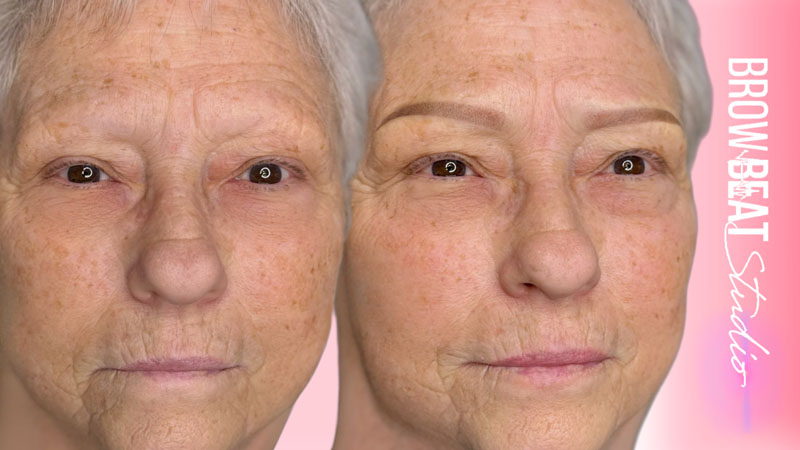
Clients between the ages of 60 and 80 choose BrowBeat Studio Dallas because we understand the unique needs of mature skin. This stage of life requires a different approach to semi-permanent makeup — one that prioritizes gentle techniques, controlled pigment placement, and natural-looking definition. From lighter complexions to high melanin skin tones, each powder brow and brow tattoo treatment is customized.
For clients in their 60s, 70s, and beyond traveling to BrowBeat Studio Dallas, fair powder brows require soft pigment layering and precise microshading control. Light beige and neutral ash tones are selected to enhance definition without overwhelming delicate mature skin. Our semi-permanent brow tattoo approach focuses on subtle structure and elegant blending, creating natural-looking results trusted by mature clients across the Dallas–Fort Worth area.

Cool gray powder brow tones are ideal for Dallas-area mature clients with silver or cooler hair tones. These pigments create clean structure while maintaining softness on aging skin. At BrowBeat Studio Dallas, microshading allows for even saturation and controlled layering, producing semi-permanent brow tattoo results that appear refined, subtle, and naturally blended across the DFW region.
Ombré Brows are also machine-shaded permanent makeup cosmetic tattoo.
The word ombré places more emphasis on how the density changes as it moves through the eyebrow.
The beginning is typically softer.
The shading gradually develops through the body.
The tail can carry greater definition.
Instead of the same visual weight from beginning to end, the brow moves through a gradient.
Ombré means transition.
At the beginning of the eyebrow, more skin may remain visually present through the shading.
Move farther through the brow and the permanent color becomes more noticeable.
By the tail, the result can be cleaner and more defined.
The transition can be pronounced or extremely subtle.
Some clients love an obviously airy front.
Others simply want enough softness to prevent the eyebrow from beginning abruptly.
Both can fall within an Ombré Brow approach.
Ombré Powder Brows combine two descriptions of the same machine-shaded brow.
Powder describes the shaded permanent color.
Ombré describes the gradient within that color.
So an Ombré Powder Brow is a powder-style permanent eyebrow in which the density generally moves from softer to more defined.
It is not a separate fourth permanent brow technique that clients need to add to the list.
Microshading is another common term for permanent eyebrow shading created with a permanent makeup machine.
The artist builds pigment through the eyebrow to create color and density rather than relying primarily on individual manual hairstrokes.
Microshading can be extremely soft.
It can be more defined.
It can include a gradient.
It can sit behind substantial natural eyebrow hair.
Or it can provide more visual support where natural growth becomes lighter.
The term tells you that shading is involved.
It does not tell you exactly what the finished eyebrow has to look like.
Often, the two terms describe very similar permanent brow work.
Some artists primarily use the name Microshading.
Others use Powder Brows.
Others use both terms for slightly different finishes within their own service menu.
There is no universal permanent makeup dictionary that every artist follows in exactly the same way.
At BrowBeat Studio Dallas, both terms belong to the same broad machine-shading family.
There can be considerable overlap.
Microshading describes machine-shaded permanent brow work.
Ombré describes how that shading can change in density through the eyebrow.
A microshaded brow can therefore be created with an Ombré effect.
The words describe different aspects of the same broader concept rather than requiring the client to choose between completely unrelated procedures.
The simplest answer is:
Powder Brows describe the shaded effect.
Ombré Brows describe a gradient within that shading.
Microshading describes the machine-shading approach.
There is substantial overlap between all three.
That is why photographs can look almost identical even when different artists have given the service different names.
Permanent makeup terminology has developed through different training systems, artists, brands and beauty trends.
One artist may have learned to call the service Microshading.
Another may primarily use Powder Brows.
Another may use Ombré Powder Brows because the gradient is an important part of her style.
Those naming differences are much less important than understanding what the artist actually creates.

You may see a photograph labeled Powder Brows and love it.
Then find an almost identical photograph labeled Microshading.
That does not mean you are missing an important technical distinction.
Look at the result instead.
How soft is the front?
How much color sits behind the natural hair?
How defined is the body?
How polished is the tail?
How much of the client’s skin remains visually present through the shading?
Those observations tell BrowBeat much more about what you want than the caption underneath the photograph.
Machine-shaded brows are permanent eyebrows created by using a permanent makeup machine to place pigment through the brow in a controlled pattern.
The pigment is built gradually rather than treating the eyebrow as one flat block of color.
This allows the artist to control how much density different parts of the brow carry.
Powder Brows, Ombré Brows and Microshading all sit within this machine-shading category.
Yes.
At BrowBeat Studio Dallas, all three refer to machine-shaded permanent brow work.
The permanent makeup machine is the tool used to build the shading.
How that tool is used determines the softness, density and gradient of the finished eyebrow.
The machine creates the shading. The artist creates the brow.
Very close photographs of machine shading may show many tiny placements of pigment.
These are sometimes described as pixels, which is why clients may encounter terms such as pixel shading, pixel brows or powder pixels.
Pixel shading does not need to become another permanent brow category for the client to decipher.
The individual pigment placements work together visually to create the complete shaded effect.
No. The intention is not for someone looking at your eyebrows from normal conversational distance to see individual dots.
The small pigment placements work together visually as a field of shading.
Extreme close-up photography may reveal more of the technical texture.
The client wears the finished eyebrow as a complete feature.
The fundamental distinction is straightforward.
Powder Brows, Ombré Brows and Microshading use machine shading to create density.
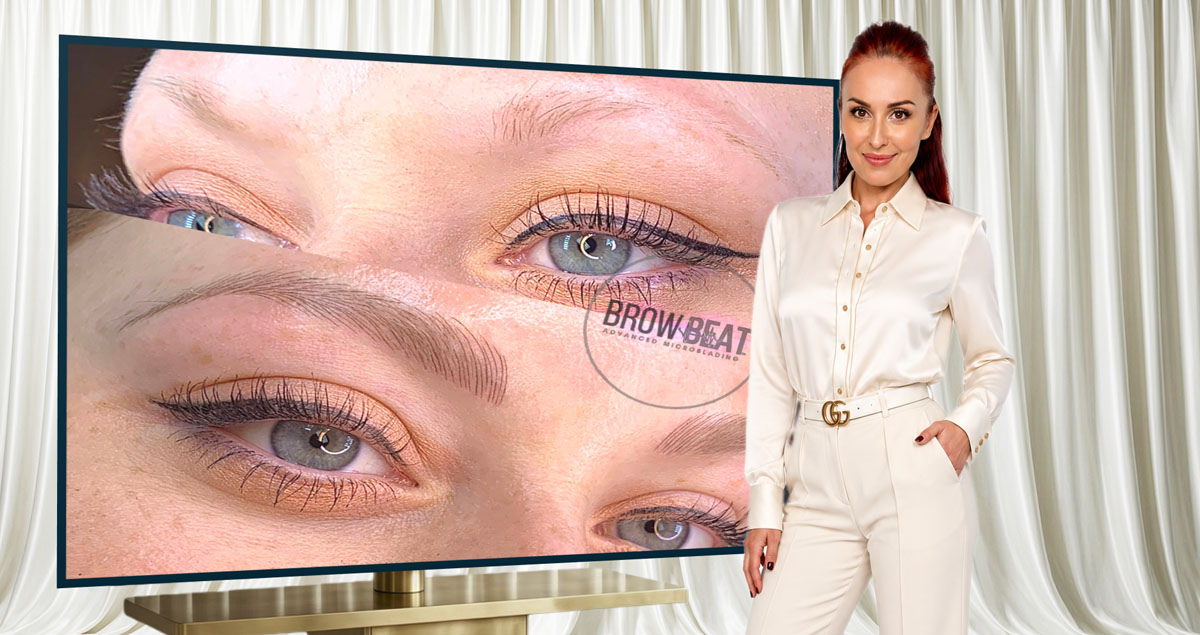
Microblading uses a handheld tool to create individual permanent hairstrokes.
One builds an area of shaded color.
The other builds hair-like lines.
Both can create beautiful permanent eyebrows, but they create their structure differently within the skin.
Yes. Powder Brows are a form of permanent makeup and cosmetic tattooing.
Pigment is placed within the skin rather than applied temporarily to its surface.
The visible result gradually softens and changes over time, but that does not make Powder Brows equivalent to conventional makeup that simply washes away.
Ombré Brows are permanent makeup.
The word permanent does not mean the eyebrow remains visually identical forever.
The shaded color gradually becomes softer over time.
A client who wants to maintain greater definition may eventually choose to refresh the result.

High melanin mature brows require specialized pigment selection and advanced microshading techniques. At BrowBeat Studio Dallas, carefully balanced brown tones are used to enhance depth while maintaining softness on aging skin. Semi-permanent brow tattoo application focuses on smooth transitions and even coverage, delivering elegant results trusted by mature clients across the Dallas–Fort Worth area.
Dark brown powder brows provide deeper structure for mature Dallas clients who prefer stronger definition without heaviness. Rich neutral brown pigments are applied using precise microshading to maintain softness on aging skin. BrowBeat Studio Dallas tailors each semi-permanent brow tattoo treatment to deliver smooth blending, refined shaping, and polished results trusted throughout the DFW metroplex.


Brown powder brows are a classic choice for Dallas clients ages 50–80 who want natural warmth and balanced enhancement. Medium brown pigments provide gentle contrast while preserving softness on mature skin. BrowBeat Studio Dallas uses layered microshading and semi-permanent makeup techniques to create brow tattoo results that remain timeless, wearable, and beautifully proportioned for DFW clients.
Dark brown powder brows provide deeper structure for mature Dallas clients who prefer stronger definition without heaviness. Rich neutral brown pigments are applied using precise microshading to maintain softness on aging skin. BrowBeat Studio Dallas tailors each semi-permanent brow tattoo treatment to deliver smooth blending, refined shaping, and polished results trusted throughout the DFW metroplex.

Yes. Microshading places pigment within the skin to create lasting eyebrow color.
The visible shading changes and becomes softer with time, but the procedure still belongs to permanent makeup and cosmetic tattooing.
The beauty industry frequently uses the phrase semi-permanent makeup because cosmetic tattoo pigment gradually fades and may be maintained over time.
At BrowBeat, we prefer clients to understand the more important point:
the procedure places pigment within the skin and should be approached as a lasting cosmetic decision.
Fading does not make it temporary makeup.
Once the terminology is clear, the service becomes much easier to understand.
Powder tells us we are creating a shaded effect.
Ombré tells us that the density can move through a gradient.
Microshading tells us that machine shading is being used.
None of those words decides exactly how light, defined or polished your finished eyebrow should be.
That comes from what we build with the technique.
Once the terminology is clear, the technique itself is fairly easy to understand.
A Powder Brow is not created by outlining an eyebrow and filling the entire shape with one solid level of color.
The permanent makeup machine allows the artist to build pigment gradually through the brow.
That gradual build gives us control.
One area can remain light.
Another can carry more color.
The beginning can stay soft.
The body can develop greater density.
The tail can become more defined.
The finished brow comes from how those different levels of shading work together.
Think of the shading as layers of color.
A lighter layer allows more skin to remain visually present.
Build additional density and the color becomes more noticeable.
Continue building selectively and the eyebrow gains greater definition without requiring every section to become equally strong.
This layered approach is what gives machine shading such a wide visual range.
Density describes how much visual color the permanent shading creates.
Lower density creates a lighter, more transparent effect.
Greater density creates a fuller, more filled appearance.
Density is not simply another word for dark.
A lighter pigment can still be built to create visible coverage.
A deeper pigment can be used with restraint.
Color and density work together, but they are not the same decision.
This is one of the biggest advantages of machine shading.
The artist can distribute permanent color according to what different parts of the eyebrow need.
The front may remain light.
The body may need more coverage.
The tail may carry greater definition.
An area with substantial natural brow hair may need less permanent color than an area where the hair becomes sparse.
That variation prevents the eyebrow from becoming one flat block of identical density.
A soft Powder Brow is created by controlling how much permanent density is built.
More skin remains visually present through the shading.
Natural eyebrow hair continues to contribute strongly to the finished result.
The permanent color acts more like a background than a dominant layer.
Soft does not mean unfinished.
It means the intended density is restrained.
Softness and structure are not opposites.
A lightly shaded brow can still have a visible tail.
The lower portion of the brow can still feel clean.
The two eyebrows can still feel balanced.
The client can still wake up and see a complete eyebrow.
The difference is simply how much permanent color is being used to create that structure.
A more defined Powder Brow is created by building greater density.
The permanent color becomes more visually present.
The overall shape becomes easier to see.
The result can move closer to the polished appearance a client normally creates with conventional brow makeup.
Even then, every part of the eyebrow does not need to carry the same visual weight.
A client may want a clearly filled eyebrow without wanting one uninterrupted block of color.
The front can remain softer.
Natural hair can remain visible.
The body can carry greater coverage.
The tail can finish cleanly.
The eyebrow can have substantial definition while still having dimension.
An Ombré Brow is created by changing the density as the shading moves through the eyebrow.
The beginning carries less permanent color.
The density gradually increases through the body.
The tail can carry the strongest definition.
The important word is gradually.
There should not be a visible line where the soft section suddenly stops and the defined section begins.
The shading transitions.
The beginning of the eyebrow sits close to the center of the face.
It also commonly contains natural brow hair that already gives the area texture.
Keeping the permanent density lighter there allows the brow to begin more gently.
That softer entry can prevent the front from feeling visually heavy while still allowing the complete eyebrow to have plenty of definition.
As the brow moves away from the front, the shading can begin doing more work.
Additional density gives the body greater visual continuity.
This is often where machine shading begins making gaps between natural hairs much less noticeable.
The amount of color depends on the result being created.
A subtle Ombré Brow may increase very gradually.
A more polished result may develop greater density sooner.

Natural eyebrow hair frequently becomes finer or less dense through the tail.
That makes it an area where permanent shading can contribute considerably.
Greater density can give the eyebrow a clean ending and keep the tail visually connected to the rest of the shape.
The tail can therefore be the most defined part of an Ombré Brow without requiring the front to match it.
No.
Some clients love a pronounced gradient with a very airy beginning.
Others want a more consistently filled eyebrow with only enough softness to keep the front from feeling abrupt.
Both use changes in density.
The difference is how noticeable the gradient becomes.
Yes.
Not every Powder Brow needs a dramatic Ombré transition.
A client may prefer more consistent density through the eyebrow while still keeping the very beginning appropriately soft.
This is another reason Powder and Ombré terminology overlaps.
We are adjusting the distribution of machine shading rather than changing to a completely unrelated technique.
Microshading uses the same broad layered principle.
The permanent makeup machine places pigment through the eyebrow and the artist gradually develops the amount of color needed for the intended result.
The shading can remain sheer.
It can be built further.
It can transition from softer to more defined.
The word Microshading does not require one particular density or finish.
At very close range, fresh machine shading is made from many small pigment placements rather than one continuous painted surface.
Those placements collectively create the visible powder effect.
The artist controls where they are built more densely and where they remain lighter.
At normal viewing distance, the eye reads the complete shaded brow rather than the individual technical components used to create it.
Because the shading is built from controlled pigment placements and changing density.
There can be more transparency in one area and greater coverage in another.
Natural eyebrow hair also remains part of the visual result.
That combination allows modern machine shading to create dimension rather than requiring one flat level of color throughout the brow.
The word pixels is sometimes used to describe the tiny pigment placements visible in close-up machine-shading work.
It is useful technical language, but it does not describe another completely different permanent brow service.
Those small placements are simply working together to create the shaded effect.
The finished goal is not for someone looking at your eyebrows normally to see a collection of dots.
The pigment placements work together visually as shading.
Extreme close-up photography may reveal technical texture that is not noticeable when the eyebrow is viewed as part of the face.
There is no automatic Ombré setting that designs the brow.
The permanent makeup machine is the tool used to place pigment.
The artist creates the gradient by deciding where to build more density and where to remain lighter.
The same is true of softness.
The machine does not know what “soft” means for a particular client.
The artist has to create it.
The ability to build additional density does not mean additional density should always be added.
A soft brow reaches a point where it has enough.
A more defined brow reaches a point where it has enough too.
The goal is not to place as much pigment as possible.
The goal is to build the amount of shading the eyebrow actually needs.
The permanent color is not being created on an empty surface.
Natural eyebrow hair is already contributing texture, color and visual weight.
A section with substantial natural hair may look complete with relatively light shading underneath it.
An area where the hair becomes sparse may need more permanent density to carry the same visual weight.
That means equal shading everywhere does not necessarily create a balanced result.
A client can have plenty of real eyebrow hair and still feel that her brows look unfinished.
The hairs may be separated.
They may be light.
The skin underneath them may be highly visible.
In that situation, the missing element may not be more hair-like lines.
It may simply be background density.
Machine shading can provide that color while allowing the natural hair to remain the texture of the eyebrow.
Wiry eyebrow hair already creates strong linear texture.
Adding more permanent lines underneath it does not necessarily solve the visual problem.
Soft shading can connect the spaces between those hairs and give the eyebrow greater continuity.
The natural hair remains visible.
The permanent color gives it a more consistent background.
A client may have substantial natural hair through the front and body but very little through the tail.
The permanent shading does not need to ignore that difference.
Density can be adjusted so the lighter section receives more visual support while the fuller areas remain softer.
The technique responds to the brow rather than requiring the brow to conform to one shading formula.
Because technique is only one part of the finished result.
Natural eyebrow hair changes what you see.
Density changes what you see.
Pigment color changes what you see.
Skin tone changes how that color is perceived.
Shape changes the result.
And the client’s preferred amount of definition changes what the artist is trying to create in the first place.

This is the point worth remembering.
A very soft Powder Brow and a polished, highly defined Powder Brow can both come from machine shading.
An Ombré Brow can have an obvious gradient or one that is barely noticeable.
Microshading can create subtle background color or considerably more visible density.
The technique gives the artist a range.
The result comes from how that range is used.
Instead of asking whether Powder, Ombré and Microshading are three completely different procedures, think about what the machine is actually allowing the artist to control.
How much permanent color?
Where should that color be strongest?
Where should it remain softer?
How should the density transition through the eyebrow?
Those decisions create the finished shaded brow.
That is the technical foundation underneath Powder Brows, Ombré Brows and Microshading.
The machine gives the artist a controlled way to place permanent pigment.
Layering creates density.
Changes in density create softness, coverage and gradient.
And natural brow hair remains part of what the artist is working with throughout.
Once that is understood, the next question is not how the machine works.
It is how the artist decides what shape, color and amount of shading should belong on a particular client.
Once we understand how machine shading works, another distinction becomes important.
The technique gives BrowBeat Studio Dallas a way to create permanent density.
It does not decide the shape.
It does not decide the color.
It does not decide how soft or defined the finished eyebrow should be.
And it does not decide which parts of your natural brow already work beautifully and should simply be left alone.
Those decisions turn machine shading into an individual permanent eyebrow.
Natural eyebrow hair is part of the design.
We look at where it begins.
Where it grows densely.
Where it becomes lighter.
Whether the tail loses definition.
Whether one brow naturally carries more hair than the other.
And which parts of the eyebrow the client repeatedly changes with conventional makeup.
Permanent shading should contribute where it is useful rather than automatically covering everything equally.
Powder Brows are not only for clients with sparse eyebrows.
A client may have substantial natural brow hair and still fill underneath it every morning.
The hair provides texture.
The shading provides background color.
That can make the complete eyebrow look more consistent without asking permanent makeup to replace hair that is already doing its job.
If natural growth becomes lighter through part of the eyebrow, permanent color may need to contribute more visual structure there.
A sparse tail may need more density than a naturally full front.
A gap may need enough shading to remain connected to the surrounding brow.
The amount of natural hair therefore changes how much work the permanent shading needs to do.
The purpose of machine shading is not to erase the natural eyebrow and replace it with a tattooed one.
Existing brow hair can remain an important part of the finished result.
The permanent color works underneath and around that natural growth to create the intended density and shape.
For many clients, the combination of real hair and soft shading is precisely what makes the brow work.
What you repeatedly do to your own eyebrows tells us something about what you like.
If you always fill the tail, we notice that.
If you add color underneath the complete brow, that tells us something else.
If you leave the front almost untouched but make the body more defined, that is useful too.
You may already have years of evidence about the eyebrow you prefer without knowing any permanent makeup terminology.

High melanin mature brows require specialized pigment selection and advanced microshading techniques. At BrowBeat Studio Dallas, carefully balanced brown tones are used to enhance depth while maintaining softness on aging skin. Semi-permanent brow tattoo application focuses on smooth transitions and even coverage, delivering elegant results trusted by mature clients across the Dallas–Fort Worth area.
Dark brown powder brows provide deeper structure for mature Dallas clients who prefer stronger definition without heaviness. Rich neutral brown pigments are applied using precise microshading to maintain softness on aging skin. BrowBeat Studio Dallas tailors each semi-permanent brow tattoo treatment to deliver smooth blending, refined shaping, and polished results trusted throughout the DFW metroplex.


High melanin mature brows require specialized pigment selection and advanced microshading techniques. At BrowBeat Studio Dallas, carefully balanced brown tones are used to enhance depth while maintaining softness on aging skin. Semi-permanent brow tattoo application focuses on smooth transitions and even coverage, delivering elegant results trusted by mature clients across the Dallas–Fort Worth area.
One client says natural and means almost invisible permanent color.
Another says natural and shows BrowBeat a beautifully filled eyebrow with a soft front and polished tail.
What she may really mean is:
not harsh,
not blocky,
not excessively dark,
and not obviously tattooed.
That is why the word natural is a starting point rather than a complete design instruction.
You can bring photographs of Powder Brows, Ombré Brows or Microshading that you like.
They do not need to match each other perfectly.
One may have the front you like.
Another may have the amount of density you prefer.
Another may have a tail you love.
We are not looking for one photograph to copy.
We are looking for the pattern in what keeps appealing to you.
Machine shading creates permanent color, but that color still needs an intentional place to live.
The shape determines where the shaded eyebrow begins, how it moves through the face and where it ends.
That is why design comes before permanent pigment.
Mapping is the temporary design of the proposed permanent eyebrow before machine shading begins.
It allows BrowBeat to establish the overall shape while the client can still see it, respond to it and make appropriate adjustments before anything becomes permanent.
The front becomes visible.
The arch becomes visible.
The tail becomes visible.
And most importantly, the complete eyebrow can be viewed on the client’s own face.
Two clients can both receive Powder Brows without receiving the same eyebrow shape.
The design should respond to the person wearing it.
Natural brow growth provides useful information.
The face provides useful information.
The client’s established preferences provide useful information.
Mapping brings those things together into a visible proposal.
Human faces are naturally asymmetrical.
One eyebrow may sit slightly differently.
One eye may open more.
Muscle movement can differ from side to side.
Natural brow growth can differ too.
The goal is to create brows that feel visually balanced on the actual face rather than forcing two mathematically identical drawings onto naturally different sides.
Temporary mapping gives the client an opportunity to look.
Close up.
Farther away.
At both brows together.
And at the complete face.
If the tail feels too long, that matters.
If the brow feels too thin, that matters.
If the shape is exactly what you hoped to see, that matters too.
The useful time to have that conversation is while the design is still temporary.
Looking at the design is not an inconvenience that delays the permanent makeup appointment.
It is part of the appointment.
You should have enough time to understand what is being proposed before permanent shading begins.
BrowBeat brings the professional experience.
The client still needs to recognize herself in the result.
You do not need to determine the technical measurements.
You do not need to decide how the machine should be used.
You do not need to know how much density each section requires.
Your role is much simpler.
Tell us what you like.
Tell us what you do not like.
Tell us what feels familiar and what feels too far away from how you normally see yourself.
BrowBeat’s job is to turn that information into a workable permanent brow design.
Once the shape and overall result make sense, the permanent color needs to make sense too.
Natural eyebrow hair gives us an important reference.
Skin tone affects how the permanent color is visually experienced.
The amount of density being created matters.
And the client’s preferred amount of brow definition matters.
There is no reason every Powder Brow should be created from one standard brown.
Pigment names are useful because artists need a practical way to identify colors.
But the name on a bottle does not describe the complete finished result.
Permanent color is being viewed through skin and alongside natural eyebrow hair.
The amount of density also changes how strongly that color reads.
Color selection therefore needs more thought than choosing the pigment whose name sounds closest to the client’s hair color.

The permanent shading should work with the eyebrow hair that remains visible over it.
A blonde client may need enough permanent color to make the eyebrow clearly visible while still keeping the result connected to light natural hair.
A brunette may need greater depth, but that does not mean the permanent brow needs to become as dark as possible.
The shading is supporting the natural eyebrow, not competing with it.
Soft blonde permanent makeup does not need to disappear.
A lighter pigment can still create a clear eyebrow when the density is built appropriately.
On fair or porcelain skin, even a relatively soft color can create beautiful visible contrast.
The goal is not simply to make the brow light.
It is to make a light brow useful.
Deeper natural brow hair does not require maximum permanent density.
Sometimes the natural hair is already supplying substantial visual strength.
The shading simply needs to connect the spaces underneath it and support the overall shape.
A brunette Powder Brow can therefore have depth without becoming unnecessarily heavy.
Permanent brow pigment is not viewed against a blank background.
It is viewed through the client’s skin and within the complete face.
Fair, medium and deeper complexions create different visual relationships with permanent brow color.
That is why the same broad color family can read differently from one client to another.
This is especially important with machine shading.
A color built lightly can appear considerably softer than the same color developed to greater density.
That means the artist is not choosing pigment in isolation.
We are considering what color is appropriate and how much of that color the finished eyebrow needs.
Keep the shape exactly the same and change the permanent color.
The eyebrow can immediately feel different.
Keep the color similar and change the density.
The result changes again.
This is why Powder Brows cannot be reduced to drawing a shape and filling it in.
Shape, color and density work together.
A softer front does not require another procedure.
A more defined tail does not require another procedure.
A blonde brow does not require another procedure.
A more polished brow does not require another procedure.
These are design choices made within machine shading.
The technique stays within the same broad family while the eyebrow changes around the client.
A very soft Powder Brow may appear as though the client’s natural eyebrow simply has more consistent color behind it.
The skin can remain visually present.
Natural hair remains important.
The shape becomes easier to see without the permanent makeup becoming the dominant feature.
This can be particularly appealing to clients who wear little conventional makeup but still want their eyebrows to remain visible.
A more defined Powder Brow carries greater permanent density.
The shape becomes clearer.
The body can look more filled.
The tail can become more polished.
The result may resemble the finished eyebrow the client normally creates with conventional brow products.
It can still retain variation and softness rather than becoming one flat block of color.
An Ombré Powder Brow uses the same shaded foundation but makes the change in density more deliberate.
The beginning remains softer.
The permanent color develops through the body.
The tail carries more definition.
The amount of contrast between those areas depends on the client’s preferred result.
Microshading can look remarkably similar to Powder or Ombré Brows because it belongs to the same broad machine-shading family.
The finished result depends on the density, color, gradient and design rather than on the word microshading itself.
This is why clients should look at actual results rather than trying to predict the finished brow from the service name alone.
Soft background density.
A more visible Powder Brow.
An airy Ombré front.
A polished body and tail.
Light blonde definition.
Deeper brunette structure.
Coverage underneath substantial natural hair.
More support through sparse areas.
All of those can be created within the machine-shading family.

Using the same broad permanent makeup method does not require producing the same eyebrow repeatedly.
The natural brow changes.
The desired shape changes.
The color changes.
The density changes.
The client’s makeup preferences change.
The permanent eyebrow should be allowed to change with them.
Powder Brows, Ombré Brows and Microshading give BrowBeat a flexible way to create permanent shaded color.
Then the individual decisions begin.
What should stay?
What needs more support?
How much definition does the client actually want?
Where should the brow remain soft?
What color works with the existing eyebrow?
What shape makes sense on the complete face?
Those decisions are what turn a machine-shading technique into a permanent eyebrow that belongs to the person wearing it.
Fresh Powder Brows look stronger than the permanent result will look once healed.
The shading has just been created.
The pigment is fresh.
The skin has just been treated.
The shape and color can therefore appear more noticeable immediately after the appointment.
That treatment-day appearance is a stage.
It is not the final version of the brow.
Fresh Ombré Brows already show the planned movement from a softer front into greater density through the body and tail.
But the complete eyebrow is still fresh.
The color is stronger and the contrast can be more noticeable than it will be once the brow has healed.
As the result settles, the gradient becomes easier to judge as part of the complete face.
Fresh Microshading also begins with more visible intensity.
The shaded color has just been placed and the skin has just been worked.
A client should therefore expect the permanent eyebrow to change from what she sees during the first mirror check.
The softer healed result comes later.
This is particularly true for clients who began with very light, sparse or incomplete-looking eyebrows.
You may have spent years seeing skin through the brow.
Your tail may have been almost invisible without makeup.
Then suddenly there are two complete eyebrows looking back at you.
Even when the shape is exactly what you approved, your eye may need a moment to adjust to seeing permanent color there.
Once healed, the shading is softer than it appeared immediately after treatment.
The permanent color settles into the brow.
Natural eyebrow hair and shading begin to read together.
A softly designed Powder Brow can look like subtle background density.
A more defined Powder Brow can retain a polished filled effect.
The healed result still reflects the amount of density that was intentionally created—it simply no longer carries the same fresh-treatment intensity.
Healed Ombré Brows retain the idea of a gradient while becoming softer overall.
The beginning remains lighter.
The body carries more visible density.
The tail can retain greater definition.
The transition should feel like part of one eyebrow rather than three different sections of color.
Healed Microshading reads as permanent shaded color within the eyebrow.
Depending on how it was designed, that can mean a very subtle background or a much more visible filled-brow effect.
The term Microshading does not determine how strong the healed result will be.
The original density, color and design do.
A soft Powder Brow does not suddenly become a strong makeup brow because of healing and aftercare.
A client who intentionally chose greater definition should not expect all of that definition to disappear either.
Healing softens the fresh result.
It does not replace the original design with a completely different eyebrow.
If you are deciding whether machine-shaded brows appeal to you, look at both stages.
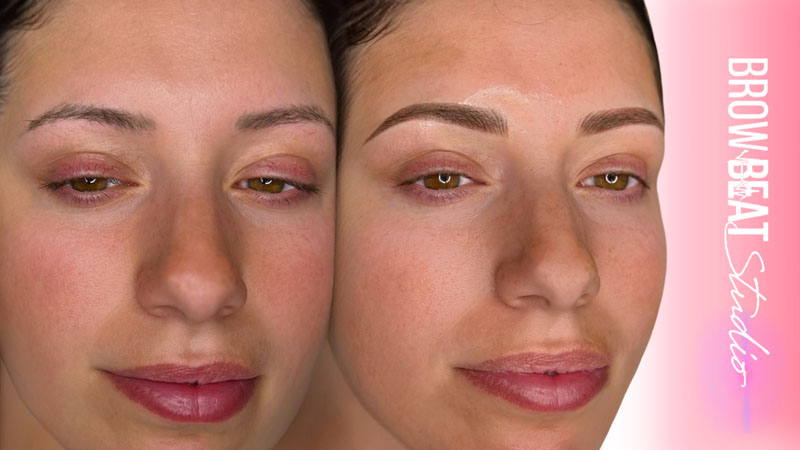
Fresh photographs show newly completed technique and design.
Healed photographs show the softer result the client actually spends far more time wearing.
That comparison is particularly useful for clients who are worried that Powder Brows will look too strong.
Powder Brows, Ombré Brows and Microshading are forms of permanent makeup and cosmetic tattooing.
They should be approached as lasting cosmetic decisions.
The color gradually becomes softer over time, but it is not conventional brow makeup that can simply be washed away when you change your mind.
The word permanent sometimes creates the opposite misunderstanding.
Clients imagine the eyebrow will remain exactly as it looked when first healed for the rest of their lives.
It will not.
Permanent makeup changes.
The color gradually softens.
The density becomes lighter.
A client who enjoys greater definition may eventually decide she wants more color again.
Powder Brows are created as an area of shaded color.
As that color becomes lighter over the longer term, the eyebrow can gradually move into a softer version of its earlier result.
The shape may remain useful even after some of the original density has faded.
The tail can still be visible.
There may still be enough background color to reduce how much conventional brow makeup the client wants to use.
This gradual softening is one of the qualities BrowBeat values in machine shading.
Longevity is not only a question of how long pigment remains visible.
It is also a question of what the eyebrow looks like while it is becoming lighter.
Shading is designed from the beginning to read as an area of color.
That means a softer version of the shading can still make visual sense as shading.
For clients who intend to maintain permanent brows over many years, that long-term structure can be particularly useful.
A client who loves her shaded brows may eventually want more definition after the color has softened.
At that point, BrowBeat is working with a client who already knows the brow she likes.
The existing permanent makeup and the way it has aged become part of the next decision.
Maintenance is not simply pretending the skin has never been worked on before.
Powder Brows are one of BrowBeat’s most versatile permanent brow approaches so the candidacy is broad.
They can work beautifully for clients with substantial natural eyebrow hair, sparse areas, light brows, oily skin, dry skin and clients who want anything from very soft background color to a more polished makeup effect.
They are also an important option for mature or delicate skin because the result does not need to depend on many fine permanent hairstrokes remaining distinctly separated.
Yes. BrowBeat generally favors machine shading for oily skin.
Powder Brows create density as an area of permanent color rather than making the complete result dependent on many fine permanent lines.
That makes shading a particularly useful permanent brow direction when oilier skin is part of the picture.
The result can still be extremely soft.
Yes.
Dry skin can hold beautifully shaded permanent brows.
A client with dry skin may also have other permanent brow options available, but she does not need a reason to choose Powder Brows beyond liking the result.
Shading is not merely the technique clients receive when they cannot have Microblading.
Yes. BrowBeat generally favors shading as skin becomes older or more delicate.
Mature clients can still have very soft permanent eyebrows.
They can also have more definition when that reflects how they have worn their brows for years.
Age influences the technical decision.
It does not decide the client’s personal style.
BrowBeat generally prefers shading when skin is particularly thin or delicate.
Machine shading gives us a way to create permanent density without making the result dependent on repeated fine hairstrokes.
The amount of shading can then be adjusted to suit the brow the client actually wants.
Yes.
In fact, substantial natural brow hair can make shading especially useful.
The real hair already provides texture.
If the client is filling underneath it because the eyebrow looks patchy, light or visually disconnected, the missing element may simply be background density.
Soft shading can provide that color while allowing the natural hair to remain the texture of the brow.
Yes.
Shading can provide visible coverage where natural growth is lighter and help connect sparse areas to the rest of the eyebrow.
A thin tail, gaps through the body or generally light density can all benefit from permanent background color.
The amount of shading can change according to how much support different areas need.
No.
Machine shading can create visible eyebrow structure even when very little natural hair remains.
When substantial brow loss is involved, the design and long-term permanent makeup plan become particularly important because the cosmetic tattoo may be responsible for much more of the visible eyebrow.
Relevant medications and health circumstances should be disclosed before permanent makeup.
When bleeding or healing is a greater consideration, BrowBeat often becomes more conservative about fine Microblading or Nano hairstrokes and may favor machine shading instead.
The client should not independently stop or change prescribed medication to qualify for a particular permanent makeup technique.
They are not simply the oily-skin alternative.
They are not only for mature women.
They are not only for sparse brows.
And they are not only for clients who wear a lot of makeup.
Machine shading is useful because the density can be changed dramatically while remaining within the same broad technique family.
A client who fills her eyebrows every day may love the idea of having more of that density already present.
A client with plenty of natural hair may want soft color behind it.
A blonde client may simply want her eyebrows to remain visible without pencil.
A mature client may want a reliable permanent brow as natural density decreases.
Another client may love the clean, polished appearance of a beautifully shaded eyebrow.
All of those are legitimate reasons to choose Powder Brows.
Powder Brows can add visible density.
They can make the eyebrow easier to see.
They can support sparse areas.
They can strengthen a tail.
They can create a clearer overall shape.
They can provide a more consistent background underneath natural hair.
And they can create anything from subtle permanent definition to a much more polished filled-brow effect.
This is why the design deserves thought.
You can add conventional brow makeup after healing when you want more.
But the permanent base itself should be something you are comfortable wearing on ordinary days too.
That makes an established brow preference more useful than choosing a permanent shape simply because it is fashionable at the moment.
Yes.
Once appropriately healed, Powder Brows can become the permanent base underneath conventional brow products.
A client can wear the healed result alone on most days and add pencil, powder or gel when she wants a stronger look.
Permanent shading does not require the client to wear exactly the same cosmetic intensity every day.
Powder Brows gradually soften over time rather than reaching one universal expiration date.
Skin, pigment density, lifestyle and individual retention all contribute to how the result changes.
Because the shading is built as an area of color, a lighter version of the brow can remain visually useful even after some of its original intensity has faded.
Fresh Powder Brows begin stronger and then change as the treated skin heals.
The appearance can shift through the early stages before the permanent shading settles into its softer result.
The important thing to understand at the definition level is that the first few days are not the final brow.
Powder Brow pricing should be considered in the context of the complete permanent makeup service rather than only the minutes the machine is touching the skin.
Design, mapping, color planning, procedure time and the studio’s treatment structure all contribute to what the client is purchasing.
Current BrowBeat pricing is available through our booking information, while our Powder Brows, Ombré Brows & Microshading Cost & Pricing information explains the value and pricing considerations in more depth.
Start with the result.
If you want more permanent brow density, shading deserves serious consideration.
Then skin, age, natural brow hair, relevant healing considerations and long-term maintenance help BrowBeat decide how appropriate that approach is and how the result should be built.
They are their own permanent brow approach.
Microblading builds hair-like detail.
Machine shading builds density.
That distinction changes how the eyebrow is created and how the permanent work is structured within the skin.
Neither technique needs to be treated as the default version of permanent eyebrows.
This distinction matters.
Clients sometimes divide permanent brows into:
Microblading = natural.
Powder = makeup.
That is too simplistic.
A soft Powder Brow can look extremely natural.
A client with substantial real eyebrow hair may actually look more natural with gentle shading underneath that hair than with additional permanent lines placed among texture she already has.
An Ombré Brow can have a visible gradient and a polished finish.
It can also have such a gentle transition that the client simply experiences the beginning as softer than the tail.
The term describes the movement of density.
It does not determine how dramatic the finished brow must be.
The word describes the shading approach.
The finished visual strength comes from the density, color, shape and gradient selected for the client.
That is why looking at an artist’s actual healed work is more useful than trying to imagine the result from the treatment name alone.
They are closely related forms of machine-shaded permanent eyebrows.
Powder describes the shaded effect.
Ombré describes how that shading can move from softer to more defined.
Microshading describes the machine-shading approach.
The machine gives the artist a way to build permanent color.
Layering controls the density.
Changes in density create softness and gradient.
Shape and color determine how that shading belongs on the face.
And the client’s preferences determine how much permanent definition we are ultimately trying to create.
You do not need to arrive knowing whether the photograph you love should technically be called Powder Brows, Ombré Brows or Microshading.
Show us what you like.
Tell us how you normally wear your eyebrows.
Tell us whether you want a whisper of background color or a brow with considerably more definition.
The terminology is easy to sort out.
The important part is understanding the result you actually want to wear.
Powder describes the effect. Ombré describes the gradient. Microshading describes the shading approach. The brow itself belongs to you.

They belong to the same broad family of machine-shaded permanent eyebrows and there is considerable overlap between the terms. Powder describes the shaded effect, Ombré describes a transition in density, and Microshading describes the machine-shading approach. Different artists may use the names somewhat differently.
Powder Brows are permanent eyebrows created with machine shading. Instead of relying primarily on individual permanent hairstrokes, the artist builds controlled color through the eyebrow to create density, definition and a more complete-looking brow.
Ombré Brows are machine-shaded permanent eyebrows in which the density typically moves from softer at the beginning to more defined through the body and tail. The gradient can be very subtle or considerably more noticeable depending on the intended result.
Microshading is a term commonly used for permanent eyebrow shading created with a permanent makeup machine. Pigment is built through the brow to create color and density rather than constructing the complete eyebrow primarily from individual manual hairstrokes.
Ombré Powder Brows combine two descriptions of the same shaded brow. Powder refers to the shaded effect, while Ombré refers to the way that shading can transition from a softer beginning into greater density and definition.
The difference is primarily in how the shading is described and distributed. Powder Brows describes the overall shaded effect, while Ombré places greater emphasis on a gradient in which the beginning is softer and the brow becomes progressively more defined.
In many cases, Powder Brows and Microshading describe very similar permanent brow work. Microshading emphasizes the machine-shading method, while Powder Brows describes the soft or filled effect that shading creates. The exact terminology varies between artists.
There can be substantial overlap. Microshading describes machine shading, while Ombré describes a particular distribution of that shading. A microshaded eyebrow can therefore also be designed with an Ombré gradient.
Permanent makeup terminology has developed through different artists, training systems, brands and beauty trends. One artist may call a result Powder Brows while another calls very similar work Microshading or Ombré Powder Brows. Looking at the artist’s actual results is often more useful than relying on the treatment name alone.
Yes. At BrowBeat Studio Dallas, Powder Brows are created with a permanent makeup machine. The artist gradually builds pigment through the eyebrow and controls where the shading remains soft and where greater density is needed.
Yes. Ombré Brows are created with machine shading. The artist uses changes in pigment density to create the transition from a softer beginning into a more defined body and tail.
Density describes how much visual color the permanent shading creates. Lower density allows more skin to remain visually present and produces a softer effect, while greater density creates more coverage and a more defined or filled appearance.
No. Powder describes shading, not heaviness. Machine shading can be built very lightly so natural eyebrow hair and skin remain visually present, or it can be developed further for a client who prefers greater definition.
Yes. A soft Powder Brow can create subtle background color underneath natural eyebrow hair without dominating the face. The amount of density, color, shape and existing natural hair all influence how understated or defined the finished brow appears.
No. Some clients prefer a pronounced airy beginning, while others want only enough softness to prevent the front of the eyebrow from looking abrupt. Ombré describes a transition in density, not one mandatory level of contrast.
Yes. A Powder Brow can remain soft throughout much of the eyebrow without having a dramatic front-to-tail gradient. Density can be distributed in many ways while still remaining within the machine-shading family.
Pixel shading is a term sometimes used for the many small pigment placements that collectively create machine shading. It does not need to be considered a completely separate permanent brow procedure; the individual placements work together visually to create the powder effect.
The goal is not for individual dots to be noticeable when someone sees your eyebrows normally. The pigment placements work together visually as an area of shading. Extreme close-up photography may reveal technical texture that is not apparent at normal conversational distance.
Powder Brows use machine shading to create density, while Microblading uses a handheld tool to create individual permanent hairstrokes. One builds an area of shaded color and the other builds hair-like lines, so the structure of the permanent brow is fundamentally different.
No. Powder Brows are their own permanent brow approach. Machine shading is specifically used to build density and coverage through the eyebrow rather than simply being a version of Microblading with the strokes removed.
No. Natural eyebrow hair can remain an important part of the finished result. Machine shading can work underneath and around existing hair, allowing the real hair to provide texture while permanent color creates greater continuity and density.
Yes. Someone can have substantial natural brow hair and still want more consistent background color underneath it. In that situation, the natural hair supplies much of the texture while soft machine shading can help visually connect the eyebrow.
Yes. Machine shading can provide additional visual support where natural growth becomes lighter, including gaps, sparse areas and tails with limited natural hair. The density can be adjusted according to what different parts of the eyebrow need.
Yes. Machine shading can create visible eyebrow structure even when little natural hair remains. When the permanent makeup is responsible for more of the visible eyebrow, careful decisions about shape, color, density and long-term wear become especially important.
Fresh Powder Brows appear stronger and more noticeable than the settled result. The pigment has just been placed and the skin has just been treated, so the treatment-day appearance should not be mistaken for the final healed brow.
Healed Powder Brows appear softer than they do immediately after treatment. Depending on the original design, the result may look like subtle background density underneath natural hair or retain a more polished, filled-brow appearance.
Powder Brows are permanent makeup and cosmetic tattooing because pigment is placed within the skin. Although the visible color gradually softens over time, BrowBeat prefers clients to approach the procedure as a lasting cosmetic decision rather than thinking of it as temporary brow makeup.
Yes. Once the area has appropriately healed, the permanent shading can act as a base underneath conventional brow products. A client can wear the healed brows alone most days and add pencil, powder or gel whenever she wants additional definition.
No. Powder Brows can range from extremely soft background shading to a more polished filled-brow effect. A client who wears very little conventional makeup can still choose machine shading if she wants subtle permanent density rather than a strongly made-up appearance.
You do not need to arrive at BrowBeat Studio Dallas knowing the perfect terminology. Look at actual brow results and consider what you like: how soft the front is, how much skin remains visible, how much density sits behind the natural hair and how defined you want the body and tail. Those preferences are more useful than choosing a service simply because of its name.