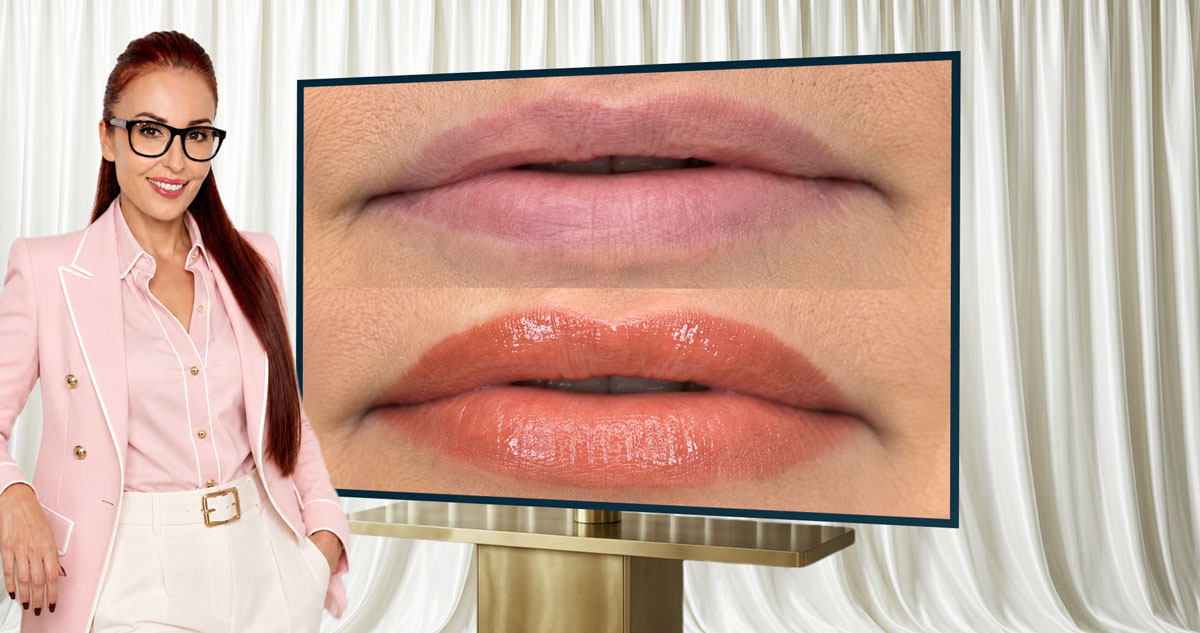
Choosing a Lip Blush color is not the same as choosing a lipstick. That is probably the most important thing to understand before we start talking about pink, peach, coral, rose or any other permanent lip color.
Lipstick is almost like a crayon. It sits on top of the lips. It can be opaque. It can temporarily cover the natural lip color underneath, which gives you enormous freedom to play with shades that may be fun for a few hours—deep maroon, violet, beige nude, dramatic red or almost anything else you feel like wearing that day.
Lip Blush does not behave that way. Permanent lip pigment heals within your own lips. Your natural lip color remains part of what you see, and the freshly implanted color becomes softer and less warm as it settles.
That changes the way we choose color. At BrowBeat Studio Dallas, we favor Lip Blush colors that retain warmth and life in the lips: pinks, peaches, corals, salmon-influenced shades, roses and warmer red families in different levels of intensity.
We do not offer true nude Lip Blush colors or violet-based permanent lip colors. There is a reason for that. Permanent lip color needs to continue looking healthy once it has softened and cooled within the lips. A shade that looks interesting as an opaque lipstick can become flat, dull or unhealthy-looking when translated into healed permanent pigment.
Our goal is not simply to choose a pretty pigment in a bottle. It is to choose a color that still looks alive on your face after it heals.

Have you ever struggled to follow your lip border with lipstick? When the natural edge looks patchy or diffused, even carefully applied makeup can appear uneven. Red Lip Blush can bring definition back to the existing lip shape while introducing richer permanent color. At BrowBeat Studio Dallas, we consider both the shade and the border so the lips look more complete without creating an entirely different mouth.
Ever wondered why the same pink looks different on two people? Your starting lip color is part of the answer. Some lips have cooler pink undertones, while others contain lighter and deeper areas. Permanent pigment works with those existing colors rather than covering them like lipstick. At BrowBeat Studio Dallas, we consider the natural lip base before selecting a pink that complements the client.


Full lips don’t always have a clearly visible outline. When the outer edge fades into the surrounding skin, the mouth can appear less defined than its actual shape. Red Lip Blush introduces color that makes the existing lip area easier to recognize. The lips don’t need additional physical volume; they need better visual definition. A richer red influence can highlight their shape without changing their anatomy.
Some clients want a delicate hint of pink. Others want to wake up and clearly see color on their lips. This stronger pink result demonstrates that Lip Blush doesn’t have to be almost invisible. At BrowBeat Studio Dallas, we discuss both shade and saturation so the finished appearance reflects the client’s preferences. Richer pink can create noticeable permanent color while preserving the lips’ own texture and character.

Lip Blush can be created within a broad range of warm, lively color families. At BrowBeat, those commonly include:
Even that list can be misleading if it makes Lip Blush sound like a collection of fixed colors. Pink alone is enormous.
One pink can be very light and delicate. Another can be warmer and peachier. Another can have more rose. Another can be considerably brighter.
Coral can lean pink or peach. Rose can be soft and understated or much richer. A salmon influence can bring warmth without necessarily making the finished lips look orange.
So when a client tells us, “I want pink,” that is the beginning of the color conversation, not the end of it.
We start with two things:
What color do you already have, and what color do you want to see?
Those questions sound simple, but together they explain most of Lip Blush color selection. Your natural lip color is the starting canvas. Your desired result tells us where we are trying to go.
Then we consider your complexion, overall coloring, the lip colors you normally wear and how much visible saturation you want when you are wearing no lipstick at all. A client who says she wants “natural pink” but shows us five bright coral-pink lipsticks is giving us useful information. So is the client who brings a barely tinted balm and says anything stronger than that would feel like too much.
We are not trying to convince either client to like somebody else’s lips. We are trying to understand what color makes sense on her.
Permanent lip pigment does not completely cover your natural lips the way an opaque lipstick can. The natural lip base remains part of the visible result. This means the same pigment does not necessarily produce the exact same healed color on two different people.
Imagine placing a translucent color over two different backgrounds. The color you see at the end is influenced by what was underneath it. Lip Blush works in a similar way.
If one client begins with a very pale warm-pink lip and another begins with a stronger natural rose, the same added pigment is interacting visually with two different starting colors. That is why choosing Lip Blush from a photograph alone can be misleading.
You may love the finished lips in the photograph. But we also need to look at where that client started.
Fresh permanent lip pigment is not the final color. As Lip Blush settles within the lips, the visible intensity reduces and the color can appear less warm than it did when freshly implanted. That matters when we choose the starting pigment.
If we select color solely according to what looks perfect while it is fresh, we are ignoring what that color still needs to become. The natural lip base can already be fairly dull in some clients. Even lips that are not candidates for Dark Lip Neutralization may have a cooler or slightly violet influence within their natural color.
Adding permanent color means working with that starting point while also anticipating the way the implanted pigment will soften and cool. That is one of the reasons BrowBeat tends to favor warmth in permanent lip color. We are choosing for the healed lips—not for the pigment cup and not for the first photograph taken immediately after treatment.
Think about lighting for a moment. Most people have walked into a bathroom under harsh blue-white fluorescent lighting, looked in the mirror and thought, “Why do I look like that?”
Then think about flattering photography. Ring lights commonly give you the option of warmer light. Photographers use warmth deliberately because the way color falls across human skin changes how healthy, vibrant and youthful the face appears.
Cold light can make the face look flatter and harsher. Warmth tends to bring life back into it. We think about permanent lip color in a similar way.
The lips sit in the center of the face, and color has enormous visual influence. Warm pinks, peaches, corals, salmon influences and warm roses can bring vibrancy into the lips without requiring the finished result to look bright or heavily made up.
Warm does not automatically mean orange. It means we are considering how that pigment will interact with the client’s natural lip base and how the color is likely to read once it is no longer freshly implanted.

Nude lipstick can be beautiful. Nude Lip Blush is a different proposition.
A lipstick can create an opaque beige, tan, brownish or muted nude effect because the cosmetic product is sitting on top of the lips. You wear it for the day and remove it when you are finished.
Permanent lip pigment heals within the lips. That means a shade selected to imitate an opaque nude lipstick can lose the warmth and liveliness we want permanent lips to retain. At BrowBeat, we do not want permanent lip color to make the mouth appear flat, dull or drained of life.
If a client wants a very understated result, we can create soft. Soft does not require beige. A delicate warm pink, soft peach or muted warm rose can create subtle permanent color while still allowing the lips to look healthy and alive.
Violet, plum and deep maroon can be fantastic lipstick colors. They can be dramatic, fashionable and beautiful precisely because lipstick gives you the freedom to put an opaque color on top of your lips and remove it later. We do not approach permanent lip color the same way.
Lips can already have coolness within their natural base, and implanted color becomes less warm as it heals. Starting with a strongly violet-based permanent shade can therefore move the finished result in a direction we do not want.
For BrowBeat, permanent lip color should maintain a healthy quality within the face. We would rather create depth with a richer pink, warm rose, coral influence or warmer red family than deliberately build a cold violet permanent lip.
This distinction solves a lot of confusion around Lip Blush colors. You can own twenty lipsticks and have twenty completely different personalities in that drawer.
One day you can wear bright red. The next day you can wear nude. You can wear plum at night and pink the following morning.
Permanent makeup has a different job. It becomes the color underneath all of those choices. That makes Lip Blush much closer to choosing the lip color you would like to wake up with than choosing the lipstick you would like to wear to dinner tonight.
Once the Lip Blush is healed, you can still put any lipstick you want over it. That is where we would rather leave the extreme color experimentation.
Your favorite lipstick is one of the best things you can bring to a Lip Blush appointment. Not because we are going to promise to tattoo an exact replica of that lipstick into your lips. Because it tells us what you like.
If you have purchased essentially the same warm pink five times from five different brands, that is meaningful. If every lipstick you love is coral, that tells us something too. If you think you like subtle lips but the lipstick you wear every day is actually quite vibrant, seeing the product gives us much better information than the word “subtle.”
Photographs can work the same way. Bring examples. Show us what you are drawn to. Then we can discuss how that color direction translates into permanent pigment on your natural lip base.

Some clients don’t want their lips to look as though they’ve applied lipstick. They simply want more color when they wake up. Pink 1 represents a softer direction that can make pale lips appear fresher without overwhelming the face. At BrowBeat Studio Dallas, we consider the natural lip base and desired saturation because the same pigment can look different on different clients. The best shade is one you enjoy without makeup.
Peach adds warmth without necessarily creating a dramatic lip color. It can brighten pale lips and create a fresh-looking appearance that feels comfortable for everyday wear. This Peach 2 example demonstrates how the same warm pigment can appear differently depending on the starting lips. A pale base may reveal more peach, while naturally pink lips may create a peachy-pink result. The existing lip color always contributes to the finished shade.


Two clients can choose Peach 2 and still have noticeably different results. One application may appear soft and pink-peach, while another shows a stronger orange-peach influence. The difference can come from natural lip color and the amount of pigment saturation. More appropriate layering can create greater visible intensity, but the starting lips still influence the appearance. The pigment bottle tells us the color family; your lips help determine the result.
Peach is often associated with soft, understated lips, but it can also create a much richer result. This Peach 3 example demonstrates how greater saturation brings more visible warmth and color to the mouth. At BrowBeat Studio Dallas, choosing peach doesn’t automatically mean choosing a faint application. Some clients want a gentle wash, while others want clearly colored lips without lipstick. The shade and the intensity are two separate decisions.


Some women have worn lipstick every day for decades because they love seeing color on their face. This Red 3 example offers a richer permanent lip direction for someone who prefers noticeable saturation. At BrowBeat Studio Dallas, warm red-influenced pigments can create visible color without imitating opaque lipstick. The natural lip base and texture remain part of the appearance. You don’t have to choose barely-there pink simply because the service is called Lip Blush.
Red can sound bold, but red-influenced permanent lip colors don’t always have to dominate the face. Red 1 represents a softer direction within the warm red family, offering more warmth than a pale pink without requiring cherry-stain intensity. At BrowBeat Studio Dallas, the natural lip base and desired saturation guide the result. A gentle red influence can bring life to the lips while remaining comfortable for everyday wear.

Pink is one of the broadest Lip Blush color families because it can move in so many directions. A pink Lip Blush can be soft and delicate.
It can lean warm and slightly peachy. It can have a rosy influence. It can be fresh and brighter. Or it can be built with enough saturation to create a clearly colored lip while still remaining within the pink family.
This is why asking for “pink lips” is not specific enough by itself. We need to know which pink you are imagining and how much of it you want to see once the lips are healed.
Soft pink works well for clients who want visible color without wanting their lips to become the dominant feature of the face. The objective is not necessarily to make the lips look like they are wearing lipstick. It may simply be to give naturally pale lips enough pink that they look healthier and more defined without makeup. Soft still needs enough pigment to remain visible once the fresh intensity has reduced.
Warm pink introduces a little more warmth into the pink family without necessarily becoming peach or coral. This can create a lively, flattering permanent lip color while retaining the familiarity of pink. For clients who say they want pink but consistently choose warmer cosmetics, this direction can make considerably more sense than a cold pink.
Rosy pink adds a little more depth. It can sit beautifully between a light pink and a fuller rose, making it useful for clients who want more visible color without moving into a very bright result. The exact appearance still depends on the client’s natural lip base and the amount of saturation being built.
Peach is a warm, fresh color family that can range from extremely soft to considerably more noticeable. It can also blend beautifully with pink, creating peachy-pink permanent lip colors that feel lively without looking aggressively orange.
For some clients, peach provides exactly the warmth they want while remaining softer than a stronger coral. For others, a peach influence is simply part of a customized pink or rose rather than the dominant finished color. Again, the name is less important than what the shade actually looks like on the individual client.
Coral sits in a particularly interesting place because it can combine pink, peach and warmer red influences. Some corals are soft. Some are vibrant. Some lean much more pink, while others have a stronger peach presence.
That flexibility makes coral an excellent family for clients who want permanent lip color with warmth and life. A coral Lip Blush does not automatically mean bright orange lips. It means the color direction contains enough warmth to create the coral character the client likes.
Salmon is another useful way of describing a warm lip color that sits between pink, peach and coral. It can be softer than people imagine when they first hear the name. A salmon influence can bring warmth into the lips while still allowing the finished result to read as a believable permanent lip color rather than an orange cosmetic effect. As with every Lip Blush family, the natural lip underneath contributes to how that color ultimately appears.
Rose is an excellent Lip Blush family for clients who want more depth than a very light pink without necessarily moving into a bright permanent lip color. It can feel polished, healthy and visibly colorful while still looking at home on a makeup-free face.
Rose can also move in different directions. A softer rose may have a gentle pink influence. A warmer rose can carry more peach or red warmth. A richer rose can create noticeably more presence while still avoiding the cold quality of a violet-based shade.
This is why we treat “rose” as a color direction rather than one fixed pigment. The client’s natural lip base and desired saturation still determine what that rose should actually become.
Muted does not have to mean grey, violet or lifeless. A muted rose can simply mean the color has been softened so it is less bright while still retaining enough warmth to look healthy in the lips. This can be useful for clients who want more depth than a light pink but do not want their permanent lip color to feel vivid. The distinction is important because BrowBeat’s idea of a softer permanent lip does not rely on deliberately making the lips cold.

Not every Lip Blush client wants subtle color. Some people genuinely love a colorful lip. They wear lipstick every day, feel more like themselves when their lips are visible and would be disappointed if their healed permanent color were barely noticeable.
For those clients, richer pink and warmer red-influenced color families can create considerably more presence. The objective is still not to reproduce the opaque appearance of red lipstick.
Permanent pigment heals within the natural lip tissue, so even a more saturated Lip Blush retains some of the character of the lips underneath it. A richer permanent color should therefore be chosen for the way it is expected to live in the lips—not simply because a dramatic lipstick looks beautiful for an evening.
Berry, mauve and plum are popular words in conventional lip makeup, but the names can cover very different undertones. Some berry colors are essentially rich warm pinks or reds and can provide useful inspiration. Others move strongly toward violet, blue or plum.
That is where BrowBeat becomes much more cautious. We do not deliberately create violet-based permanent lip color. If a client shows us a berry lipstick she loves, we look at what she actually likes about it.
Maybe it is the depth. Maybe it is the saturation. Maybe it is the richness of the pink or red.
We can often capture that feeling through a warmer permanent color without reproducing the coldest part of the lipstick shade. This is another reason photographs and actual lip products are more useful than color names alone.
Clients sometimes use the word “nude” when what they really mean is soft. Those are not necessarily the same thing.
In lipstick, nude may mean beige, tan, brown, muted pink or a color selected to sit very close to the wearer’s skin tone. BrowBeat does not tattoo true beige or drained nude shades into the lips.
If the goal is understated permanent lip color, we would rather create a soft shade with enough warmth and life to remain flattering once healed. That might be a delicate warm pink, a soft peach or a gentle warm rose depending on the client’s natural lips and overall coloring.
You can still achieve an understated result. It simply does not need to look beige to be subtle.
Warmth can exist in almost every color family we use. There are warm pinks, warm roses, peachy pinks, corals, salmon influences and warmer red directions.
Warm does not mean every client receives orange pigment. It means the color retains enough warmth to counter the natural cooling that occurs as permanent pigment settles into the lips and interacts with the client’s existing lip base.
That warmth can be very subtle. A client may look at a healed warm pink and simply see healthy pink lips. She does not need to look at them and think, “Those are warm-toned lips.” The color theory is doing its job when the finished result looks right on the person rather than calling attention to the theory behind it.
There is an important difference between a pink that is less warm and a permanent color that is deliberately strongly violet-based. We can adjust a shade so it does not feel excessively peachy or coral on a client who prefers a cleaner pink or rose direction.
But BrowBeat does not pursue cold permanent lips for the sake of making them cold. The natural lip tissue and the way implanted pigment settles already influence the warmth we see in the finished result. Our priority is maintaining a healthy-looking lip color rather than reproducing every cool cosmetic shade that can be created with lipstick.
Choosing a Lip Blush color involves more than choosing the hue. You also have to decide how much of that color you want to see. Take pink as an example.
A client can have a very soft pink Lip Blush that simply prevents her lips from looking pale. Another client can choose the same general pink family but want considerably greater saturation so the lips remain visibly colored without makeup.
The same principle applies to peach, coral and rose. Color family and color intensity are two separate decisions.
This is why asking, “What color do you want?” is not enough.
We also need to know, “How much color do you want?”

Yes. Lip Blush does not have to be whisper-soft. The word blush has created an expectation that permanent lip color should always be barely visible.
That is not appropriate for every client. If you have worn colorful lipstick for years and love seeing color on your face, an extremely faint permanent result may leave you wondering why you had the procedure at all.
A brighter Lip Blush can be created by building more saturation during treatment while still choosing a color that makes sense as healed permanent pigment. The key distinction is between visible permanent color and trying to reproduce the opaque appearance of freshly applied lipstick.
A natural Lip Blush color is not one universal shade. Natural is about whether the color looks believable on the person wearing it.
A soft pink can look natural. A peach can look natural. A warm rose can look natural. Even a more visible coral can look completely at home on someone whose complexion, natural coloring and personal style support it.
Natural also does not mean invisible. Healthy lips have color. The objective of a natural result can simply be to create the impression that the client naturally has more attractive lip color than she started with.
For one person, that requires very little saturation. For another, it requires more.
Complexion is part of the color conversation, but it should not be reduced to a chart that says fair skin gets one color and deeper skin gets another. Human coloring is more complex than that.
Two people with similarly fair complexions may look completely different in the same pink. Two people with medium complexions may have different hair, eyes, natural lip colors and personal preferences. And skin tone alone does not tell us how much natural melanin is present within the lips themselves.
We look at the whole person. The complexion matters. The natural lip base matters.
The client’s usual makeup matters. And what she actually likes matters.
The goal is not to follow a rigid color rule. It is to choose permanent lip color that belongs on that particular face.
Fair skin does not automatically mean pale pink lips. A fair-complexioned client may look beautiful with soft pink, peach, coral, rose or considerably stronger color depending on her overall coloring and preferences.
Some fair clients naturally have very little lip color and want enough permanent pigment to create noticeable contrast. Others already have strong natural pink lips and are looking for a subtle shift in direction rather than a dramatic increase in saturation. The natural lips still provide more useful information than the complexion alone.
Medium and deeper complexions also have enormous variation. Warm pink, peach, coral, rose and richer color families can all be relevant depending on the client’s natural lips and desired result.
A deeper complexion does not automatically mean the client needs Dark Lip Neutralization. The relevant question is what pigmentation is actually present in the natural lips.
If the natural lips have significant dark, cool, brown, purple, grey or strongly two-toned pigmentation, color planning is different from ordinary Lip Blush shade selection. That is a different service approach. You can read more about it in Dark Lip Neutralization.
They can contribute to the overall picture, but they should not dictate the color by themselves. We do not use rules such as “blondes get pink” or “brunettes get red.” Those shortcuts ignore too much information.
A blonde client may wear warm coral every day and look fantastic in it. A brunette may want the softest pink imaginable. A redhead may prefer peach, rose or something completely different.
Hair and eye color can help us understand the client’s overall coloring, but they are supporting information rather than instructions. The lips and the person wearing them remain the priority.

Some clients want to wake up with enough lip color to feel complete without wearing makeup. This Pink 1 result demonstrates how a soft pink can make a difference without demanding attention. At BrowBeat Studio Dallas, we choose shades that complement the client’s existing lip color and overall appearance. The lips retain their normal texture, while permanent pigment adds a gentle pink influence that feels comfortable for everyday wear.
A beautiful peach lip doesn’t need shine to look colorful. Lip Blush adds pigment within the lips rather than creating a glossy surface coating. This Peach 3 result demonstrates how warm permanent color can remain visible without the shine often seen in fresh treatment photographs. At BrowBeat Studio Dallas, peach can be soft or more saturated depending on the client. Gloss is always optional after healing; the permanent color is already there.


The same pigment doesn’t guarantee the same result on every client. One person may begin with very pale lips, while another already has more pink or rose within her natural color. Even when both choose Pink 1, the final appearance can differ. At BrowBeat Studio Dallas, we consider the starting lip base and desired saturation rather than relying on pigment names alone. Photographs inspire color decisions, but your own lips determine the direction.
Pale natural lips give us a relatively light starting base, which can make the selected color particularly visible once pigment has been added. That does not mean every pale lip should receive a strong color.
For many clients, the objective is simply to replace the washed-out appearance with enough pink, peach or rose to make the lips visible within the face. Others deliberately want more saturation. Because the starting lip is light, we still consider how the chosen pigment is expected to soften and interact with that natural base rather than assuming the color in the pigment cup will be the exact healed result.
Mild variation in natural lip color is common. One area may be slightly pinker. The center may have more visible color than the border. The upper and lower lips may not look completely identical.
Ordinary Lip Blush color selection can take those differences into account when the variation is relatively mild. The objective is to create a more cohesive overall color without pretending natural lips begin as perfectly uniform surfaces. When natural pigmentation becomes significantly dark, cool or strongly two-toned, the color strategy changes because simply choosing the desired final Lip Blush shade is no longer the only consideration.
Because the pigment is only one part of what you ultimately see. A useful way to think about healed Lip Blush is:
selected pigment + natural lip base + chosen saturation + healing = visible healed color.
That is not a mathematical formula. It is simply a useful way to understand why permanent lip color cannot be selected by looking at a pigment bottle in isolation.
Your natural lips are underneath it. The pigment is implanted rather than painted opaquely on top. The fresh intensity reduces. The warmth softens.
And what remains is the interaction of all of those factors. That is the color we are planning for.
Fresh Lip Blush is stronger than healed Lip Blush. That is expected. Immediately after treatment, the pigment can appear brighter and warmer than the permanent color the client ultimately requested.
As the lips settle, visible intensity can reduce substantially—sometimes by around 50 percent—and the color becomes softer. That expected change is considered during shade selection.
It is one reason a client should not choose a pigment simply because she loves exactly how that pigment looks immediately after it has been implanted. We are choosing for what remains.
For a closer look at the changes that happen as the lips settle, see Lip Blush Healing & Aftercare.
Lip Blush can become substantially softer than it appears immediately after treatment. At BrowBeat, we prepare clients for the possibility that the visible intensity may reduce by around 50 percent as the lips settle.
That is not an exact percentage for every person. Different lips retain pigment differently, and the amount of saturation intentionally built during treatment also matters. But it explains why permanent lip color cannot be selected by looking only at how bright it appears on appointment day.
If a client wants a clearly visible healed result, the fresh lips need enough saturation to allow for that reduction. If she wants something very soft, the color can still be planned accordingly without pretending that barely visible fresh pigment will necessarily leave enough permanent color behind.
Yes. The warmth seen in freshly implanted pigment can soften as the color settles into the lips. That expected cooling is part of the reason warmth matters during color selection.
A pigment that looks very warm immediately after treatment can become much more balanced once it is no longer fresh. The client’s natural lip color contributes to that finished appearance as well.
We therefore do not judge permanent color by asking whether the fresh lips look slightly warmer than the client ultimately wants. We are thinking about where that color is going.

Yes. Two clients can receive the same pigment and still not end up with visually identical lips.
Their natural lip bases may be different. One may begin very pale and another may already have significant natural pink. The amount of saturation built during treatment may differ. Individual retention can differ as well.
This is why another person’s Lip Blush photograph is useful as inspiration but should not be treated as a guaranteed color sample for your own lips. We can identify what you like about that result and use it to guide the color direction, but your lips remain part of the finished color.
Absolutely—photos are useful. Bring screenshots. Bring saved photographs. Show us the lips you keep coming back to.
Those images can tell us whether you prefer soft pink, warm rose, peach, coral, greater saturation or a barely-there result. But we also need to look at the person in the photograph.
What was her starting lip color?
Is the photograph fresh or healed?
Is there lighting or editing changing the way the shade appears?
And does your natural lip base look anything like hers?
A photograph is an excellent communication tool. It is not a paint swatch.
This is often a more useful question than simply asking which shade you want. Think about your normal relationship with lip color.
Do you put something on your lips every morning because you feel washed out without it?
Do you normally wear only clear balm?
Do you love visible lipstick?
When you look at yourself without makeup, do you want your lips to look subtly healthier or clearly more colorful?
Those answers tell us a great deal about appropriate saturation. Permanent makeup should make sense in your everyday life.
A client who wants only a little color should not be pushed into a bold lip. A client who loves color should not automatically be given an almost invisible result because someone else decided all Lip Blush has to be subtle.
For the wrong client, yes. A very soft result can be beautiful when that is what the client wanted. But softness is not automatically superior.
If someone has spent years wearing noticeable lipstick and specifically wants visible permanent color, a result that heals so softly that she can barely see it may not meet her goal. The important question is whether the level of saturation matches the request. That is why BrowBeat discusses intensity as part of color selection rather than treating every client as though she wants the same result.
It can be too bright for the person wearing it if that is not what she wanted. That is different from saying bright permanent lip color is inherently wrong. Some clients look fantastic with stronger color and genuinely prefer it.
The problem is not brightness itself. The problem would be creating a level of saturation that does not reflect the client’s preferences. This is why words like “natural” and “bright” need to be discussed rather than assumed.
Permanent lip color should be chosen with the understanding that it is permanent makeup, not a lipstick shade you can wipe off at the end of the day. Color can soften substantially over time, and in appropriate circumstances additional pigment can influence the visible color during a future treatment.
But that should not be interpreted as unlimited freedom to repeatedly switch permanent lip color from one extreme to another. The better approach is to choose the original color thoughtfully.
If you love experimenting with very different cosmetic colors, continue doing that with lipstick over your healed Lip Blush. Your permanent color can remain the flattering base underneath.

Yes. Permanent lip color gradually becomes softer over time. The way a particular shade ages depends on more than the name of the color, so we do not choose a Lip Blush shade simply because someone claims one color “lasts the longest.”
The starting lips, saturation, individual retention and other factors all contribute to how visible the color remains. Color selection should first be based on what belongs on the client’s lips.
For more detail on how permanent lip pigment ages and when additional color may be considered, see How Long Does Lip Blush Last?.
Color-specific before-and-after photographs are particularly useful when you look at more than the finished shade. Start with the natural lips.
How pale were they?
How much natural pink was already present?
Was the border clearly visible?
Then look at the finished color. A warm pink healed result means more when you can see the natural base underneath it before treatment. The same is true of peach, coral and rose.
This is why BrowBeat’s color examples are useful for understanding possibilities rather than selecting a pigment by photograph alone. Your starting lips will still influence your result.
Look first at whether the photograph is actually healed. Fresh lips can be considerably brighter and warmer than the settled color. Then look at the client as a whole.
Does the color belong on her face?
Does it make the lips look alive?
Does the shade work with her natural coloring?
Does the amount of saturation make sense for the result she appears to be wearing?
A good permanent lip color should not make you think only about the pigment. It should make the entire face look more complete.
BrowBeat does not approach permanent lip color as a menu where every client chooses one fixed shade and receives exactly the same result. We start with the lips in front of us.
What natural color is already there?
How warm or cool does that base appear?
How much visible color does the client want?
What lip products does she normally love?
Does she want the finished result to look extremely soft, or does she want to wake up and clearly see color?
Those questions matter more than the name printed on a pigment bottle. The final Lip Blush color is created from the relationship between the client’s natural lips and the permanent color we add.
That is why custom color selection is not about finding the universally “best” Lip Blush shade. There isn’t one. There is the shade that makes sense for your lips.
Lip Blush should give you a better starting point every morning. It does not need to replace your makeup collection.
If you want violet lipstick on Saturday night, wear it. If you want deep maroon for an event, wear it. If you want beige nude the next day, you can wear that too.
Those are temporary cosmetic choices, and that is exactly where extreme color experimentation belongs. Your Lip Blush has a different job.
It should be the color that still makes sense when you wake up. It should make sense when you are wearing no makeup. It should work under the lipstick colors you choose later. And it should still bring life to the lips once the fresh pigment has softened.
That is why BrowBeat chooses permanent lip color with the healed result in mind.
For clients choosing Lip Blush colors at BrowBeat Studio Dallas, the process begins with your natural lips and the colors you actually enjoy wearing. Bring your lipstick. Bring your photos.
Tell us if you love pink. Tell us if you hate pink. Tell us if you want barely-there color or if you want to wake up and clearly see your lips.
The more accurately we understand what you like, the better the color decision can reflect you. From there, we consider the natural lip base, overall coloring, warmth and the amount of saturation appropriate for the result.
For a broader look at permanent lip color, treatment and results at BrowBeat, visit our Lip Blushing Dallas page.
The goal of shade selection is not to make your lips match somebody else’s photograph. It is to create permanent color that belongs on your face.

Lip Blush can be created in a range of warm, lively color families including soft pink, warm pink, rosy pink, peach, peachy pink, coral, salmon-influenced shades, rose, richer pinks and warmer red-influenced colors. The exact shade and saturation are customized to the client’s natural lips and desired result.
Start with your natural lip color and the color you would like to see when you are wearing no lipstick. Your complexion, overall coloring, favorite lip products and preferred level of saturation can all help guide the decision. There is no single Lip Blush shade that is best for everyone.
Yes. Lip Blush pigment heals within the lips rather than sitting opaquely on top like lipstick, so the natural lip base remains part of the visible result. Two clients can use the same pigment and still not heal to visually identical colors.
Not necessarily. The selected pigment interacts with the client’s natural lip base, the amount of saturation created during treatment and the way the color settles. The pigment color is therefore only one part of the final healed result.
Yes. Fresh Lip Blush appears much stronger than the settled color. Visible intensity can reduce substantially, sometimes by around 50 percent, although retention varies between clients. Shade selection takes that expected softening into consideration.
Yes. The warmth seen in freshly implanted pigment can soften as the color settles within the lips. This expected cooling is one reason BrowBeat considers warmth carefully when selecting permanent lip color.
There is no universal natural Lip Blush shade. A soft pink, peach, warm rose or coral-influenced color can all look natural depending on the client’s lips and overall coloring. Natural means the color looks believable on the person wearing it, not that every client receives pale pink.
Yes. Lip Blush can range from very soft to considerably more saturated. Some clients want only a small increase in visible color, while others regularly wear lipstick and want their healed lips to remain clearly colorful without makeup.
Pink Lip Blush is a broad color family that can include soft pink, warm pink, rosy pink and brighter pink variations. The right direction depends on the client’s natural lip base, overall coloring and how much pink she wants to see once the lips are healed.
Peach Lip Blush is a warm color direction that can range from very soft peach to peachy pink. It can add warmth and visible color without necessarily becoming as strong as a more vibrant coral.
Coral Lip Blush combines warm influences that may include pink, peach and warmer red. Some corals lean pink while others lean more peach. Coral can be soft or vibrant depending on the shade and saturation selected.
Salmon describes a warm color direction that can sit between pink, peach and coral. It can bring warmth into permanent lip color without necessarily making the healed lips appear orange.
Rose provides more depth than many very light pinks while still creating a wearable permanent lip color. It can range from a softer rosy pink to a richer warm rose depending on the client’s preferences and natural lip base.
BrowBeat does not offer true beige or drained nude permanent lip colors. If a client wants an understated result, we prefer soft pink, peach or warm rose directions that retain enough warmth and life to look healthy once healed.
BrowBeat does not deliberately create strongly violet-based permanent lip colors. Mauve, plum and violet can be beautiful as temporary lipstick, but permanent pigment behaves differently within the lips. If a client likes the depth of those cosmetics, we can discuss warmer pink, rose or red-influenced directions that capture richness without deliberately creating a cold violet result.
Permanent lip pigment becomes softer and can appear less warm as it settles. Natural lips can also begin with some coolness. BrowBeat uses warmth thoughtfully so the healed lips retain a healthy, lively appearance rather than becoming flat or overly cool.
No. Warmth can exist within pink, rose, peach, coral and red color families. A healed warm pink may simply look like healthy pink lips. Warmth describes the color direction, not a requirement that the finished lips look orange.
Your favorite lipstick can be an excellent reference for the color family and intensity you like, but Lip Blush will not behave exactly like opaque lipstick. Permanent pigment heals within your natural lips, so the goal is to translate the color direction rather than promise an exact cosmetic match.
Yes. Bring lipsticks, glosses, stains, screenshots or photographs of colors you repeatedly like. These references help communicate whether you prefer pink, peach, coral, rose, warmer colors, stronger saturation or a very soft result.
A photograph can provide useful inspiration, but it should not be treated as an exact color swatch. The other client’s natural lip base, whether the photograph is fresh or healed, lighting and editing can all affect how the color appears.
Complexion is one part of color selection, but it does not determine the shade by itself. BrowBeat also considers the client’s natural lip color, overall coloring, makeup preferences and desired saturation rather than assigning fixed Lip Blush colors according to skin tone alone.
Fair-complexioned clients can wear many permanent lip color families, including pink, peach, coral and rose. The natural lip base and the client’s preferences are more useful than assuming every fair client should receive a pale pink.
Warm pink, peach, coral, rose and richer permanent lip colors can all be considered for medium and deeper complexions depending on the client’s natural lips and desired result. Skin tone alone does not determine whether the natural lips require a different color approach.
No. Hair and eye color can contribute to the client’s overall coloring, but BrowBeat does not use rigid rules such as blondes get pink and brunettes get red. The natural lips, complexion, personal style and colors the client actually enjoys wearing are more important.
Pale natural lips can be enhanced with pink, peach, coral, rose and other warm color directions depending on the desired result. Some clients want only enough color to stop the lips looking washed out, while others want much greater visible saturation.
Mild natural variation can be considered when selecting and applying Lip Blush color. When the lips contain significantly dark, cool or strongly two-toned natural pigmentation, the color approach is different because ordinary final-shade selection may not be the first step.
Naturally high-melanin lips with significant brown, purple, grey, cool or strongly two-toned pigmentation require a different color assessment. These lips may need Dark Lip Neutralization before working toward the desired final Lip Blush shade.
Permanent lip color can soften over time, and additional pigment may influence the visible shade in appropriate circumstances. However, Lip Blush should not be treated like lipstick that can be switched freely from one extreme color to another, so the original shade should be selected thoughtfully.
Color name alone does not determine how long a Lip Blush result remains visible. Saturation, the natural lip base, individual retention and other factors influence how permanent lip color ages, so BrowBeat does not select a shade simply because it is claimed to last longer.
The best Lip Blush color is one that works with your natural lip base, overall coloring, preferred level of saturation and the colors you genuinely enjoy seeing on yourself. BrowBeat customizes permanent lip color rather than giving every client the same standard shade.