When permanent makeup is being used for significant eyebrow restoration, BrowBeat Studio Dallas does not approach technique selection as a menu of equally appropriate choices.
Microblading, Nano Brows, Powder Brows, Ombré shading and Combo or Hybrid Brows are all available options.
These techniques can all create permanent color in an eyebrow. But they do not create the same permanent structure, they do not age in the same way, and they do not leave the same canvas behind for future treatments. That distinction becomes particularly important when natural brow hair is substantially missing.
For true eyebrow restoration, BrowBeat Studio Dallas has a clear preference:
we use shading rather than permanent hairstrokes.
And when a restoration brow presents additional challenges, controlled pointillism shading can give us even greater versatility.

Most people choosing permanent makeup think about the first appointment: what the eyebrows will look like, whether they’ll love the shape and color. At BrowBeat Studio Dallas, we’re also thinking about the appointment five or ten years from now: if natural brow hair remains substantially absent, permanent makeup may continue providing most of your visible brow, and repeated hairstroke treatments can gradually leave lines that are softer or less distinct for future shading to work with. That’s why we prefer starting restoration with Powder Brows. The first treatment should leave a sensible foundation for the fifth.
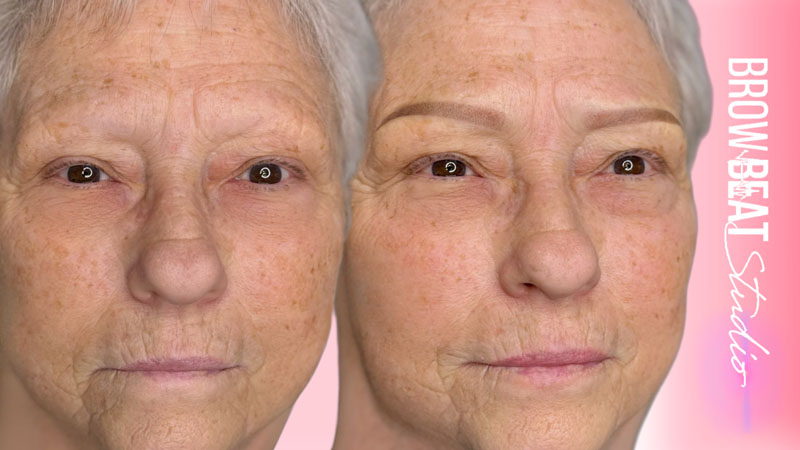
A restoration client may return for permanent eyebrow maintenance many times throughout her life, which changes how we think about the first treatment. This dark blonde powder brow shows the shaded structure BrowBeat Studio Dallas prefers when natural hair is substantially reduced. Individual Microblading strokes look beautiful at first, but as pigment ages and more treatments are performed, those lines may soften, widen or lose their separation. Powder shading starts with a different objective, working together as color rather than staying separated into lines, giving a more straightforward foundation for repeated maintenance.


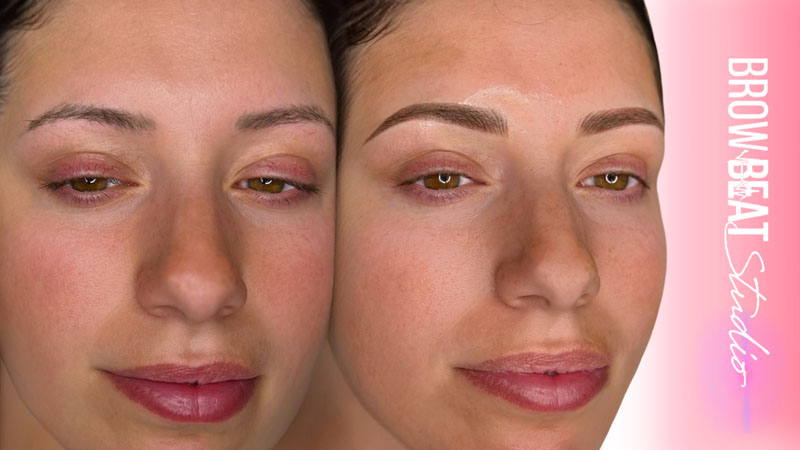
Hairstroke photographs are popular because up close, individual lines can look impressively similar to natural hairs. But most people see your face from across a table or room, not two inches away, and at that distance the eye recognizes the complete eyebrow: shape, color, thickness and balance. This brunette powder brow shows how machine shading creates that complete visual impression without permanent hairstrokes. For BrowBeat Studio Dallas, that’s an important restoration distinction. A softly shaded eyebrow provides the structure the face needs without the long-term requirement that individual tattooed lines stay clearly separated.
Some clients hear ‘Powder Brow’ and immediately imagine a dark, solid eyebrow. But that’s not the only result machine shading creates. This brunette client’s completed brow shows how pigment can be distributed softly enough for definition without an opaque block of color, which is especially useful for restoration: when natural hair is missing, pigment may cover most of the visible brow, but that doesn’t mean every part needs maximum saturation. BrowBeat Studio Dallas can build a softer beginning, controlled density and enough definition at the tail for a recognizable eyebrow that doesn’t dominate her face.

Someone with a full natural eyebrow may be choosing permanent makeup because she wants more definition, a stronger shape or less work in the morning. That is a want eyebrow. Restoration is different. A restoration client may have substantial sections of natural brow hair missing. She may have almost no eyebrow. She may have no natural brow hair at all. Or an accident, scar, medical treatment or hair-loss condition may have permanently interrupted the natural structure. Permanent makeup is now being asked to do much more of the work.
Restoration is much closer to a need eyebrow than a want eyebrow. That is why BrowBeat Studio Dallas thinks much further into the future when choosing the permanent structure we put into the skin.
For significant eyebrow restoration, BrowBeat Studio Dallas generally recommends a Powder Brow or another carefully controlled form of machine shading. For difficult restoration areas, we may use a pointillism-style shading approach that allows permanent color to be built with additional control. Our preference is not based only on how a technique looks immediately after the appointment. It is based on what that technique is asking the permanent pigment to continue doing as it heals, fades and is maintained over the years.
Shading is designed to remain visually readable as shading. Hairstrokes are designed to remain visually readable as individual hairs. For a restoration client who may depend on permanent makeup for much of the visible eyebrow, BrowBeat Studio Dallas considers the shaded structure the more useful long-term foundation.
BrowBeat Studio Dallas does not begin a restoration appointment by asking which permanent makeup name sounds most attractive. We look at the eyebrow. How much natural hair remains? Where is it missing? Does the existing hair still create a recognizable brow? Is permanent makeup filling a section or creating most of the eyebrow? What are the characteristics of the skin? Is scar tissue involved? How much permanent color does the client want?
And perhaps most importantly: what do we want this permanent eyebrow to leave behind for the next treatment? Only then does technique selection make sense.
Natural eyebrow hair does more than create individual hairs. It provides texture, contributes color, establishes shape and softens permanent pigment, and it can camouflage changes in permanent makeup as that pigment ages.
As natural hair disappears, permanent makeup has to carry more of those jobs by itself. The less natural hair remains, the more exposed the permanent technique becomes.
Permanent brow terminology can become unnecessarily complicated. For a restoration client, it is more useful to understand what kind of permanent structure is actually being created.
Hairstroke techniques create individual permanent lines intended to resemble eyebrow hairs. Microblading creates those lines manually. Nano Brows create them with a permanent makeup machine. The methods differ, but both finished results depend on individual permanent lines continuing to read visually as individual hairs.
Powder Brows, Ombré Brows and Microshading belong to the machine-shading family. Instead of asking individual lines to imitate hairs, permanent pigment works together as a field of color. That shading can be extremely soft and transparent. It can also be built with greater definition when the client prefers a stronger brow.
Combo and Hybrid Brows combine permanent hairstrokes with machine shading. The shading provides broader color and density while the hairstrokes add individual line detail. For true eyebrow restoration, BrowBeat Studio Dallas generally does not see a long-term advantage in adding permanent strokes to a shaded structure when we already know the client may depend heavily on that permanent brow for years.
That difference becomes increasingly important as permanent makeup ages.
Microblading can create beautiful fresh hairstrokes. But BrowBeat Studio Dallas does not recommend Microblading when we are truly reconstructing an eyebrow because we do not believe the fresh result tells the complete story.
A restoration client may become a long-term permanent makeup client. If substantial natural hair is permanently absent, she may want those brows maintained repeatedly for years. That means BrowBeat Studio Dallas has to consider what repeated hairstroke treatments can leave in the skin, not simply whether the first set of strokes looks crisp.
Nano Brows and Microblading are not the same procedure. One creates hairstrokes with a machine and the other creates them manually. But from the long-term restoration perspective, they share an important visual requirement.
The lines need to remain separated enough to continue looking like hairs.
BrowBeat Studio Dallas does not consider changing the method used to create the line enough to remove that long-term concern. For true restoration, our preference remains shading.

A line does not look like a hair simply because it was originally tattooed as one. The eye needs to be able to distinguish that permanent line from the pigment around it.
As permanent hairstrokes age, they can soften and widen. With repeated treatments, areas of permanent line work can become increasingly difficult to keep visually separated. Eventually, sections that began as distinct hairstrokes may read more like merged or solid permanent pigment.
The pigment may still be there. But the visual structure that originally made it look like hair has changed.
Fresh permanent hairstrokes photograph beautifully. They are crisp. They are separated. They can look extraordinarily hair-like in a close-up image. But a restoration client should not make a long-term permanent eyebrow decision from the first photograph alone.
The more important questions are: What happens after those strokes have lived in the skin? What happens when the client returns for another treatment? And another? What does the artist have to work with when those lines are no longer the first generation of pigment in that eyebrow?
When BrowBeat Studio Dallas sees a photograph of newly created Microblading or Nano Brows, we are seeing one moment. We are not necessarily seeing that same client’s eyebrows after several treatments. That distinction matters enormously in Restoration.
Everything can look beautiful the first time. The greater skill is creating permanent makeup that can be repeated responsibly while continuing to give the client a useful eyebrow.
A client with substantial natural brow hair has camouflage. Real hairs cross over permanent pigment.
They create texture. They interrupt areas of color. And they can help aging permanent work blend into the eyebrow.
A restoration client may have very little of that camouflage. If permanent strokes become less distinct or increasingly solid over time, there may be nothing sitting over them to visually break up the pigment. The permanent makeup itself becomes easier to see.
BrowBeat Studio Dallas does not use permanent hairstrokes for male eyebrow restoration. Our concern is long-term appearance.
A fresh stroke-based eyebrow can initially provide convincing hair-like detail. But if those permanent lines later soften, widen or merge, the result can begin reading as visible permanent makeup rather than natural brow texture. For a male restoration client who may want a brow result maintained over many years, BrowBeat Studio Dallas prefers soft shading that can be built through the eyebrow without depending on permanent lines remaining crisp.
This is one of the simplest questions behind BrowBeat Studio Dallas’s restoration philosophy. If a client has a substantial area with no natural brow hair, the problem is not simply that individual hairs are missing.
The area may be missing color, density, shape and continuity, and sometimes most of the visible eyebrow itself.
A permanent line can imitate one hair. Shading can create an area. That makes shading much more versatile when BrowBeat Studio Dallas needs to visually connect an area of natural hair with an area containing little or no hair.
For more challenging restoration brows, BrowBeat Studio Dallas may use a controlled pointillism-style shading approach. This allows us to build permanent color with precision across areas that may not all behave identically. That can be particularly useful when a restoration brow includes scar tissue, damaged areas or another irregular treatment surface.
The goal is still a cohesive shaded eyebrow. Pointillism simply gives BrowBeat Studio Dallas another way to control how that permanent color is built.
This is an important expectation to establish before booking. If you are seeking significant eyebrow restoration from BrowBeat Studio Dallas, our approach is based on shading. We are not trying to persuade a client who specifically wants a stroke-based restoration into booking something she does not want. We want the client to understand our philosophy first.
We choose shading because we believe it gives a restoration client the stronger combination of coverage, versatility, future fade and long-term repeatability. Restoration at BrowBeat Studio Dallas is about building the best permanent eyebrow for future you, not simply choosing the technique that looks most impressive on day one.
For BrowBeat Studio Dallas, Powder is not simply another permanent brow style within Restoration. It is the foundation we prefer when permanent makeup needs to replace a substantial amount of missing visual brow structure.
Shading can create color where there is no hair. It can blend into areas where natural hair remains. It can be made soft and transparent. It can be built stronger when the client prefers greater definition. And importantly, it does not depend on individual permanent lines continuing to look like hairs.
That gives BrowBeat Studio Dallas considerably more flexibility when we are building a brow that may need to be maintained repeatedly over many years.

Think about how often someone changes the way they draw their eyebrows: darker for an evening out, softer for the weekend, a different shape as style changes. Brow pencil gives that freedom; permanent makeup is a longer commitment, so BrowBeat Studio Dallas prefers not making every beauty decision permanent at maximum intensity. A softly shaded Powder Brow can provide the everyday eyebrow, while conventional makeup stays available for a stronger look. For someone with significant brow loss, that’s an ideal balance: the eyebrow is already there every morning, but there’s still room to play.
When someone has experienced significant medical treatment, BrowBeat Studio Dallas believes the permanent eyebrow approach should be carefully considered. This client’s softly shaded gray brows show the machine-based restoration we prefer over traditional manual Microblading. Microblading creates hairstrokes through small incisions, while machine shading deposits pigment through repeated punctures, building color without the same continuous cut-like strokes, though puncture-based methods still create skin injury and neither is automatically safer. For clients following chemotherapy, medical clearance and individual skin assessment remain essential. Our goal is a controlled shaded structure rather than individual cuts imitating missing hairs.


Imagine two beautifully shaped eyebrows, one created with individual permanent hairstrokes and the other with soft powder shading. Now step away from the mirror. At normal conversational distance, those tiny details matter much less than whether the eyebrows have the right shape, color, thickness and definition. For a client with little or no natural brow hair, why depend on individual tattooed lines staying separated for years when shading creates the same effect? At BrowBeat Studio Dallas, we choose shading for true eyebrow restoration because we want the structure to remain useful as it ages, not just look impressive freshly applied.
One of the biggest misunderstandings about Powder Brows is that shading automatically means a dark, opaque eyebrow. It does not.
BrowBeat Studio Dallas likes transparency in permanent shading. The eyebrow can contain enough color to create a complete shape while still allowing the result to feel soft. This becomes especially important on restoration clients because the permanent pigment may be completely exposed in areas where there is no natural hair. We do not need to fill every piece of visible skin with maximum color in order to create an eyebrow.
See-through does not mean unfinished. It means the permanent shading has visual softness rather than reading as one dense block of pigment.
The beginning can remain gentle. The body can carry enough color to establish the eyebrow. The arch and tail can have definition. And the complete brow can still retain some transparency.
For BrowBeat Studio Dallas, that quality is particularly valuable when permanent makeup is responsible for most or all of the visible eyebrow.
When there is no natural brow hair, Powder does not need hair underneath it to create a recognizable eyebrow. The shading itself can establish the complete visual structure.
Beginning, body, arch, tail, thickness, color and density can all be built with pigment alone.
That is one of the reasons BrowBeat Studio Dallas considers shading more versatile than permanent hairstrokes for full brow reconstruction.
Restoration does not always mean complete hair loss.
A client may have substantial natural hair through the beginning of the brow and almost nothing through the tail. Another may have irregular areas of loss. Another may have enough hair to provide texture but not enough to create a complete visual eyebrow.
Shading can work beneath and between the hair that remains while continuing into the areas where hair is absent. That allows BrowBeat Studio Dallas to create continuity rather than asking individual tattooed lines to bridge the difference between a hairy area and a hairless one.
Significant brow loss often creates missing areas, not simply missing individual hairs. That distinction matters.
If half of an eyebrow is visually absent, BrowBeat Studio Dallas needs to rebuild more than a collection of lines. We need to restore the color and density that make that area read as part of the eyebrow. Shading allows us to work with the missing area as a whole. For BrowBeat Studio Dallas, that is a much better match for the restoration problem.
This is one of the most important differences in BrowBeat Studio Dallas’s long-term technique philosophy. A Powder Brow is supposed to be shading. As the permanent color becomes lighter, it is still visually behaving as shading.
A hairstroke has a different requirement. It needs to retain enough separation from the pigment around it to continue behaving visually as a hair. If the pigment remains but the lines eventually merge together, pigment longevity and useful hairstroke longevity are no longer the same thing.
A permanent brow can still contain plenty of pigment while the original visual structure has changed. This is particularly important when comparing hairstrokes with shading. A faded Powder Brow may still look like a softer Powder Brow. A permanent hairstroke that has widened or merged with surrounding lines may still contain pigment, but it may no longer look like an individual hair. For BrowBeat Studio Dallas, the question is therefore not simply:
“How long will the pigment remain?” It is: “How will that permanent structure look while the pigment remains?”
The permanent color gradually becomes softer. The eyebrow may lose some visual intensity. Areas with little or no natural hair may begin looking less defined because the shading is carrying more of the visible brow.
Eventually, the client may want additional permanent color. But BrowBeat Studio Dallas does not automatically add pigment simply because a particular amount of time has passed. We look at what remains first.
Any permanent makeup can become unnecessarily dense if more pigment is repeatedly added without enough attention to what is already present in the skin. That is not how BrowBeat Studio Dallas approaches maintenance.
Before adding permanent color, we evaluate the existing eyebrow. How much pigment remains? How strong does it look? What does the client actually want changed?
Does the brow need additional density at all? The existence of an appointment does not automatically mean the eyebrow needs more pigment everywhere.
This distinction matters. When BrowBeat Studio Dallas calls Powder a repeatable restoration technique, we do not mean blindly repeating the original treatment at the same intensity every time the client returns.
Repeatability means the existing shaded structure gives us something useful to evaluate. We can look at what faded. What retained. Where the client still has enough permanent color. And where additional work may actually be useful.
The next treatment responds to the eyebrow that exists then.
Microblading and Powder solve the visual brow problem differently. Microblading creates individual manual hairstrokes. Powder creates permanent shading.
For ordinary brow enhancement, those differences can create different aesthetic options. For significant Restoration, BrowBeat Studio Dallas considers the long-term distinction more important. Microblading relies on permanent lines continuing to read as hairs. Powder relies on permanent shading continuing to read as shading. When little or no natural hair is available to camouflage the permanent work, BrowBeat Studio Dallas chooses Powder.

Nano Brows move the hairstroke from a manual tool to a machine. Powder Brows use the machine to create shading instead. That difference in application does not change the visual requirement of the finished Nano result. A Nano stroke still needs to remain sufficiently distinct from the lines around it to continue reading as a hair.
For BrowBeat Studio Dallas, that makes Powder the preferred restoration structure when natural brow hair is substantially absent.
Nano and Microblading are technically different hairstroke methods. But for BrowBeat Studio Dallas, the more important restoration question is what both techniques ultimately leave in the eyebrow: permanent lines.
Those lines may initially look extremely different depending on the technique, artist and skin. But both approaches depend on line separation for the finished effect to continue reading as hairstrokes. That shared long-term requirement is why BrowBeat Studio Dallas does not choose between Nano and Microblading for true Restoration. We move to shading.
Combo or Hybrid Brows add hairstrokes to a shaded brow. For BrowBeat Studio Dallas, adding shading does not remove the long-term considerations attached to those permanent lines.
The Powder component may continue behaving as shading. The strokes still need to continue behaving as strokes.
If the restoration client is already well served by a shaded structure, BrowBeat Studio Dallas does not see a reason to add permanent line work that may become a limitation later. For significant Restoration, we choose Powder.
The simplest comparison is this:
This is one of the most important things a Restoration client should understand before choosing permanent hairstrokes. Permanent pigment does not return to zero simply because the client later chooses another technique.
If repeated Microblading or Nano treatments leave softened, widened or merged permanent lines, those areas remain part of the eyebrow. Putting Powder over them does not create the same starting point as creating a Powder Brow on skin that did not first accumulate years of permanent hairstrokes. Existing pigment affects the canvas available for future permanent makeup.
BrowBeat Studio Dallas likes Powder Brows to retain some visual transparency. That is easier to achieve when the underlying permanent structure is already shading rather than areas of stronger merged line work.
This is why we do not consider hairstrokes a temporary first chapter with an automatic clean transition to Powder later. The first technique decision can influence the options available years afterward.
What goes into the skin today becomes part of what the artist has to work with tomorrow.
A fresh permanent brow can look beautiful. The harder question is what happens when the client comes back. And then comes back again.
For BrowBeat Studio Dallas, the real skill in semi-permanent makeup includes being able to repeat the work without allowing every treatment to make the next one more difficult. That is particularly important in Restoration because these clients may rely on permanent makeup much more heavily than someone who still has a complete natural eyebrow.
A client understandably wants to love her eyebrows now. BrowBeat Studio Dallas wants that too. But a restoration technique should not be chosen only for present-day impact. Future you may want these eyebrows maintained five years from now. Ten years from now. Twenty years from now.
For BrowBeat Studio Dallas, shading gives that future client the better starting point. We want the permanent eyebrow to have a good first treatment, and a good future.
The amount of natural hair remaining absolutely changes the visual problem. A client with partial brow loss may still have natural hair providing texture, color and some of the original eyebrow structure. But once the loss is substantial enough to become true eyebrow restoration, BrowBeat Studio Dallas still prefers shading.
The reason is versatility. Powder can sit softly beneath the natural hair that remains and continue through the areas where hair is missing. That allows us to create one continuous eyebrow rather than trying to bridge a substantial hairless area with permanent lines.

Having more natural hair can make permanent pigment less exposed. It gives the eyebrow physical texture and can help permanent color blend into the natural brow. But if enough of the eyebrow is missing that BrowBeat Studio Dallas considers the treatment Restoration, we do not switch to hairstrokes simply because some natural hair remains.
We use that hair. We blend with it. And we use shading to reconstruct what it no longer provides.
As natural hair disappears, the reason BrowBeat Studio Dallas prefers shading becomes even clearer. The permanent makeup becomes increasingly responsible for the complete eyebrow.
There is less natural texture to disguise permanent pigment. Less hair to break up the tattoo visually. And less camouflage for the way permanent makeup changes with time.
A soft Powder Brow can create the complete visual structure without asking permanent lines to imitate hairs on exposed skin.
At BrowBeat Studio Dallas, the answer is Powder shading. When no natural eyebrow hair remains, we want a technique capable of creating the entire visual brow while still allowing softness, transparency and future maintenance.
We do not believe the absence of hair creates a stronger argument for permanent hairstrokes. For us, it creates a stronger argument for shading.
This is one of the most important concepts in eyebrow restoration. Natural hair can make permanent makeup forgiving.
Without that hair, the client sees more of the permanent work itself. The placement, the color, the density and the way the technique ages are all exposed.
That is why BrowBeat Studio Dallas does not choose a Restoration technique based only on which one can produce the finest detail when it is brand new.
For substantial or complete Alopecia-related brow loss, BrowBeat Studio Dallas recommends Powder shading. Many Alopecia clients who find permanent eyebrows they love may choose to maintain them for decades.
When little or no natural hair exists, there is also very little camouflage for aging permanent pigment. For those reasons, repeatability becomes particularly important. BrowBeat Studio Dallas would rather begin with a shaded structure intended to remain shading than create a completely hairless brow from permanent lines that depend on long-term separation.
For medically cleared clients with substantial eyebrow loss after chemotherapy, BrowBeat Studio Dallas also recommends soft machine shading. Our approach is deliberately conservative.
We prefer to create soft color coverage, allow the permanent brow to heal and build additional density when appropriate rather than rely on individual permanent hairstrokes. If natural brow hair remains limited long term, the repeatability of the permanent structure becomes important here too.
BrowBeat Studio Dallas uses shading for eyebrow restoration involving scar tissue. We do not use permanent hairstrokes through eyebrow scars.
Scar tissue can accept pigment differently from the unaffected skin immediately around it, which makes the behavior of a permanent line difficult to predict. Shading gives BrowBeat Studio Dallas more flexibility to respond to those differences while rebuilding the complete visual eyebrow. In selected difficult areas, a controlled pointillism-style shading approach can provide additional versatility.
Not every Restoration client has Alopecia, chemotherapy-related loss or scar tissue. Some people simply have substantial permanent brow loss with no single cause driving the treatment. The same BrowBeat Studio Dallas philosophy applies.
Once enough natural structure is missing that permanent makeup is reconstructing the eyebrow rather than merely enhancing it, we prefer shading. The exact softness, density and distribution of that shading can be individualized. The underlying permanent structure remains Powder.
Technique selection is not made from a photograph alone.
Skin matters. The way the skin accepts permanent pigment matters. Existing tissue differences matter. Previous medical circumstances may matter to the overall treatment plan. Scar tissue certainly matters.
But for BrowBeat Studio Dallas, skin characteristics do not create a reason to force hairstrokes into a Restoration case. Instead, they help determine how the shaded restoration should be approached.
Photographs are useful. They help clients communicate what they like. But a close-up photograph of fresh permanent makeup cannot show the complete future of that technique.
It does not show how the pigment healed. It does not show what happened at the next treatment. It does not show the third treatment. And it does not show what the artist eventually has to work with years later.
A Restoration client needs more information than a beautiful first-day image can provide.
BrowBeat Studio Dallas does not define natural-looking eyebrows by the presence of permanent hairstrokes. For us, a natural-looking eyebrow is one that belongs on the face.
Its placement makes sense, its shape makes sense, its color makes sense and its density makes sense, and the permanent technique does not unnecessarily call attention to itself.
For significant Restoration, soft shading can create that result beautifully.

Microblading and powder shading begin with different objectives. Microblading creates individual permanent lines meant to resemble hairs, while powder shading builds an area of color through small pigment deposits. This close-up shows early machine shading along the lower brow line, with visible pixelation as pigment begins establishing the permanent structure. For a restoration client, this area-based approach is particularly useful, since significant brow loss often means entire sections are missing, not just a few hairs. By creating a shaded foundation, BrowBeat Studio Dallas can begin restoring the visible eyebrow without depending on separate tattooed lines to recreate every missing hair.
When a large section of an eyebrow is missing, the problem is bigger than absent individual hairs. The area may have lost most of its color, density and connection to the remaining brow. This image shows machine shading extending into the body of the eyebrow, gradually connecting the pigmented sections into a more complete structure. At BrowBeat Studio Dallas, this is one reason we favor shading for restoration: it works across a missing area rather than asking individual hairstrokes to create the entire impression of density, building coverage into a continuous eyebrow that can be adjusted for softness or definition.


One interesting thing about powder shading is that the finished eyebrow isn’t defined by a single pigmentation. It’s the combined appearance of many small deposits that creates the overall structure. Viewed closely the individual deposits may still show, but from a normal distance they work together to create the impression of an eyebrow, a useful contrast with permanent hairstrokes, where individual lines are meant to remain visually recognizable as hairs. For BrowBeat Studio Dallas, shading provides a structure that doesn’t depend on preserving that line-by-line appearance through future treatments.
A brow can have pigment distributed across the entire intended shape without being heavily saturated. A distinction that’s especially important for restoration clients. This image shows the eyebrow after a complete shading pass, with the basic structure established so the artist can evaluate pigment distribution rather than assume more color must be added everywhere. At BrowBeat Studio Dallas, we consider how much density is actually necessary: a client with no natural brow hair may need complete coverage, but that doesn’t automatically mean an opaque result. The objective is a recognizable eyebrow with controlled color strength.


Permanent makeup isn’t improved simply by adding more pigment. This image shows the eyebrow being wiped so the artist can evaluate the shading already placed. That moment of reassessment matters, weighing how much color is visible, whether distribution is even and how the skin is responding before deciding if additional work is appropriate. For restoration clients, who may depend on permanent eyebrows for years, avoiding unnecessary pigment buildup is an important part of the long-term approach. At BrowBeat Studio Dallas, the goal isn’t the darkest eyebrow on day one, but a useful structure that preserves options for future maintenance.
There is an understandable reason clients associate hairstrokes with natural eyebrows. Natural eyebrows contain hairs. So individual tattooed lines seem like the closest visual imitation.
But permanent makeup is being placed into skin, not adding actual three-dimensional brow hair. When natural hair is substantially missing, those permanent lines are exposed in a way they are not when surrounded by a dense natural eyebrow. BrowBeat Studio Dallas therefore judges realism by the complete face rather than by how convincingly one tattooed line resembles a hair in an enlarged photograph.
A highly detailed hairstroke photograph can be impressive when viewed inches from the skin. But clients do not live as close-up photographs.
People see the complete face. Across a room. Across a table. During conversation.
At those distances, a beautifully placed soft eyebrow can look extraordinarily natural because the eye reads the complete brow rather than the individual hairstrokes used to create it.
A soft field of color can establish an eyebrow without requiring the viewer to believe a collection of tattooed lines are actual hairs.
The shading creates enough contrast to frame the eye. Enough shape to establish the brow. And enough density to replace what the missing natural hair no longer provides.
When that color remains transparent and appropriately balanced, the eyebrow can simply settle into the face.
Hairstrokes begin as individual permanent lines. As they heal and age, those lines can soften and become less crisp. Over repeated treatments, some can widen or begin merging with pigment around them.
For a Restoration client, that change is particularly important because there may be little natural hair available to disguise the permanent line work. This is one of the main reasons BrowBeat Studio Dallas does not use hairstrokes as our Restoration foundation.
Powder Brows begin stronger and then soften as the permanent pigment heals. The finished result remains a field of shading rather than a collection of individual lines. With Restoration, BrowBeat Studio Dallas can evaluate that healed color and decide at the second treatment where more density is useful and where enough permanent color already remains.
The goal is not maximum pigment. It is the right amount of healed brow.
A Combo Brow contains both shading and permanent hairstrokes. Those two components still have different visual requirements as they heal and age.
The shading needs to remain useful as shading. The hairstrokes need to remain separated enough to continue reading as hairs. Because BrowBeat Studio Dallas does not believe the stroke component improves the long-term Restoration foundation, we prefer Powder rather than adding both structures.
A fresh photograph answers one question: What did the eyebrow look like immediately after this treatment? A Restoration client needs another question answered too:
What can this eyebrow look like after it has been maintained repeatedly? That second question is harder to photograph. But for BrowBeat Studio Dallas, it is more important.
BrowBeat Studio Dallas does not think raw pigment duration is the best way to choose a Restoration technique. Permanent pigment remaining in the skin does not automatically mean the original visual result remains useful.
A hairstroke can still contain pigment after it has stopped reading clearly as an individual hair. A Powder Brow can become lighter while still reading as shading.
So we care about more than how long pigment is detectable. We care about how the eyebrow behaves as it changes.
That is the longevity question BrowBeat Studio Dallas wants Restoration clients to ask.
Will the permanent structure soften in a way that still makes sense? Will natural hair camouflage it, or is the permanent makeup completely exposed? What happens when more permanent work is eventually needed? And will the next artist have a useful foundation to work with?
Those questions tell us much more than a simple number of months.
A Restoration client may rely on permanent eyebrows for many years. That means treatment number one should not consume the options needed for treatment number five.
BrowBeat Studio Dallas wants the eyebrow to remain workable. We want to be able to evaluate what is already in the skin before adding more. We want enough flexibility to respond to the way the client, skin and natural brow change. And we want the permanent structure itself to continue making sense.
For BrowBeat Studio Dallas, that is the strongest argument for beginning Restoration with shading.
By the time someone needs significant eyebrow restoration, BrowBeat Studio Dallas is not trying to choose between four techniques simply because four techniques exist. We are deciding what kind of permanent structure should be placed into this particular eyebrow.
We consider:
For true Restoration at BrowBeat Studio Dallas, those considerations consistently lead us back to shading.

A client does not need to arrive at BrowBeat Studio Dallas having decided between Microblading, Nano, Combo and Powder. In fact, if significant eyebrow restoration is the goal, we would rather begin with the eyebrow problem than a requested technique name.
Tell us what is missing. Show us what you have been doing with your brows. Show us old photographs if they are useful. Tell us what you want the eyebrow to look like.
Then BrowBeat Studio Dallas can evaluate the permanent structure needed to create it.
A client does not ultimately walk around wearing a technique name. She wears eyebrows.
The goal is not for someone to look at the face and say, “Those are Powder Brows.” The goal is for the permanent makeup to do its job so well that the eyebrow simply belongs there. That is why BrowBeat Studio Dallas is comfortable choosing one restoration approach repeatedly when we believe it produces the better long-term foundation.
We do not need to use every available permanent makeup technique to create an individualized result. The individuality comes from the eyebrow we create with the technique.
Choosing shading does not mean BrowBeat Studio Dallas produces one standardized brow. A Powder Brow can be:
The technique provides the permanent structure. The design makes the eyebrow individual.
Pointillism is not a separate eyebrow style that the client needs to choose instead of Powder Brows. At BrowBeat Studio Dallas, it is a controlled way of building shaded permanent color in restoration situations where additional versatility is useful. That can include areas affected by scar tissue or other irregularities where one part of the treatment area may behave differently from another.
The finished objective remains a cohesive shaded eyebrow. The client should see the brow, not the method used to build the color.
Restoration brows are often problem-solving brows.
There may be missing sections. Scar tissue. Very little natural hair. Different tissue characteristics within the same eyebrow. Or a need to transition from an area containing natural hair into an area containing almost none.
Controlled pointillism shading gives BrowBeat Studio Dallas another way to build color through those differences without relying on permanent hairstrokes. That versatility is particularly useful in the kind of Restoration work BrowBeat Studio Dallas performs.
Male clients can need eyebrow restoration for the same reasons anyone else can.
Hair loss, injury, scar tissue, missing sections, or significant loss of the natural eyebrow can all be reasons.
BrowBeat Studio Dallas does not use permanent hairstrokes for male Restoration. Our concern is not whether a fresh hairstroke can initially resemble male eyebrow hair. Our concern is what that permanent line may look like after it has aged and after additional treatments have been added.
For a male client who does not ordinarily wear visible brow makeup, the long-term appearance of permanent pigment deserves particular consideration. A collection of fresh hairstrokes may initially read as hair.
If those strokes later soften, widen and merge, the remaining permanent color may begin reading differently. BrowBeat Studio Dallas does not want to create a short-term solution that may eventually become an obviously tattooed pattern on a client who wanted natural-looking brow structure. Instead, we prefer controlled soft shading that can be designed conservatively and maintained as shading over time.
Shading is a method of depositing permanent color. It is not a gendered eyebrow shape.
A male Restoration brow does not need a highly polished arch, a makeup-style gradient or an unnecessarily defined outline simply because Powder is being used. BrowBeat Studio Dallas can use shading softly to recreate missing visual density while allowing the shape and overall brow presence to remain appropriate for the individual client.
BrowBeat Studio Dallas understands the appeal. A client may have seen fresh Microblading or Nano photographs and feel that individual lines must be the most natural way to replace missing hairs.
But true Restoration at BrowBeat Studio Dallas is not offered as a hairstroke service. That is an important expectation to understand before booking. We would rather explain our long-term reasoning clearly than perform a technique we do not believe gives a Restoration client the best future.
Being able to perform a permanent makeup technique does not mean BrowBeat Studio Dallas believes that technique belongs in every eyebrow. Permanent pigment creates consequences beyond the day of the appointment. The artist who creates the first treatment is also influencing the canvas available for the second, third and later treatments.
For significant Restoration, BrowBeat Studio Dallas is not willing to create permanent hairstrokes simply because the client prefers the idea of strokes today. Our responsibility includes considering what that choice may leave behind.

BrowBeat Studio Dallas still does. Fifteen years from now, the client may care very much about what remains in her skin.
She may still want permanent eyebrows. She may want them softer. She may want a different shape. She may have different natural hair.
And another artist may eventually need to work with the decisions made today. BrowBeat Studio Dallas does not believe long-term responsibility disappears simply because the future feels far away during the first appointment.
BrowBeat Studio Dallas generally prefers to begin a Restoration Powder Brow with enough permanent color to establish the eyebrow while still leaving room to respond after healing. The first treatment gives us information.
How did the skin retain? How does the healed density look? How does the permanent color work with any natural hair that remains? Does the client want more strength?
Those answers are more useful than assuming the maximum permanent result needs to be created immediately.
A good Restoration technique should give BrowBeat Studio Dallas somewhere useful to go after the first treatment heals. With shading, we can evaluate the existing field of color and build where appropriate.
Some areas may need additional density. Others may already have exactly enough. The client may also decide that the softer healed brow is perfect.
The second treatment does not have to mean making every part of the eyebrow darker.
When a Restoration client returns in the future, BrowBeat Studio Dallas does not assume that the eyebrow needs to be completely redone. We look first.
How much permanent color remains? Where has it softened? How does the eyebrow look with the natural hair that exists now? What does the client want?
And does the skin actually need more permanent pigment? Maintenance should respond to the existing brow rather than simply adding another complete layer because time has passed.
Powder is BrowBeat Studio Dallas’s preferred Restoration foundation, but it is still permanent makeup.
Existing pigment matters. Skin matters. Color matters. And the artist still has to make decisions about whether additional permanent work is appropriate.
The advantage is not that Powder removes the need for judgment. The advantage is that BrowBeat Studio Dallas prefers the shaded structure it leaves us to evaluate.
For BrowBeat Studio Dallas, repeatable means the permanent brow can be revisited without requiring us to pretend the previous treatment is not there.
We can evaluate the shading that remains. We can respect areas that already contain enough color. We can build areas that genuinely need more. And we can make decisions from the eyebrow that exists at that moment.
That is very different from expecting every appointment to reproduce the exact same procedure from the beginning.
Fresh permanent makeup has an advantage in photographs. It is new. It is defined. And the artist has just finished controlling every visible detail.
Healed results tell us more. They show what the skin retained. They show how the permanent color settled.
And repeated healed results can tell us something even more valuable: whether the technique remains useful as the client continues maintaining it.
If you are researching permanent makeup techniques for significant brow loss, BrowBeat Studio Dallas recommends looking beyond fresh close-up photographs.
Look for healed work. Look at clients with starting points similar to yours. Look at eyebrows with little natural hair rather than assuming a technique will look the same beneath a full natural brow. And when possible, consider what the artist’s work looks like after the client has returned for maintenance.
The first treatment shows artistic ability. Repeated treatments reveal long-term judgment.
BrowBeat Studio Dallas provides permanent eyebrow restoration in Dallas for clients with significant natural brow loss, little or no natural eyebrow hair, Alopecia-related loss, post-chemotherapy brow loss and eyebrow loss involving scar tissue or trauma. For true Restoration, our technique philosophy is deliberately focused.
We use shading. We may use controlled pointillism shading when a difficult restoration area benefits from additional versatility. We do not use Microblading, Nano hairstrokes or Combo/Hybrid hairstrokes as our Restoration foundation.
That clarity allows clients to understand the BrowBeat Studio Dallas approach before choosing to move forward.
The permanent eyebrow you choose today may still influence what can be created years from now. That matters more when permanent makeup is replacing a facial feature the client may continue relying on long term. BrowBeat Studio Dallas wants the eyebrow to look beautiful after the first treatment. We also want it to remain something we are comfortable working with after the second. And the fifth. And years into the future. That is why our Restoration philosophy is built around shading.
With the right artist and thoughtful maintenance, we want the permanent brow to continue looking like the kind of eyebrow we intended to create from the beginning. For Restoration, we choose the technique with future you in mind.

For true eyebrow restoration involving significant natural brow loss, BrowBeat Studio Dallas recommends Powder shading. Restoration asks permanent makeup to create much more of the visible eyebrow, so we prioritize coverage, softness, repeatability and what the permanent pigment will leave behind for future treatments.
BrowBeat Studio Dallas recommends Powder shading when little or no natural eyebrow hair remains. A shaded brow can create the complete visual structure without depending on individual permanent lines continuing to look like hairs as they heal, age and are maintained over time.
Powder can create color across substantial missing areas, blend with natural hair when some remains and create an entire eyebrow when none remains. BrowBeat Studio Dallas also prefers the long-term shaded structure because it can be evaluated and maintained without relying on permanent hairstrokes remaining individually separated.
They do not have to be. BrowBeat Studio Dallas likes a degree of transparency in Restoration Powder Brows. Shading can be soft and see-through while still creating enough shape, color and density to form a complete visible eyebrow.
Yes. BrowBeat Studio Dallas defines natural-looking by how the eyebrow works on the complete face rather than by whether it contains tattooed hairstrokes. Appropriate placement, shape, thickness, color, density and soft shading can create a very natural visual brow even without natural hair.
BrowBeat Studio Dallas does not use Microblading for true eyebrow restoration. Microblading creates permanent hairstrokes that depend on line separation to continue reading as individual hairs. Restoration clients may have little natural hair to camouflage those lines as they change and may also require permanent brow maintenance for many years.
It is not the approach BrowBeat Studio Dallas recommends. Completely hairless skin leaves permanent hairstrokes fully exposed, and repeated stroke treatments can eventually leave lines that are softer, wider or more merged. BrowBeat Studio Dallas prefers a shaded permanent structure for complete brow recreation.
Nano Brows and Microblading use different methods to create hairstrokes, but both finished results depend on permanent lines continuing to read visually as individual hairs. BrowBeat Studio Dallas does not choose between the two for true Restoration; we prefer shading.
Not as BrowBeat Studio Dallas’s Restoration approach. Nano strokes may look extremely detailed when fresh, but they remain permanent lines on exposed skin. When little or no natural hair exists, BrowBeat Studio Dallas prefers Powder shading for its coverage and long-term repeatability.
Hairstrokes use individual permanent lines to imitate hairs. Shading uses permanent pigment as a field of color to create visual brow density and structure. BrowBeat Studio Dallas prefers shading for significant Restoration because the result does not depend on individual permanent lines remaining visually separated.
Permanent hairstrokes can soften and widen with time. Through repeated treatments, some lines can become less distinct or begin merging with surrounding pigment. When natural brow hair is substantially missing, those changes can be more visible because there is less real hair available to camouflage the permanent work.
There is no universal timeline because skin, pigment, technique, lifestyle and previous treatments all matter. BrowBeat Studio Dallas does not choose a Restoration technique based on a promise that permanent lines will remain crisp for a particular number of months. Our concern is the long-term behavior of repeated stroke work, which is why we prefer shading for Restoration.
A later technique can be different, but changing the technique does not erase pigment already in the skin. Repeated hairstrokes can leave softened, widened or merged areas that become part of the canvas underneath future shading. A future Powder Brow therefore may not have the same starting point as one created before years of permanent stroke work.
BrowBeat Studio Dallas does not use Combo or Hybrid hairstrokes as our foundation for true Restoration. Adding shading does not remove the long-term considerations attached to the stroke component. If shading can create the complete restoration result, we prefer not to add permanent lines that may become a limitation later.
BrowBeat Studio Dallas uses the natural hair that remains. Shading can sit beneath and around that hair while continuing into substantially missing areas. Once the treatment has crossed into true Restoration rather than ordinary enhancement, our preference remains Powder even when some natural brow hair is present.
Yes. Natural hair provides texture, color, shape and camouflage for permanent pigment. As the amount of natural hair decreases, the permanent technique becomes increasingly exposed and responsible for the complete visual eyebrow. That makes long-term technique behavior especially important.
For substantial or complete Alopecia-related brow loss, BrowBeat Studio Dallas recommends Powder shading. Alopecia clients with little or no natural brow hair may rely on permanent eyebrows for many years, so we place particular importance on a shaded structure that can be evaluated and maintained over time.
For medically cleared post-chemotherapy clients who need significant eyebrow restoration, BrowBeat Studio Dallas recommends soft machine shading. We prefer a conservative shaded approach that can create the complete visual brow, be evaluated after healing and be built further when appropriate.
BrowBeat Studio Dallas uses shading for eyebrow scar restoration and does not use permanent hairstrokes through scar tissue. Scar tissue can accept pigment differently from the surrounding skin, so shading gives us greater flexibility to build a cohesive visual brow across areas that may behave differently.
At BrowBeat Studio Dallas, pointillism is a controlled shading approach that may be used for more challenging Restoration brows. It can provide additional versatility when building permanent color through areas such as scar tissue or other irregular treatment surfaces. The finished objective remains a soft, cohesive shaded eyebrow.
Yes. Shading does not have to create a heavily made-up or feminine-looking eyebrow. BrowBeat Studio Dallas can use Powder softly to restore missing visual density while designing the shape, strength and overall brow presence for the individual male client.
No. BrowBeat Studio Dallas does not use permanent hairstrokes for male eyebrow restoration. Our concern is how the permanent lines may look after aging and repeated treatments. We prefer soft shading that is designed and maintained as shading from the beginning.
BrowBeat Studio Dallas does not choose Restoration techniques according to raw pigment duration alone. Pigment can remain in the skin after the original visual structure has changed. We consider how the permanent eyebrow looks as it ages and what kind of foundation it leaves for future maintenance.
Pigment longevity describes permanent color remaining in the skin. Structural longevity describes whether that color still creates the visual effect the technique was intended to produce. A hairstroke may still contain pigment after it no longer reads clearly as an individual hair, while softened Powder can still read as shading.
Permanent makeup should not be repeatedly darkened without evaluating what is already present. BrowBeat Studio Dallas assesses the existing pigment, healed density and client’s goals before deciding whether more color is needed. Repeatable does not mean automatically adding another complete layer at every visit.
Fresh photographs show what permanent makeup looked like immediately after treatment. Healed results show what the skin actually retained. For BrowBeat Studio Dallas, repeated healed results are even more informative because they help demonstrate whether the permanent structure remains useful as the client continues maintaining it.
No. A Restoration client does not need to diagnose her own technique. BrowBeat Studio Dallas begins with the amount and location of brow loss, remaining natural hair, skin, desired result and long-term maintenance needs. For true Restoration, our approach is based on shading rather than hairstrokes.
BrowBeat Studio Dallas understands why fresh hairstrokes are appealing, but true Restoration at BrowBeat Studio Dallas is not offered as a hairstroke service. We prefer to be clear about that before treatment rather than perform a technique we do not believe provides the long-term Restoration foundation we want for our clients.
Consider more than the first fresh result. Think about how much natural hair remains, how exposed the permanent pigment will be, how the technique is intended to age, whether you may depend on permanent eyebrows long term and what the existing pigment may leave for future treatments. BrowBeat Studio Dallas calls this choosing with “future you” in mind.
BrowBeat Studio Dallas provides Powder-based eyebrow restoration in Dallas for significant natural brow loss, complete or near-complete brow loss, Alopecia-related loss, medically cleared post-chemotherapy clients and eyebrow loss involving scar tissue or trauma. Selected problem brows may also be approached with controlled pointillism shading when additional versatility is useful.