Mature skin is not one skin type — it is a stage of life containing many different skin types, different histories and different starting points. That distinction matters.
One woman in her fifties may have smooth, medium-to-dry skin. Another may have considerable texture or years of visible sun exposure. One woman in her seventies may have relatively firm, even skin. Another may have thinner, more delicate skin.
Two women can be exactly the same age and require completely different permanent makeup planning. So when BrowBeat talks about permanent makeup on mature skin, we are not describing one type of client. We are describing a point in life when changes to skin, natural color, hair, anatomy and daily makeup routines may become increasingly relevant to permanent makeup.
Age gives us context.
The person in front of us gives us the treatment plan.

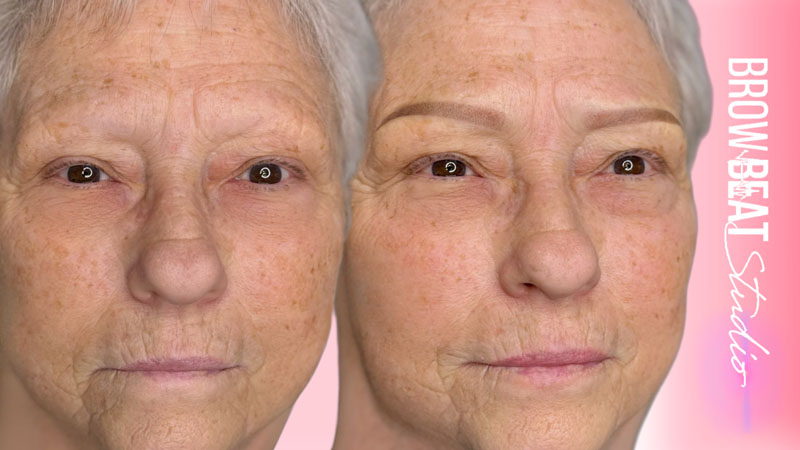
Sun exposure can contribute to visible changes in skin texture, pigmentation and overall appearance over time. Mature clients have different sun histories, so the artist considers the actual skin rather than assuming everyone has experienced the same changes. A natural close-up can illustrate why skin history is part of permanent makeup planning.
Two photographs of the same mature client’s eyebrows, taken at verified dates, can demonstrate how permanent color changes over time. The later photograph may show softer shading or less distinct detail while the overall brow remains visible. This type of documentation provides more meaningful information about pigment retention than assigning one universal lifespan to mature skin.


A client in her seventies may retain relatively smooth, firm-looking skin and substantial natural eyebrow hair. Her chronological age does not make permanent makeup more difficult or less appropriate. The artist considers the actual skin and desired enhancement rather than assuming the treatment must become increasingly limited with every decade.
The answer is less obvious than it sounds. Someone in her twenties may consider 50 mature. A woman approaching 50 may strongly disagree. Someone in her seventies may think of mature skin very differently again.
There is no universally useful birthday when skin suddenly moves from one category into another. Terms such as mature skin, aging skin and older skin are useful because they describe a stage of life people recognize. They are much less useful when they are treated as a diagnosis.
At BrowBeat, mature permanent makeup can include clients in their fifties, sixties, seventies, eighties and beyond. But the older the number becomes, the more important it is—not less important—to stop treating the number as the treatment plan.
There is a strange imbalance in the way permanent makeup is often presented online. Much of the imagery and conversation centers on younger faces. Yet mature clients can be some of the people who benefit most from permanent makeup.
As we move through life, some of the features we once created easily with natural color, natural hair or conventional makeup may become harder to maintain. That is exactly where permanent makeup can become incredibly useful. Not because there is something wrong with getting older. Because we now have the ability to maintain selected color and definition in ways previous generations simply did not.
Natural eyebrow hair can become lighter, thinner, grayer, whiter, coarser or less evenly distributed. Permanent color can help maintain a visible brow framework underneath those changes.
The natural lip may become paler or less visually distinct from the surrounding skin. Permanent lip color can restore contrast that once existed naturally or was previously created with conventional makeup.
Changes around the eye and lash line can make the eyes feel less defined. Permanent upper eyeliner can establish color that is already present before conventional makeup is applied.
Eyesight changes. Glasses can get in the way. Drawing two brows evenly can become frustrating.
Creating fine eyeliner detail can become more difficult. Permanent makeup can remove some of that daily precision work.
Many mature clients have spent decades learning their own face. They know whether they like stronger brows. They know whether eyeliner feels like part of their identity.
They know whether they feel better with visible lip color. Permanent makeup can help maintain those preferences rather than asking the client to give them up.
Most of us carry a visual idea of ourselves. It may not be the exact face we had at 25. It is simply the version that feels most like us. The brows have enough color. The eyes have definition. The lips are visible.
The face feels finished. Then, gradually, the reflection can stop giving back all of those things without conventional makeup. Permanent makeup offers another option. In today’s world, some of the color and definition you used to recreate every morning can already be there when you wake up. That can be a remarkably positive part of getting older.

Mature skin can affect permanent makeup because the treatment is being performed in skin that has its own individual characteristics. Those characteristics may include changes in thickness, dryness, texture, elasticity, movement or the way the surface presents fine detail. But the important word is may. Age does not guarantee any one of those characteristics. The artist has to look at what is actually present. A useful way to think about it is: Age → gives context.
Skin thickness → gives information. Texture → affects how permanent detail may visually read. Elasticity and movement → affect the treatment surface. Dryness → becomes one part of the skin picture.
Anatomy → affects permanent design. Personal taste → still determines what the client actually wants. No single item should be treated as the entire answer.
Some mature clients have thinner skin. Others do not. The actual treatment surface matters more than the stereotype.
Soft can be beautiful. So can visible color and definition. Mature is not a makeup style.
Mature clients can heal permanent makeup beautifully. Individual healing varies at every age.
Two clients with the same birthday can have completely different skin, natural features and permanent makeup goals.
BrowBeat does not have an upper age cutoff. A birthday alone does not tell us whether permanent makeup can add something valuable to your life.
People sometimes search for the “best permanent makeup for a 60-year-old” or ask whether permanent makeup is suitable after 70. Those are reasonable questions. But they assume everyone within an age group has a similar treatment surface. They do not.
A client’s skin has been influenced by genetics, environment, sun exposure, skincare, lifestyle and decades of individual history. That creates enormous variation.
Age belongs in the conversation. It should not dominate the conversation.
Skin can become thinner with age, but it should not be assumed that every mature client has thin skin. When skin is thinner or more delicate, the artist needs to recognize that characteristic and plan permanent makeup around the actual treatment surface. That does not mean the client has become a poor permanent makeup candidate. It means the skin is giving the artist information.
Delicate skin is not a rejection — it is a treatment consideration.
Yes. The word delicate should not become the word untreatable. Permanent makeup is not reserved for people with one idealized type of skin.
The artist needs to understand what she is working with and make decisions appropriate to that individual client. This is one of the reasons experience with a broad range of ages and skin characteristics matters.

A mature woman may have visible facial texture while enjoying bright lip color and polished makeup. Those characteristics are not contradictory. Permanent makeup planning considers the actual treatment surface while still respecting the client’s preferred appearance. Individualized does not mean pale, minimal or conservative.
A mature woman may have visible smile lines and changing facial contours while enjoying beautifully defined permanent lip color. Those characteristics can coexist naturally. Lip Blush enhances color within the existing lip without requiring the surrounding skin to look younger or smoother than it actually is.


A mature woman may have visible pores, fine lines and natural skin texture while enjoying beautifully defined permanent eyebrows. The purpose of permanent makeup is not to erase those characteristics — it is to add color and structure that complement the individual face. A realistic close-up can show how permanent pigment and natural skin coexist without artificial smoothing.
A mature client may have naturally dry-looking skin while preferring a fuller, more defined permanent eyebrow. Dryness does not determine the style she should wear. The artist considers the actual skin condition and intended result before deciding whether treatment is appropriate and how the permanent makeup should be planned.

Dryness is another characteristic that may become more noticeable with age, but dry skin is not a disadvantage for permanent makeup. In some permanent makeup contexts, medium-to-dry skin can actually provide a very useful treatment surface. The larger point is that the word dry does not determine an entire procedure by itself. How dry is the skin? What is the texture?
What feature is being treated? What permanent result is being requested? Those questions matter more than attaching a positive or negative label to one skin characteristic.
Texture matters because permanent makeup is being viewed through and within a real skin surface. Extremely fine permanent detail may visually behave differently on a very smooth surface than it does on a more textured one. That is not unique to mature clients. It simply becomes an increasingly relevant consideration when the skin has developed more visible texture over time. Again:
Texture is information, not a rejection. The permanent makeup plan should work with the surface rather than pretending the surface is not there.
Skin is not a flat piece of paper. It moves. It folds. It changes position with facial expression.
And the way it sits can change over time. Changes in elasticity or movement can therefore become relevant to permanent makeup design. This is particularly easy to understand around features such as the eyes, but the broader principle applies across permanent makeup: the design has to belong to living, moving anatomy.
Fine lines and changes in surface texture are normal parts of many people’s skin as they age. They do not rule out permanent makeup. They simply change the surface the artist is looking at. The location matters. The amount of texture matters.
The service matters. And the desired result matters. A mature client should not be reduced to a list of wrinkles any more than a younger client should be reduced to a list of pores. The complete face is what matters.
Imagine two women who are both 68. The first has smoother, medium-to-dry skin with relatively little visible texture. The second has thicker skin, more surface texture and considerably more movement through the area being treated. They are the same chronological age. They do not have the same treatment surface. Now add everything else that makes them individuals. One may want extremely soft permanent makeup.
The other may have worn visible makeup for 40 years and want considerably more definition. One may have naturally dark features. The other may have very little natural contrast remaining.
One may have excellent natural brow hair. The other may have hair that has become lighter, coarser or increasingly inconsistent. The number 68 cannot make those decisions for them.
Age and skin quality are related, but they are not interchangeable. A woman in her seventies may have a smooth, stable treatment surface that supports permanent makeup beautifully. Someone decades younger may have substantial oil production, texture, large pores, sun damage or other characteristics that make a particular type of permanent detail more challenging.
This is why BrowBeat does not rank permanent makeup candidacy according to birthdays. The skin in front of the artist tells us considerably more.

The goal is not to find reasons to exclude a mature client.
The goal is to understand the starting point.
What does the treatment surface actually look and feel like? Is it smooth? Dry? Textured?
Thin? Thicker? More mobile? A combination of several characteristics?
Brows, eyelids and lips are different treatment areas. A skin characteristic that matters greatly to one permanent makeup service may matter differently to another.
Natural brow hair, lash-line visibility, natural lip color and existing definition all contribute to what permanent makeup needs to accomplish.
Permanent makeup needs to work with the feature as it currently sits and moves—not an imagined version of the face from decades earlier.
Permanent makeup is an elective cosmetic tattoo, so clients should disclose relevant health information and medications before treatment. That information becomes part of understanding the individual rather than making assumptions from age alone.
Does the client want soft? More defined? More color? Less daily makeup work?
A result that is almost invisible to other people? Or permanent makeup that is clearly present? There is no single mature-client answer.
People search permanent makeup by decade because age is an easy reference point. But the decades themselves do not create fixed permanent makeup rules. There is no treatment switch at 50. There is no second switch at 60. And there is no birthday at 70 when permanent makeup suddenly becomes inappropriate.
What can change over those decades is the collection of individual characteristics the artist is working with. Skin may change. Natural hair may change.
Color may change. Anatomy may change. Eyesight may change.
Daily makeup habits may change. And the client’s priorities may change. Those changes deserve attention. The decade itself does not dictate the treatment.
BrowBeat does not have an upper age cutoff for permanent makeup. Being 60, 70, 80 or older does not make someone too old for permanent brows, upper permanent eyeliner or Lip Blush. The better question is:
What do you want permanent makeup to do for you now? If restoring color, definition or everyday ease would add something meaningful to your life, age alone is not a reason to dismiss the idea.
A mature client does not need to justify wanting to look good by pretending age does not exist. You can be 75 and want visible eyebrows. You can be 82 and miss the color in your lips.
You can have worn eyeliner your entire adult life and still want your eyes defined. Those things are not attempts to become somebody else. They are personal style. Permanent makeup simply gives mature clients another way to maintain it.

Health history and medications can matter to an elective cosmetic tattoo appointment. But BrowBeat does not assume that every mature client has the same medical history simply because she is older.
Clients should provide accurate information about relevant medications, health conditions and the treatment area. That allows the appointment to be considered with the actual client in mind.
A person should never independently stop or change a prescribed medication simply to have permanent makeup. Questions about changing prescribed medication belong with the healthcare professional who manages it.
Blood-thinning medication is something a permanent makeup client should disclose before treatment. It is not something a client should simply stop on her own because she wants a cosmetic tattoo. The important point for this page is straightforward:
Tell us what you are taking. Accurate information is more useful than assumptions based on age.
Skin conditions can occur at any age. If the treatment area is irritated, inflamed or experiencing an active skin issue, that matters to permanent makeup planning. Again, the concern is the actual treatment surface—not the client’s age category. A mature client with calm, healthy-looking treatment skin should not be treated as though her skin is problematic simply because of her birthday.
It can. But there is no universal mature-skin healing pattern. Some mature clients heal beautifully and uneventfully. Some may take longer for the treatment area to feel completely settled.
Others may experience very little visible disruption. The service itself also matters. Brows, upper eyeliner and lips are different treatment areas and do not all move through healing in exactly the same way. That is why BrowBeat does not tell every mature client that her permanent makeup will heal faster, slower or in one predetermined way simply because of age.
Not necessarily. Chronological age alone does not give us an exact healing timeline. Healing is influenced by the treatment performed, the skin, individual recovery and how the area is cared for afterward.
A mature client should expect permanent makeup to require a healing period. She should not expect a poor or unusually slow recovery.
At a broad level, several things can contribute:
None of those variables exists in isolation. And none can be accurately replaced by simply writing the client’s age at the top of the list.
Yes. Mature skin can absolutely retain permanent makeup pigment. Being older does not mean cosmetic tattoo pigment simply disappears.
How strongly it retains and how the result ages varies between individuals, just as it does in younger clients. The more useful conversation is about the quality of the healed and aging result—not whether mature skin is capable of holding pigment at all.
There is no universal answer. Some mature clients retain permanent makeup strongly. Others fade more quickly. The result can be influenced by skin characteristics, the service performed, pigment, sun exposure, skincare, lifestyle and individual retention. Different permanent makeup structures also age differently.
A fine permanent line does not have the same visual job as a field of shading. Permanent upper eyeliner does not age exactly like Lip Blush. That is why a broad mature-skin page should not promise one lifespan for every service.

Some mature women prefer stronger eyeliner because visible eye definition has always been part of their personal style. When the anatomy and treatment area are suitable, a more defined upper eyeliner result may be considered. Individualized permanent makeup respects the client’s preferences rather than prescribing a subtle look based on age.
A genuine same-client progression can show the natural upper lash line, freshly completed permanent eyeliner and a documented later result. This provides a realistic view of how the appearance changes after treatment. Each photograph should represent the actual stage shown, without assuming all mature eyelids recover on an identical schedule.


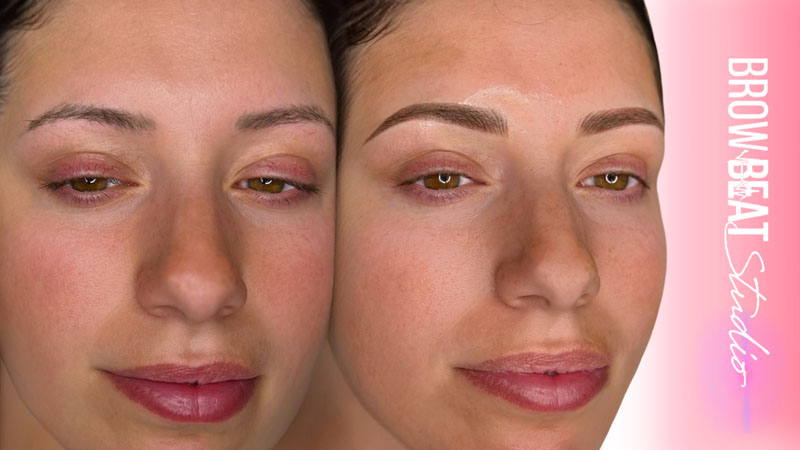
Freckles and visible pigmentation differences may be part of a mature client’s natural complexion. They can also reflect years of environmental exposure. A realistic portrait helps illustrate why the artist evaluates the actual treatment surface rather than assuming every fair-skinned mature woman has identical skin characteristics.
It can, but age does not create one predictable fading pattern. Pigment may become lighter. Color can change gradually.
Fine permanent detail can soften. And the surrounding skin continues changing over time too. The long-term result is therefore a relationship between the permanent pigment and a living treatment surface. That is true at every age. It simply becomes particularly important when permanent makeup is being planned for years of continued maintenance.
Clients understandably want permanent makeup to last. But more retention is not better retention. A permanent result needs to do more than remain visible. It needs to continue making sense on the feature. It needs to age in a way that can be maintained.
And it needs to leave the artist reasonable options when the client returns in the future. This matters at every age, but it becomes particularly relevant for a mature client who intends to maintain permanent makeup for years. The goal is not simply:
“How much pigment can we make stay?” The better question is: “How can this permanent makeup continue to serve this client as both the pigment and the face change over time?”
The skin present at the first appointment will not remain exactly the same forever. Neither will the permanent makeup. That is normal. A client may begin permanent makeup in her fifties and continue maintaining it through her sixties and seventies. The skin can change during that time. The natural brow hair can change.
The eyelid can change. The lips can change. The client’s style can even change. Long-term permanent makeup works best when maintenance responds to what exists now rather than blindly recreating the original treatment again and again.
Maintenance should not be treated as though every client needs the same appointment on the same calendar. The artist needs to look at what remains. How much pigment is still visible? How has the color changed? How has the skin changed?
How does the client feel about the current result? And does the original treatment approach still make sense? A mature client’s permanent makeup journey can evolve. That flexibility is a strength—not a problem.
UV exposure matters to tattoos at every age. Long-term sun exposure can contribute to pigment fading and color change. For a mature client, there may simply be a longer lifetime history of sun exposure behind the skin the artist sees today.
But again, BrowBeat does not assume every mature client has the same sun history. The important point is that healed permanent makeup should be considered part of the skin you are trying to protect long term.
Many clients use active skincare to maintain the appearance and texture of their skin. Those products can be valuable for the skin while still being relevant to permanent makeup longevity. Retinoids, prescription Retin-A, acids and aggressive exfoliating products can increase skin turnover and contribute to faster visible fading when repeatedly used through a permanent makeup area.
This does not mean mature clients need to abandon skincare. It means skincare and permanent makeup should not be thought of as completely unrelated parts of the face.

No. Soft permanent makeup can be beautiful on mature skin. So can more visible permanent makeup. The idea that every older woman should receive barely-there brows, an almost invisible lash line and the palest possible lip color is simply another age-based assumption. Some clients want softness. Some want structure.
Some want visible color. Some have worn strong makeup for decades and still feel most like themselves when their features are clearly defined. Mature is not a design style.
Individualized permanent makeup means the treatment responds to the person. It does not mean every mature client receives less. Sometimes the right answer is subtle. Sometimes the right answer is stronger. The important thing is that the permanent makeup works with the client’s current skin and anatomy while still respecting her personal taste.
There is no prize for making permanent makeup so faint that the client cannot enjoy it. And there is no reason to make it stronger than she wants simply because more pigment can be placed. The result should be intentional.
Natural does not have to mean invisible. A natural result can have obvious color. It can have visible shape.
It can create a meaningful difference. What makes it feel natural is that the result belongs on the person wearing it. The color makes sense.
The scale makes sense. The shape makes sense. The permanent makeup works with the feature instead of competing with it. That principle applies whether the client is 35 or 85.
Texture, thickness and the treatment surface can affect the appearance of extremely fine permanent detail.
Changes in elasticity, folds and anatomy can influence how permanent design sits on the face.
Individual skin characteristics can contribute to how permanent makeup heals and ages.
The artist may need to respond differently as both the skin and old permanent pigment change over time.
Your birthday does not tell us whether you like soft or strong makeup.
BrowBeat does not have an upper age cutoff.
Permanent makeup gives clients another option for maintaining selected color and definition as natural features change.
Skin characteristics matter when permanent brow techniques depend on extremely fine detail, background color or a combination of pigmentation. The artist needs to consider how the skin is likely to display the intended result and how that result may age.
Natural eyebrow hair also matters. As we age, that hair may become thinner, lighter, gray, white, coarse, wiry or less evenly distributed. Those factors can influence which permanent brow approach makes sense.
The important principle here is that mature skin and natural hair should be considered together rather than selecting a brow technique from age alone.

Hairstrokes depend on individual permanent lines remaining visually useful as hairs. That gives them a narrower ideal starting point than techniques that create broader fields of color. Skin texture, thickness, natural brow hair, medications, healing characteristics and long-term maintenance can all become relevant to how those fine lines perform. For that reason, BrowBeat does not treat hairstrokes as the default “natural” choice for a mature client.
Fine lines are one permanent brow option. They are not the definition of natural permanent makeup.
The eye area makes the relationship between skin and anatomy particularly easy to understand. Skin movement, folds and available visible space can change over time. That means a permanent eyeliner design needs to make sense on the eye that exists today.
A line that worked beautifully as conventional makeup years ago may not translate identically into a permanent design on a changing eyelid. That does not mean mature eyes cannot have permanent eyeliner. It means the design has to respect current anatomy.
Lips can also change with age. Natural color may become softer. The visible border can become less obvious.
Texture can change. Those characteristics become part of Lip Blush planning because the artist is adding permanent color to the lip that exists now. The purpose of this mature-skin page is not to prescribe a particular lip color or design — it is to establish the principle that age-related changes should be recognized rather than ignored.
Aging is continuing whether someone has permanent makeup or not. The skin will continue changing. The natural hair will continue changing.
The face will continue changing. Good permanent makeup does not need to fight that reality. It can work alongside it. Color can be maintained.
Definition can be maintained. The technique can evolve. The client can continue choosing how she wants to present herself. That is a much more useful long-term goal than trying to freeze the face at one particular age.
The permanent makeup decision that makes sense today does not have to become a lifetime contract with one technique. As skin changes and previous pigment becomes part of the treatment canvas, future decisions can change too.
A client may want a different level of definition. A technique that once worked beautifully may eventually be replaced by another approach.
The goal is continuity of a good result—not loyalty to a technique name.
BrowBeat’s approach to mature skin begins with a simple principle: look at the person before deciding what the age means. We do not assume thin skin. We do not assume poor healing.
We do not assume a client wants subtle permanent makeup. And we do not impose an upper age cutoff. We look at the skin.
We look at the feature. We listen to what the client wants. Then permanent makeup can be planned around the version of herself she wants to see when she looks in the mirror. Because getting older does not mean surrendering color, definition or personal style. In today’s world, permanent makeup gives us another way to maintain them.

Yes. Mature skin can be an excellent permanent makeup canvas. The important point is that mature skin is not one skin type. Thickness, dryness, texture, elasticity, anatomy and individual healing can vary considerably, so permanent makeup should be planned around the skin actually present rather than age alone.
Yes. BrowBeat welcomes mature permanent makeup clients and does not have an upper age cutoff. Getting older does not make skin unsuitable for permanent brows, upper permanent eyeliner or Lip Blush.
Age can provide useful context because skin, natural hair, facial anatomy and natural color can change over time. However, chronological age does not determine the treatment plan by itself. Two people of the same age can have very different permanent makeup starting points.
Aging skin may become thinner, drier, more textured or different in elasticity and movement, but those changes are not universal. The artist needs to evaluate the actual treatment surface and consider how its individual characteristics may affect design, healing and pigment retention.
BrowBeat does not have an upper age cutoff for permanent makeup. Being older does not make someone unsuitable for permanent makeup or mean that she should stop wanting visible brows, eyeliner or lip color.
No. Many clients in their sixties can benefit enormously from permanent makeup, particularly as natural color, brow density, eyesight or the ease of applying conventional makeup begins to change. The treatment should be based on the individual rather than the number 60.
No. A woman in her seventies can have an excellent permanent makeup starting point. Skin characteristics vary enormously, and a healthy-looking treatment surface on a 70-year-old may be more favorable for some permanent detail than the skin of someone considerably younger.
No automatic age rule makes 80 too old for permanent makeup at BrowBeat. Clients in their eighties may still value visible brows, upper eyeliner or lip color and may particularly appreciate not having to recreate those features with conventional makeup every morning.
No. BrowBeat does not have an upper age cutoff. We work with the client’s current skin, features, anatomy and desired result rather than using a birthday as the treatment plan.
No. Skin can become thinner with age, but not every mature client has thin skin. Some have thicker skin, some have significant texture, some remain relatively smooth and some have a combination of characteristics. The actual skin matters more than the stereotype.
Yes. Thin skin is a treatment consideration rather than an automatic rejection. The artist needs to recognize the skin she is working with and plan the permanent makeup appropriately for that individual treatment surface.
Yes. Delicate does not mean untreatable. Mature clients with more delicate skin can still be permanent makeup clients; the important point is recognizing the skin characteristics rather than pretending every treatment surface behaves identically.
Yes. Dry skin is not a disadvantage for permanent makeup. It is one characteristic among many, and the significance of dryness depends on the treatment area, texture and permanent result being planned.
Yes. Texture does not rule out permanent makeup. It can affect how extremely fine permanent detail visually reads, so the treatment plan should work with the skin surface rather than ignoring it.
Fine lines and wrinkles do not exclude someone from permanent makeup. Their location, the amount of texture, the treatment area and the desired result all matter. The design needs to belong to living, moving skin rather than an idealized flat surface.
It can. Skin moves and folds, and changes in elasticity can affect the treatment surface and how a permanent design sits on the face. This is why current anatomy is more useful than choosing a design based only on age or an old photograph.
It can, but there is no single mature-skin healing pattern. Some mature clients heal very easily, while others may take longer to feel completely settled. Skin characteristics, the service performed, individual healing and aftercare all contribute.
Not necessarily. Age alone does not provide an exact healing timeline. A mature client should expect a normal healing period for permanent makeup but should not assume that being older means poor or unusually slow healing.
Yes. Mature skin can retain cosmetic tattoo pigment. The amount of retention and the way the result ages vary between individuals, so the quality of the healed result matters more than assuming older skin cannot hold color.
There is no universal rule that permanent makeup lasts longer on mature skin. Skin characteristics, technique, pigment, skincare, sun exposure, lifestyle and individual retention all influence longevity.
No. Some mature clients retain pigment strongly and others fade more quickly. Age by itself does not predict the fading pattern, and different permanent makeup services also age differently.
Retention can be influenced by individual skin characteristics, the permanent makeup service, pigment, healing, aftercare, sun exposure, skincare, lifestyle and time. The client’s age is only one piece of a much larger picture.
Yes. Retinoids, prescription Retin-A, acids and other strong exfoliating or skin-turnover products can contribute to faster visible fading when repeatedly used through a permanent makeup area. Mature clients do not need to abandon skincare, but skincare and permanent makeup longevity are connected.
Yes. UV exposure can contribute to tattoo pigment fading and color change at any age. A mature client may have a longer history of sun exposure, but BrowBeat does not assume that every older client has the same sun history.
Relevant medications should be disclosed before an elective cosmetic tattoo appointment. BrowBeat does not assume that every mature client takes the same medications, and clients should not independently stop or change prescribed medication simply to have permanent makeup.
Blood-thinning medication should be disclosed before treatment. A client should not independently discontinue prescribed blood thinners for a permanent makeup appointment. Questions about changing prescribed medication should be discussed with the healthcare professional who manages it.
No. Soft permanent makeup can be beautiful, but mature is not a design style. Some clients want subtle definition while others want stronger brows, more visible upper eyeliner or noticeable lip color. Personal style still matters.
Yes. Individualized permanent makeup does not mean conservative permanent makeup. The level of definition should make sense for the client’s current features, anatomy, skin and preferences rather than being reduced simply because she is older.
Useful considerations include the actual skin characteristics, the feature being treated, natural hair or color, current anatomy, relevant health and medication information, the client’s desired result and how the permanent makeup may be maintained over time.
Start with the person rather than the age category. Look at the skin that exists now, the feature being treated, what has changed, what the client wants to maintain or restore and how permanent makeup can fit into the years ahead. Age gives context; the individual gives the treatment plan.