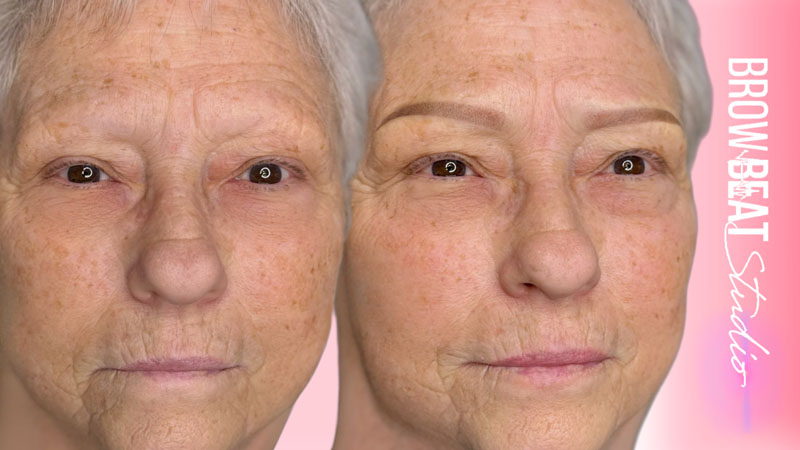
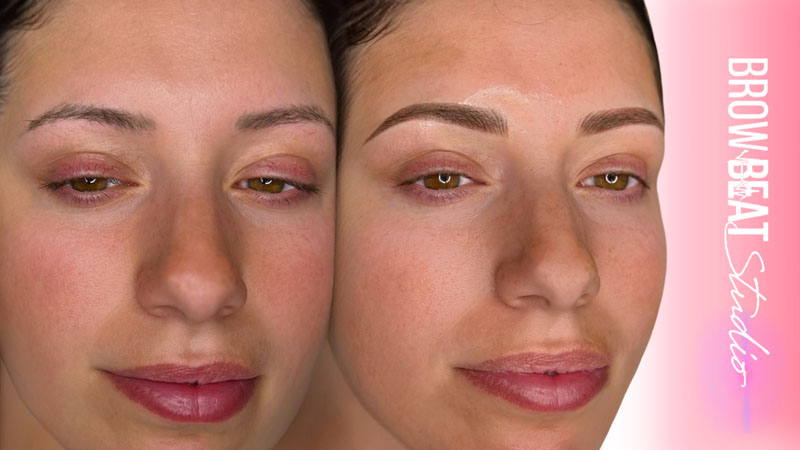
Permanent eyebrows can be one of the most valuable permanent makeup services for mature women. Natural brow hair changes. It can become thinner. It can become gray or white.
Individual hairs can become longer, coarser or wirier. Areas that once grew evenly can become increasingly sparse. And drawing two balanced eyebrows every morning can become considerably harder when eyesight changes too.
Permanent makeup can put color, shape and structure back underneath those changes. But there is an important decision to make:
What kind of permanent eyebrow should we create?
Microblading?
Nano Brows?
Powder or Ombré Brows?
Combo or Hybrid Brows?
At BrowBeat, we do not consider all four approaches equally useful as a long-term starting point for most mature clients. Our preference is generally clear.
If you are a mature client who expects to maintain permanent eyebrows for years, BrowBeat will usually recommend beginning with a soft shaded brow rather than beginning with permanent hairstrokes.
That recommendation is not based on the idea that mature women cannot have hairstrokes. Some can. It is based on what we have learned from years of creating, healing, maintaining and repeating permanent eyebrow treatments.
We are not only planning the eyebrows you want today.
We are thinking about the eyebrows we may need to maintain later.


For many mature clients, BrowBeat prefers Powder, Ombré or machine-shaded permanent brows. Shading gives us control over color. It gives us control over density.
It gives us control over structure and symmetry. It works beautifully underneath natural brow hair that may have become gray, white, sparse, coarse or wiry. And importantly, shading is highly maintainable. When a shaded brow fades, we are still working with a shaded brow. That gives us a very different long-term starting point from repeatedly layering permanent hairstrokes over previous permanent hairstrokes. For a mature client who knows she wants to keep her brows looking polished year after year, that matters enormously.
This is where BrowBeat’s mature-brow philosophy differs from a lot of technique marketing. It is easy to choose a service according to a beautiful fresh photograph. Nano strokes can look spectacular. Microblading can look incredibly delicate. Individual permanent hairs can be extremely appealing. But the first healed result is only the beginning of a long-term permanent makeup relationship. If you love having permanent eyebrows, you are probably going to maintain them. That means the more useful question becomes:
What happens when we need to do these brows again? And again later? And again as both the permanent pigment and your natural eyebrows continue changing? For BrowBeat, that long-term repeatability is one of the strongest reasons we often recommend shading from the beginning for mature clients.
A mature client may begin permanent makeup in her fifties, sixties, seventies or beyond and decide she never wants to go back to drawing her eyebrows every morning. We understand that completely. Permanent brows can make an enormous difference. So BrowBeat prefers to think beyond one treatment cycle. A soft shaded brow gives us a permanent structure that can be maintained as shading. It can become lighter.
It can soften. Then, when additional color is appropriate, the existing faded shading still makes sense as the background for a shaded treatment. That creates continuity. Hairstrokes have a different long-term problem. They need clean visual space around individual lines if those lines are going to continue reading as hairs. Once previous strokes remain in the skin, the next treatment is no longer being performed on a clean canvas.
Imagine the first Microblading or Nano treatment. The skin between the permanent strokes is relatively clean. Each line has room around it. The lines can read as individual hairs. Then those strokes age. Some become lighter.
Some remain stronger. Some widen. Some become less distinct.
The client returns and more strokes are added. Now the artist is working around old pigment. Later, the client returns again. There can now be areas with stronger residual color, areas with softer color and areas where old permanent lines have increasingly blended together. The issue is not that the client did anything wrong — it is simply what repeated permanent hairstroke work can eventually create. The canvas changes.
Clients sometimes assume that if hairstrokes eventually stop being appropriate, the artist can simply put a Powder Brow over them and the eyebrow will immediately behave like a clean first-time Powder Brow. Sometimes the transition can be made beautifully. But it is not always that simple.
Old hairstroke pigment may remain unevenly throughout the eyebrow. One area may contain stronger color. Another may be much lighter. Some old lines may have become broader or increasingly blended.
When shading is added over that varied background, the artist is not creating a Powder Brow on clean skin. The old permanent work is participating in the finished result. That can make it harder to achieve the soft, even Powder effect we could have created if the eyebrow had originally been built and maintained as shading.
Because we want the treatment to remain useful to you. Not only this year. In future years too. A Powder or Ombré Brow gives BrowBeat a repeatable permanent structure. The brow can be created softly the first time.
It can heal softly. It can gradually fade. And future maintenance can continue working with that shaded foundation. For clients who know they are going to keep permanent brows as part of their lives, BrowBeat considers that a major advantage.
No. There are mature clients whose skin and natural eyebrow hair can support permanent hairstrokes beautifully. But BrowBeat selects those clients more carefully. And even when the initial starting point is excellent, we still discuss the shorter structural shelf life of permanent hairstrokes and what repeated maintenance may eventually mean. The question is not: “Can we physically put hairstrokes into this eyebrow?”
The better question is: “Is beginning a long-term permanent brow journey with hairstrokes the best use of this clean skin?” For many mature clients, BrowBeat believes the answer is no.

This is the conceptual difference behind almost every mature brow technique decision.
Microblading and Nano both create individual permanent lines intended to resemble eyebrow hairs. For those lines to work visually, they need enough separation and contrast to continue reading as hairs. That makes hairstrokes more dependent on the skin, natural brow framework and available clean space.
Powder, Ombré and Microshading create a field of permanent color. The pigment deposits are intended to work together. They do not need to remain individually identifiable. That gives shading greater flexibility as the permanent makeup softens and is maintained over time.
This is one of the biggest misconceptions BrowBeat sees. A mature client says: “I want something natural.” And the automatic assumption becomes:
“Then you need Microblading or Nano.” Not necessarily. A soft shaded brow can look extremely natural. Natural does not mean the tattoo has to imitate individual hairs. Natural can mean:
For a mature client with changing natural hair, a soft shaded foundation can actually create a more cohesive-looking eyebrow than adding another pattern of fine permanent lines underneath it.
Permanent eyebrow planning cannot look at the skin and ignore the hair growing above it. Natural brow hair may become:
Those characteristics change what permanent makeup needs to accomplish. A fine tattooed hairstroke sitting underneath fine, evenly distributed natural hair can integrate beautifully. The same fine tattooed line underneath coarse, wiry or multidirectional mature hair may have a much harder time visually matching what is growing above it.
Shading does not have to imitate those hairs. It can create a consistent color foundation underneath them.
The client’s real eyebrow hair provides actual three-dimensional texture above the skin.
Permanent pigment can restore visual presence where the natural eyebrow has become lighter or less consistent.
The mapped brow gives the eyebrow an intentional overall structure.
Shading can create consistent color underneath natural hairs and across areas where density has changed.
Permanent hairstrokes can add the appearance of individual hairs when the skin and natural framework strongly support them.
The future treatment needs to work with the permanent pigment that remains rather than pretending every appointment begins on untouched skin.
Gray or white natural eyebrow hair can reduce the visible color of the brow even when plenty of physical hair remains. Wiry hairs can create texture without necessarily creating a clean, consistent eyebrow shape. Some hairs may remain dark while others become gray. Some may grow longer.
Some may begin pointing in directions they never did years earlier. A soft shaded background can create visual continuity underneath that changing natural hair. The individual hairs can remain themselves. The permanent makeup supplies the consistent color and structure underneath them. For many mature clients, that combination can be remarkably effective.


Microblading can be performed on some mature clients, but BrowBeat does not consider it the default permanent brow choice for mature skin. Microblading creates individual permanent hairstrokes with a manual hand tool. For those strokes to remain visually successful, the skin needs to support fine permanent lines and there needs to be enough visual space around the strokes for them to continue reading as hairs.
That can work beautifully on the right starting point. But when a mature client is planning to maintain permanent eyebrows for years, BrowBeat also considers what happens after the first set of strokes has aged. That long-term question is one of the reasons we often recommend beginning with shading instead.
A mature client may have a stronger starting point for Microblading when several things come together. The skin supports fine permanent detail. The natural eyebrow hair is relatively fine. The hair has a useful existing framework.
The client has smaller gaps rather than needing extensive permanent density. She genuinely wants visible hairstrokes rather than simply using the word natural. And she understands that the long-term maintenance story of permanent strokes is different from the long-term maintenance story of shading.
Chronological age does not remove Microblading as an option. BrowBeat simply considers the option more selectively.
BrowBeat is more likely to move the conversation away from Microblading when the skin does not provide a strong fine-line canvas, when natural brow hair has become coarse or wiry, when the client wants substantial density, or when long-term repeatability is a major priority. We also think carefully about clients who are highly focused on perfect visual symmetry and consistent color throughout the eyebrow. Those goals can require more structural control than a stroke-only treatment naturally provides. In those situations, shading may give us a better foundation from the beginning.
There is no BrowBeat rule that says Microblading stops at 50, 60 or 70. A birthday is not the reason we may recommend another technique. The recommendation comes from the complete starting point: the skin; the natural brow hair;
the desired amount of density; the client’s expectations; and the likelihood that she will want to maintain permanent eyebrows repeatedly in the future. For many mature clients, those factors collectively make shading the more practical long-term choice.
Nano Brows are sometimes presented as the modern solution for clients who may not be ideal for Microblading. BrowBeat takes a more measured view.
Nano uses a PMU machine to create individual permanent hairstrokes rather than creating those strokes manually with a Microblading tool. The method of creating the line is different.
But the finished permanent structure is still a hairstroke. That means Nano still depends on fine lines remaining visually separated enough to continue reading as hairs. For a mature client, the machine does not remove the fundamental long-term limitations of permanent hairstrokes.
The clearest distinction is: Nano → machine-created hairstrokes. Microblading → manually created hairstrokes. Nano creates the line through repeated machine perforations rather than the manual cutting motion used in Microblading. That can make Nano a gentler way of creating a permanent hairstroke. But gentler does not mean more repeatable forever.
Both techniques still leave permanent lines in the skin. Both need space. Both soften.
Both can become increasingly blended as treatments accumulate. And both can eventually make future stroke work more complicated. For BrowBeat, that long-term similarity matters more than marketing one hairstroke method as universally better for mature clients.
BrowBeat does not assume that Nano lasts longer simply because a machine created the line. Retention depends on much more than the tool name. Skin, implantation, pigment, stroke spacing, lifestyle and individual retention all contribute.
More importantly for a mature client, both Nano and Microblading need the permanent lines to continue behaving visually like hairs. The existence of pigment is not the same thing as preservation of crisp hairstroke detail.
Powder Brows are often BrowBeat’s preferred starting point for mature permanent brow clients. The reason is not simply that Powder works on a wider range of skin characteristics — it is also the way the permanent structure behaves over time.
Powder uses machine shading to create a field of color through the eyebrow. The pigment deposits are supposed to work together. They do not have to remain separated into individual lines. That gives the artist considerable control over:
For a mature client who expects to maintain permanent eyebrows repeatedly, those are substantial advantages.

A mature natural eyebrow can contain several different visual problems at once. Some areas may be sparse. Some hairs may be gray. Some may be white.
Some may remain dark. Some hairs may become coarse or wiry. The two eyebrows may no longer carry equal natural density. Shading does not need to imitate each of those individual hairs. It creates a consistent permanent foundation underneath them. That can make the complete eyebrow look cleaner and more intentional while still allowing the client’s real hair to provide physical texture.
They do not have to. The word Powder describes a shading structure. It does not prescribe darkness.
A Powder Brow can be created softly. It can be translucent. Natural hair can remain visible through it. The client can have enough permanent color to establish the eyebrow without making the result unnecessarily strong.
This is why BrowBeat does not accept the idea that mature clients have to choose between “natural hairstrokes” and “heavy Powder Brows.” There is an enormous amount of space between those two extremes.
Ombré Brows sit within the machine-shading family. The difference is the distribution of saturation.
One area of the brow can remain softer while another carries greater definition. That can create a graduated result without giving up the structural advantages of shading. For a mature client who wants softness but also wants a clear, maintainable permanent eyebrow, Ombré can be a useful way to think about the finished effect.
Microshading is another term used for machine-created shading. Rather than building the eyebrow from individual permanent hairs, the artist creates small pigment deposits that work together visually as a field of color.
For mature clients, the important distinction is not which shading term sounds newest — it is that the permanent result is being built as shading rather than relying exclusively on fine lines.
If BrowBeat is choosing between Microblading and Powder for a mature client who expects to maintain permanent eyebrows long term, we will generally favor Powder. Microblading can create beautiful individual hairstrokes on the right skin. Powder gives us broader control over the complete eyebrow.
As the treatments age, that difference becomes increasingly important. A fading Microblading stroke can become softer, wider or less individually distinct. A fading Powder Brow becomes softer shading.
The Powder Brow is still behaving like the structure it was originally intended to be. That makes future maintenance more straightforward.
This comparison is particularly useful because both techniques can use a PMU machine. The machine is not the deciding factor. The permanent structure is. Nano creates lines.
Powder creates shading. Nano lines need separation. Powder pigment is intended to work together. For a mature client planning repeated maintenance, BrowBeat generally prefers the long-term flexibility of the shaded structure.
Combo or Hybrid Brows combine hairstrokes with shading. For a mature client who strongly wants some visible hairstroke texture, Combo can offer a useful middle ground.
The permanent lines provide hair-like detail. The shading provides density and structural support.
If the strokes soften, the eyebrow does not depend entirely on those lines to maintain its shape. That makes Combo more structurally flexible than a pure stroke-only treatment.
The hairstrokes inside a Combo Brow are still hairstrokes. They still soften.
They still leave residual permanent pigment. And repeated stroke work can still reduce the amount of clean skin available for future lines. The shading gives the eyebrow more support. It does not make the stroke component infinitely repeatable. This is why a mature client who does not particularly care about seeing individual permanent hairstrokes may be better served by beginning with a pure shaded result.
The deciding question is often surprisingly simple: How important are permanent hairstrokes to you?
If the answer is “very important,” and the skin and natural brow framework support them, Combo can preserve some hair-like detail while adding shaded structure. If the client mainly wants attractive, balanced, visible permanent eyebrows and does not have a strong attachment to permanent strokes, Powder can provide the structural benefits without adding a stroke component that may complicate future maintenance.

In BrowBeat’s experience, shading is the most repeatable long-term permanent brow structure. That is one of the most important reasons we recommend it so frequently for mature clients.
A faded shaded brow remains a shaded starting point. Future shading can work with that background.
Repeated hairstrokes create a different canvas because old lines do not necessarily disappear evenly before the next treatment is wanted. For a client who already knows permanent eyebrows are going to become part of her regular maintenance, repeatability matters.
When a BrowBeat client has a shaded brow and the healed result is appropriate for regular maintenance, it can be easier to anticipate future brow appointments because the permanent structure is designed to be maintained as shading. With hairstrokes, BrowBeat is more cautious about assuming another stroke treatment will be appropriate on a fixed calendar.
The old lines need to fade enough. There needs to be enough visual space. And the existing permanent pigment needs to provide a reasonable starting point for additional hairstrokes. That is why BrowBeat does not treat stroke maintenance as though every client can simply receive another identical set of lines every year indefinitely.
Thinning eyebrows are one of the most common reasons mature clients begin thinking seriously about permanent makeup. The brow may still be there. It simply may not have the same visual strength it once had.
There can be less hair through the body. The tail can become sparse. One brow can thin differently from the other. And lighter or gray hairs can make the remaining eyebrow look even less dense against the skin.
Permanent color can restore a visible foundation underneath that natural hair. For many mature clients, shading is particularly useful because it can create consistent density without asking individual permanent strokes to manufacture an entire eyebrow.
This is another common assumption. A client sees an empty area and thinks: “I need hairs there.” Sometimes that is true. But the larger the sparse area becomes, the more permanent hairstrokes are required to create visual density.
As more lines are placed into the same area, there is less negative space between them. And those lines still have to age. Shading approaches the same problem differently. Instead of trying to create density by drawing more and more permanent hairs, it creates a soft field of color underneath the natural eyebrow. For many mature clients, that can be the cleaner long-term solution.
Many mature clients lived through decades when very thin eyebrows were fashionable. Repeated tweezing can leave areas that never returned to their previous density. If there is still a useful natural eyebrow framework, permanent makeup can create greater continuity through those thinner areas and reestablish a more visible overall shape.
The technique decision still depends on the skin, remaining natural hair, amount of missing density and long-term maintenance plan. The fact that the brows were overplucked does not mean they need to be rebuilt with permanent hairstrokes.
Gray eyebrow hair creates an interesting permanent makeup problem because the client may still have plenty of physical hair while losing much of the visible color that once defined the eyebrow. The hairs are there. But from normal viewing distance, the brow can look increasingly faint.
Permanent shading underneath that hair can restore visual color without trying to turn every individual gray hair into something it is not. The natural hair continues providing physical texture. The permanent pigment provides the color foundation underneath it.
The answer is not simply “gray.” Permanent brow color needs to make sense with the client’s complete coloring, remaining natural brow hair and desired result. A mature client may have a mixture of gray and darker brow hairs. Another may have silver hair on her head but warmer remaining eyebrow hair.
Another may have almost completely white brows. The permanent color should create a believable relationship with what is actually present rather than being selected from the name of the client’s hair color alone.
White eyebrow hair can become almost invisible against some skin tones even when a reasonable amount of natural hair remains. Permanent color underneath those hairs can give the eyebrow visual presence again.
The white hairs do not need to disappear. They can continue creating natural physical texture above the permanent brow. The tattoo supplies the visible framework the natural hair no longer provides by color alone.
Very light natural eyebrows can create a similar problem. The client may not be missing large amounts of hair at all. She may simply have insufficient contrast for the eyebrow to read clearly on the face.
Permanent pigment can increase that contrast while still remaining soft. The goal does not need to be a dark brow. It is to create enough color for the eyebrow to become visually useful again.


Natural eyebrow hair can become more challenging with age even when it does not become sparse. Some hairs become coarse. Some become longer.
Some begin pointing upward, downward or outward in ways the client never dealt with when she was younger. Trying to solve that problem by adding another pattern of fine tattooed hairs underneath it can create more competing texture. Shading gives the artist another option. Instead of attempting to imitate every natural hair, permanent color can establish a consistent background shape underneath the changing hair pattern. That is one of the reasons BrowBeat likes shading so much for mature brows.
There is no universal mature eyebrow shape. BrowBeat does not make mature brows thin. We do not flatten the arch.
We do not create a higher arch because someone believes it will make the client look younger. The brow shape should make sense with the client’s natural hair, facial proportions, existing asymmetry, personal style and the amount of permanent structure she wants. The goal is a brow that belongs on the face.
Not simply because they are mature. Some clients naturally suit a finer eyebrow. Others look considerably more balanced with greater brow presence.
Making every mature woman’s eyebrows thin can actually remove some of the facial framing permanent makeup is being used to restore. Thickness should be a design decision—not an age rule.
There is no universal “anti-aging” arch. An arch can influence how the eyebrow visually frames the eye, but pushing it higher does not physically lift facial tissue.
The shape still needs to relate to the client’s natural brow and facial structure. Permanent makeup should not chase an artificial lifting effect at the expense of a believable eyebrow.
Brow shape can influence visual balance. A well-designed tail and arch can help the eyebrow feel cleaner and more intentional. That may create a more open or refreshed visual impression.
But permanent makeup does not physically lift skin, muscle or tissue. The effect is visual framing—not a surgical lift.
The tail deserves careful thought because it completes the visual direction of the eyebrow. Natural tails can become sparse with age. Some almost disappear. Others contain only a few lighter hairs.
Permanent makeup can restore that missing visual structure. But the tail should be designed for the current face rather than extending or lifting it according to a generic mature-brow formula.
Color is one of the most powerful parts of mature permanent eyebrows. Often, the client has not lost every natural brow hair. She has lost some of the visible contrast that made the eyebrow easy to see.
Permanent pigment can put that contrast back. But the goal is not simply to make the brow darker. The color needs to relate to the natural hair, the client’s overall coloring and how much permanent definition she wants.
A client with mixed gray and darker eyebrow hair does not need a tattoo that somehow changes color underneath every individual strand. The permanent brow creates a foundation.
The natural hairs sit over it. Together they create the finished eyebrow. This is another reason shaded permanent color can work so beautifully as natural brow hair becomes more varied.
For BrowBeat, the answer is generally shading. This is different from claiming that every Powder Brow will retain more pigment than every hairstroke brow. The advantage is structural.
A shaded brow can soften and still remain a shaded brow. A permanent hairstroke needs to remain sufficiently separate and defined to continue reading as a hair. That makes the long-term behavior of the two structures very different.
Permanent hairstrokes can become lighter, softer and less distinct over time. Some lines may remain stronger than others.
Some can widen. And neighboring strokes can gradually lose some of the visual space that originally separated them. The client can therefore still have plenty of permanent pigment while having much less of the original hair-by-hair effect. That is what BrowBeat means when we talk about the shorter structural shelf life of hairstrokes.
Powder Brows also fade and soften. Permanent shading is not frozen in place forever. But the pigment was originally designed to function as a field of color.
As that field becomes lighter, it can continue creating useful background density and shape. When additional color is eventually appropriate, the artist is still working with a shaded structure. That is why BrowBeat considers Powder particularly useful for long-term mature-brow maintenance.

If permanent eyebrows improve your life, there is a good chance you are going to want to keep them. BrowBeat plans with that assumption in mind. We want a treatment that can look beautiful now and still give us sensible maintenance options later.
Shading allows us to maintain color and structure without repeatedly asking clean skin to appear between new permanent lines. For a mature client who knows she wants permanent brows to remain part of her routine, that repeatability is a major benefit.
When appropriate, BrowBeat may plan regular maintenance for a shaded-brow client so the permanent color and structure can be kept looking polished rather than waiting until the brows feel extremely old or depleted. That does not mean blindly tattooing every eyebrow because exactly twelve months have passed.
The existing permanent makeup still needs to make sense for additional treatment. But a shaded brow gives BrowBeat a much more predictable long-term maintenance structure.
With Microblading or Nano, the passage of time does not guarantee that another set of hairstrokes will be appropriate. There may still be too much residual pigment. Some old lines may remain stronger than others.
The clean visual space needed for another fine pattern may not yet exist. That is why BrowBeat does not want to promise a mature hairstroke client that the exact same stroke treatment can simply be repeated on a yearly schedule forever. The skin has to give us the canvas first.
Mature permanent brows still need time to heal before the result can be judged. The fresh color will initially appear stronger. The skin settles. The permanent pigment becomes softer.
And the relationship between the tattoo and the client’s natural brow hair becomes easier to evaluate once healing has progressed. BrowBeat does not assume that every mature client will heal slowly or poorly.
Skin characteristics and individual healing vary considerably. The more useful question is how the particular permanent brow technique heals in the particular skin being treated.
Microblading healing needs to be considered in relation to the individual permanent lines. The fresh strokes initially look darker and more distinct. As they heal, they soften.
How clearly they remain separated depends on the skin, the natural brow framework, the permanent work itself and individual retention. That is one reason BrowBeat does not judge mature Microblading by the appearance of fresh strokes alone.
Nano strokes are created with a PMU machine rather than a manual Microblading tool, but they are still permanent hairstrokes. The fresh lines soften as the skin heals over them.
Some mature clients may retain excellent visible detail. Others may heal considerably softer. The machine technique does not guarantee that every mature skin will preserve fine hairstroke detail in the same way.
Powder Brows begin with stronger visible saturation and settle into softer healed shading. Because the result does not depend on every pigment deposit remaining individually identifiable, the artist is evaluating the healed field of color rather than a collection of separate permanent lines. For many mature clients, that gives the healed result greater visual flexibility.
Mature skin can absolutely retain permanent brow pigment. Age does not mean color simply disappears. How much pigment remains and how the result looks over time depend on the individual skin, permanent technique, pigment, skincare, sun exposure, lifestyle and maintenance.
What BrowBeat cares about is not only whether pigment remains. We care about whether the permanent structure still looks useful.
A permanent hairstroke can still contain pigment while no longer looking particularly hair-like. A shaded brow can still contain pigment while becoming much lighter than the client prefers. Simply asking whether pigment is “still there” does not tell us enough. We need to ask: Does the brow still have useful color? Does the shape still read well?
Does the client still like the density? Can the existing permanent makeup support another treatment? Those are more useful long-term questions.
There is no single mature-brow lifespan. Microblading, Nano, Powder, Ombré and Combo Brows do not all age in the same way. Skin characteristics vary. Skincare varies. Sun exposure varies.
Individual pigment retention varies. And clients have different standards for when they feel their brows need more color. The most important long-term distinction is the structure being maintained. Hairstrokes need to continue reading as hairs. Shading needs to continue providing useful background color.

At BrowBeat, the permanent brow technique itself does not need to determine what a client pays. A mature client should not feel pressured to choose Microblading, Nano, Powder or Combo because one technique happens to have a more attractive price attached to it.
Current BrowBeat permanent brow pricing is displayed through our online booking system. The technique can be decided in person after looking at the client’s skin, natural eyebrow hair, inspiration photographs and desired result. That allows the treatment decision to remain about the eyebrow rather than the menu.
At BrowBeat, we do not use a mature client’s technique decision as a reason to push her toward one brow because it is cheaper or away from another because it is more expensive. The permanent brow structure follows the studio’s current brow pricing rather than treating every technique as a completely separate financial product. Current pricing can be viewed when booking.
No. In fact, BrowBeat would rather you arrive with an understanding of the result you want than feel responsible for diagnosing your own skin and choosing a permanent makeup technique from the internet. Bring inspiration photographs. Bring photographs of yourself on days when you really liked your eyebrows. Tell us how you used to wear them.
Tell us what has changed. Tell us what you want back. Tell us whether you want soft, defined, fuller or more symmetrical. Then we can decide how the permanent brow should actually be built.
BrowBeat Studio Dallas has worked with permanent brow clients across a wide range of ages for approximately a decade. Mature clients are some of our favorite brow clients because permanent color can make such a substantial difference when natural eyebrow hair has become lighter, thinner, gray, white, wiry or increasingly inconsistent. BrowBeat does not have an upper age cutoff for permanent brows. We also do not prescribe the same brow technique to every mature client.
But when someone expects permanent eyebrows to become part of her long-term routine, we are clear about our preference: for many mature clients, we would rather begin with a soft, maintainable shaded brow than use clean skin for a hairstroke pattern that may eventually need to transition into shading anyway.
Permanent eyebrows are not only about creating a result today. They are about what today’s treatment leaves behind for tomorrow. A client who loves her permanent brows is likely to maintain them. So BrowBeat thinks about the next treatment before the first one is even finished. Will this structure be easy to maintain? Will the old pigment still make sense?
Will we have flexibility as the natural brow changes? Can we continue creating a polished result without repeatedly fighting previous permanent work? Those questions are part of the original technique decision. Many mature brow clients go on to ask about permanent eyeliner for mature eyes or Lip Blush for mature lips as part of that same longer-term plan.
BrowBeat’s preference for shading is not about telling mature women what they cannot have — it is about giving mature clients a permanent brow structure that we believe offers excellent flexibility over time. Powder can be soft. It can be natural. It can be more defined.
It can sit beautifully beneath gray, white, blonde, sparse or wiry natural hair. It can create symmetry without relying on every individual permanent line to remain perfectly readable. And when the client returns for maintenance, we are still working with the kind of structure we intended to create from the beginning. That is a very strong starting point.
If you genuinely love individual permanent hairstrokes and your skin and natural brow framework strongly support them, Microblading or Nano may still be considered. If you love hairstrokes but need more density and structure, a Combo or Hybrid approach may offer additional support. But if your main goals are attractive permanent eyebrows, visible color, consistent density, symmetry and a treatment that can be maintained repeatedly over the years, BrowBeat will usually steer the conversation toward Powder, Ombré or machine shading.
Not because it is the only permanent brow technique mature women can have. Because after years of working with permanent eyebrows, we believe it is often the strongest place to begin.
A permanent eyebrow should not be judged only by the day it is created. It should be judged by how it heals. How it softens.
How it works with changing natural hair. How it can be maintained. And what options it leaves available for the future.
Mature clients are not an afterthought in permanent makeup. They are some of the clients for whom good permanent brow planning matters most. We are not trying to create one perfect photograph and then leave you to solve the rest later. We are trying to give you brows we can continue taking care of together.
Brow technique is only one part of planning permanent makeup for mature skin, which BrowBeat considers together with every service.

For many mature clients, BrowBeat prefers Powder, Ombré or machine-shaded brows because shading provides color, structure and symmetry while remaining highly maintainable over time. Hairstrokes can still suit selected mature clients, but BrowBeat considers them a narrower long-term choice.
There is no technique selected by age alone. Skin, natural brow hair, desired result and long-term maintenance all matter. However, when a mature client expects to maintain permanent brows repeatedly for years, BrowBeat will usually favor a soft shaded approach.
Microblading can work on selected mature clients with skin and natural brow hair that strongly support fine hairstrokes. BrowBeat does not consider it the default mature-brow choice because repeated permanent strokes have a shorter structural shelf life and can make future maintenance more complicated.
Yes. BrowBeat does not use 60 as a Microblading cutoff. The question is whether the client’s actual skin, natural brow framework and long-term goals make permanent hairstrokes a sensible starting point.
Yes. Powder Brows are frequently BrowBeat’s preferred option for mature clients. Shading can create soft color, density and structure underneath natural hair and can be maintained repeatedly without depending on individual permanent lines remaining readable as hairs.
Yes. Ombré Brows belong to the machine-shading family and can create graduated saturation while retaining the structural advantages of shading. The result can be very soft and does not need to look heavy or overly made up.
It can be an excellent approach. Microshading creates a field of machine shading rather than relying entirely on individual hairstrokes. That can provide consistent color and structure as natural mature brow hair becomes lighter, sparse, gray, white or less even.
Nano Brows can work on selected mature clients, but machine-created hairstrokes still need appropriate skin, useful natural brow hair and enough visual space to remain readable. BrowBeat does not assume that Nano is the best mature-brow option simply because the strokes are created by machine.
Nano uses a PMU machine while Microblading creates strokes manually. Nano can be a gentler method of creating a permanent line, but both techniques still produce hairstrokes with similar long-term requirements for spacing, clarity and clean visual background. BrowBeat evaluates either selectively on mature clients.
For many mature clients planning long-term maintenance, BrowBeat prefers Powder. Nano depends on individual permanent lines remaining visually useful as hairs, while Powder can soften and still continue functioning as shading. That gives Powder greater structural flexibility over repeated treatments.
BrowBeat generally favors Powder for mature clients who expect to maintain permanent eyebrows over time. Microblading can create beautiful hairstrokes on the right starting point, but Powder offers broader control over density, symmetry, color and repeated long-term maintenance.
They can be, particularly when a client strongly wants some hairstroke detail but also needs greater density or structure. The shading component supports the overall brow as the permanent strokes soften, although Combo still contains hairstrokes and therefore does not eliminate their long-term limitations.
If permanent hairstrokes are very important to the client and her starting point supports them, Combo can preserve some hair-like detail while adding shading. If hairstrokes are not a priority, BrowBeat often prefers pure Powder because it provides the structural and maintenance benefits of shading without adding a stroke component that may complicate future treatments.
In BrowBeat’s experience, shading has broader usefulness for mature clients. Hairstrokes have a narrower ideal starting point because fine permanent lines need appropriate skin, natural brow support and visual separation. Shading can work as a soft field of color and is generally more repeatable over time.
Either can look natural. Natural does not mean hairstrokes. A soft Powder Brow can create a believable color foundation underneath natural hair without looking heavy, while hairstrokes can look beautiful when the skin and existing brow framework strongly support them.
It depends on how much natural hair remains and how much permanent density is needed. BrowBeat often likes shading for mature thinning brows because it can create a consistent background of color without requiring many permanent lines to manufacture the appearance of density.
For ordinary age-related sparseness, shading can be particularly useful because it creates continuity across areas of uneven density. Smaller gaps may sometimes support hairstrokes, but larger sparse areas often require more structural color than a stroke-only treatment naturally provides.
Yes. Permanent pigment can create a visible color foundation underneath gray natural hair. The gray hairs continue providing physical texture while the tattoo restores some of the color and structure that the natural eyebrow may no longer provide on its own.
Yes. White natural hairs can become difficult to see against the skin even when plenty of physical hair remains. Permanent color underneath those hairs can make the overall eyebrow visible again without needing to eliminate or imitate the white hair itself.
Permanent makeup can add enough contrast for very light brows to become more visible while still remaining soft. The goal is not to create a dark eyebrow, but to establish a color relationship that works with the client’s natural hair and overall coloring.
There is no rule that gray hair requires gray permanent brows. BrowBeat considers the client’s remaining natural brow hair, overall coloring and desired result. Permanent pigment creates the visual foundation beneath the natural hair rather than attempting to copy every individual gray or silver strand.
Not simply because they are mature. Some faces suit finer brows and others benefit from more brow presence. Permanent brow thickness should be determined by the natural eyebrow, facial proportions and personal preference rather than an age-based rule.
There is no universal mature eyebrow shape. BrowBeat considers natural hair, facial proportions, existing asymmetry, the client’s historical brow preferences and how much permanent structure she wants. Mature brows do not need to be thinner, flatter or more highly arched.
Brow shape can influence visual balance and may create a more open or refreshed appearance, but permanent makeup does not physically lift skin or tissue. The effect comes from facial framing rather than an actual lifting procedure.
BrowBeat focuses more on structural longevity than simply how long pigment remains. Shading has an advantage because it can soften while continuing to function as shading. Hairstrokes can still contain pigment while becoming wider, softer or less individually readable as hairs.
Permanent hairstrokes can soften, widen and become increasingly blended over time. This can happen with both manual Microblading and machine-created Nano strokes. The amount varies by client, but the possibility is important when planning repeated long-term brow treatments.
In BrowBeat’s experience, yes. A faded shaded brow remains a shaded starting point, giving the artist greater flexibility when additional color is appropriate. Repeated hairstrokes require enough clean visual space for new lines to continue reading as individual hairs.
Mature clients can heal permanent brows beautifully. Fresh permanent color initially appears stronger and settles as the skin heals. Individual skin characteristics and the technique used influence the healed result, so BrowBeat does not assume every mature client will heal the same way.
Current BrowBeat permanent brow pricing is displayed through online booking. The client does not need to select a technique based on price before arriving; Microblading, Nano, Powder or Combo can be discussed in person according to the skin, natural brow and desired result.
BrowBeat Studio Dallas provides permanent brows for mature clients and does not have an upper age cutoff. For many mature clients planning long-term brow maintenance, BrowBeat generally recommends soft Powder, Ombré or machine shading because of the control, structural longevity and repeatability those techniques can provide.