Nano Brows and Powder, Ombré and Microshading Brows can all be created with a permanent makeup machine. But the machine is being asked to do two very different things.
Nano Brows → machine-created hairstrokes.
Powder / Ombré / Microshading → machine-created shading.
That is the technical distinction. But for a client trying to decide between them, BrowBeat believes there is a much more useful conversation to have. How do you want your eyebrows to look? How important is precise structure and symmetry to you?
What kind of skin do you have? How much natural brow hair do you have? How do you want your permanent makeup to age?
How often are you prepared to maintain it? And if you intend to wear permanent eyebrows for many years, what happens after the first beautiful treatment? Those questions tell you considerably more than simply asking whether hairstrokes or shading are more “natural.”

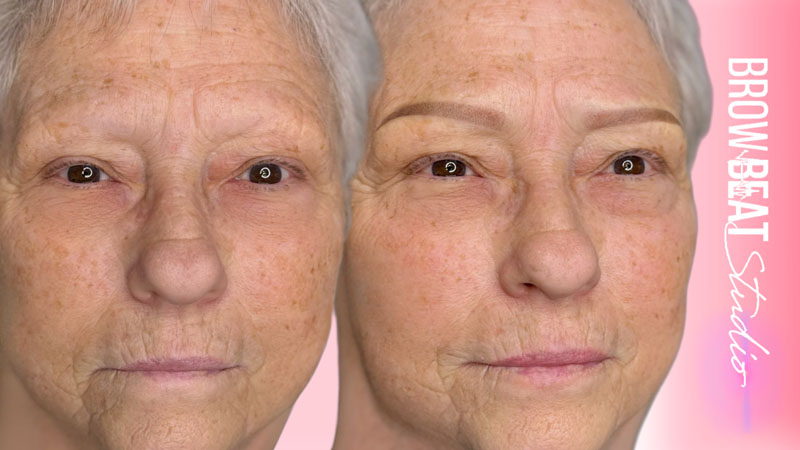
Nano Brows create individual hairstrokes using a permanent makeup machine rather than building a shaded background. On this client’s fine, evenly distributed natural brow hair, the added strokes integrate beautifully without making the eyebrow appear heavily filled. The soft-looking result retains visible spaces between the permanent lines, demonstrating the delicate texture that makes Nano different from Powder Brows.
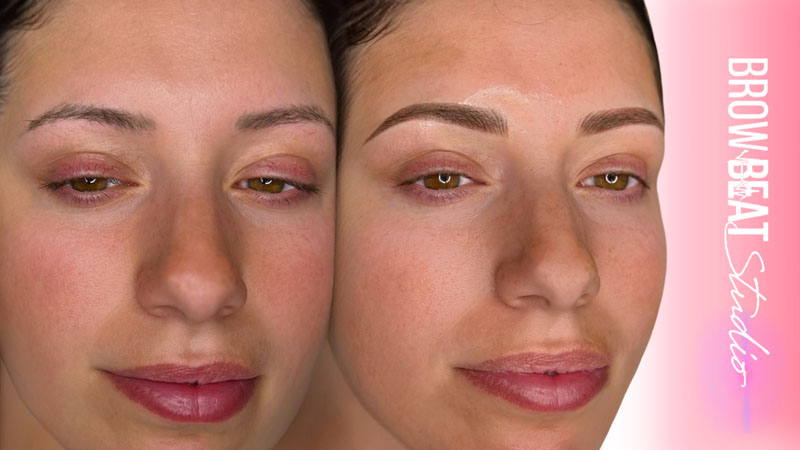
One of Nano’s defining characteristics is the negative space between its permanent hairstrokes. This young client’s fine, organized eyebrow hair provides a beautiful setting for machine-created lines that add definition without forming a solid field of pigment. Powder Brows approach softness differently, using light shading rather than separated strokes. Both can look soft, but the permanent structures are fundamentally different.


Nano asks the skin to display many separate, delicate lines. On smooth, even skin with small pores, those machine-created hairstrokes can look exceptionally crisp and controlled. This result illustrates the visual precision Nano can achieve when the skin and existing brow hair support fine-line work. Powder shading does not depend on individual lines remaining distinguishable, giving it a different structural advantage.
This Nano result demonstrates how individual machine hairstrokes can add visible eyebrow definition without creating a continuous powder effect. Fine natural hair and a light, separated stroke pattern give the brow a wispy appearance. Powder Brows can achieve an equally soft-looking finish, but through controlled pigment saturation rather than individual hair-like lines. The difference is texture, not simply darkness.

Nano creates individual lines. Powder creates a field of color. With Nano, a fine PMU needle—commonly a 1R in BrowBeat’s Nano work—is guided through individual permanent hairstrokes. With Powder, the machine creates many small deposits of pigment across an area until those deposits visually become shading. The same broad category of machine can therefore create two completely different permanent structures. A simple way to understand it is: Nano → line → line → line → hairstroke texture.
Powder → pigment deposit → pigment deposit → pigment deposit → shading. The machine is not the technique. What the artist creates with it is.
Ombré Brows belong to the shading family. The difference is how that shading is distributed. An Ombré result generally uses changes in saturation to create a gradient rather than making every part of the eyebrow equally strong. That can allow one area to remain softer while another carries greater definition. Nano does something different. Instead of using saturation to build the eyebrow, it uses individual permanent lines intended to resemble hair.
Nano → hair-like lines. Ombré → graduated shading.
Microshading also belongs to the machine-shading family. The terminology can become confusing because both Nano and Microshading use a PMU machine. But using the same type of tool does not mean the artist is creating the same type of pigment deposit. Nano builds lines.
Microshading builds color across an area. One creates the visual impression of additional eyebrow hairs. The other creates the visual impression of soft permanent brow makeup or natural background density.
This is the concept BrowBeat wants clients to understand. Machine + hairstroke movement → Nano. Machine + shading movement → Powder / Ombré / Microshading.
Both are cosmetic tattooing. Both place permanent pigment into skin. Both can be soft. Both can be natural-looking. Both can be customized. But they do not rely on the permanent pigment behaving in the same way. And that becomes increasingly important as the brows age.
Not necessarily. This is where simple internet comparisons can become misleading. Close up, Nano and Powder are structurally very different. One contains individual lines. The other contains shading. But eyebrows are not normally viewed through a magnifying glass. At normal viewing distance, a skilled artist can make either technique look soft, balanced and beautifully integrated into the face. A soft Powder Brow does not have to look like heavy makeup. A Nano Brow does not have to look barely visible. There can be considerable visual overlap in how subtle, polished or natural the finished eyebrows feel. That is why BrowBeat does not believe the decision should be reduced to:
“Do I want hairs or do I want makeup?” The real decision has more layers.
Neither technique owns the word natural. Nano is frequently marketed as the natural option because the pigmentation resemble hairs. That makes intuitive sense.
But a soft shaded eyebrow can also look extremely natural. Natural appearance can come from:
Nano creates naturalness through texture and separation. Powder can create naturalness through softness and transparency. Ombré can create naturalness through graduated saturation. Those are different ways of reaching a soft permanent result.

The word natural is one of the most complicated words clients use in permanent makeup. One client means: “I want individual hairs.” Another means:
“I don’t want my eyebrows to look dark.” Another means: “I want my eyebrows to look like they belong on my face.”
Another means: “I want symmetry, but I don’t want anyone to notice I’ve had permanent makeup.” Those are not the same request. This is why simply telling every client who asks for a natural result to choose hairstrokes can miss what she actually wants.
Nano can create an airy, wispy appearance because the permanent work is separated into individual lines. Skin remains visible between those lines. The edges of the eyebrow can feel less continuous. The result can blend into natural hair without creating a completely filled background.
For the right client, that slight irregularity is part of the beauty. It can feel very much like a natural eyebrow. But that also introduces a trade-off. If a client is highly focused on precise structure, strong borders or extremely controlled symmetry, a stroke-only result may not satisfy her in the same way a shaded brow can.
Powder does not mean dark. It does not mean blocky. It does not mean an eyebrow that looks as though it has been drawn on with a heavy pencil.
Shading can be translucent. It can be soft. It can be built lightly.
It can allow natural hair to remain visible through the permanent color. The difference is that the artist has a continuous background to work with rather than relying exclusively on separate lines. That can make it easier to create structure while still maintaining softness.
Many BrowBeat clients are highly focused on symmetry. They look closely at the height of both brows. They notice the tails. They notice whether one arch appears slightly fuller.
They want the overall eyebrow structure to remain visually balanced. For those clients, shading can offer an important advantage. A Powder or Ombré Brow gives the artist a field of pigment through which the shape can be visually reinforced. Nano is built from individual lines.
Those lines need to continue behaving like hairs. There is less freedom to keep adding permanent pigment simply to make every small area look perfectly filled and symmetrical. If you are someone who knows you will repeatedly inspect tiny differences between your eyebrows, that should be part of your technique decision before treatment.
This is a useful way to think about the visual difference. Nano is comfortable with some visual air and irregularity. That is part of what makes hairstrokes believable.
Shading gives the artist greater control over the complete silhouette and density of the eyebrow. Neither approach is prettier. They satisfy different kinds of clients. A person who loves a slightly wispy, imperfect hair pattern may adore Nano. A person who wants her eyebrows to look consistently balanced every morning may appreciate the structural control of shading.
In BrowBeat’s experience, shading has broader skin candidacy. Nano requires the skin to display many individual fine lines successfully. That creates a narrower ideal candidate.
Powder, Ombré and Microshading do not depend on every individual pigment deposit remaining visually identifiable. The deposits work together as shading. That gives the technique more flexibility across different skin characteristics.
Oily skin can be challenging for fine permanent hairstrokes. The strokes can soften, widen or lose visual separation more quickly. Powder shading is generally more forgiving because the result does not depend on a collection of fine lines continuing to look like individual hairs.
The shading can soften and still remain shading. For a client with significantly oily skin who wants a dependable permanent brow structure, BrowBeat will often prefer a shading-based approach over pure Nano hairstrokes.

Large pores and uneven skin texture can make fine permanent hairstrokes more difficult to maintain as distinct lines. Powder Brows take a different approach by building small pigment deposits into a soft field of shading. This result demonstrates how machine shading can provide consistent visual coverage without depending on individual strokes. The brow can still look beautifully soft while offering greater flexibility across challenging skin characteristics.
A Powder Brow doesn’t need to be dark to provide consistent eyebrow definition. This client has visible skin texture and larger pores, yet the shaded result creates a cohesive brow shape without relying on crisp individual lines. Nano creates texture through separate hairstrokes. Powder creates structure through controlled pigment coverage, allowing the artist to build a soft-looking result while accommodating more variation in the skin.


Thicker or more textured skin places different demands on permanent makeup. Nano requires individual strokes to remain visually separated, while Powder Brows use many pigment deposits working together as shading. This result demonstrates why a shaded technique can be more practical when the skin is less suited to delicate line work. The finished eyebrow can retain a soft appearance while providing consistent coverage and visible structure.
Some skin retains pigment unevenly, causing certain areas to hold more color than others. Nano’s individual hairstrokes can make this unevenness more visible, since each line either holds or fades independently. Powder Brows avoid this problem by distributing pigment across a soft shaded field rather than relying on separated strokes, producing a consistently saturated, cohesive eyebrow even when pigment retention varies across the skin.

The same principle applies to large pores, thicker skin and significant texture. Nano is asking that skin to display a fine line elegantly. Shading is asking it to hold an overall field of color. Those are different demands.
If the surface does not strongly support crisp fine-line work, shading can provide considerably more flexibility. The goal is not to force the newest technique onto every skin type — it is to choose a permanent structure that the skin can realistically support.
When the client has smooth, smaller-pored, medium-to-dry skin, both approaches become much more realistic options. At that point, the desired result becomes a larger part of the decision. Does she want an airy hairstroke pattern? Does she want more structure?
How important is long-term maintenance? How focused is she on symmetry? How much natural brow hair does she already have?
And how does she want her permanent eyebrows to age? Good skin gives the client more choices. It does not make those choices identical.
Fine, evenly distributed natural hair can be a beautiful Nano starting point. The permanent hairstrokes can integrate with the visual weight of the client’s real hairs and create additional texture without overwhelming them. But fine hair does not prevent someone from choosing Powder.
A soft shaded background can sit underneath fine natural hair and create additional structure while still allowing the real hairs to remain visible. Again, the question is not simply what the client has — it is what she wants the permanent makeup to add.
Coarse, wiry or highly multidirectional natural hair can be difficult for a stroke-only technique. The natural eyebrow already contains a lot of physical texture. Adding another pattern of fine permanent lines underneath it may create more visual competition rather than greater cohesion.
Shading can approach the problem differently. Instead of trying to imitate each hair, the artist can create a consistent background of permanent color that visually blends areas of uneven density and supports the overall brow shape. For this kind of natural hair, that can be a significant advantage.
Small gaps can be excellent Nano territory. A few permanent hairstrokes can bridge an area and disappear visually among surrounding natural hairs. Large gaps are different.
Particularly when an empty area sits beside dense natural hair, a stroke-only technique may struggle to create equivalent visual density without packing many permanent lines into the space. Shading can create more consistent coverage across the transition. This is why the size and location of a gap matter—not simply whether the client describes her eyebrows as “sparse.”
Clients do not need to understand permanent makeup terminology perfectly before choosing a service. Sometimes it is easier to forget the technique names for a moment and describe the result. These are the kinds of statements BrowBeat listens for.
Either technique may be capable of creating that. Soft does not mean Nano. A light machine-hairstroke pattern can be soft.
A sheer Powder Brow can also be soft. The next question is whether the client wants that softness created through separated lines or through transparent background color.
Again, either technique may work. The word natural is not specific enough by itself to choose a procedure. Does natural mean wispy? Does it mean light?
Does it mean symmetrical without looking heavily made up? Does it mean keeping as much of the client’s existing brow character as possible? Once the word is defined, the technique decision becomes easier.
This begins moving the conversation toward structure. Shading gives the artist more flexibility to create a consistent visual silhouette because the permanent pigment is not restricted to individual lines that need to continue looking like hairs. Nano can absolutely be mapped symmetrically.
But the final brow is still built from hairstrokes and open skin rather than a continuous background of color. For a client who knows that tiny differences in density will bother her, that distinction matters.
This can be an excellent Nano request when the surrounding natural hair and skin support hairstrokes. The permanent lines can bridge the gaps without changing the entire eyebrow into a shaded result.
This is different. If the client wants continuous visual density through the eyebrow, she is describing coverage. Trying to create that coverage by packing more and more Nano strokes into the skin can work against the very thing that makes hairstrokes look like hairs.
This is where Powder is often misunderstood. Filled does not have to mean heavy. Shading can be light and translucent while still giving the brow consistent background density. The client can have coverage without having a dark makeup-style eyebrow.
This is a true Nano goal. The client is specifically asking for separated permanent lines and the texture they create. If the skin and natural eyebrow support them, Nano makes sense.
This changes the conversation significantly. If someone already knows that permanent brows are going to be part of her long-term routine, shading has practical advantages. A shaded result can soften while continuing to function as shading. Hairstrokes have a more complicated long-term problem because each individual line needs enough separation to continue functioning visually as a hair.

The first appointment is only one part of permanent makeup. If you plan to maintain your eyebrows for years, it is worth thinking beyond the first healed result. What will the pigment look like at one year?
What happens at two years? What happens after several treatments? How easy is the technique to maintain?
How much clean skin does it need? And what happens when previous permanent pigment becomes the background for the next treatment? This is where Nano and shading begin behaving very differently.
In BrowBeat’s experience, shading generally has the stronger long-term structural advantage. That does not mean every Powder Brow will retain more pigment than every Nano Brow. The more important distinction is what happens when the pigmentation soften. A Nano stroke needs to continue reading as a line.
A Powder deposit is already part of a field of shading. If that shading softens, it can still function as shading. If an individual Nano line widens, softens or begins visually merging with neighboring lines, it gradually loses the characteristic that made it a hairstroke.
A Powder or Ombré Brow creates a continuous visual structure. The permanent pigment establishes the overall brow shape and density. As that pigment gradually fades, the entire field can become softer while the basic structure remains understandable. Nano depends on separate lines.
Each line is contributing to the illusion of hair. As those lines change, the relationship between them changes too. This is why a shaded brow can often hold its overall shape longer even while the color itself is becoming lighter.
A fading Powder Brow usually becomes a lighter version of a shaded brow. A fading Nano Brow is more complicated. Some strokes may become lighter than others. Some may widen.
Some may remain strong. Some may lose enough definition that they no longer read clearly as separate hairs. And neighboring lines can begin appearing increasingly blended. That means the Nano result can change not only in intensity, but in visual structure.
At approximately one year, both techniques may still look very good. But they may be aging in different ways. A Nano Brow may have softer individual strokes than it had during the first months after healing. Some lines may remain beautifully visible while others have become lighter.
A Powder Brow may also be lighter than it was when newly healed, but the shading can continue defining the overall eyebrow. Neither result follows an identical schedule for every client. The point is that the two permanent structures are aging differently.

By approximately two years, that structural difference can become even more obvious. Older Nano strokes may be increasingly soft and blended. Permanent pigment can remain while the original hair-by-hair appearance becomes less distinct.
Older Powder shading can also fade and change, but it does not have to preserve individual line separation in order to continue functioning as shading. This is one reason BrowBeat thinks about the long-term maintenance plan when helping clients choose a brow technique.
Powder, Ombré and Microshading are generally easier to maintain repeatedly over the long term.
The reason is not that shading is indestructible. It fades too. But future shading can work with a faded shaded background.
Hairstrokes need clean visual space. Once previous strokes have softened and left residual pigment behind, every future set of fine lines has less untouched skin available around it. That makes repeated stroke work increasingly complicated.
This is true whether the original strokes were Nano or Microblading. Hairstrokes cannot simply be recreated forever over an area that already contains layer after layer of old hairstroke pigment. Eventually, residual color reduces the clean background needed for a new line to read as a separate hair.
That does not mean there is one universal number of hairstroke treatments that applies to every person. There is not. It means there is a practical limit determined by what remains in the skin.
Shading does not require every new pigment deposit to remain individually identifiable. The deposits are supposed to work together. That gives the artist more flexibility when maintaining an eyebrow that already contains faded permanent color.
A faded Powder Brow can often be evaluated and rebuilt as shading without pretending the skin is blank again. With Nano, the artist has to ask whether there is still enough clean visual space for another fine stroke pattern to make sense.
Some clients think only about which technique they prefer today. That is understandable. But permanent makeup is cumulative.
If you already know that you love waking up with your eyebrows done and expect to maintain them for many years, the maintenance story deserves consideration from the beginning. Shading generally gives BrowBeat more flexibility over repeated treatments. Nano can be beautiful, but its long-term success depends on maintaining enough visible space for permanent lines to continue reading as hairs.
Comparing Nano and Powder financially should not stop at: “What does today’s appointment cost?” The longer-term question is:
How frequently am I likely to want this result maintained, and how easy is it to recreate? Nano clients who love crisp visible hairstrokes may begin wanting maintenance as those lines soften. Shading can often retain its overall structure for longer even while becoming lighter. That can change the long-term investment. A technique with a shorter visual shelf life may require the client to think about maintenance sooner.
At BrowBeat, permanent brow services are completed as a first treatment and a second treatment, and the brow techniques are priced consistently rather than charging a client more simply because one technique happens to take longer on a particular day. The value of the appointment includes much more than machine time. There is numbing. There is discussion.
There is mapping. There is client feedback. There are design and color decisions.
And there is the permanent procedure itself. That is why BrowBeat does not use price to push someone toward Nano or Powder. The more meaningful financial difference can appear later through the maintenance needs of the chosen technique.

Powder Brows begin as a field of pigment rather than individual hairstrokes. As the color gradually becomes lighter, the eyebrow remains a shaded result instead of losing a hair-by-hair pattern. This gives Powder an important long-term advantage: the overall shape and coverage can remain visually understandable even as saturation reduces. For clients planning years of permanent makeup, that structural consistency matters.
One of Powder’s strongest advantages is how its pigment structure supports future maintenance. A shaded eyebrow can gradually lighten while remaining a shaded eyebrow, allowing the artist to evaluate the existing color before adding more saturation. Nano requires separate lines to remain recognizable as hairs. Powder does not. This gives shading greater flexibility when clients intend to maintain permanent brows over multiple treatments.


Nano creates beautiful individual machine hairstrokes, especially when fine natural brow hair and smooth skin support the result. Those permanent lines gradually soften as pigment ages. As their edges become less distinct, the original hair-like detail changes. The same separation that makes fresh Nano so attractive becomes increasingly difficult to preserve through repeated treatments, particularly when previous pigment remains in the skin.
Nano hairstrokes are designed to remain visually separate, but permanent pigment does not stay as crisp as it was when freshly implanted. Over time, the lines soften, widen and may visually merge with neighboring strokes. Residual pigment also reduces the clean space available for future hairstroke work. This is why BrowBeat encourages clients to consider Nano’s long-term maintenance limitations before choosing it over Powder shading.

At BrowBeat, Powder Brows generally take longer to physically perform because shading requires the artist to build saturation across the eyebrow. Nano can sometimes be faster from a pure procedure standpoint because the work is built from individual hairstrokes rather than developing an entire shaded field. But that does not mean a Nano appointment is necessarily short. Permanent brow appointments are generally reserved for more than three hours.
Numbing takes time. Conversation takes time. Mapping takes time.
A client may want to look at her brows several times. Feedback and adjustments take time. The actual tattooing technique is only one part of the appointment.
Pain is too individual for BrowBeat to promise that one technique will universally feel easier than the other. Both are cosmetic tattoo procedures performed with a PMU machine. Nano concentrates machine work along individual hairstroke paths.
Powder distributes machine work through areas of shading. Numbing is part of the BrowBeat appointment, and individual sensitivity has a major influence on what the client feels.
If small differences in brow density bother you, shading offers more structural control.
Those are different reasons.
The answer matters more than how beautiful Nano looks on someone else’s skin.
If the answer is yes, long-term maintenance deserves weight in today’s decision.
Every permanent makeup treatment changes the starting point for the one that comes after it.
A client can want softness without needing a stroke-only technique.
Neither priority is wrong. But knowing which one matters more can make the decision considerably easier.
Some clients want permanent brows once and then decide later how they feel about maintaining them. Others already know permanent eyebrows are going to be part of their lives for years. That difference matters. If you know you are likely to maintain your brows long term, BrowBeat believes the future canvas deserves consideration from the first appointment.
Every treatment leaves a history in the skin. With Nano, that history is made from individual hairstrokes that gradually soften, fade and may become increasingly blended. With Powder, that history is already a field of shading. When future maintenance becomes necessary, faded shading is generally easier to work with as shading than old hairstroke pigment is to recreate indefinitely as fresh, isolated lines.
Powder has one major structural advantage: It does not need permanent pigment to remain separated into individual hairs.
The shading is supposed to work together. That means gradual softening does not fundamentally change the identity of the technique. A lighter Powder Brow is still a shaded brow. A Nano Brow whose individual strokes have merged substantially is no longer expressing the original hair-by-hair effect in the same way. For clients thinking several treatments ahead, that distinction can be important.
None of this makes Nano a poor technique. Nano can be beautiful. It can be light. It can be wispy.
It can integrate extremely well with fine natural brow hair. And for someone with good skin for strokes who specifically loves that airy hairstroke aesthetic, Nano can be exactly the right choice. The point is not to make Nano compete with Powder by pretending it has the same strengths.
Its strength is different. Nano gives the client individual permanent hair-like detail. Shading gives the artist greater control over continuous density and long-term structure.

When natural brow hair is extremely limited, every pigmentation has to do more visual work. With Nano, individual tattooed lines may need to create most of the apparent eyebrow texture themselves. That can look beautiful initially on appropriate skin, but the long-term appearance depends heavily on those lines retaining enough separation to continue reading as hairs.
Shading does not have that same requirement. It can create a complete eyebrow structure without relying on natural hair or individual permanent lines to carry the entire result. For significant brow loss, there are additional considerations beyond a general Nano-versus-Powder comparison, but the basic structural difference remains important.
Strong definition does not mean dark brows. It means the eyebrow has a clearly readable shape. Powder can create that structure while remaining relatively soft in color.
Nano can also create definition, but the shape is being expressed through a collection of individual lines and the natural hair around them. If the client wants every part of the brow to remain consistently readable as one balanced shape, shading gives the artist more control over that goal.
A client who says she wants a soft front does not need hairstrokes. Ombré shading can create a softer beginning to the eyebrow through controlled saturation. The front can remain lighter while the body and tail gradually gain greater definition. Nano creates softness differently.
It uses separated permanent lines and visible skin. Both can produce a soft beginning to the brow. The visual structure underneath that softness is different.
Microshading has an advantage when consistent density is the primary goal. The artist can build color through areas where the natural brow is weaker without needing every pigment deposit to imitate a hair. Nano creates density indirectly by adding the appearance of more hairs.
That works beautifully when the amount of additional density required is relatively modest. The more coverage the client requests, the more naturally the goal begins aligning with shading.
Yes, particularly when the client already has a good amount of natural brow hair. Natural hair plus permanent hairstrokes can create a very complete-looking eyebrow. But there is a limit to how much density should be created by continually packing additional lines into the skin.
Nano needs negative space. That space is what helps each permanent line continue reading as a hair. If the client wants almost no visible space, she is asking the technique to move away from its strongest characteristic.
Yes. This is one of the most useful misconceptions to remove. Powder refers to the structure of the permanent pigment—not a mandatory level of darkness.
A Powder Brow can be built softly and transparently. The client can have a defined permanent shape without necessarily having a strong makeup-style eyebrow. The amount of saturation matters.
That is completely reasonable. A skilled result from either technique may satisfy someone who simply wants better permanent eyebrows. Not every client has a deep emotional preference for seeing tattooed hairstrokes versus seeing soft shading. If you like both, the decision can move to the practical questions:
For some clients, those questions make the choice much clearer than looking at another set of fresh photographs.
Permanent makeup decisions are often made from newly completed work. That is understandable because fresh results are easy to show and easy to admire. But BrowBeat thinks the better comparison includes time. A Nano Brow needs its individual strokes to continue functioning as individual strokes.
A Powder Brow needs its shading to continue creating useful color and structure. Those are different long-term jobs. A technique should be judged not only by what it can create today, but by what that permanent structure is likely to become as it is maintained.

A close-up of fresh Nano can be spectacular. Every line is visible. The detail is obvious. The pattern can look intricate and technically impressive. But permanent eyebrows live on a moving face for years—not in one close-up moment. The questions a fresh image cannot answer by itself are: How will these strokes heal in this skin?
How will they look after a year? How much residual pigment will remain? What happens when the client wants another treatment? Will there still be enough clean skin to create another separated stroke pattern? Those questions are less exciting than a fresh close-up. They are also extremely important.
Smooth, medium-to-dry, smaller-pored skin gives hairstrokes more opportunity to perform well. Shading generally has broader flexibility across skin characteristics.
Fine, organized natural hair can be an excellent Nano framework. Coarse, wiry or highly irregular hair can make shading more useful for visually unifying the brow.
If tiny differences in density or structure bother you, shading gives the artist greater control over the complete brow silhouette.
Nano creates additional hair-like detail. Powder creates background color and coverage. The more coverage you want, the more important that distinction becomes.
Nano strokes need to remain separated to keep functioning as hairs. Powder can soften and still function as shading.
Repeated hairstroke treatments eventually run into residual pigment and reduced clean skin. Faded shading generally gives the artist more flexibility for future shading.
The first appointment price is only one part of permanent makeup ownership. How quickly you want the result refreshed and how easily it can be maintained also contribute to the long-term investment.
There is no universal winner. Nano has a beautiful purpose. Powder has a beautiful purpose. The more useful question is:
Which set of strengths matters more to you?
Nano may be particularly appealing if you have skin that supports fine strokes, a useful natural brow framework and a strong preference for wispy permanent hairstrokes. Powder may make more sense if you value structure, symmetry, broader skin compatibility, consistent coverage and easier long-term maintenance. Neither answer needs to be based on which technique happens to be newer or more fashionable.
Start with the result and the long-term plan rather than the service name. If you genuinely love individual permanent hairstrokes and your starting point supports them, Nano can be a beautiful choice. If you want more control over density and structure, or you know that you want permanent brows maintained repeatedly for years, machine shading has practical advantages worth considering.
If you like the idea of shading but want a softer transition in saturation, an Ombré approach can create that gradient. The technique should support the eyebrow you want to live with—not simply the terminology that sounds most appealing today.
BrowBeat offers machine-created hairstrokes and machine shading because they solve different permanent brow problems. We do not need to make Powder sound heavy in order to make Nano sound natural. And we do not need to make Nano sound impractical in order to explain the long-term advantages of shading. Nano can be exceptionally soft and beautiful on the right starting point. Powder, Ombré and Microshading can be equally soft while giving the artist more control over density, structure and repeated long-term maintenance. What matters is understanding the trade-off. Nano depends on individual lines continuing to behave like hairstrokes.
Shading depends on permanent color continuing to function as shading. That difference affects far more than what the eyebrows look like on the day they are created.
Powder and Ombré Brows are not the only alternative worth considering. For how Nano compares to another hairstroke technique, see Nano Brows vs. Microblading, and for how it compares to a combined hairstroke-and-shading approach, see Nano Brows vs. Combo & Hybrid Brows. For what healing looks like afterward, see Nano Brows Healing & Aftercare.

Nano Brows use a PMU machine to create individual permanent hairstrokes. Powder Brows use a PMU machine to build shading across the eyebrow. Nano creates hair-like lines, while Powder creates a field of permanent color that can range from very sheer to more defined.
Nano creates individual machine hairstrokes. Ombré Brows use machine shading with changes in saturation to create a gradient, often keeping one area softer while building greater definition through another part of the eyebrow.
Nano uses the machine to create separate hair-like lines. Microshading uses the machine to build pigment across an area so the deposits work together as shading rather than individual eyebrow hairs.
They can. Both are machine-based permanent makeup techniques. The difference is what the artist creates with the machine: Nano builds hairstrokes, while Powder, Ombré and Microshading build shading.
At BrowBeat, pure Nano Brows are machine-created hairstrokes without shading. If shading is added to a hairstroke treatment, the result moves into a combined technique rather than a pure Nano stroke-only service.
No. Powder Brows are created through machine shading rather than separate permanent lines designed to imitate individual eyebrow hairs.
Neither technique owns the word natural. Nano can create naturalness through separated hair-like texture, while Powder can create naturalness through soft, translucent shading and an appropriate brow shape. Both can look extremely natural when performed well.
There is no universal winner. Nano may suit someone with good skin for fine lines, a useful natural brow framework and a preference for wispy hairstrokes. Powder offers broader skin flexibility, greater structural control and easier long-term maintenance.
Consider your skin, natural brow hair, desired level of structure, symmetry, coverage and long-term maintenance expectations. If you genuinely want separated permanent hairstrokes and your skin supports them, Nano can be beautiful. If you value consistent density and structural control, shading may make more sense.
In BrowBeat’s experience, Powder is generally more forgiving on oily skin. Nano depends on fine lines remaining visually separated, while shading can soften and still continue functioning as shading.
Smooth, smaller-pored, medium-to-dry skin can support either technique well. When the skin is favorable for hairstrokes, the decision can focus more heavily on the client’s desired structure, texture, coverage and long-term maintenance preferences.
Shading generally has greater flexibility on large-pored, thick or textured skin because it does not require individual fine lines to remain visually crisp. Nano has a narrower ideal skin candidate because the hairstroke effect depends on fine-line clarity.
Fine, evenly distributed natural hair can be an excellent Nano starting point because machine hairstrokes can integrate with the client’s existing texture. Powder can also work beautifully if the client wants more background density or structural definition.
Shading can have an advantage when natural hair is coarse, wiry or grows in many directions. Rather than adding another competing pattern of fine lines underneath the natural hair, shading can create a consistent background that visually unifies the eyebrow.
It depends on how sparse the brows are. Smaller gaps within a useful natural brow framework can work beautifully with Nano. Larger areas of uneven density may benefit from the consistent visual coverage that shading can provide.
Shading generally offers more control when large empty areas sit beside dense natural hair. Trying to match substantial natural density by packing many Nano strokes into an empty area can reduce the negative space that hairstrokes need to remain visually separate.
Powder Brows provide greater continuous coverage because shading creates a field of pigment through the eyebrow. Nano creates visual fullness by adding the appearance of individual hairs while intentionally preserving space between the permanent strokes.
Yes. Powder describes the shading structure, not a required level of darkness. Shading can be sheer, translucent and softly saturated while still providing a more consistent eyebrow structure.
Yes, especially when the client already has a good amount of natural eyebrow hair. Natural hair and permanent Nano strokes can work together to create a fuller-looking brow, but Nano still needs enough negative space for the individual lines to read as hairs.
Shading generally gives the artist greater control over the complete brow silhouette and density. Nano can be mapped symmetrically, but the finished result is still built from individual lines and visible skin rather than a continuous field of color.
In BrowBeat’s experience, shading generally has a long-term structural advantage. A Powder Brow can become lighter while continuing to function as shading. Nano depends on individual lines remaining separated enough to continue reading as eyebrow hairs.
Powder pigment deposits are intended to work together as shading, so softening does not fundamentally change the identity of the result. When a Nano stroke widens, softens or visually merges with neighboring strokes, it can gradually stop reading as an individual hair.
They can become increasingly blended, particularly when strokes were placed closely together. Permanent lines naturally soften as they age, and less negative space gives them less room to change while remaining visually separate.
Powder Brows also soften and fade. The difference is that the permanent pigment is already intended to work as a field of color, so a softer Powder Brow can still maintain the visual structure of a shaded eyebrow.
Both are cosmetic tattoos and both begin stronger before settling into softer healed results. With Nano, clients tend to notice changes in individual hairstrokes. With Powder, the more noticeable change is usually the overall saturation and softness of the shaded brow.
Pain perception is individual. Both are performed with a PMU machine, but Nano concentrates machine work along individual hairstroke paths while Powder builds pigment through areas of shading. Numbing is used as part of BrowBeat’s permanent brow appointments.
At BrowBeat, Powder Brows generally take longer to physically perform because shading requires saturation to be built throughout the eyebrow. Nano can sometimes be faster during the tattooing portion, although complete permanent brow appointments are generally more than three hours once numbing, discussion, mapping and client feedback are included.
Nano can require earlier attention if the client wants to maintain clearly defined hairstrokes as they soften. Powder shading can often hold its overall brow structure longer even while becoming lighter. Individual skin and retention still affect both techniques.
Powder is generally easier to maintain repeatedly because faded shading can continue functioning as a background for future shading. Repeated hairstroke treatments eventually leave residual pigment that reduces the clean skin and contrast needed for new fine lines to read as individual hairs.
Choose according to your skin, natural brow framework, desired structure, symmetry, coverage and long-term expectations rather than the newest technique name. Nano is strongest when the client genuinely wants machine hairstrokes and has a suitable starting point. Powder, Ombré and Microshading offer greater flexibility when structure, coverage and repeated long-term maintenance are priorities.