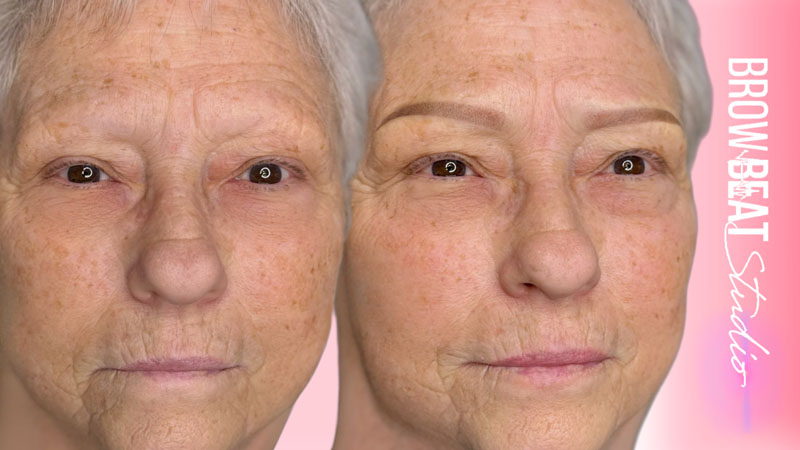
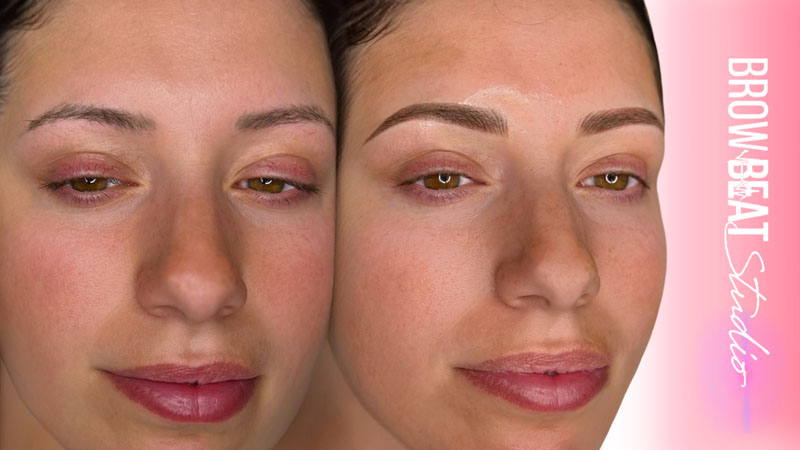
Nano Brows and Microblading can look remarkably similar. Both techniques create permanent hairstrokes designed to resemble natural eyebrow hairs. Both can create soft, wispy brows.
Both can fill smaller gaps. Both can add texture and definition to an existing natural eyebrow. And when either technique is performed well, another person looking at the finished brows may have absolutely no idea which method created the strokes.
The fundamental difference is not necessarily the appearance — it is how the permanent hairstroke is created in the skin.
Nano Brows → PMU machine → repeated needle perforations → hairstroke. Microblading → manual hand tool → controlled cutting motion → hairstroke.
Different implantation method. Very similar visual goal. That distinction is the starting point for understanding Nano Brows vs Microblading without turning one technique into the hero and the other into the villain.

Nano Brows and Microblading both create permanent hairstrokes designed to resemble individual eyebrow hairs. Looking at a finished stroke pattern doesn’t always reveal which tool produced it. A skilled artist can create fine, believable lines using either a PMU machine or a manual Microblading handle. This open pattern demonstrates how individual strokes can remain visually separated, allowing skin to show between the lines. At BrowBeat Studio Dallas, the distinction begins with the implantation method rather than assuming one finished pattern belongs to Nano or Microblading.
An eyebrow can contain beautifully placed permanent hairstrokes without needing every available space filled. When additional lines are introduced, the artist must consider how they interact with the existing pattern. Too much density can reduce the visual separation that makes hairstrokes convincing. This applies whether the lines were created with a Nano machine or a Microblading blade. At BrowBeat Studio Dallas, we evaluate the complete eyebrow rather than treating the number of strokes as a measure of quality. The goal is believable texture, not maximum line count.


Natural eyebrow hairs change direction throughout the brow, and both Nano and Microblading need to respect that movement. The front, body, arch, and tail each contribute different visual directions to the complete eyebrow. Whether a permanent stroke is created through machine perforations or a manual blade, its placement still needs to make sense beside the client’s existing hair. This educational pattern demonstrates the importance of directional flow. At BrowBeat Studio Dallas, the artist’s design decisions remain essential regardless of which hairstroke technique is chosen.
A permanent eyebrow can lose its delicate hairstroke appearance when too many lines compete within the same small area. Closely placed strokes have less visual space available as pigment softens over time, potentially creating a more blended appearance. This concern applies to both machine-created Nano Brows and manual Microblading. At BrowBeat Studio Dallas, we consider the spacing and visual weight of permanent lines before adding more detail. The goal isn’t to create the most elaborate pattern possible, but to preserve an eyebrow that continues reading as individual hairs.

This is the part that can get lost when Nano is marketed as an entirely new type of eyebrow. Nano did not reinvent the visual idea of a permanent hairstroke. Microblading had already established that concept.
The innovation was creating those hair-like lines with a machine rather than a manual hand tool. That changes the mechanics of implantation. It does not necessarily change what the finished eyebrow looks like.
A beautiful Microblading stroke can look like an eyebrow hair. A beautiful Nano stroke can look like an eyebrow hair. Both are trying to create the same illusion: more visible eyebrow hairs than the client naturally has.
The simplest comparison is: Nano = machine hairstrokes. Microblading = manual hairstrokes. With Nano, a PMU machine moves a fine needle rapidly in and out of the skin. The artist guides that movement along a planned path, using repeated perforations to build the permanent line.
With Microblading, the artist uses a manual hand tool to create the permanent line through a controlled cutting motion. One builds the line through repeated machine needle movement. The other creates the line manually. That mechanical difference is real. But it should not be exaggerated into claims the difference cannot support.
Nano uses a PMU machine. The machine moves the needle repeatedly through the skin as the artist creates the planned hairstroke. That means the line is formed through a sequence of small perforations. The artist controls the movement of the machine, the path of the line and how effectively pigment is implanted.
Machine-created does not mean automatic. The machine does not decide the depth. It does not decide how slowly the line should be worked.
It does not decide whether an area needs another pass. And it does not guarantee that the stroke will retain simply because a machine created it. Artist technique remains central.
Microblading creates the permanent hairstroke manually. The artist uses a hand tool and a controlled cutting motion to open the skin along the planned line and introduce pigment. It is a different mechanical action from Nano. Instead of building the stroke from repeated machine perforations, the artist creates the line through a manual movement.
Again, artist control matters. Pressure matters. Depth matters. How the stroke is worked matters. Neither technique becomes successful simply because the correct tool is in the artist’s hand.
The machine-perforation method can be considered a gentler way of creating a hairstroke than making the line through a manual cutting motion. That is one of the genuine reasons Nano has attracted so much attention within permanent makeup. But there is an important distinction between saying: “The stroke is created through a less cutting-based method.”
and saying: “Therefore Nano lasts longer, heals perfectly or can be repeated indefinitely.” Those conclusions do not follow. Nano changes the way the hairstroke is created. It does not eliminate the long-term behavior of permanent hairstrokes in skin.
You will see Nano described as longer-lasting than Microblading. BrowBeat does not treat that as a universal truth. Both treatments are trying to create fine permanent hairstrokes at a superficial cosmetic tattoo depth. The fact that one stroke was made with a machine and another was made manually does not, by itself, determine how long either stroke will remain visually useful.
A Nano stroke can fade quickly. A Microblading stroke can retain strongly. A Nano stroke can retain strongly. A Microblading stroke can fade quickly. There are too many variables involved to reduce longevity to: machine = longer.

Nano is a newer evolution within the hairstroke category, and newer techniques are often introduced around the problems artists and clients already know. Microblading gave the permanent makeup industry years of information about how hairstrokes heal, soften, merge and age. Creating those strokes with a machine offered a different implantation method and potentially less cutting trauma to the skin.
That is meaningful. But it is easy for a genuine technical advantage in one area to become a much broader marketing claim.
Gentler implantation does not necessarily translate into longer-lasting hairstroke definition. Those are separate questions.
The tool is only one piece of the pie. The longevity of either hairstroke depends on a combination of variables.
Permanent pigment has to be implanted effectively. A stroke that is too superficial may fade very quickly. A stroke placed too deeply can remain stronger, darker or less delicate than intended. The artist is balancing retention with the quality of the healed line.
With machine hairstrokes, simply moving a needle across the skin does not guarantee adequate pigment implantation. The artist may work a line more slowly, make additional controlled passes or carefully work back through part of the stroke where appropriate to establish enough pigment. Those application decisions influence retention. The same broad principle exists with manual hairstrokes: how the artist creates and implants the line matters.
Fine permanent hairstrokes do not behave identically in every skin. Oil production matters. Pore structure matters. Skin thickness matters.
Texture matters. And individual retention matters. A technique cannot be separated from the skin receiving it.
A hairstroke needs visual space around it. If many lines are packed very closely together, they have less room to soften over time while remaining visually separate. This applies to both Nano and Microblading. The denser the stroke pattern, the greater the long-term risk that separate lines begin reading as a more blended field of pigment.
The pigment itself matters. Different permanent makeup pigment systems are formulated differently and can behave differently as they age in skin. Some are designed to fade more readily. Others can hold more strongly.
And longer retention is not the superior outcome. For a hairstroke technique, gradual fading can actually be useful because future fine lines need enough visible skin and transparency around them to remain readable. A pigment that holds extremely densely and eventually creates a solid background of residual color can make future hairstroke work more difficult.
The initial healed result establishes what actually remained after the procedure. Two equally beautiful fresh eyebrows can heal differently. That is why permanent makeup should be evaluated after healing rather than only through photographs taken immediately after treatment.
Sun exposure matters. Skincare matters. Retinoids and aggressive exfoliation through the brow area matter.
Skin treatments matter. And individual habits can influence how quickly permanent pigment becomes lighter and softer.
Eventually, time affects both techniques. Nano strokes age. Microblading strokes age. Neither technique creates a permanent line that remains frozen forever at the width, color and definition visible in a fresh photograph.

When clients compare Nano Brows and Microblading, they often expect the finished eyebrows to look obviously different. In reality, both techniques can produce fine permanent lines that resemble natural eyebrow hairs. This delicate hairstroke result demonstrates why appearance alone isn’t always enough to identify the implantation method. At BrowBeat Studio Dallas, we encourage clients to consider the artist’s broader body of work rather than assuming a particular result must be Nano because the strokes look especially fine. The tool matters mechanically, but the finished design depends on much more.
Some permanent hairstroke eyebrows have a clearly defined shape while still showing individual hair-like lines. That stronger structure doesn’t identify the technique used. Nano Brows can create defined patterns, and Microblading can create delicate ones. The artist’s mapping, pigment selection, and stroke placement influence the completed eyebrow. At BrowBeat Studio Dallas, we distinguish between the method used to create each line and the overall appearance those lines produce together. A structured hairstroke result should be evaluated for how it works with the client’s features, not simply its technique label.


A soft-looking permanent eyebrow depends on more than whether the artist uses a machine or a manual tool. Pigment color, line spacing, stroke density, and the relationship to existing natural hair all influence the appearance. This hairstroke result illustrates how individual permanent lines can contribute definition without creating a heavily filled brow. At BrowBeat Studio Dallas, we explain that Nano isn’t softer than Microblading simply because it uses a fine machine needle. Both techniques can create understated results when the artist designs and applies the strokes appropriately.
The words Nano and Microblading describe different implantation methods, but neither name guarantees a particular level of hairstroke definition. Crisp permanent lines depend on careful placement, appropriate skin conditions, pigment application, and the artist’s technique. This high-definition hairstroke result demonstrates how clearly individual lines can appear within a completed eyebrow. At BrowBeat Studio Dallas, we look beyond the service name to evaluate the actual work. A fine machine stroke isn’t superior to a fine manual stroke simply because the equipment is different.


A spacious permanent hairstroke pattern allows natural eyebrow hair and visible skin to remain part of the finished appearance. Rather than filling every gap with pigment, the artist places individual lines where they contribute to the complete brow. This approach can work with either Nano Brows or Microblading when the client’s natural features support it. At BrowBeat Studio Dallas, we consider how permanent strokes interact with existing hair and how the pattern may soften over time. Sometimes restraint creates a more believable result than adding unnecessary detail.
This is why BrowBeat does not choose between Nano and Microblading based on a single marketing promise. A machine can change the mechanics of the procedure. It cannot remove the client from the equation. It cannot remove the artist. It cannot remove pigment chemistry.
It cannot remove lifestyle. And it cannot remove time. The useful question is not: “Which tool is newer?” It is: “Which technique makes sense for this skin, this natural eyebrow, this artist and the hairstroke result this client actually wants?”
This is another important permanent makeup distinction. Clients understandably hear “lasts longer” and assume that must always be better.
But hairstrokes need transparency. They need visible skin between them. They need enough separation for each line to continue reading as an eyebrow hair. If permanent pigment holds so densely that repeated treatments eventually create a solid background of color, the fact that the pigment lasted is not necessarily helping the hairstroke result.
Sometimes fading is useful. It creates room. It allows old work to soften. And it can make future permanent makeup decisions easier than trying to place another set of fine lines over heavily saturated old pigment.
They share the fundamental long-term limitation of permanent hairstrokes. Both techniques create fine lines in skin. Both rely on those lines remaining visually separate enough to resemble hair.
Both can soften over time. Both can fade. Both can lose stroke definition. And closely packed work from either technique can eventually appear more blended as it ages.
Nano changes the implantation method. It does not make the basic aging behavior of a permanent hairstroke disappear.
Potentially. Because Nano creates the stroke through machine perforations rather than repeatedly making a manual cut, the technique can offer an advantage when thinking about cumulative skin trauma.
But potentially more repeatable does not mean infinitely repeatable. There is another limitation: the pigment already in the skin.
Every successful permanent treatment can leave residual color. When another set of hairstrokes is added later, those new lines need enough clean visual space to remain readable. Eventually, old pigment can become as important to repeatability as the method used to create the new stroke.
Imagine a new Nano or Microblading client with clean skin between her natural eyebrow hairs. A fine permanent line has contrast. You can see it. Now imagine the same eyebrow after several years and several permanent hairstroke treatments. Old lines have softened. Some have merged. Residual pigment remains underneath.
The skin is no longer the same blank background. If another fine stroke is placed over an existing layer of permanent color, it has less contrast. It can blur visually into what is already there. That problem exists regardless of whether the new line is created with a machine or a manual tool. This is why BrowBeat looks at Nano and Microblading as two different methods of creating hairstrokes—not as one old technique with problems and one new technique that solved all of them.
Yes. This is one of the most important things to understand when comparing the two techniques. An excellent Nano result and an excellent Microblading result can look remarkably similar.
Both are creating individual permanent lines intended to resemble eyebrow hairs. If the pigment color, stroke pattern, spacing, shape and density are similar, a client may not be able to identify which tool created the finished eyebrow simply by looking at it.
The visual result does not carry a label saying “machine” or “manual.” The difference happened during implantation.

Neither technique looks more natural. A natural-looking permanent eyebrow depends on much more than whether the artist held a machine or a manual tool. Natural appearance depends on:
A beautiful Microblading result can look extremely natural. A beautiful Nano result can look extremely natural. A poorly chosen stroke technique can look inappropriate regardless of which tool created it.
Nano can create extremely fine machine hairstrokes. But the word Nano should not be interpreted as a guarantee that every healed Nano stroke will be finer than every Microblading stroke. Microblading can also create very fine permanent lines.
The healed width and appearance of either type of stroke depend on the tool, artist, implantation, skin and how the pigment settles over time. Fresh photographs can exaggerate this comparison because both techniques are photographed when the lines are at their crispest. Healed work tells us much more.
Both techniques can create detailed permanent eyebrow patterns. Nano uses machine movement to build the line. Microblading creates the line manually. But the tool does not design the eyebrow by itself. The artist still decides: Where should the stroke begin? Which direction should it travel?
How much space should sit between neighboring strokes? How should the front transition into the body? How should the pattern interact with the client’s real eyebrow hair? Those design decisions can matter more visually than whether the line was created manually or by machine.
Fine natural eyebrow hair can be a strong starting point for either technique when the skin is appropriate for hairstrokes. Both Nano and Microblading can create delicate permanent lines that integrate with fine existing hairs.
Nano can be particularly beautiful when the client wants an airy machine-hairstroke result. Microblading can also create very believable fine hair-like texture.
BrowBeat would not choose between them simply because the natural hair is fine. The skin, desired result and overall starting brow still matter.
Both can work well when the client has a useful natural brow framework with smaller gaps or areas of lighter density. The permanent strokes can sit among natural hairs and visually create additional texture. The distinction becomes less about “Nano or Microblading?” and more about whether a hairstroke result makes sense in the first place. If the client has some hair, appropriate skin and wants the appearance of additional individual hairs, either technique may be considered.
Large empty areas create the same basic challenge for both techniques. A permanent line is flat pigment within skin. A dense natural brow contains actual hairs with physical texture and dimension.
If a large empty section sits beside very dense natural hair, neither Nano nor Microblading can recreate that same physical density simply by adding more and more lines. The more strokes are packed into the empty area, the less negative space remains between them. That can work against the long-term hairstroke effect.

Very coarse, wiry natural hair is not BrowBeat’s favorite starting point for either hairstroke technique. This is a good example of why a comparison does not always need a winner.
If the natural hairs are large, stand far away from the skin, curve strongly or point in many different directions, delicate tattooed lines underneath them may not convincingly imitate the existing texture. The question may not be whether Nano or Microblading is better. The more useful question may be whether fine permanent hairstrokes are the best match for that natural eyebrow at all.
Nano is frequently promoted online as the better hairstroke choice for oily skin. BrowBeat does not treat that as a universal rule.
Fine hairstrokes are still fine hairstrokes. On oily or more porous skin, maintaining crisp separation between permanent lines can be difficult regardless of whether those lines were created with a machine or manually.
Nano changes the implantation method. It does not change oily skin into medium-to-dry skin. If the client’s primary goal is delicate, clearly separated hairstrokes, the skin itself remains a major part of the decision.
Medium-to-dry, smoother, smaller-pored skin can provide a strong environment for either Nano or Microblading hairstrokes. On an appropriate starting surface, both techniques can produce beautiful permanent hair-like detail. That is another reason BrowBeat does not need to declare one universal winner. When the skin is good for hairstrokes, the artist can consider the implantation method, natural eyebrow, desired result and the technique that makes the most sense for that individual client.
Neither has unlimited skin candidacy. This is one of the realities that can get lost when Nano is marketed as a solution to every limitation associated with Microblading.
Both are hairstroke technologies. Both depend on individual lines remaining visually useful. Very oily skin, large pores, significant texture and other characteristics that make fine-line permanent makeup less predictable still matter.
A machine can change how the line enters the skin. It cannot remove the skin from the equation.
There is no honest universal answer. BrowBeat does not agree with the blanket statement that Nano lasts longer than Microblading. Longevity depends heavily on artist pressure, implantation depth, how thoroughly the stroke is worked, pigment, skin characteristics, spacing, lifestyle and individual retention.
A Nano stroke that is created too superficially may have a very short shelf life. A well-implanted Microblading stroke may remain visible longer. The reverse can also happen. The tool alone does not determine the winner.
Nano hairstrokes need to retain enough pigment to remain visible while still looking fine and delicate. That balance can be technically demanding.
If the machine-created line remains too superficial, it can heal softly and have a short visible lifespan. The artist may need to work the line deliberately enough to establish pigment without simply making the stroke unnecessarily deep or heavy. This is one reason BrowBeat does not assume that a machine creates superior retention.
Yes. Both are permanent hairstrokes in living skin. Both can become lighter. Both can become softer.
Both can lose some of their original crisp definition. And both can eventually become less visually separated than they were when freshly healed.
The exact timing differs from client to client. But neither technique escapes the long-term aging of fine permanent lines.
Yes. Closely packed permanent lines from either technique have less visual room available as they soften over time.
If the strokes were designed with appropriate negative space, they have more room to age while remaining understandable as separate hairs. If they were packed tightly to create maximum fresh density, the long-term separation can be more difficult to preserve. This is a hairstroke issue—not exclusively a Nano issue or a Microblading issue.

Some of the most convincing Nano Brow results begin with fine natural eyebrow hair that is already distributed evenly through the brow. When those hairs lie close to the skin, carefully spaced machine-created strokes can integrate with the existing texture. This wispy Nano example shows how generous spacing allows individual permanent lines to remain visible without creating excessive density. At BrowBeat Studio Dallas, we consider whether the client’s natural hair supports that delicate appearance. Both Nano and Microblading can create fine hairstrokes, but the starting eyebrow influences the result.
An eyebrow with no natural hair creates a very different visual starting point from one with substantial existing growth. Every permanent line becomes responsible for contributing to the complete eyebrow because there are no surrounding natural hairs to blend with it. This Nano example illustrates the challenge of creating believable texture without an existing framework. At BrowBeat Studio Dallas, significant eyebrow loss requires a separate restoration discussion. Neither Nano nor Microblading recreates the physical depth of natural hair, and a stroke-only result may not provide the coverage someone expects.


A permanent makeup machine can create fine Nano hairstrokes and also produce cosmetic shading, depending on how the artist uses it. This photograph shows individual machine-created strokes through the brow front with additional shaded definition toward the tail. Some artists describe this appearance as Nano Brows because the work is performed with a machine, although the result includes more than hairstrokes alone. At BrowBeat Studio Dallas, we distinguish between the implantation tool and the finished visual effect. Pure Nano creates hairstrokes, while added shading introduces another element.
At approximately one year, either technique may still show clear individual hairstrokes. But those strokes are usually softer than they were shortly after healing.
Some clients retain strongly. Others have much lighter work.
The important point is that you cannot look at the calendar and declare that Nano must look better than Microblading at one year simply because a machine created it. The actual skin and actual healed work decide that.
By approximately two years, the distinction between pigment retention and hairstroke retention becomes increasingly important for both techniques. Permanent color may still be visible.
But some individual lines may have become softer or increasingly blended. The eyebrow can gradually move away from a clearly separated hair-by-hair appearance even though permanent pigment remains.
Again, this is not proof that one technique failed — it is part of the long-term reality of permanent hairstrokes.
Nano Brows and Microblading are created through different actions in the skin, but both still need to heal as permanent hairstrokes. Fresh Nano strokes can look dark, crisp and extremely defined. Fresh Microblading strokes can look dark, crisp and extremely defined.
Then the skin heals. The fresh wound component disappears. The pigment is viewed through healed skin. The lines become softer.
And the final result should be evaluated as healed permanent makeup rather than by comparing fresh close-up photographs. The exact healing experience varies from client to client, so BrowBeat does not promise that one technique will always complete healing faster than the other.
No. Nano creates the line through repeated machine perforations, while Microblading creates it through a controlled manual cutting motion. That mechanical difference is meaningful.
But “different skin action” and “better healed result” are not interchangeable statements. The healed result still depends on application, depth, skin, pigment, aftercare and individual healing. Nano may offer a gentler method of creating the initial line, but that does not guarantee superior retention or a more beautiful healed eyebrow in every client.
BrowBeat does not use faster healing as a universal reason to choose Nano. Both procedures create superficial cosmetic tattoo wounds that need time to recover. The amount of visible redness, dryness, flaking and the speed of surface recovery can vary between individuals. The technique matters, but so does the person receiving it.
Both treatments need appropriate care while the skin is healing. Freshly tattooed brows should not be picked, aggressively scrubbed or treated as though the skin has not just undergone a permanent makeup procedure.
The exact BrowBeat aftercare instructions should be followed for the treatment received. The purpose is the same: allow the skin to heal without unnecessary interference while the permanent pigment settles.
There is no pain answer that applies to every client. The physical action is different. Nano uses repeated machine needle perforations.
Microblading uses a manual cutting motion. But individual sensitivity, numbing and the way the client experiences repeated permanent makeup work all influence discomfort. BrowBeat would not choose between Nano and Microblading based on a promise that one will always be painless or that one universally hurts more.

The BrowBeat appointment surrounding either technique has many similarities. There is time for numbing and discussion. We look at the client’s natural eyebrows. We discuss what she wants. We can review inspiration photographs or photographs of her own good brow days. Forms are completed.
The eyebrows are mapped. The client reviews that mapping. Color is selected. Then the actual hairstroke implantation method changes. Nano → machine-created hairstrokes. Microblading → manually created hairstrokes.
Nano can be more technically time-consuming for the artist because the machine is building the line through repeated perforations. Microblading allows the artist to create a manual stroke through a controlled hand movement. With Nano, the artist is managing machine movement while establishing enough pigment within each permanent line.
The line may need to be worked deliberately, and implantation needs to be sufficient without sacrificing the fine character of the stroke. That can make Nano detailed and demanding work. Actual appointment length still depends on the client, mapping, design decisions and the amount of permanent work required.
This depends partly on the artist’s training and experience. At BrowBeat, Nano is technically more demanding to maneuver than Microblading.
The machine is repeatedly perforating while the artist guides the line, manages movement and establishes sufficient pigment implantation. Microblading gives the artist a more direct manual relationship with the stroke.
That does not make Microblading easy. Both require depth control, design skill and an understanding of skin. It simply means that machine hairstrokes should not be assumed to be easier because a powered device is doing the needle movement.
Both techniques need long-term maintenance if the client wants to preserve a defined hairstroke appearance. Neither should be refreshed simply because a calendar date arrived. The artist needs to look at what remains.
How much pigment is still present? Can the individual strokes still be distinguished? Is there enough clean skin between them?
Has the color shifted? Would adding more lines improve the eyebrow or simply create more permanent density? Those questions matter for both Nano and Microblading.
Yes. But a refresh is not the same as starting again on untouched skin.
Some previous pigment remains. That pigment becomes part of the new canvas. A future hairstroke has to remain visible against whatever permanent color is already there.
This is why allowing permanent makeup to fade can actually be useful. More faded, transparent old work leaves more visual room for future permanent detail.
Not as endlessly crisp hairstrokes on an unchanged canvas. Permanent makeup is cumulative. Every successful treatment can leave pigment behind.
Over multiple treatments, old strokes soften and residual color can begin creating a background within the eyebrow. Eventually, there may not be enough clean contrast for another set of fine lines to look like the first treatment did. This applies to both Nano and Microblading.
Potentially, from the perspective of how the stroke is created in the skin. Nano uses repeated needle perforations rather than repeatedly creating a manual cut, so there can be an advantage when considering cumulative tissue trauma.
But that is only half of the long-term story. The other limitation is pigment accumulation.
Even if the skin can physically tolerate another machine treatment, new hairstrokes still need enough visible skin and contrast to read as hairs. Once significant residual pigment exists, that becomes a limitation regardless of whether the next stroke is made with a machine or a hand tool.

Price should not be used as shorthand for which hairstroke technique is better. The client is paying for much more than the tool that creates the line. She is paying for artist time, evaluation, mapping, design, color decisions, client feedback, permanent application and the experience required to understand how that work should heal and age.
If two techniques require different amounts of technical effort, that does not tell us which result is appropriate for a particular eyebrow. The correct comparison begins with suitability and desired result rather than choosing a technique simply because one happens to cost more or less.
Nanoblading is a grey-area term because the permanent makeup industry does not use it consistently. Some artists use Nanoblading to describe very fine manual hairstrokes created with a small blade configuration. In that context, Nanoblading is much closer to a fine form of Microblading than to BrowBeat’s definition of Nano Brows.
Other artists may use the word Nanoblading when they actually mean machine-created Nano hairstrokes. The name alone therefore does not tell you enough.
The clearest way to understand the terminology is to ask what actually creates the permanent line. Nano Brows at BrowBeat → PMU machine → repeated perforations → hairstroke. Microblading → manual hand tool → controlled cutting motion → hairstroke. Nanoblading → industry term that may describe a very fine manual blade technique or may be used by some artists for machine Nano.
If you see the word Nanoblading, ask: “Is the hairstroke created with a machine or a manual blade?” That answer tells you what procedure is actually being described.
There is no universal winner. Both techniques can create beautiful permanent hairstrokes. Both can look extremely natural. Both depend heavily on artist skill.
Both need appropriate skin. Both need a natural brow starting point that makes sense for hairstrokes. And both eventually face the long-term limitations of fine permanent lines aging within skin.
Nano offers a machine-based implantation method and avoids creating the stroke through a manual cutting motion. Microblading gives the artist a direct manual method for creating the permanent line. The better choice is the one that makes sense for the client’s actual skin, natural eyebrow and treatment priorities.
Start by deciding whether you are actually a good candidate for permanent hairstrokes. Do you have skin that supports fine lines? Do you have some natural brow framework for those strokes to work with?
Do you want visible individual hairs rather than significant permanent coverage? If the answer is yes, both Nano and Microblading may be legitimate options. Then the implantation method, artist’s experience and the characteristics of your individual brows can help determine the treatment choice.
If the answer is no—if the skin is working strongly against crisp strokes or the desired result is really substantial coverage—then asking which hairstroke technique is “better” may be asking the wrong question.
BrowBeat offers both Nano Brows and Microblading. We do not need to make one technique sound bad in order to sell the other. Microblading creates the stroke manually. Nano creates it with a machine. Nano’s perforation-based application can be gentler on the skin than a manual cutting action.
But Nano still creates permanent hairstrokes, and permanent hairstrokes still soften, fade and accumulate pigment over repeated treatments. That is why BrowBeat does not promise that Nano lasts longer or that choosing the newer machine technique removes every limitation associated with hairstroke permanent makeup. The goal is simpler: Choose the method that makes sense for the skin and the eyebrow in front of us, then create the best hairstroke result that starting point can realistically support.
Microblading is not the only comparison worth making. For how Nano compares to shading-based techniques, see Nano Brows vs. Powder & Ombré Brows, and for how it compares to a combined hairstroke-and-shading approach, see Nano Brows vs. Combo & Hybrid Brows. For what healing looks like afterward, see Nano Brows Healing & Aftercare, and for pricing, see Nano Brows Cost & Pricing.

Both techniques create permanent hairstrokes designed to resemble eyebrow hairs. The primary difference is how the stroke is created: Nano uses a PMU machine and repeated needle perforations, while Microblading uses a manual hand tool and a controlled cutting motion.
No. They belong to the same hairstroke family but use different implantation methods. Nano is machine-based and Microblading is manual. Their finished results can look remarkably similar.
Yes. At BrowBeat, Nano Brows specifically means machine-created hairstrokes. A fine PMU needle repeatedly perforates the skin while the artist guides the permanent line.
Yes. Microblading uses a manual hand tool to create individual permanent hairstrokes through a controlled cutting motion rather than repeated machine needle movement.
Yes. An excellent Nano result and an excellent Microblading result can look extremely similar because both techniques are designed to create hair-like permanent lines. The major difference may be how the strokes were created rather than what another person sees afterward.
Neither technique looks more natural. Natural appearance depends on the client’s skin, natural eyebrow hair, pigment color, stroke pattern, spacing, density, shape and the artist’s design and application.
Nano can create extremely fine machine hairstrokes, but Microblading can also create very fine manual strokes. The word Nano does not guarantee that every healed Nano line will be thinner than every healed Microblading line.
There is no universal winner. Both can create beautiful permanent hairstrokes. The better fit depends on the client’s skin, natural brow framework, desired result, artist experience and how the individual technique is likely to perform in that particular situation.
Nano creates a hairstroke through repeated machine perforations rather than the manual cutting motion used in Microblading, so the method can be gentler from the perspective of how the line is created. That does not mean Nano lasts longer or produces a better result for every client.
No. BrowBeat does not treat Nano as a universal solution for oily skin. Fine hairstrokes can lose visual clarity on oily or more porous skin regardless of whether the lines were created by machine or manually.
Smoother, smaller-pored, medium-to-dry skin can be a strong starting point for either technique. When the skin supports hairstrokes well, both Nano and Microblading can create fine, believable permanent hair-like detail.
Both can work beautifully with fine natural brow hair when the skin is appropriate for hairstrokes. Nano machine strokes and fine Microblading strokes can both integrate with existing hairs and create additional texture.
Either technique can work well for mildly sparse eyebrows with a useful natural hair framework. When large areas are completely empty, the more important question becomes whether a stroke-only technique can create the amount of density the client expects.
Very coarse, wiry or highly multidirectional natural hair is not BrowBeat’s favorite starting point for either technique. Fine tattooed lines may struggle to visually imitate substantial natural hairs, so neither Nano nor Microblading wins that comparison.
There is no universal answer. BrowBeat does not agree with the blanket claim that Nano lasts longer. Artist pressure, implantation depth, stroke application, pigment, skin, spacing, lifestyle and individual retention can matter more than whether the line was created with a machine or a manual tool.
No. A machine changes how the hairstroke is implanted, but it does not guarantee greater longevity. A superficial Nano stroke can fade quickly, while a well-implanted Microblading stroke can retain strongly, and the reverse can also occur.
Yes. Both are permanent hairstroke techniques placed in living skin. The lines can become lighter and softer over time, and the original crisp separation between individual strokes can gradually decrease.
Both can become softer and increasingly blended as they age. Closely packed strokes from either technique have less visual space available for long-term softening before neighboring lines begin appearing less separate.
Yes. Pigment formulation and the way a particular pigment ages in skin are part of long-term retention. Stronger retention is not better for hairstrokes because future fine lines need enough transparency and visible skin to remain readable.
Both begin with darker, crisper fresh hairstrokes and heal into softer permanent lines. Nano uses repeated machine perforations while Microblading uses a manual cutting motion, but individual skin, application, depth, aftercare and healing response still influence the final result.
BrowBeat does not promise that Nano universally heals faster. The procedures create the hairstroke through different skin actions, but visible recovery and the final healed result still vary from person to person.
There is no universal answer. Nano involves repeated machine needle perforations and Microblading uses a manual cutting motion. Individual sensitivity, numbing and the way each person experiences permanent makeup influence discomfort.
Nano can be more technically time-consuming for the artist because the machine builds the line through repeated perforations and the artist must establish sufficient pigment while maintaining a fine stroke. Total appointment time also depends on mapping, design decisions and the client’s brows.
Both eventually require maintenance if the client wants to preserve a defined hairstroke appearance. The existing permanent pigment should be evaluated before either technique is refreshed rather than adding more strokes on a fixed calendar schedule.
Yes. Both can be refreshed when the existing pigment and skin provide an appropriate starting point. A refresh is performed over previous permanent makeup, so the amount of residual color and available clean skin matter.
Not indefinitely on an unchanged canvas. Repeated treatments can leave residual pigment in the skin. As old strokes soften and background color accumulates, there can eventually be less clean visual space for another set of fine lines to read as separate hairs.
Potentially, because Nano creates the line through machine perforations rather than repeatedly making a manual cut. However, pigment accumulation still limits long-term repeatability because new hairstrokes need visible skin and contrast around them to remain readable.
Nanoblading is an inconsistent industry term. Some artists use it for very fine manual blade work, making it closely related to Microblading. Others use the word for machine Nano. Ask whether the hairstrokes are created with a PMU machine or a manual blade.
At BrowBeat, Nano Brows means machine-created hairstrokes. Microblading means manually created hairstrokes using a hand tool. Nanoblading is a grey-area term that may refer to fine manual blade work or may be used by some providers for machine Nano, so the tool should always be clarified.
First determine whether your skin, natural eyebrow and desired result are suitable for permanent hairstrokes at all. If they are, both Nano and Microblading can create beautiful hair-like results. The final choice should consider your individual skin, existing brow framework, the implantation method and the artist’s experience rather than assuming that the newer technique is better.