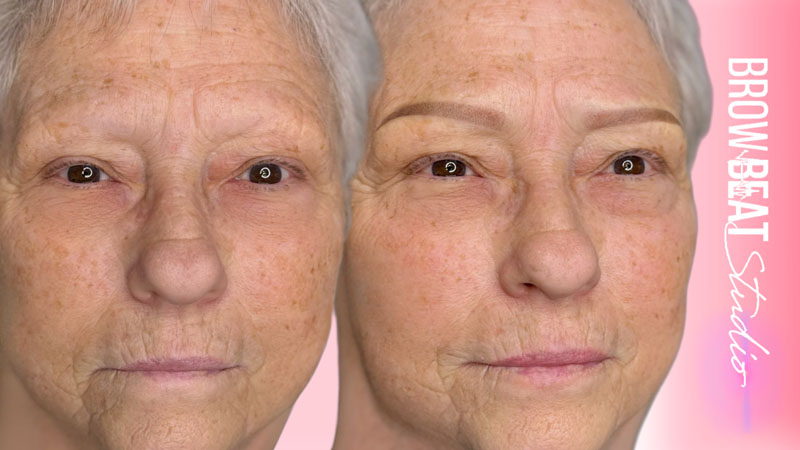
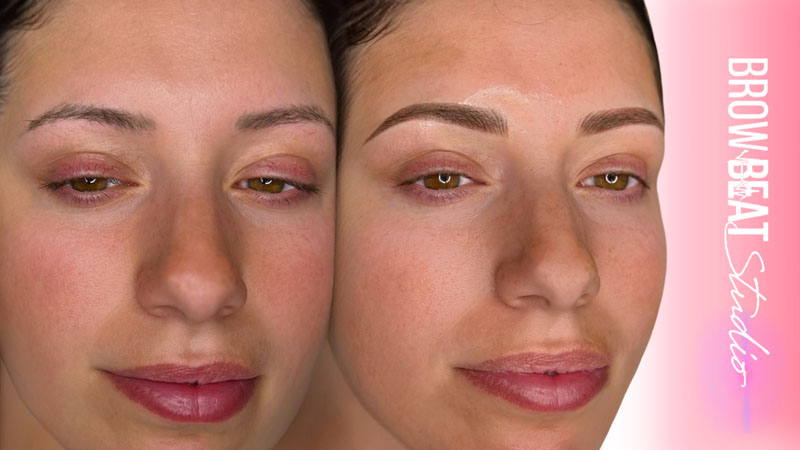
Nano Brows and Combo or Hybrid Brows have something important in common: They can both contain permanent hairstrokes. The difference is what happens after those hairstrokes are created.
Nano Brows → machine-created hairstrokes.
Combo / Hybrid Brows → hairstrokes + machine shading.
That additional shading changes much more than the appearance of the finished eyebrow. It can add density. It can strengthen the shape.
It can create more consistent coverage between natural hairs and permanent strokes. It can give the artist more control over symmetry. And over time, the shading can continue supporting the overall eyebrow even after individual hairstrokes have begun to soften.
This makes Nano vs Combo a more subtle decision than simply choosing “natural” or “defined.” Both can look natural. Both can look soft. Both can contain beautiful hairstroke detail.
The more useful question is:
How much work are you asking the hairstrokes to do?

Nano Brows create individual machine hairstrokes without adding a shaded background. On this blonde client’s smooth skin and fine, evenly distributed brow hair, the strokes blend beautifully with the existing eyebrow. Skin remains visible between the lines, preserving a light, wispy appearance. Combo Brows would introduce shading for additional density, but when the existing brow already provides enough fullness, hairstrokes alone may be sufficient.
This brunette Nano result demonstrates how machine hairstrokes can enhance an already organized eyebrow without filling every space with pigment. The fine natural hairs provide much of the existing density, while the permanent strokes add subtle continuity and definition. Combo or Hybrid Brows would introduce another layer of shaded color. Here, the appeal is the open texture created by hairstrokes working alongside the client’s own hair.


This dark-brown Nano result on medium-melanin skin demonstrates how individual machine hairstrokes can create additional definition while preserving visible separation between lines. The client’s smooth skin and evenly distributed natural hair support a clean, hair-like appearance. Combo Brows approach density differently by introducing shading around or beneath the strokes. The difference is not the client’s complexion, but how much permanent coverage the finished eyebrow needs.
Nano Brow suitability is not determined by complexion alone. This high-melanin client has exceptionally smooth, even skin and fine natural eyebrow hair that allows individual machine hairstrokes to remain visually distinct. The result shows how Nano can create soft-looking texture without shaded coverage. Combo would add background density, but that extra component is not necessary when the client prefers a lighter, stroke-based eyebrow.

Pure Nano Brows are built from machine-created hairstrokes. The permanent lines work with the client’s natural eyebrow hair to create additional texture, shape and visible fullness. Combo Brows add another permanent component: shading. That means the eyebrow no longer depends entirely on natural hair and permanent hairstrokes to create its visual density. The shading can create a soft background underneath and between the hairs and permanent lines.
In simple terms: Nano → hairstrokes only. Combo → hairstrokes + shading.
At BrowBeat, Combo and Hybrid describe the same broad permanent brow concept: a treatment combining hairstrokes with shading.
The exact balance can vary. One client may need only a small amount of shading. Another may need considerably more background density while still preserving visible hairstrokes. That flexibility is part of what makes a combined brow useful. Nano remains the stroke-only option.
The term 3D Brows is sometimes used to describe permanent eyebrows that create visual dimension through more than one type of pigmentation. Within BrowBeat’s service architecture, that sits within the Combo/Hybrid family rather than representing an entirely separate tattoo technology. The dimension comes from layering visual elements: natural eyebrow hair;
permanent hairstrokes; and shaded pigment. Those layers can make the eyebrow feel fuller and more dimensional than a stroke-only result.
Nano vs Powder is a comparison between two fundamentally different permanent structures. Nano creates lines. Powder creates shading. Nano vs Combo is different. Combo keeps the hairstroke component and then adds shading. So the comparison becomes: lines
versus lines + background color. That makes Combo particularly relevant for someone who genuinely likes hairstrokes but wants more from the finished eyebrow than strokes alone can easily provide.
This is one of the most useful questions BrowBeat can ask when a client is deciding between Nano and Combo. Imagine a client who already has fine, relatively even natural eyebrow hair. She has a good basic shape. She has a few gaps. She wants a little more texture. She likes seeing skin between her permanent strokes. In that eyebrow, Nano does not have to do very much. The natural eyebrow is already doing most of the work.
Now imagine another client. She wants hairstrokes. But she also wants more density. She wants stronger symmetry. She wants several sparse areas filled. She wants a more consistently defined tail. She does not want to see obvious gaps. Now the hairstrokes are being asked to create:
That is a lot to ask from individual lines. Adding shading gives the eyebrow another way to accomplish those goals without trying to solve every density problem by simply adding more strokes.
Nano can be incredibly beautiful when the client already has a useful natural brow framework. Natural hair supplies physical texture. The permanent strokes add where needed. Skin remains visible between them.
The finished result can feel airy and wispy because the tattoo does not have to manufacture the entire eyebrow. This is why fine, relatively even natural hair and smaller gaps are such strong Nano starting points. The permanent makeup is supporting the eyebrow rather than carrying it alone.

Combo gives the artist another tool. The hairstrokes can continue creating hair-like detail. But the shading can create the density that individual lines would otherwise have to manufacture.
That can be useful when:
Combo does not replace the hairstrokes. It stops the hairstrokes from having to solve every problem by themselves.
Hairstrokes: Yes. Shading: No. Density: Comes from the client’s natural hair plus the permanent machine hairstrokes.
Structure: Created through mapping, natural hair and the permanent stroke pattern. Visible skin: An important part of the result. Strong starting point: A client who already has a useful natural brow framework and genuinely wants a lighter, stroke-based result.
Hairstrokes: Yes. Shading: Yes. Density: Comes from natural hair, permanent hairstrokes and machine shading.
Structure: Can be reinforced through the shaded background. Visible skin: Less essential because the result is not relying exclusively on separated lines. Strong starting point: A client who likes hairstroke texture but also wants additional density, coverage or structural control.
This is another useful way to understand the difference. Nano emphasizes texture. Combo adds density to that texture.
Nano uses separate permanent lines to create the impression of additional eyebrow hairs. Combo keeps some of that hair-like detail but uses shading to support the spaces around and beneath it. The client does not have to choose between “natural” and “made up.” She is choosing how much of the permanent eyebrow should be built from individual lines and how much should be supported by background color.
Neither technique owns the word natural. Nano can look extremely natural because the pigmentation resemble hairs and visible skin remains between them. Combo can also look extremely natural because the shading does not need to be dark or heavy.
A soft shaded background can sit underneath natural hair and permanent strokes without turning the eyebrow into a strong makeup brow. The final appearance depends on shape, color, saturation, natural hair, stroke pattern and how much permanent density is added.
Nano has visual breathing room. There is skin between permanent strokes. There can be small differences in density. The edge of the eyebrow can feel less continuous.
That openness helps the permanent lines behave visually like hairs. For someone who loves wispy eyebrows, that can be exactly the point.
Combo creates a different kind of natural result. The client may have real eyebrow hair. Permanent hairstrokes add more hair-like texture. Then soft shading adds background density.
Those elements sit together rather than asking one permanent technique to do everything. A well-controlled Combo Brow can therefore look dimensional without needing to look heavy.
Not necessarily. The presence of shading does not determine how dark the eyebrow must be.
Shading can be very soft. It can be translucent. It can be concentrated only where additional density is useful.
A Combo Brow can still preserve visible hairstrokes and natural eyebrow hair while creating more consistent structure underneath them.

This blonde Combo Brow combines delicate hairstrokes at the front with a fully shaded body, creating a more consistent eyebrow shape without requiring a dark finish. Nano alone would rely on individual strokes and existing natural hair for fullness. Here, the shading supplies additional density while the front strokes preserve hair-like texture. The result demonstrates that adding shading does not mean creating a heavy eyebrow.
This brunette Combo Brow retains individual hairstrokes through the front while using shading to establish density throughout the body. That additional pigment creates a more continuous visual structure than Nano alone. The hairstrokes still contribute texture, but they no longer carry the entire responsibility for making the eyebrow look full. This is the advantage of Combo: hair-like detail supported by a shaded foundation.


When an eyebrow needs greater visible width, density, and a clearly defined silhouette, individual hairstrokes may not provide all the coverage the client wants. This thin-brow Combo result uses strokes for texture and shading for a more continuous body with a crisp border. Nano would preserve more open skin between lines, while Combo offers greater control over the finished shape and overall visual weight.
This high-melanin Combo Brow combines front hairstrokes with shading through the body, providing density without depending entirely on individual lines. Visible pores and skin texture can make fine strokes less predictable, but shading gives the eyebrow another permanent component to support its shape. The hairstrokes still contribute detail. The shaded body provides the coverage that pure Nano would otherwise need to create through additional lines.

Yes. The hairstroke component can preserve a wispy appearance, particularly through areas where individual lines remain visually important. The shading simply gives the artist another way to support the eyebrow. How wispy or how structured the finished result becomes depends on the balance between strokes and shading.
Yes, especially when the client already has substantial natural brow hair. Natural hair plus well-placed Nano strokes can create a very complete-looking eyebrow.
But the permanent lines still need space. If the client wants greater and greater density, there comes a point where adding more strokes begins working against the separated hairstroke effect. That is where a Combo conversation can become useful.
This is one of the clearest signs that a client may prefer a combined result. She genuinely likes hairstrokes. She wants to see them. But she also wants the eyebrow to look consistently filled.
Those are two different visual requests. Combo allows the hairstrokes to create texture while shading creates the density between them. Instead of packing more and more permanent lines into every visible space, each component can do the job it is better suited to do.
Combo gives the artist greater structural control.
The reason is the shading. A shaded background can reinforce the overall brow silhouette, create more consistent density and strengthen areas that would otherwise depend on individual hairstrokes.
Nano can absolutely create a beautifully mapped shape. But the finished shape still needs to be expressed through separate lines and the client’s existing natural hair. Combo gives the artist another permanent layer through which to support that structure.
If a client is highly focused on symmetry, Combo can offer an advantage. Some clients notice every small difference in density.
They notice if one tail looks slightly stronger. They notice if one section has more visible skin. They want both eyebrows to maintain a consistently balanced visual weight.
Shading gives the artist more ability to balance those differences while still preserving hairstroke texture. For someone who wants hairstrokes but knows that tiny density differences will bother her, Combo can be a useful middle ground.
Skin matters to both techniques because both contain permanent hairstrokes. The difference is that Combo has another component supporting the finished eyebrow.
With pure Nano, the individual strokes carry much of the permanent result. With Combo, the hairstrokes still matter, but shading can continue providing density and structure even when the stroke component heals more softly. That can make Combo more forgiving on some starting points.
Oily skin is not BrowBeat’s ideal starting point for fine permanent hairstrokes. That remains true whether those hairstrokes are used alone or inside a combined treatment. But if a client with oilier skin is strongly committed to having visible hairstrokes, Combo can offer more support than pure Nano.
The reason is not that adding shading suddenly makes oily skin ideal for strokes. It does not.
The advantage is that the entire finished eyebrow no longer depends on those strokes maintaining perfect visual clarity. If some of the permanent lines soften more quickly, the shaded component can still support the brow’s shape and density.
No. This distinction is important. The hairstroke portion of a Combo Brow is still made from hairstrokes.
Those lines can still widen. They can still soften. They can still lose visual separation.
Combo does not change the skin. It simply reduces how much responsibility the individual lines have for the overall eyebrow.

The same principle applies to large pores, thicker skin and significant texture. Pure Nano asks the treatment surface to display many individual fine lines successfully.
Combo still asks the skin to hold hairstrokes, but it also uses shading to create a more continuous visual foundation. For a client who insists on preserving a hairstroke component despite a less-than-ideal fine-line canvas, that added shading can make the overall result more structurally resilient.
There are still starting points where BrowBeat may recommend moving away from hairstrokes altogether. Adding shading does not make every skin an ideal stroke candidate.
On smoother, smaller-pored, medium-to-dry skin, both Nano and Combo can become strong options. The decision can then focus more heavily on the desired result. Does the client want visible skin between permanent strokes? Does she want only a little additional texture?
Or does she want that texture supported by more consistent density and structure? Good skin for hairstrokes gives the artist more flexibility.
Fine, relatively even natural brow hair is an excellent Nano starting point when the client wants a lighter result. The machine-created strokes can blend into the existing hair without needing a shaded background to make the eyebrow feel complete. But if the same client wants greater density, stronger symmetry or more consistent color through the brow, Combo can add those things without giving up the hairstroke component entirely.
The natural hair may suit both techniques. The desired amount of permanent work can decide between them.
Coarse, wiry or highly multidirectional natural hair remains challenging for hairstrokes. Combo does not make that issue disappear. A fine tattooed line underneath a substantial natural hair still has a different visual weight.
But the shading component can help create a more consistent background and visually unify areas where the natural hair itself is uneven. That can make Combo more useful than pure Nano when the client insists on retaining some hairstroke texture.
The amount and pattern of sparseness matter. A few smaller gaps within a good natural framework can be excellent Nano territory. The permanent lines can bridge those spaces without requiring additional background color.
More widespread sparseness creates a different challenge. If the client wants the entire brow to look consistently fuller, shading can provide density between the natural hairs and permanent strokes. Combo can therefore create a more complete result without forcing the artist to pack excessive numbers of hairstrokes into every sparse area.
A client with relatively full natural eyebrows may need very little permanent work. If she wants only a few additional hairs, slightly stronger tails or subtle texture, Nano may be enough. If she wants the same hairstroke detail but also wants a more consistently defined shape or background density, Combo can provide that additional layer.
Full natural brows do not dictate either technique. The amount of permanent enhancement desired still matters.

Sometimes the client says Nano, but the result she describes begins sounding increasingly combined. These are some of the statements that change the conversation.
You want hair-like texture, but you are also asking for continuous density. Shading can provide the density without forcing the hairstrokes to fill every visible space.
This may be a situation where permanent strokes alone are being asked to provide coverage. A shaded component can create that density while allowing the strokes to remain more open.
A combined approach gives the artist two permanent tools. Hairstrokes can preserve texture where they matter visually, while shading can strengthen areas where greater density is desired.
Shading gives the artist more control over small differences in density and visual weight between the two eyebrows. The client can keep the hairstroke element without asking those individual lines to create every part of the symmetry.
The more widespread the density problem becomes, the more useful a shaded background can be. Nano can add hairs. Combo can add hairs and create density between them.
This brings long-term behavior into the decision. The Nano strokes will still age. But in a Combo Brow, the shaded component can continue supporting the overall structure as the individual lines soften.
The client’s real hair provides actual dimension above the skin. It remains an important part of how the finished eyebrow looks.
The permanent strokes visually fill spaces and add the appearance of additional eyebrow hairs. If Nano machine strokes are used, those lines are created through repeated machine perforations.
The shading creates background color between and beneath the hair and permanent strokes. It can help unify sparse areas, strengthen the overall silhouette and create more consistent visual density.
The mapped design establishes the framework within which the natural hair, permanent strokes and shading need to work.
The permanent color needs to make sense with the client’s natural eyebrow hair, skin and desired finished result.
These components work together. Combo is not simply “Nano plus some extra color.” It is a layered permanent brow structure.
The most accurate answer requires separating hairstroke longevity from whole-brow longevity. The hairstrokes inside a Combo Brow still have the same fundamental shelf-life issue as other permanent hairstrokes. They can soften. They can fade. They can widen. And their visual separation can decrease over time. But Combo has something pure Nano does not:
shaded density supporting the eyebrow underneath and around those strokes. That gives the overall Combo result greater structural longevity.
This distinction explains why simply asking “which lasts longer?” can be misleading. Imagine that the Nano strokes and the hairstrokes inside a Combo Brow soften at a similar rate. In the pure Nano eyebrow, those strokes are carrying most of the permanent result. As they soften, the entire brow becomes softer. In the Combo eyebrow, the strokes may soften too, but the shading can continue defining the shape and providing background density.
The individual hairs did not magically last longer. The complete eyebrow had another permanent component supporting it.
No. This is important. Combo does not make permanent hairstrokes immune to aging.
The lines still exist in living skin. They still soften. Closely placed strokes can still become increasingly blended. Old hairstroke pigment can still accumulate over repeated treatments.
What Combo changes is how dependent the entire eyebrow is on those strokes remaining perfect. The shading gives the result another visual foundation.

In this Nano Combo example, shading is concentrated between the lower permanent hairstrokes, adding depth without requiring every open space to be filled with another line. The lower stroke pattern remains part of the eyebrow’s texture, while the shaded pigment contributes background coverage. This demonstrates how a combined technique can build density selectively instead of turning the entire eyebrow into either pure hairstrokes or full shading.
A Nano Combo Brow combines machine-created hairstrokes with shading placed between the permanent lines. This creates additional background density while allowing the individual strokes to remain visible. Pure Nano depends on separated lines and existing eyebrow hair to build fullness. By introducing shading into the open spaces, the combined technique can produce a more complete-looking eyebrow without relying on increasingly crowded hairstrokes.


This blonde Nano Combo Brow shows how delicate machine hairstrokes can work alongside very soft shading without losing their airy appearance. The head strokes preserve fine hair-like texture, while the shaded areas contribute gentle density. Compared with pure Nano, the eyebrow gains additional background color without becoming heavily filled. The result illustrates how subtle the difference between Nano and a lightly shaded Combo Brow can be.
At approximately one year, either technique may still look very good. A Nano Brow may show softer individual strokes than it did during the first months after healing.
A Combo Brow may show similar softening through its hairstroke component. But the Combo result can still have background density supporting the brow’s overall structure. That difference can become increasingly important as time passes.
At approximately two years, individual hairstrokes in either technique may be considerably softer than when new. Some may still be distinct. Others may be lighter or increasingly blended.
In a pure Nano result, the appearance depends heavily on what those strokes have become. In a Combo result, residual shading may continue providing a readable brow shape even when the original hair-by-hair detail has become less prominent. That is the structural advantage of the combined technique.
Combo generally gives the artist more maintenance flexibility than pure Nano. The reason is the shaded component. When a Nano Brow returns for maintenance, the artist needs to evaluate the old hairstrokes. How many are still visible? How much have they softened? Have some of the lines begun blending together?
How much clean skin remains between them? Is there enough visual space for another set of fine permanent strokes to make sense? Those same questions still matter with the hairstroke component of a Combo Brow. But Combo has another option. The existing shading can continue supporting the brow, and future maintenance does not have to depend entirely on recreating another pristine stroke pattern.
This is an important distinction. Combo is not as simple long term as a pure shading strategy because it still contains permanent hairstrokes.
Those old lines still become part of the future canvas. They can soften. They can merge visually. They can leave residual pigment.
And repeated stroke work can eventually reduce the amount of clean skin available for new lines. So Combo has more flexibility than pure Nano, but it does not eliminate the cumulative nature of hairstroke permanent makeup.
Yes, when the existing permanent makeup provides an appropriate starting point. But maintenance should not mean blindly repeating the exact same procedure every time. The artist needs to evaluate what is already there.
Sometimes the hairstroke component still has enough clarity that additional strokes make sense. Sometimes the old lines have softened enough that adding many more would create unnecessary congestion. Sometimes the shaded component needs more attention than the strokes. And over a long enough period, the balance between hairstrokes and shading may change.
The next treatment should respond to the eyebrow that exists now—not simply recreate the treatment name from years earlier.
Not necessarily in the exact same proportions forever. The shading can generally be maintained with considerable flexibility.
The hairstrokes have a more limited visual shelf life because new fine lines need enough clean background around them to remain readable as hairs. After repeated treatments, residual stroke pigment can become increasingly blended into the overall brow. At that point, future maintenance may rely more heavily on shading because the skin no longer provides the same clean canvas that existed during the first treatment.
That is not a failure — it is the natural evolution of long-term permanent makeup.

The first Combo Brow may have beautifully visible hairstrokes sitting over relatively clean skin with a soft shaded background.
Years later, the client may return with:
Trying to force the exact original stroke pattern back into that canvas may not produce the same result. Shading can work with the permanent color that remains. That makes it a more adaptable long-term component.
The answer depends on what the client values. If she specifically loves pure, airy hairstrokes and has an excellent starting point for them, Nano may be worth the shorter structural shelf life and more limited long-term repeatability. If she wants hairstrokes but also values density, symmetry, structure and more maintenance flexibility, Combo can offer practical advantages.
The financial decision therefore goes beyond the first appointment price. It includes how quickly the client wants the result refreshed and how easily the existing permanent work can support future treatments.
At BrowBeat, Nano and Combo Brows follow the same permanent brow pricing structure. Both are completed through a first treatment and a second treatment.
The client is not charged more simply because Combo contains an additional permanent technique. The price reflects the complete permanent brow service rather than counting hairstrokes and shading as separate items.
That means the choice between Nano and Combo does not need to be made according to which technique costs more at the initial treatment. The more important question is which result makes sense for the client’s brows.
Combo can take longer because the artist is creating more than one type of pigmentation. There is a hairstroke component. There is also a shading component. But procedure time is only one part of a BrowBeat appointment. Permanent brow appointments are generally reserved for more than three hours.
There is numbing. There is discussion. There are forms. There is mapping. The client reviews the design. There are color decisions. And some clients need more time than others to make decisions about their face. So while Combo may require more tattooing work, the total appointment time also depends heavily on communication, mapping and client feedback.
There is no universal answer. Both are cosmetic tattoo procedures.
Nano concentrates the permanent work into individual machine-created hairstrokes. Combo adds machine shading to the hairstroke component.
That can mean more permanent work is being performed overall, but individual sensitivity varies considerably. Numbing is part of BrowBeat’s permanent brow appointments, and BrowBeat does not promise that one technique will universally feel easier than the other.
Both techniques begin stronger and soften as they heal. With Nano, the client is primarily watching the individual hairstrokes change.
They begin dark and crisp. They soften. Some may appear lighter than others during healing.
With Combo, the client is watching two permanent elements settle at the same time. The hairstrokes are healing. The shading is also changing in saturation. The fully healed Combo result is therefore the relationship between the healed strokes and the healed shaded background.
The shading does not make the hairstrokes themselves immune to normal hairstroke healing. The permanent lines still soften as the skin heals over them. What changes is the visual context.
If one hairstroke heals lighter than expected, the Combo Brow still has shaded density in that area. In a pure Nano Brow, that individual stroke may have more visual responsibility. Again, Combo reduces how much the complete eyebrow depends on every individual line.

The term Nano Combo Brows is generally used to describe a combined eyebrow treatment that includes machine-created Nano hairstrokes together with shading. At BrowBeat, the terminology is simpler. Nano alone = machine hairstrokes.
Nano hairstrokes + shading = a Combo or Hybrid Brow. The Nano technique can describe the hairstroke component. Once shading is added, the complete eyebrow is a combined treatment.
The hairstrokes may still be Nano hairstrokes. But the complete treatment is no longer stroke-only Nano. It now contains two permanent structures:
machine-created hairstrokes and machine shading. For clarity, BrowBeat considers that a Combo or Hybrid result.
Nano Hybrid Brows is another term clients may encounter for machine hairstrokes combined with shading. The word hybrid simply communicates that more than one permanent brow approach is being used together. At BrowBeat, that sits within the Combo/Hybrid family.
This describes the same basic relationship. The Nano component creates individual machine hairstrokes. The Powder component creates shaded density. Once those elements are combined within one eyebrow, the finished treatment is conceptually a Combo/Hybrid Brow.
Start by asking how much you need the permanent makeup to do. If you already have a useful natural eyebrow framework and want only additional wispy hair-like texture, pure Nano may be enough. If you want hairstrokes but also want greater density, stronger structure, more consistent symmetry or fewer visible gaps, Combo may align more closely with that goal.
Your skin matters too. If the skin is less ideal for fine hairstrokes but you are strongly committed to having some stroke detail, the shaded component of Combo can give the finished eyebrow more support.
The choice is not about which technique has the more fashionable name — it is about how much responsibility you want the individual hairstrokes to carry.
If yes, pure Nano may align strongly with the result you like.
If yes, a combined result may make more sense.
If yes, shading gives the artist more structural control.
If yes, Nano may only need to add a little.
If yes, adding shading may prevent the artist from having to overpack the stroke pattern.
If yes, remember that the shaded component gives Combo more long-term flexibility even though the hairstrokes themselves still age like hairstrokes.
BrowBeat offers both because there are clients who genuinely need only hairstrokes and clients who want hairstrokes to be part of a more structured permanent eyebrow. We do not believe every Nano client needs shading. And we do not believe adding shading makes an eyebrow less natural. The decision comes down to what the client’s skin, natural eyebrow and expectations are asking the permanent makeup to accomplish. Nano allows the natural brow and permanent hairstrokes to carry the result. Combo keeps those hairstrokes but gives them support. The shading can add density. It can strengthen symmetry. It can preserve overall structure as individual strokes soften. And it can give future maintenance more flexibility.
The simplest question remains the most useful: How much work are you asking the hairstrokes to do?
For a complete explanation of how Nano hairstrokes are created, see What Are Nano Brows & How Do They Work?. For comparisons with the other two most common alternatives, see Nano Brows vs. Microblading and Nano Brows vs. Powder & Ombré Brows. And for what healing looks like after a hairstroke-and-shading result, see Nano Brows Healing & Aftercare.

Nano Brows use machine-created hairstrokes without shading. Combo Brows combine hairstrokes with machine shading, allowing the permanent eyebrow to have hair-like texture together with additional density, coverage and structural support.
At BrowBeat, Hybrid and Combo describe the same broad concept: hairstrokes combined with shading. Nano alone remains a stroke-only technique, while Hybrid adds shaded pigment to support the hairstroke result.
3D Brows is supporting terminology often used for brows that create dimension through multiple visual elements. At BrowBeat, hairstrokes combined with shading sit within the Combo/Hybrid family rather than being treated as a completely separate tattoo technology.
Yes. Hairstrokes are one of the defining components of a Combo Brow. The difference from pure Nano is that Combo also includes machine shading to create additional background density and structure.
At BrowBeat, pure Nano Brows do not include shading. Nano means machine-created hairstrokes. Once shading is added to those strokes, BrowBeat considers the complete result a Combo or Hybrid Brow.
Nano Combo Brows generally refers to machine-created Nano hairstrokes combined with shading. At BrowBeat, the Nano name describes the hairstroke component, while the complete strokes-plus-shading treatment belongs to the Combo/Hybrid family.
Nano Hybrid Brows is another term used for Nano machine hairstrokes combined with shading. The word Hybrid indicates that more than one permanent brow technique is being used within the finished eyebrow.
Neither looks more natural. Nano can create naturalness through open skin and separated hair-like lines. Combo can create a natural result by layering natural hair, permanent hairstrokes and soft shading without requiring the shaded component to look heavy.
There is no universal winner. Nano may be a strong fit when the natural brow already provides much of the density and the client wants light hairstroke texture. Combo can provide greater density, structure and maintenance flexibility when the permanent makeup needs to do more.
Consider how much responsibility the hairstrokes need to carry. If you want wispy permanent lines and already have a useful natural brow framework, Nano may be enough. If you want hairstrokes together with additional density, coverage or structural control, Combo may align more closely with the result.
Combo provides more options for creating density because it uses both hairstrokes and shading. Nano creates visual fullness through natural hair and individual permanent strokes while intentionally preserving more space between the lines.
Combo generally gives the artist greater structural control. Shading can reinforce the complete brow silhouette and create more consistent visual density, while pure Nano relies on the natural brow and individual hairstrokes to express the shape.
Combo can offer an advantage for clients who are highly focused on symmetry because shading gives the artist more ability to balance small differences in density and visual weight while still preserving hairstroke texture.
Yes. Combo Brows can preserve visible hairstrokes and a wispy appearance while using controlled shading where additional density is useful. Adding shading does not require the entire eyebrow to become dark or heavily filled.
Yes, particularly when the client already has a good amount of natural eyebrow hair. Natural hair plus Nano strokes can create a full-looking result, but there still needs to be enough space between permanent lines for them to continue reading as hairs.
Oily skin is not BrowBeat’s ideal starting point for fine permanent hairstrokes. If a client with oilier skin is strongly committed to having strokes, Combo can provide more support because the shaded component can maintain density and structure as individual lines soften.
Pure Nano becomes less predictable as the skin becomes more porous, thick or textured. Combo can be more forgiving because the overall eyebrow does not depend exclusively on fine-line clarity, although some skin may still be better suited to a treatment without hairstrokes.
Smoother, smaller-pored, medium-to-dry skin can be a strong starting point for either Nano or Combo. The decision can then focus more on whether the client wants open hairstroke texture alone or additional shaded density and structure.
Fine, relatively even natural hair can be an excellent Nano starting point when only subtle additional texture is wanted. If the same client wants stronger density or more consistent structure, Combo can add shading without giving up the hairstroke component.
Coarse, wiry or highly multidirectional hair remains challenging for fine hairstrokes. If the client strongly wants some hairstroke detail, Combo can use shading to create a more consistent background, but adding shading does not make the natural hair itself an ideal stroke framework.
Smaller gaps within a useful natural brow framework may need only Nano hairstrokes. When sparseness is more widespread and the client wants consistent density, Combo can use shading between the natural hair and permanent strokes to create a more complete result.
The hairstrokes themselves share similar long-term limitations, but Combo has greater structural longevity because shading continues supporting the overall eyebrow as the individual strokes soften. The complete Combo result can therefore remain visually structured even when its hairstroke component has aged.
No. The hairstrokes inside a Combo Brow can still fade, soften, widen and become increasingly blended. Combo simply reduces how dependent the complete eyebrow is on those individual lines remaining perfectly separated.
They can. Permanent hairstrokes remain permanent hairstrokes whether they appear alone or alongside shading. Closely placed lines can become increasingly blended as they age, while the shaded component can continue supporting the brow underneath them.
Combo generally offers more maintenance flexibility because the artist has both the existing hairstrokes and shaded background to work with. Pure Nano requires enough clean visual space for future fine lines to continue reading as individual hairs.
Yes, when the existing permanent makeup supports additional treatment. However, the balance may change over time. As old hairstrokes accumulate and soften, future maintenance may rely more heavily on shading rather than repeatedly recreating the original number of fine lines.
Both begin stronger and soften during healing. With Nano, the client is primarily watching individual hairstrokes settle. With Combo, both the hairstrokes and shaded saturation are healing, so the final result depends on how those two permanent components settle together.
There is no universal answer because pain perception varies. Combo includes both hairstroke work and shading and may involve more overall tattooing, but individual sensitivity and numbing have a major influence on the client’s experience.
Combo can take longer because the artist is creating hairstrokes and adding machine shading. However, complete BrowBeat brow appointments are generally more than three hours, and total time also depends on numbing, discussion, mapping, client feedback and the amount of permanent work required.
At BrowBeat, Nano and Combo follow the same permanent brow pricing structure and are completed through a first treatment and a second treatment. The technique decision is therefore based on the client’s skin, natural brow and desired result rather than one service being priced higher simply because it combines strokes and shading.