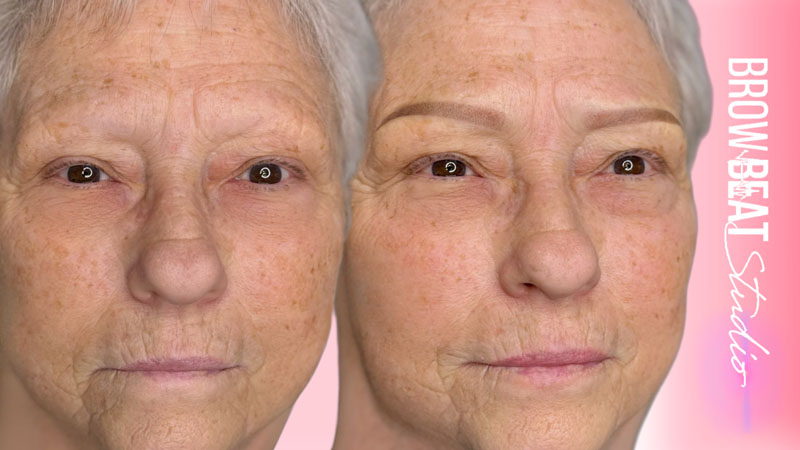
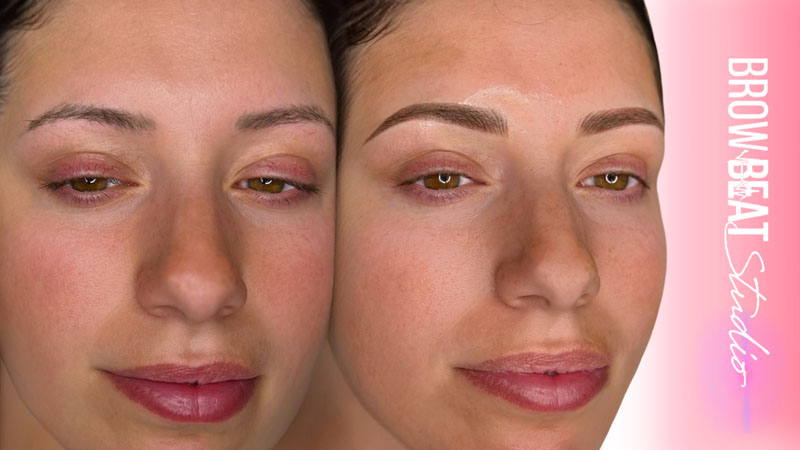
Nano Brows are permanent makeup, but individual hairstrokes have a relatively short visual shelf life. That distinction matters. A client can still have pigment in her skin long after the eyebrow has stopped looking like the crisp, separated Nano hairstrokes she originally chose.
At BrowBeat Studio Dallas, we generally find that clients who want to maintain a recognizable hairstroke result begin considering a refresh somewhere around 12–18 months. That does not mean every Nano stroke suddenly disappears at 18 months. It means the eyebrows at 12 or 18 months do not look exactly like they did one month after healing.
The strokes have aged. They have softened. Some have become lighter.
Some may have lost definition. And the separation between individual permanent lines may not be as obvious as it was when the result was new. This is the central truth about Nano longevity:
How long pigment remains in the skin and how long that pigment continues to look like individual eyebrow hairs are two different questions.

Blonde Nano Brows begin with lighter pigment selected to complement the client’s existing eyebrow hair. Because the permanent strokes have relatively little contrast against fair skin, even gradual fading can make individual lines increasingly difficult to identify. This illustration follows a possible progression from visible blonde hairstrokes toward a softer eyebrow appearance. The pigment has not necessarily disappeared; its visual contrast has changed. At BrowBeat Studio Dallas, Nano Brow longevity is evaluated by how long the permanent lines remain recognizable as hairs, not simply whether color remains within the skin.
Brunette Nano Brows often begin with clearly defined brown lines separated by visible skin. As those lines age, their edges may soften and the spaces between neighboring strokes can become less obvious. This illustrated progression highlights possible changes around eleven to fifteen months, when some clients notice that the original hairstroke pattern is becoming more blended. The timing is illustrative rather than universal. At BrowBeat Studio Dallas, the important distinction is that permanent pigment may still be present even when the eyebrow no longer displays the same individual hair-like detail.


The spaces between Nano hairstrokes are not unfinished areas of the eyebrow. They help each permanent line remain visually recognizable as an individual hair. This cool brunette illustration demonstrates why spacing becomes important as pigment ages and stroke edges gradually soften. A crowded pattern has less room for that change before neighboring lines begin appearing connected. At BrowBeat Studio Dallas, hairstroke design considers the future appearance of the brow, not only its fresh definition. Generous spacing cannot prevent fading, but it can help preserve the intended visual separation.
The same brown pigment does not guarantee identical Nano Brow longevity from one client to another. Implantation depth, skin texture, oil production, pigment formulation and individual retention all influence how permanent hairstrokes appear months later. This Fitzpatrick IV illustration demonstrates one possible transition from defined brown lines to a softer eyebrow appearance. It should not be interpreted as a fixed fading schedule or a prediction based on complexion. At BrowBeat Studio Dallas, we evaluate the actual aging of the permanent work rather than assuming skin tone alone determines how long Nano hairstrokes remain visible.

When someone asks, “How long do Nano Brows last?” it is tempting to answer with a number. One year. Two years. Three years. But a number alone can be misleading with a hairstroke technique. Imagine that some permanent pigment is still visible three years after a Nano treatment. Technically, the tattoo still exists. But if those original individual strokes have softened and merged enough that the eyebrow now reads more like a light layer of residual color, is that still the Nano result the client was asking about? Usually, no.
The client chose Nano because she wanted hairstrokes. So BrowBeat evaluates Nano longevity by asking a more useful question: How long does the work continue reading as hairstrokes?
Nano is asking permanent pigment to do something extremely specific. It is not simply asking pigment to remain visible — it is asking many individual lines to remain visually separate enough that the eye continues reading them as eyebrow hairs. That is a much higher standard.
Permanent makeup is placed superficially into skin, and skin is living tissue. The surface continually renews. The implanted pigment is viewed through that changing tissue.
Over time, permanent hairstrokes can become lighter, softer and less sharply separated. That is why the shelf life of a hairstroke result should not be confused with the total amount of time some pigment can remain visible.
This is probably the most important concept on this page. Pigment longevity asks: “Can I still see permanent color in the eyebrow?” Stroke longevity asks: “Can I still see separate lines that look like individual eyebrow hairs?”
Those are not interchangeable. A Nano Brow can lose much of its original hairstroke definition while still leaving visible pigment behind. That residual pigment may become softer and more blended. Years later, an old Nano Brow can sometimes read less like a collection of separate hairs and more like a light layer of permanent brow color. The pigment did not necessarily vanish. The hairstroke effect aged.
Once Nano Brows are fully healed, the long-term aging process begins. There is no single progression that every client follows exactly, but the broad pattern is understandable:
Defined strokes → softer strokes → lighter strokes → less separation → increasingly blended residual pigment.
Some clients hold distinct strokes longer. Some fade considerably faster. Some retain a surprising amount of color but lose the crisp separation that originally made the treatment look like hair. Skin characteristics, artist application, stroke spacing, pigment, sun exposure, skincare and individual retention all influence that progression.
Yes. Nano Brows fade because permanent makeup does not remain visually unchanged in living skin. The color can become lighter.
The individual strokes can become softer. The contrast between the pigmentation and the surrounding skin can decrease. And over a longer period, the original stroke pattern can become increasingly difficult to distinguish.
Fading is not necessarily a sign that something went wrong. Permanent makeup is expected to age. The question is how quickly it happens and what the brow looks like as it does.

Yes. Fresh Nano strokes begin at their sharpest and most highly defined. They already soften during the initial healing process.
After healing, they continue aging gradually. The edges can become less visually crisp. The color can become lighter.
And the distinction between neighboring strokes can become less obvious. This is one reason BrowBeat does not describe Nano as a technique where every individual line remains frozen indefinitely in its fresh appearance. Skin does not behave that way.
They can become increasingly soft and less defined. How much that happens varies. A beautifully spaced Nano pattern has more visual room available for the strokes to soften while still remaining understandable as separate lines.
A very dense pattern has less room. If permanent strokes begin extremely close together, even modest long-term softening can reduce the visible space between them. That can make the brow appear increasingly blended.
Yes, particularly when many permanent strokes are packed closely together. This is where the desire for maximum fresh density can work against the long-term hairstroke result. Clients sometimes think:
“If twenty strokes look good, wouldn’t forty look even fuller?”
Not necessarily. The visible skin between hairstrokes is part of what allows the eye to read each line as a separate hair. As those lines age and soften, they need room. If that room was never there, the strokes have much less visual space available before they begin appearing connected or blended.
Nano is strongest when the client actually wants a stroke-based result. That means accepting some negative space. It means allowing skin to show between permanent lines. And it means understanding that trying to create the density of a shaded brow using an enormous number of hairstrokes can create a long-term problem. Freshly, dense stroke work can look impressive in a close-up photograph. But the photograph does not age. The skin does.
As the strokes soften, very dense work can lose separation more quickly. This is one reason BrowBeat repeatedly comes back to the same principle: Nano is often at its best when less is the goal.
Yes. Implantation depth is one of the reasons Nano longevity can vary so much between artists and clients. If machine hairstrokes are implanted very superficially, they can have a particularly short shelf life.
The color may heal softly and fade relatively quickly. But simply going deeper is not the answer. A deeper stroke can retain more strongly and remain much darker.
It can also lose some of the delicate visual quality the client wanted from a Nano treatment. The artist is balancing retention against the appearance of the healed line. That balance requires skill.
One of the assumptions surrounding Nano is that machine application creates longer-lasting hairstrokes. BrowBeat does not make that promise. The machine changes how the permanent stroke is implanted. It does not change the fundamental fact that the result is still made from fine permanent lines placed superficially in living skin.
Machine hairstrokes can have their own challenges with depth and retention. A beautifully delicate Nano stroke may be intentionally superficial enough that its visible shelf life is shorter than a client expected.
A stronger, deeper line may remain longer but look different as it ages. There is always a relationship between how the pigment is implanted and what the client sees later.

Nano hairstrokes are created by depositing pigment into the skin through repeated machine needle perforations. The placement must be controlled carefully because implantation depth influences both retention and the appearance of the permanent line. A stroke placed too superficially may lose visible color quickly, while excessive depth can create unwanted pigment spread or a heavier result. This educational diagram illustrates the relationship between the epidermis and superficial dermis, where lasting tattoo pigment is retained. At BrowBeat Studio Dallas, the goal is balanced implantation rather than simply placing pigment deeper to make it last longer.
A Nano hairstroke is made from pigment particles retained within living skin, not a permanent line resting on the surface. This magnified illustration shows those particles surrounded by collagen and cellular structures in the dermis. Over time, changes in the surrounding tissue and pigment distribution can influence how clearly the line is seen. A stroke may lose some of its original definition without every pigment particle disappearing. At BrowBeat Studio Dallas, this distinction explains why a client can retain permanent eyebrow color while losing the crisp hair-like appearance that originally defined her Nano Brows.


Nano Brow longevity is influenced by several processes occurring beyond the artist’s direct control. Immune activity affects how the body responds to implanted pigment, while skin remodeling changes the tissue surrounding it. Environmental exposure, including ultraviolet light, can contribute to visible fading, and implantation depth influences retention from the beginning. This diagram brings those four factors together to explain why identical-looking fresh Nano Brows may age differently. At BrowBeat Studio Dallas, twelve to eighteen months is a common maintenance discussion window, not a guaranteed expiration date for every hairstroke.
At approximately one year, Nano Brows commonly look softer than they did during the first month after healing. Many clients can still see their hairstrokes. But the lines may be lighter.
The edges may be less crisp. Some strokes may be easier to see than others. And the overall eyebrow may have less definition than it did when the result was new.
This does not mean the brows need immediate treatment. Some clients are perfectly happy with a softer one-year result. Others want to maintain a more defined hairstroke appearance and begin thinking about maintenance.
This is the window when many BrowBeat clients who want to maintain their Nano appearance begin considering a refresh. Again, the reason is not that all pigment has disappeared. Usually it has not.
The reason is that the brows no longer look exactly the way they did shortly after the original treatment healed. The strokes have had time to soften. The eyebrow may look lighter.
And the client who chose Nano specifically because she loves visible hairstrokes may want some of that definition restored. For BrowBeat, maintenance is about the appearance of the existing work, not an arbitrary anniversary on the calendar.
By approximately two years, the difference between “pigment still exists” and “these still look like individual Nano hairstrokes” can become increasingly important. Some clients will still have visible lines. Others may have a much softer pattern.
Strokes that were originally close together may appear increasingly blended. And the overall brow can begin looking more like residual permanent color than the crisp hairstroke result visible shortly after healing.
This is why older industry expectations of simply waiting two or three years between hairstroke treatments did not always match what clients actually wanted to see in the mirror. The pigment might still be there. But the original visual result had aged.
Years later, Nano Brows can look very different from the original fresh treatment. Some permanent color may still be visible. But individual strokes can become much harder to identify. The eyebrow may eventually read as a soft layer of residual pigment rather than a collection of separate machine-created hairs. This is not unique to one artist or one client — it is part of the long-term reality of placing repeated fine permanent lines into skin. The important question then becomes not:
“Is there still pigment?” but: “What permanent brow technique makes sense on the skin that exists now?”
There is no single Nano Brow lifespan that applies equally to everyone. Two clients can receive machine hairstrokes from the same artist and return looking very different a year later. That is because Nano longevity is influenced by more than the machine. Important factors include:
Some of those variables belong to the artist. Some belong to the client’s skin. Some develop over time. That is why BrowBeat prefers realistic longevity ranges and long-term observation over promising every Nano client an identical lifespan.

Hairstrokes ask a great deal from skin. The pigment does not simply need to remain visible. The skin needs to support enough long-term separation for the individual permanent lines to continue reading as hairs.
In BrowBeat’s experience, smoother skin with smaller pores and a medium-to-dry oil profile tends to give Nano hairstrokes a better environment for maintaining visible definition. That does not mean every client with those characteristics receives identical retention. It means the starting surface is generally more compatible with what a fine hairstroke technique is trying to accomplish.
Oily skin can make long-term hairstroke definition more challenging. The concern is not simply whether some pigment remains — it is whether fine machine strokes continue to look sufficiently separate and defined as they age.
On oilier or more porous skin, the visual character of fine hairstrokes can soften more quickly. That can shorten the useful shelf life of the stroke pattern even when pigment is still present. Someone considering Nano on oily skin therefore needs to think about the long-term appearance of the lines, not only whether the procedure can physically be performed.
In BrowBeat’s experience, medium-to-dry skin is generally a stronger environment for maintaining fine hairstroke definition. Smoother skin and smaller pores can allow the individual permanent lines to remain visually understandable for longer.
Again, this is not a guarantee. Individual retention still varies. But if the goal is a delicate machine-hairstroke result, the characteristics of the skin matter.
Natural eyebrow hair does not technically make tattoo pigment last longer. But it can make an aging Nano result continue looking better. If permanent strokes soften slightly among fine, evenly distributed natural brow hairs, the overall eyebrow can still read convincingly as hair.
The natural hairs are carrying part of the texture. When permanent hairstrokes have to create almost the entire eyebrow by themselves, every change in stroke definition becomes more visually important. This is one reason BrowBeat likes Nano on clients who already have some natural brow hair and want additional texture rather than complete coverage.
Yes. UV exposure is not helpful to the longevity of any tattoo pigment. Repeated, significant sun exposure can contribute to permanent makeup fading and color change over time.
For Nano, that matters twice: The color can become lighter, and the individual hairstroke pattern can become less visually distinct. Clients who spend substantial time in the sun should expect UV exposure to become part of the longevity equation.
Once the brows are fully healed, protecting the skin from unnecessary UV exposure can help protect the appearance of permanent makeup as well. Sunscreen cannot freeze a Nano Brow in time. The skin and pigment will still age. But reducing repeated UV exposure removes one avoidable factor that can accelerate visible fading.
Products designed to accelerate skin turnover deserve particular attention when someone wants permanent brows to last. Retinol, prescription tretinoin such as Retin-A, acids and other aggressive exfoliating products can work against the longevity of superficial permanent makeup when they are repeatedly used through the eyebrow area. In BrowBeat’s experience, aggressive skincare around permanent brows can dramatically shorten their useful shelf life—sometimes by roughly half. That matters particularly with Nano because the result depends on fine individual lines rather than a large field of pigment.

BrowBeat gives clients a simple long-term guideline:
If preserving your permanent brows is a priority, keep strong turnover and exfoliating skincare from the lash line down rather than repeatedly applying it through the forehead and eyebrows.
That includes products such as retinoids and strong acids. The objective is not to tell someone she cannot use effective skincare. It is to understand that repeatedly accelerating skin turnover through an area containing superficial permanent makeup can shorten the visible life of that makeup.
They can contribute to faster fading when repeatedly used through the eyebrow area. Products and treatments intended to exfoliate, resurface or accelerate turnover are doing exactly what their names suggest. If the goal is to preserve fine permanent hairstrokes, routinely directing aggressive exfoliation through those same brows works against that goal.
This is a long-term maintenance issue rather than a reason to fear skincare. Placement matters.
Treatments that aggressively exfoliate or resurface the skin around the brows can affect permanent makeup longevity. The degree depends on the treatment and where it is performed. If you regularly receive skin-resurfacing services, tell the provider you have permanent makeup and make sure the brow area is considered when treatment is planned. The more frequently the skin around permanent hairstrokes is aggressively resurfaced, the more relevant that becomes to long-term retention.
Yes, although lifestyle is a broad category. Someone who spends substantial time in direct sun has a different long-term exposure profile from someone who rarely does. Someone who uses aggressive exfoliating skincare through the brows has a different maintenance environment from someone who avoids that area.
And some clients simply retain permanent pigment differently even when their routines appear similar. There is always an individual biological component to permanent makeup retention.
Human skin is not standardized. Oil production varies. Pore size varies. Skin texture varies.
Healing varies. Lifestyle varies. And the way individual skin holds implanted pigment varies. That is why BrowBeat does not promise that two clients receiving the same Nano technique will return at 18 months with identical eyebrows.
Yes. Permanent brow pigment can change visually as it ages. Brown is not one single color component. Brown contains relationships between red, yellow and blue.
Those components do not necessarily age or remain visually dominant in exactly the same way over time. As permanent pigment fades and the skin above it changes, the visible brow color can become warmer, cooler, lighter or more muted than it was when new.
That does not mean every Nano Brow will experience an obvious unwanted color shift. It means color aging is part of permanent makeup longevity.
They can develop a cooler or greyer appearance over time in some circumstances. Several factors can contribute, including the pigment used, implantation, the way individual color components age and how much residual pigment remains in the skin. Brown permanent makeup contains cool components as part of the color itself.
Black, for example, carries a strong blue influence. As permanent brow pigment ages, the visible balance can therefore change. A grey-looking older brow is not a universal outcome, but it is possible.
They can. Just as some aging permanent brow pigment can appear cooler, other results can become warmer as the visible color balance changes. Long-term brow color depends on the pigment, the skin, implantation and the way the permanent color has aged. This is another reason BrowBeat evaluates what is actually present before adding more permanent pigment during maintenance.

A brunette client may reach twelve months with plenty of permanent pigment still visible, yet notice that her individual Nano hairstrokes no longer stand out as clearly. The brow may still look attractive and require very little daily makeup, even though its original hair-like texture has softened. This illustration demonstrates why longevity is partly about personal expectations. At BrowBeat Studio Dallas, maintenance is not recommended because a year has passed. We consider whether the existing permanent work still provides the appearance the client wants before discussing another treatment.
A darker Nano Brow can retain visible color while the original separation between permanent lines gradually decreases. Strong pigment retention may make the eyebrow appear defined for longer, but it does not necessarily preserve the delicate texture of individual hairs. This dark brown illustration shows how a stroke pattern may become more visually blended while retaining considerable color. At BrowBeat Studio Dallas, we avoid judging longevity by darkness alone. A successful long-term Nano result depends on the relationship between retained pigment, line clarity and the client’s preferred eyebrow appearance.


A client with richly pigmented skin may retain Nano hairstrokes strongly or experience considerable softening, just as clients with lighter complexions can. Skin tone alone does not establish how long the permanent lines will remain recognizable. This illustration demonstrates one possible aging pattern, with hairstrokes gradually losing some separation while residual pigment remains. At BrowBeat Studio Dallas, long-term Nano results are considered through the actual treatment characteristics, including skin texture, oil production, pigment choice and implantation. The goal is realistic expectations without assigning a fixed lifespan to any complexion.
A refresh is not performed on blank skin. The artist is working over whatever permanent pigment remains. That residual pigment may be light.
It may be soft. It may have shifted warmer or cooler. And the original individual hairstrokes may no longer be easy to distinguish.
All of that affects what should happen next. Maintenance should therefore begin with an evaluation of the existing permanent makeup rather than repeating the exact procedure that was performed the first time.
For clients who want to keep a clearly defined Nano hairstroke appearance, BrowBeat commonly sees maintenance become desirable around 12–18 months. That is not an expiration date. It does not mean every client needs another treatment at exactly 12 months.
And it does not mean the pigment has disappeared. It means this is often the point where clients begin noticing that the brows no longer look the way they did during the first months after healing.
The strokes may be softer. The color may be lighter. Some individual lines may be less distinct. And the client may decide she wants more visible definition again.
No. The existing permanent makeup should determine whether additional pigment makes sense. One client may return at 12 months with very soft hairstrokes and want more definition.
Another may still have enough visible permanent work that adding more pigment would be premature. BrowBeat does not believe a calendar should override what is actually present in the skin. The purpose of maintenance is to improve the existing result—not simply to perform another procedure because an anniversary arrived.
Earlier permanent makeup expectations often suggested that clients could simply wait two or three years before thinking about their brows again. But that timeline can confuse pigment longevity with result longevity. At two or three years, some pigment may absolutely still be visible. The question is whether the client still likes what that pigment looks like.
With a hairstroke technique, many clients do not want to wait until the individual lines have become extremely soft, blurred or difficult to distinguish before maintaining the result. If someone chose Nano because she loves visible hairstrokes, she may want those strokes refreshed while the eyebrow still looks intentionally maintained rather than waiting for the entire result to become old and heavily softened.
Yes, but not indefinitely in exactly the same way. This is one of the most important long-term realities of hairstroke permanent makeup. The first Nano treatment begins on relatively clean skin.
There is room for individual lines. There is visible skin between them.
When the client returns later, some permanent pigment remains. A refresh adds more pigment. When she returns again, there may be residual pigment from more than one treatment. Eventually, the artist is no longer working on the same clean canvas that existed at the beginning.

Hairstrokes need clean visual space. If the skin already contains a significant amount of old permanent pigment, there is less contrast available for a new fine line to read as a separate hair. Imagine drawing a thin brown line on clean white paper. The line is easy to see.
Now imagine drawing that same fine line over paper already covered with several layers of pale brown. The new line has much less contrast. Permanent makeup is more complicated than paper, but the visual principle is useful. Over time, repeated hairstroke treatments can leave enough residual pigment that simply adding another set of crisp lines no longer produces the same effect as the original Nano treatment.
Old permanent makeup becomes part of the next starting point. It may be light. It may be blended. It may have softened into a more general field of color.
But if it is visible, the artist has to account for it. New Nano strokes need contrast against the skin to read as individual hairs. If the background already contains substantial residual pigment, that contrast decreases. This is why a technique that was perfect for the first treatment may not remain the most logical technique forever.
Permanent makeup is cumulative. Every appropriate treatment adds pigment to skin that may still contain pigment from the treatment before it. Eventually, repeated hairstroke work can reach a point where there is simply too much residual color underneath for another crisp Nano pattern to read clearly.
At that stage, trying to force more hairstrokes into the brow can create additional visual congestion rather than restoring the light, wispy result the client originally loved. A shading-based approach can eventually become more realistic because the skin is already reading as an area of permanent color rather than a clean background for isolated lines.
This does not mean every Nano client becomes a Powder Brow client on a particular date. It means the technique may need to evolve as the permanent makeup history of the brow evolves.
They can, and for some long-term permanent makeup clients that transition makes sense. A client may begin with beautiful individual hairstrokes on relatively clean skin. Years later, after several treatments, the residual pigment may create enough background color that trying to reproduce the original stroke-only effect becomes increasingly difficult.
At that point, shading can work with the permanent color already present rather than pretending the skin is still a blank Nano canvas. The decision should be based on what the brows actually look like at that stage.
No. The artist needs to evaluate how much pigment remains, how much clean skin is still visible and whether new lines will actually be readable. Adding more strokes simply because the previous treatment was called Nano can eventually create the opposite of what the client wants.
More pigment. Less negative space. Less visible separation.
And potentially less of a true hairstroke appearance. Long-term maintenance requires judgment.
Fast fading can have more than one explanation. The strokes may have been implanted very superficially. The client’s skin may not hold fine hairstrokes particularly well.
Oil production or pore structure may affect how the strokes remain visually defined. Sun exposure may contribute. Retinoids, acids or aggressive exfoliation through the brow area may shorten the visible shelf life.
Or the client may simply retain permanent pigment more lightly than another person. The timing matters too. Apparent fading during the initial healing process is different from a fully healed Nano Brow that then fades rapidly over the following months.

An eyebrow is not one perfectly uniform piece of skin. Different areas can retain differently. Natural oil distribution can vary. The skin thickness and texture can vary slightly.
Individual machine strokes may also have small differences in implantation. That is why one portion of a Nano Brow can remain relatively distinct while another becomes softer sooner. The entire eyebrow should be evaluated rather than assuming every individual line must age at exactly the same rate.
They can become extremely faint, but BrowBeat does not promise that Nano pigment will completely disappear on a fixed timeline. Permanent makeup is tattoo pigment implanted into skin. Some clients may retain residual pigment long after the original hairstroke pattern has become difficult to identify.
This is another reason “How long do Nano Brows last?” cannot be answered only by asking when the last trace of pigment disappears. The useful lifespan of the hairstroke effect can be considerably shorter than the total lifespan of every remaining pigment particle.
Yes. This is common enough to be an important expectation. Over time, the lines can soften and merge visually while permanent color remains within the eyebrow.
The result may eventually resemble a faint layer of brow color rather than distinct individual strokes. That residual color then becomes part of the decision about future maintenance.
You cannot stop permanent makeup from aging, but you can avoid unnecessarily accelerating the process. Protect healed brows from excessive UV exposure. Avoid repeatedly applying strong retinoids, Retin-A, acids and aggressive exfoliating products directly through the eyebrow area if maintaining permanent pigment is a priority.
Be thoughtful about resurfacing treatments around the brows. And do not assume that more frequent tattooing creates better long-term Nano results. Sometimes protecting what is already there and allowing sufficient fading before adding more pigment is the better maintenance decision.
Some fading and softening is expected. Nano is permanent makeup placed in living skin. The eyebrow should not be expected to look identical at 18 months to the way it looked during the first month after healing. Normal long-term aging can include:
The important question is whether the client still likes the brow and whether the remaining pigment supports another hairstroke treatment.
BrowBeat evaluates Nano Brows by more than whether pigment is technically still present. We care about whether the work still looks like the result the client originally chose. For Nano, that means hairstrokes. At around 12–18 months, many clients begin considering maintenance because the lines have softened enough that they want more definition. Over longer periods, the original stroke pattern can become increasingly blended even though permanent color remains. And after repeated treatments, there may eventually be too much residual pigment to continue recreating the same crisp stroke-only result.
That is the long-term reality of permanent hairstrokes. Nano can be beautiful. But beautiful long-term permanent makeup requires understanding not only how the first treatment looks, but what happens to every layer of pigment that comes afterward. For BrowBeat’s complete Nano Brow service and Dallas results, visit Nano Brows Dallas.
How long Nano lasts is tied to how it was created and what it is being compared against. For the fundamentals of the technique, see What Are Nano Brows & How Do They Work?. For how Nano’s aging compares to Microblading or to a combined hairstroke-and-shading result, see Nano Brows vs. Microblading and Nano Brows vs. Combo & Hybrid Brows. For pricing, including what a refresh costs, see Nano Brows Cost & Pricing.

Nano Brows are permanent makeup, but the individual hairstroke effect has a shorter visual shelf life than the total lifespan of the pigment. At BrowBeat, clients who want to maintain clearly visible hairstrokes commonly begin considering a refresh around 12–18 months because the strokes have softened, lightened and changed from their newly healed appearance.
Yes. Nano Brows gradually fade and soften after healing. The pigment can become lighter, individual strokes can lose definition and the visible separation between neighboring hairstrokes can decrease over time.
There is no universal lifespan for every machine hairstroke. Skin characteristics, implantation depth, stroke spacing, pigment, sun exposure, skincare and individual retention all affect how long the lines remain visibly distinct. Many BrowBeat clients consider maintenance around 12–18 months.
No. Pigment may remain visible in the skin after the original lines no longer read clearly as individual eyebrow hairs. Nano longevity is therefore better evaluated by how long the hairstroke effect remains useful, not simply by whether any permanent color is still present.
Nano Brow longevity can be affected by skin characteristics, individual pigment retention, implantation depth, stroke density and spacing, pigment color, UV exposure, retinoids and exfoliating skincare, skin treatments and the amount of previous permanent pigment already in the brows.
Nano hairstrokes are fine permanent lines implanted superficially into living skin. As the skin and pigment age, the lines can become lighter and softer. Because the Nano effect depends on those lines remaining visually separate, even gradual softening changes the appearance of the result.
Yes. Nano strokes generally become softer as they age. Their edges may become less crisp, their color may become lighter and the contrast between the permanent lines and surrounding skin can decrease.
Nano hairstrokes can become less sharply defined over time. The amount varies according to the skin, application and stroke spacing. Softening is particularly noticeable when permanent lines were placed very close together.
They can become visually blended, especially when many strokes were packed closely together. Nano strokes need negative space because that visible skin helps the eye continue reading each permanent line as a separate eyebrow hair.
Dense hairstroke patterns leave less clean space between permanent lines. As those lines naturally soften over time, there is less room for that change before neighboring strokes begin appearing connected or blended. This is one reason Nano often ages best when a lighter hairstroke result is the goal.
They can become extremely faint, but BrowBeat does not promise that every trace of Nano pigment will completely disappear. Residual permanent color can remain after the original hairstroke pattern has become much less distinct.
Yes. This is an important distinction. Individual Nano lines can soften and blend until the eyebrow looks more like a light layer of residual permanent color even though pigment remains in the skin.
At around one year, many Nano Brows still have visible hairstrokes, but they commonly look softer and lighter than they did shortly after healing. Some individual lines may remain stronger than others, and overall brow definition may have decreased.
By 12–18 months, many clients notice enough softening that they begin considering maintenance. The pigment may still be clearly present, but the hairstrokes may be lighter, less crisp and less individually defined than the newly healed result.
At approximately two years, some clients still have identifiable hairstrokes while others have a much softer pattern. Closely placed lines may look increasingly blended, and the brow can begin reading more like residual permanent color than newly defined Nano strokes.
Years later, permanent pigment may remain even when the original hairstroke pattern is difficult to identify. Older Nano work can eventually appear as a softer layer of brow color rather than a collection of clearly separated machine-created hairs.
Yes. Fine hairstrokes need skin that can support long-term visual separation. In BrowBeat’s experience, smoother, smaller-pored, medium-to-dry skin generally provides a stronger environment for maintaining delicate Nano stroke definition.
Oily or more porous skin can make fine hairstroke definition more difficult to maintain. The issue is not only whether pigment remains, but whether the individual machine strokes continue reading clearly as separate hairs over time.
In BrowBeat’s experience, medium-to-dry skin tends to be more favorable for maintaining fine Nano hairstroke definition. Individual retention still varies, so no skin type creates a guaranteed lifespan.
Yes. Repeated UV exposure can contribute to tattoo pigment fading and color change. Once Nano Brows are healed, protecting the brow area from unnecessary prolonged UV exposure can help reduce one factor that accelerates visible fading.
Yes. Products that accelerate skin turnover can shorten the visible life of superficial permanent makeup when repeatedly used through the eyebrow area. BrowBeat advises clients who prioritize brow retention to keep strong turnover skincare such as retinoids away from the forehead and permanent brows.
They can. Repeated exfoliation and resurfacing through the eyebrow area can contribute to faster visible fading. If maintaining Nano pigment is important, strong acids and aggressive exfoliating products should not be routinely worked through the permanent brows.
Yes. Permanent brow color can become lighter, warmer, cooler or more muted as it ages. Brown pigments contain multiple color influences, including red, yellow and blue, and those components do not necessarily remain visually balanced in exactly the same way forever.
Some older permanent brow pigment can develop a cooler or greyer appearance. Pigment composition, implantation, skin and the way individual color components age can all contribute. Grey is possible, but it is not an inevitable outcome for every Nano Brow.
Fast fading can have several causes, including superficial implantation, skin characteristics, individual retention, significant UV exposure, aggressive skincare or exfoliation through the brows. Apparent fading during initial healing should also be distinguished from true long-term fading after the brows have healed.
Many BrowBeat clients who want to maintain visible hairstroke definition begin considering a refresh around 12–18 months. The existing pigment should still be evaluated before adding more because maintenance should be based on what remains in the skin rather than the calendar alone.
No. Some clients may want more definition around one year, while others still have enough permanent pigment that additional treatment would be premature. BrowBeat evaluates the existing work before deciding whether another hairstroke treatment makes sense.
Yes, but the same crisp stroke-only result cannot necessarily be recreated indefinitely. Every treatment can leave residual permanent pigment, reducing the amount of clean skin available for new individual hairstrokes to remain visually separate.
After repeated permanent hairstroke treatments, residual pigment can create enough background color that new fine lines no longer read clearly against clean skin. At that stage, a shading-based approach may work more naturally with the permanent pigment already present rather than continuing to add increasingly crowded strokes.
Once healed, protect the brows from unnecessary UV exposure, avoid repeatedly applying retinoids, Retin-A, strong acids and aggressive exfoliating products through the eyebrow area, be thoughtful about resurfacing treatments around the brows and avoid unnecessary over-treatment. Permanent makeup will still age, but these choices can help avoid accelerating that process.