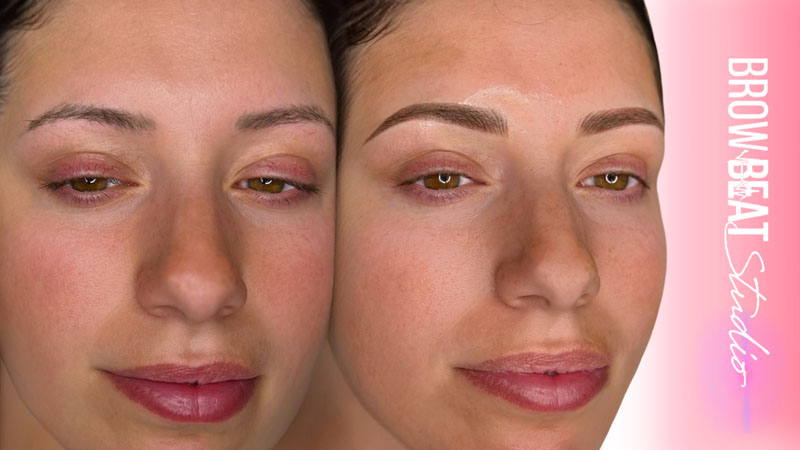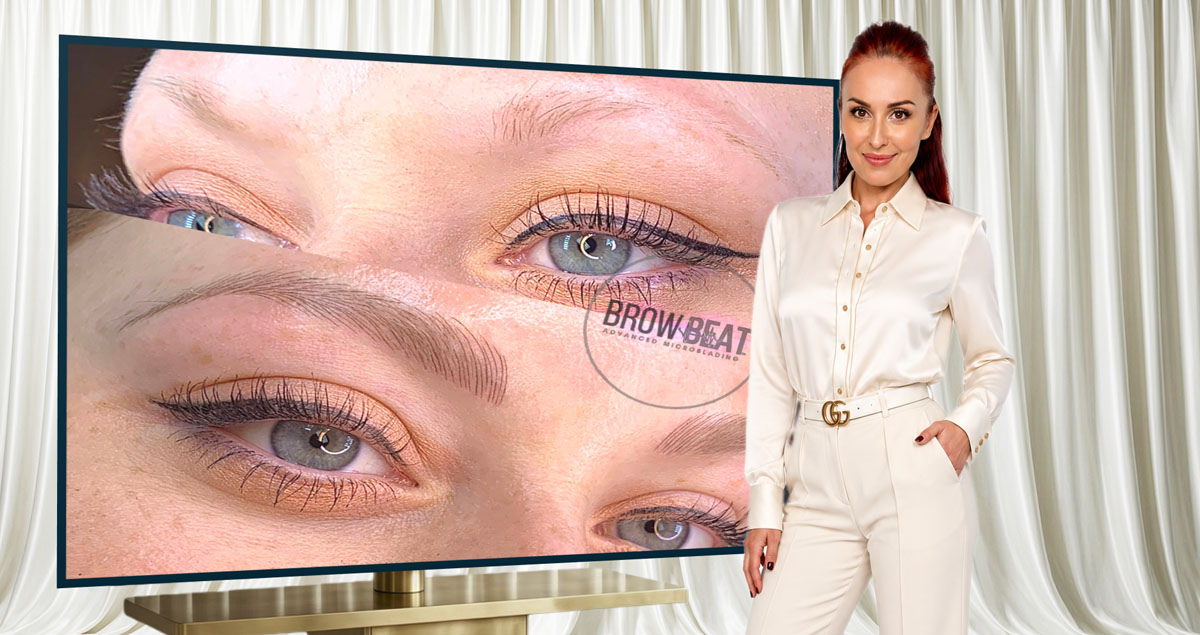
Combo Brows are permanent eyebrows created with two different types of permanent detail in the same design: manual hairstrokes and machine shading.
The hairstrokes create individual hair-like lines.
The shading creates broader color and density around those lines.
Natural eyebrow hair remains part of the finished result too.
Together, those elements allow the eye to see texture and coverage within the same eyebrow.
Hybrid Brows commonly describes the same broad combined technique.
3D Brows describes the dimensional appearance that can be created when natural hair, permanent hairstrokes and shaded density are visible together.
The terminology can sound complicated.
The underlying idea is not.
A Combo Brow uses different kinds of permanent detail to create one finished eyebrow.
Combo is short for combination.
At BrowBeat Studio Dallas, a Combo Brow / Hybrid / 3D Brow combines manual microblading hairstrokes with machine shading.
Those two components have different visual jobs.
A hairstroke is an individual permanent line designed to resemble eyebrow hair.
Machine shading builds broader pigment density through the eyebrow.
Put them together and the brow can contain hair-like texture while also carrying more background color than hairstrokes alone provide.
That is what makes the service a combination.
Combination Brows is simply the full version of Combo Brows.
There is no separate procedure hiding behind the longer name.
When BrowBeat refers to Combo Brows or Combination Brows, we are talking about the same permanent-brow family:
manual hairstrokes + machine shading.
Hybrid Brows is another widely used name for permanent eyebrows that combine hairstroke detail with shading.
The word hybrid makes sense because two permanent makeup approaches are working together within one result.
At BrowBeat, Combo Brows and Hybrid Brows describe the same broad service family.
One Hybrid Brow can still look very different from another because the amount of hairstroke texture and shaded density can be adjusted for the individual client.
At BrowBeat, yes.
Combo Brows and Hybrid Brows both combine manual hairstrokes with machine shading.
The difference in wording does not create a different procedure.
The finished appearance can still range considerably.
One result may be very stroke-forward with restrained shading.
Another may carry substantially more background density while keeping hairstroke detail visible.
That difference comes from the design—not from one client booking Combo and another booking Hybrid.

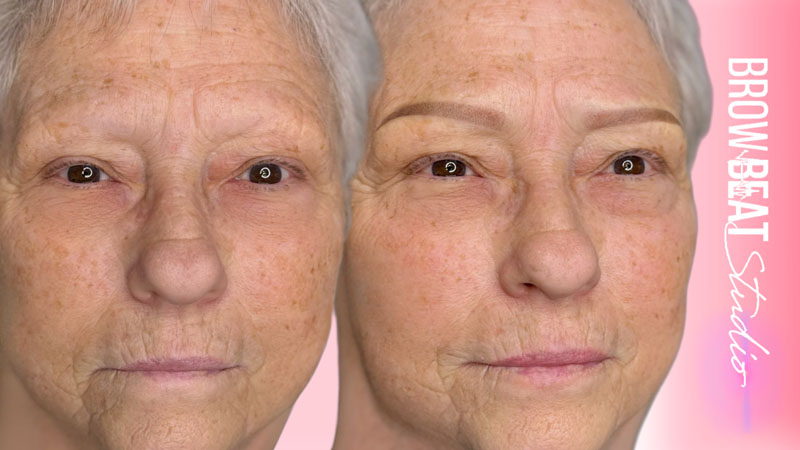
Clients between the ages of 60 and 80 choose BrowBeat Studio Dallas because we understand the unique needs of mature skin. This stage of life requires a different approach to semi-permanent makeup — one that prioritizes gentle techniques, controlled pigment placement, and natural-looking definition. From lighter complexions to high melanin skin tones, each powder brow and brow tattoo treatment is customized.
For clients in their 60s, 70s, and beyond traveling to BrowBeat Studio Dallas, fair powder brows require soft pigment layering and precise microshading control. Light beige and neutral ash tones are selected to enhance definition without overwhelming delicate mature skin. Our semi-permanent brow tattoo approach focuses on subtle structure and elegant blending, creating natural-looking results trusted by mature clients across the Dallas–Fort Worth area.

Cool gray powder brow tones are ideal for Dallas-area mature clients with silver or cooler hair tones. These pigments create clean structure while maintaining softness on aging skin. At BrowBeat Studio Dallas, microshading allows for even saturation and controlled layering, producing semi-permanent brow tattoo results that appear refined, subtle, and naturally blended across the DFW region.
3D Brows describes the dimensional appearance a combined permanent eyebrow can create.
Natural eyebrow hair provides real texture.
Manual hairstrokes add permanent hair-like detail.
Machine shading creates broader density behind and around those details.
When the eye sees those elements together, the eyebrow can appear to have greater depth than a result built from one uniform type of permanent mark.
At BrowBeat, 3D Brows therefore sits within the same broader Combo and Hybrid Brow family.
The “3D” is not a technical formula.
It does not mean three separate permanent makeup procedures are being performed.
And it does not describe a specific number of pigment layers.
It describes what the eye can perceive when texture and density work together.
Within BrowBeat’s Combo/Hybrid family, the permanent components remain:
manual hairstrokes + machine shading.
6D Brows is another term clients may encounter while researching dimensional permanent eyebrows.
There is no universal technical rule where a 6D Brow contains twice as much dimension as a 3D Brow.
A larger number does not automatically mean a more advanced or better permanent eyebrow.
The useful question is what techniques the artist is actually using and what the finished result looks like.
The terms emphasize different parts of the same broader idea.
Combo emphasizes that two permanent makeup approaches are being combined.
Hybrid communicates the same mixed-technique idea.
3D emphasizes the visual dimension that can result when hairstroke texture and shaded density work together.
At BrowBeat, they are related consumer terms within the same combined-brow family rather than three unrelated permanent eyebrow procedures.
Because a hairstroke and a shaded field do not look the same to the eye.
An individual hairstroke creates a specific piece of hair-like detail.
Machine shading creates color across a broader area.
That allows each component to concentrate on a different visual job.
Hairstrokes create texture. Shading creates density.
The complete eyebrow no longer has to depend on one kind of permanent mark to accomplish everything.
At BrowBeat, the hairstroke component of a Combo Brow is created manually through microblading.
A hand tool is used to create individual hair-like strokes within the planned eyebrow.
Those strokes can work visually alongside the client’s natural brow hair and add texture where the design needs it.
They are one distinct component of the combination.
The shaded component is created with a permanent makeup machine.
Rather than creating individual hair-like lines, the machine develops areas of pigment density.
That shading can remain extremely soft.
It can create a powder-style background.
It can transition through an ombré effect.
Or it can be built with greater density for a more visibly filled result.
The amount of shading depends on the eyebrow being created.
This is one of the clearest ways to understand the technique.
The hairstrokes are created manually.
The shading is created with a machine.
The two methods are used for different visual purposes within the same permanent eyebrow.
That is why Combo Brows are not simply another name for Microblading or another name for Powder Brows.
Yes. Microblading with shading describes the basic structure of a Combo Brow very clearly.
Microblading creates the manual hairstrokes.
Machine shading creates additional background density within the same eyebrow.
Clients may also encounter phrases such as microblading with powder shading, microblading with ombré shading and microblading with microshading.
Those terms place slightly different emphasis on the shaded component while describing the same broader combination of hairstrokes and shading.

Microblading with powder shading combines manual hairstrokes with machine shading that creates a soft powder-style background through the eyebrow.
The word powder describes the appearance of the shaded permanent color.
It can remain restrained enough for the hairstrokes and natural hair to stay visually prominent, or it can be built with greater density when the client wants more coverage.
Microblading with ombré shading combines manual hairstrokes with shading that changes in density through the eyebrow.
The front may remain softer while greater shaded definition develops through the body and tail.
The hairstrokes contribute texture within that changing field of density.
Both permanent components are still being planned as one combined result.
Microblading with microshading names the two components directly.
Microblading creates manual hairstrokes.
Microshading creates machine-shaded density.
When those two techniques are intentionally used within the same eyebrow design, the result can be described as a Combo or Hybrid Brow.
A completely shaded permanent eyebrow can be described as Powder Brows, Ombré Brows or Microshading.
Those services do not require manual hairstrokes.
A BrowBeat Combo Brow does.
If the permanent result contains only machine shading, it belongs to the shading family.
If it contains manual hairstrokes and machine shading, it belongs to the Combo/Hybrid family.
Microblading by itself creates a hairstroke-led permanent eyebrow without machine-shaded density.
Combo Brows retain that manual hairstroke detail and introduce shading as another planned part of the result.
That distinction is why a client can love microblading hairstrokes and still prefer a Combo Brow when she wants more permanent coverage between and around them.
Nano changes the method used to create the hairstrokes.
Microblading hairstrokes are created manually.
Nano hairstrokes are created with a permanent makeup machine.
Nano hairstrokes can also be combined with shading, but the hairstroke technique is different from the BrowBeat Combo Brow being defined here.
A simple way to keep the techniques clear is:
Microblading = manual hairstrokes.
Nano = machine hairstrokes.
Powder, ombré and microshading = machine shading.
Combo, Hybrid and 3D Brows = manual hairstrokes + machine shading.
A Combo Brow is not simply a completed microblading service with some shading added afterward because the eyebrow looked empty.
The combination is part of the intended result.
Before permanent work begins, BrowBeat already knows that both texture and density need a role within the design.
That affects how we think about the natural eyebrow, the shape, where hair-like detail will be useful and where additional background color will help the complete brow read more clearly.
Shading has a job from the beginning.
It may add background color where natural brow hair is lighter.
It may connect the body of the eyebrow.
It may give the tail more presence.
It may create a softer-to-more-defined transition through the shape.
Whatever its role, it belongs to the planned eyebrow rather than being used as a patch for something the hairstrokes failed to do.
The reverse is true too.
If the client chooses a combination service because she values hairstroke texture, those strokes need a meaningful role in the result.
They are not added simply so a shaded eyebrow can be marketed under another name.
The hair-like detail should contribute to the appearance the client chose Combo Brows for in the first place.

High melanin mature brows require specialized pigment selection and advanced microshading techniques. At BrowBeat Studio Dallas, carefully balanced brown tones are used to enhance depth while maintaining softness on aging skin. Semi-permanent brow tattoo application focuses on smooth transitions and even coverage, delivering elegant results trusted by mature clients across the Dallas–Fort Worth area.
Dark brown powder brows provide deeper structure for mature Dallas clients who prefer stronger definition without heaviness. Rich neutral brown pigments are applied using precise microshading to maintain softness on aging skin. BrowBeat Studio Dallas tailors each semi-permanent brow tattoo treatment to deliver smooth blending, refined shaping, and polished results trusted throughout the DFW metroplex.


Brown powder brows are a classic choice for Dallas clients ages 50–80 who want natural warmth and balanced enhancement. Medium brown pigments provide gentle contrast while preserving softness on mature skin. BrowBeat Studio Dallas uses layered microshading and semi-permanent makeup techniques to create brow tattoo results that remain timeless, wearable, and beautifully proportioned for DFW clients.
Dark brown powder brows provide deeper structure for mature Dallas clients who prefer stronger definition without heaviness. Rich neutral brown pigments are applied using precise microshading to maintain softness on aging skin. BrowBeat Studio Dallas tailors each semi-permanent brow tattoo treatment to deliver smooth blending, refined shaping, and polished results trusted throughout the DFW metroplex.

The permanent work is normally being created around a real eyebrow.
The client may have plenty of natural hair through the front and less through the tail.
She may have substantial hair overall but visible skin between it.
One section may grow densely while another looks lighter.
That natural hair already creates texture and density before BrowBeat places anything permanent.
The manual hairstrokes and machine shading need to work with it.
The purpose of a hairstroke is not simply to prove that an artist can make a fine line.
It needs to contribute something useful to the eyebrow.
Where natural hair already creates substantial texture, another permanent line may not have the same visual value as it would in a lighter area.
Where the brow needs additional hair-like detail, a permanent stroke can contribute more.
This is why Combo Brows should not be thought of as one standard stroke pattern repeated on every client.
Natural hair can make one area of an eyebrow appear much denser than another before any permanent shading is added.
Machine shading gives the artist a way to add background color where the complete eyebrow needs more visual support.
The eye sees natural hair and permanent color together.
That complete picture matters more than trying to place exactly the same amount of shading in every section.
Not every space inside an eyebrow needs to be filled until no skin is visible.
Visible skin can help a softer combination brow retain lightness.
It can make hairstroke texture easier to appreciate.
And it can allow natural eyebrow hair to remain visually important.
As shaded density increases, less skin remains visually dominant and the eyebrow begins to feel fuller.
That gives Combo Brows a wide range between delicate and defined.
Hair-like detail needs enough visual contrast for the eye to notice it.
If every area around every stroke carried identical strong density, some of the visual impact of those lines could be lost.
That does not mean a Combo Brow has to remain sparse.
It means the relationship between the hairstroke and its background matters.
The artist is deciding not only what to add, but where detail needs enough room to remain visible.
If dimension were simply a matter of adding more permanent color, every heavily shaded eyebrow would automatically look more dimensional.
That is not what the term 3D is describing.
Dimension comes from contrast between different visual elements.
Natural hair.
Permanent hairstrokes.
Shaded density.
Visible skin.
Lighter and stronger areas.
The eye notices those differences and interprets texture and depth.
This is one of the central visual ideas behind Hybrid Brows.
The eye can register background color while still noticing individual hair-like detail.
Think about a natural eyebrow.
Close up, you can see individual hairs.
Step farther away and those hairs collectively create density.
A Combo Brow is not literally recreating that structure, but it uses a similar visual relationship:
detail exists inside a broader sense of eyebrow density.
Close-up photographs let you appreciate individual hairstrokes.
You can see the shading around them.
You can see natural hair moving through the permanent work.
But clients spend most of their lives seeing the complete eyebrow from farther away.
Across a table, in the mirror and in photographs, all of those small details need to add up to a shape that reads clearly on the face.
An individual stroke can be beautifully created and still be only one small part of the finished result.
The client does not leave wearing one stroke.
She leaves wearing two eyebrows.
That means BrowBeat has to move between detail and the complete shape.
Does the brow have enough texture?
Does the body have enough presence?
Does the tail read clearly?
Does the eyebrow still make sense when we stop examining it from inches away?

The front, body and tail do not necessarily need the same visual balance.
The front can carry more visible texture and lightness.
The body can use additional shaded density to connect the eyebrow.
The tail can carry greater definition so the complete shape has a clear finish.
That is not a mandatory formula for every Combo Brow.
It demonstrates why combining two kinds of permanent detail gives the artist more flexibility than asking one technique to create every part of the result.
A client may love visible hairstroke texture through the beginning of the eyebrow while still wanting considerably more coverage through the body and tail.</p
The eyebrow can begin with more visible texture and lightness.
Move into greater background density through the body.
Then finish with a tail that carries more definition.
The visual balance changes as the eye moves through the brow, but the result should still feel like one continuous design.
That flexibility is one of the reasons Combo Brows can look so different from client to client.
A blended Hybrid Brow can contain deliberate changes in texture and density.
More visible hairstrokes in one area.
More shading in another.
More visible skin where softness is important.
Greater definition where the shape needs more presence.
The result feels blended because those changes flow through the eyebrow rather than appearing as separate sections.
The client is not receiving one microbladed eyebrow with a powder brow placed beside it.
She is receiving one combined design.
The visual emphasis can change through the shape without creating an obvious border where one technique appears to stop and another begins.
Close up, the different types of permanent detail can still be appreciated.
From normal viewing distance, the eyebrow should read as a whole.
There is no universal amount.
A very soft Combo Brow may use restrained shading so the hairstrokes, natural hair and visible skin remain prominent.
A fuller Hybrid Brow may use considerably more machine shading to create background density and a stronger permanent shape.
Both can be combination brows.
The appropriate amount depends on the natural eyebrow and the result the client wants.
There is no useful universal number of hairstrokes either.
A Combo Brow is not defined by reaching a particular stroke count.
The hairstrokes need to contribute texture where that texture is useful within the design.
Natural eyebrow hair matters too.
An area that already contains substantial real hair may need something different from an area where the natural texture becomes lighter.
Combination does not mean half hairstrokes and half shading.
One brow may be strongly stroke-forward with only quiet background color.
Another may contain substantial shaded density with selected hairstrokes providing texture.
The defining feature is that both components have a meaningful role within the same eyebrow.
The proportions can change considerably.
Natural-looking permanent makeup is not a numbers game.
If an area already has substantial natural hair, adding unnecessary permanent lines does not automatically improve it.
And if the client wants more coverage, repeatedly adding hairstrokes may not create the density she is actually asking for.
The result needs the right kind of permanent detail in the places where it contributes something useful.
The ability to build greater density is useful.
It is not an instruction to keep building indefinitely.
A soft Hybrid Brow can reach the point where it has enough background color.
A more defined Combo Brow can reach the point where the body and tail have enough presence.
The goal is not maximum pigment.
The goal is the intended eyebrow.

Density is not only about how much shading is present.
A deeper permanent color carries more visual weight than a very light one.
Natural brow hair contributes color and density too.
So a blonde client with fine natural hair and a brunette client with substantial dark hair can receive combination brows that need very different permanent color and density to create the intended visual result.
The 3D effect does not come from one special mark, a third tool or a particular number of pigment layers.
It comes from the relationship between the elements the eye can see.
Natural eyebrow hair.
Permanent hair-like strokes.
Shaded background color.
Visible skin.
Lighter and denser areas.
When those elements work together, the eyebrow can appear to have depth rather than reading as one uniform field of permanent color.
Dimension does not need to announce itself.
A client may simply notice that the eyebrow feels fuller without looking flat.
She can still see natural hair.
She can still appreciate permanent hairstroke texture.
The shading quietly provides enough background density to support both.
Greater shaded density does not automatically eliminate texture.
A polished body and tail can coexist with softer, more textured areas.
The important question is whether the natural hair and permanent hairstrokes still have a visual role within the finished result.
Dimension comes from the relationship between those elements—not simply from keeping the entire brow light.
A Combo Brow appointment begins before either permanent technique is performed.
At BrowBeat Studio Dallas, we first need to understand the natural eyebrow and what the client wants the permanent result to accomplish.
What do you normally do to your brows?
Which areas do you fill?
How much coverage do you like?
How important is visible hairstroke texture to you?
Do you like a softer front?
Do you want a more defined tail?
Those answers influence the eyebrow we design.
Where is the natural hair strongest?
Where does it become lighter?
Is the front already full?
Does the tail lose density?
Is one eyebrow naturally fuller than the other?
What is the client already doing with makeup to create the eyebrow she prefers?
The permanent design should respond to that starting point rather than pretending we are working on blank skin.
If you regularly fill your eyebrows, the way you do it contains useful information.
Maybe you always strengthen the tail.
Maybe you add color between natural hairs through the body.
Maybe you keep the front almost untouched.
Maybe you consistently create more density than you realized.
Those habits help us understand what words such as natural, soft or defined mean to you.
Two clients can both say they want natural Hybrid Brows and show us completely different photographs.
One may prefer lots of visible hairstroke texture and very restrained shading.
Another may prefer a full body and defined tail with a softer textured front.
Neither client is using the word incorrectly.
The photographs simply help translate her preference into something we can see together.
We use them for direction—not as a stencil for copying somebody else’s eyebrow onto your face.
BrowBeat uses pre-numbing before the permanent work begins.
Combo Brows involve both manual hairstrokes and machine shading, so clients naturally ask what the procedure feels like.
Individual sensitivity varies, but comfort preparation is incorporated into the appointment rather than treating it as something separate from the service.
Combo Brows can create sensation because both the manual hairstroke and machine-shading portions involve working within the skin.
How that feels varies from client to client.
Pre-numbing is used before treatment, and the fact that Combo Brows contain two techniques does not mean clients should imagine two completely separate procedures stacked on top of each other.
Both components are created as part of one planned permanent brow appointment.
Before permanent hairstrokes or shading are placed, BrowBeat establishes the eyebrow shape.
Mapping gives us a temporary framework for the permanent result.
We consider the natural brow, where the eyebrows begin, the body, arch and tail, and how the two brows relate to the complete face.
The goal is visual balance rather than forcing a human face into perfect mathematical sameness.
This matters.
We realize it is your face.
You should have time to look at the mapped brows before permanent work begins.
Look close up.
Look at the complete face.
Look at both eyebrows together.
If something feels different from what you imagined, this is exactly when we want to talk about it.
A client may arrive believing she wants a higher arch and decide she prefers something softer once she sees it on her own face.
She may think she wants considerably more fullness and discover that a smaller adjustment already gives her the presence she wanted.
Or she may realize she has been asking for less than she actually likes because the idea of permanent makeup made her cautious.
Seeing the shape makes those decisions much easier to understand.
You do not need to design your own eyebrows.
That is our job.
But you know your face and you know what you normally like.
Your feedback gives BrowBeat useful information while the design is still temporary.
Our experience helps determine how those preferences can work with the natural eyebrow and the permanent result being created.

High melanin mature brows require specialized pigment selection and advanced microshading techniques. At BrowBeat Studio Dallas, carefully balanced brown tones are used to enhance depth while maintaining softness on aging skin. Semi-permanent brow tattoo application focuses on smooth transitions and even coverage, delivering elegant results trusted by mature clients across the Dallas–Fort Worth area.
Dark brown powder brows provide deeper structure for mature Dallas clients who prefer stronger definition without heaviness. Rich neutral brown pigments are applied using precise microshading to maintain softness on aging skin. BrowBeat Studio Dallas tailors each semi-permanent brow tattoo treatment to deliver smooth blending, refined shaping, and polished results trusted throughout the DFW metroplex.


High melanin mature brows require specialized pigment selection and advanced microshading techniques. At BrowBeat Studio Dallas, carefully balanced brown tones are used to enhance depth while maintaining softness on aging skin. Semi-permanent brow tattoo application focuses on smooth transitions and even coverage, delivering elegant results trusted by mature clients across the Dallas–Fort Worth area.
Combo Brow color needs to work with the client’s natural eyebrow hair, complexion and intended density.
A blonde client does not automatically need a dark brow simply so the permanent makeup is visible.
A brunette does not automatically need the deepest pigment available.
And matching the hair on the client’s head is not the same thing as selecting an eyebrow color.
The permanent color needs to make sense beside the natural brow hair and on the complete face.
A pigment used with restrained shading can appear much softer than the same general color built with greater density.
Natural eyebrow hair adds visual depth too.
That means color and density cannot be treated as completely separate decisions.
They work together in determining how strong or subtle the finished combination brow appears.
BrowBeat uses a manual microblading tool for the hairstroke component of this service.
Individual permanent lines are created within the planned design to contribute hair-like texture.
The client does not need to understand blade configurations, stroke maps or other artist-level mechanics to understand what is happening.
At the client level, the purpose is straightforward:
manual hairstrokes add permanent hair-like detail where that texture contributes to the eyebrow.
The natural hair matters.
The mapped shape matters.
The amount of texture the client wants matters.
The hairstroke portion is therefore part of the combination from the beginning rather than a standalone microblading service performed without considering the shading that will accompany it.
The shaded component is created with a permanent makeup machine.
This is where broader pigment density develops through the eyebrow.
The shading can remain lighter where the design needs more softness.
It can become stronger where the brow needs more coverage.
And it can give the complete shape greater visual presence from normal viewing distance.
The mapped eyebrow is not treated like a coloring-book outline that needs identical pigment everywhere inside it.
BrowBeat continues looking at how the eyebrow is developing.
How much density is already coming from natural hair?
Are the hairstrokes still visually contributing?
Does one area need more background color?
Does another already have enough?
The shading is built in response to the complete brow.
Once both permanent components are present, the important question is no longer whether the microblading looks good by itself or whether the shading looks good by itself.
We look at the eyebrow.
Does the texture still read?
Does the brow have enough coverage?
Does the front feel appropriate?
Does the body feel connected?
Does the tail have enough presence?
Do both brows work together on the face?
There is doing.
And there is looking at what the doing created.
Both matter.
When two permanent components need to become one finished eyebrow, BrowBeat continues evaluating the result as it develops rather than waiting until the final minute to decide whether the balance works.
More hairstrokes are not automatically better.
More shading is not automatically better.
More definition is not automatically better.
The procedure has an intended result.
Once the texture, density, color and shape are doing what they need to do, continuing to add permanent work simply because it is possible does not improve the eyebrow.
A Combo Brow is not finished merely because both techniques have been performed.
BrowBeat looks at the overall shape.
The relationship between the two brows.
The fronts.
The bodies.
The tails.
The visible texture.
The shaded density.
The lining.
And how the complete permanent eyebrow sits on the face.
Clients should allow approximately 3 to 4 hours for a BrowBeat permanent brow appointment.
That time includes much more than the minutes when a manual tool or machine is actively touching the skin.
Discussion, pre-numbing, natural-brow evaluation, mapping, client feedback, appropriate design adjustments, color selection, the permanent procedure and final checks all need room within the appointment.

Because the appointment has several jobs to accomplish.
We need to understand the client.
Design the shape.
Work with the natural eyebrow.
Create manual hairstrokes.
Build machine shading.
Evaluate how those components work together.
And check the complete result before the client leaves.
The time gives those decisions room rather than treating pigment placement as the only part of the appointment that matters.
At the end of the appointment, the client is looking at fresh permanent makeup.
The hairstrokes have just been created.
The machine shading has just been placed.
The color is fresh.
And the skin has just undergone the procedure.
The brows can therefore appear stronger, sharper and more noticeable than they will once healed.
But the fresh result should already show the intended shape, hairstroke texture, shaded density and relationship between those elements.
This is expected.
Fresh pigment has more immediate visual intensity, and the skin has only just been treated.
A client who began the day with very light or minimally filled natural brows may notice the change particularly strongly.
The treatment-day eyebrow is the beginning of the permanent result—not a promise that the exact fresh intensity will remain unchanged.
A softer combination brow can still be clearly visible immediately after treatment.
The front may show more texture and lightness.
The shading may sit quietly behind the natural hair and permanent hairstrokes.
The body and tail can carry enough density to make the complete eyebrow visible without turning the result into a fully shaded brow.
Soft describes the character of the design.
It does not mean the fresh permanent makeup should be almost impossible to see.
A client who wanted greater coverage will see more shaded density.
The body may appear fuller.
The tail may look cleaner and more visible.
The complete eyebrow may resemble more of the polished result she normally creates with makeup.
Hairstroke detail can still remain part of that more defined design.
When you first sit up, it can be tempting to move immediately toward the mirror and inspect every individual hairstroke.
Look at the complete face first.
Look at the overall shape.
Look at where the brows begin.
Look at the body and tails.
Look at how the two eyebrows work together.
Then move closer and appreciate the individual detail.
Permanent brows are facial features before they are close-up photographs.
At closer range, the two permanent components become easier to identify.
You can see individual hairstrokes.
You can see shaded density around and behind them.
You can see natural eyebrow hair moving through the permanent work.
That close-up view helps explain how the technique was created.
Step farther away and those details begin working together as one eyebrow.
The dimensional effect does not come from a special third technique.
It comes from what the eye can see together.
Natural eyebrow hair.
Permanent hairstrokes.
Shaded color.
Lighter areas.
Denser areas.
Visible skin.
Those differences can give the eyebrow texture and depth even while the permanent makeup is fresh.

A client can love the shape and still be surprised by how noticeable fresh permanent makeup looks.
Those are two different reactions.
If you began the appointment with light, sparse or minimally filled brows, seeing a complete permanent eyebrow on your face can be a significant visual change.
Your eyes are adjusting to the new shape at the same time that you are seeing fresh pigment at its strongest stage.
That is why the treatment-day result should be understood as fresh permanent makeup rather than judged as though it has already healed.
The mapped design has just been converted into permanent work.
The tail can look particularly clean.
The lower edge can appear more defined.
The shaded areas can carry greater visual intensity.
And the individual hairstrokes can be particularly easy to see.
Those characteristics soften as the permanent makeup moves through healing.
Fresh pigment is more visually prominent than settled pigment.
That does not mean the permanent eyebrow was designed to remain at exactly that treatment-day intensity.
A client who requested a soft Hybrid Brow can therefore still see a stronger result immediately after the procedure.
The design can be soft while the permanent makeup itself is still fresh.
The eyebrow has just undergone a permanent makeup procedure.
Some clients may show temporary redness or sensitivity around the treated area.
How noticeable that is varies from person to person.
That immediate skin response is separate from the permanent brow color itself and should not be confused with the settled appearance of the eyebrow.
A fresh photograph shows what the permanent makeup looked like immediately after BrowBeat created it.
A healed photograph shows how the hairstrokes, shading and color settled after the skin recovered.
Both photographs are useful.
They simply answer different questions.
The fresh result shows the design and newly placed permanent detail.
The healed result shows the eyebrow the client actually settles into wearing.
As Combo Brows heal, the fresh intensity softens and the treatment area moves through its normal recovery.
The hairstrokes and shaded areas can both look different during that process before the complete result settles.
Temporary surface changes can also affect how visible different parts of the eyebrow appear from one day to another.
That is why the brow should not be judged from one isolated moment during healing.
Our Combo, Hybrid & 3D Brow Healing & Aftercare information explains the fresh-to-healed progression and BrowBeat’s aftercare in detail.
Healing changes the intensity of the fresh permanent makeup.
It does not change the basic idea behind the design.
The hairstroke component was created to contribute texture.
The shading was created to contribute density.
Once healed, those elements should still make sense together within the complete eyebrow.
Once the permanent makeup has healed, the brow begins a much longer period of gradual change.
Permanent hairstrokes and shading can become softer over time, and individual retention varies.
That longer-term change is different from the immediate healing period.
Our Combo, Hybrid & 3D Brow Longevity information explains how the combined result can change after healing and the factors that can influence retention.
Yes. Combo Brows are permanent makeup, also commonly described as cosmetic tattooing.
Pigment is placed within the skin to create a lasting eyebrow result.
Permanent does not mean the hairstrokes and shading remain at exactly the same color, density and definition indefinitely.
The visible result gradually changes over time.
The term semi-permanent is commonly used in the beauty industry because permanent makeup fades and softens.
But Hybrid Brows still involve pigment being placed within the skin.
They should therefore be approached as permanent makeup rather than as a temporary brow tint that simply washes away.
Microblading uses manual hairstrokes as the permanent brow effect.
Combo Brows retain those manual hairstrokes and add machine shading.
That shading provides background density the individual strokes do not create by themselves.
For a client who likes hairstroke texture but also wants greater permanent coverage, that difference can be significant.
Powder Brows use machine shading to create the permanent eyebrow effect.
Combo Brows also use machine shading, but add manual hairstrokes as another visible component of the design.
Both can provide permanent density.
The difference is whether the client also wants individual hair-like permanent detail within that shaded result.
The defining difference is how the hairstrokes are created.
BrowBeat Combo Brows use manual microblading hairstrokes together with machine shading.
Nano Brows create hairstroke-style detail with a permanent makeup machine.
Both can create hair-like texture, but the method used to create that texture is different.
Yes. Combo Brows can be created with restrained shading, visible hairstroke texture and enough visible skin for the natural eyebrow to remain an important part of the result.
Natural does not have to mean almost invisible.
The brow can still have useful shape, density and a finished tail while feeling soft on the face.
Yes.
A client who normally fills her eyebrows and prefers more visible definition may want greater shaded density through the body and tail.
The hairstrokes can remain part of the design while the permanent shading takes on a larger visual role.
That allows Combo Brows to move from very soft to considerably more polished without changing the basic technique.
No single front design belongs to every client.
Many clients like a softer, more textured beginning because it allows the brow to enter the face gently.
But the amount of texture, visible skin and shaded density through the front should respond to the client’s natural eyebrow and preferred result.
Yes. The machine-shaded component can transition from lighter density through the front into greater density through the body and tail.
Manual hairstrokes can remain visible within that broader design.
The result can therefore contain both hair-like texture and an ombré-style change in shaded density.
Yes. Machine shading can create a soft powder-style background within a combination brow.
The difference from a shading-only Powder Brow is that the Combo Brow also contains manual hairstroke detail.
The client receives both permanent texture and shaded coverage within the same design.
Yes. Natural eyebrow hair is part of the finished result.
A client may already have substantial hair and want more background density underneath it.
Another may have thinner areas where permanent hairstrokes and shading contribute more of the visible eyebrow.
The permanent work should respond to the natural starting point rather than treating every client as though she has the same brow.
Yes. Combo, Hybrid and 3D Brows can be customized across low to high melanin skin.
Pigment color, density, natural eyebrow hair and the client’s preferred result all need to be considered together.
There is no single Combo Brow color or density assigned to one complexion.
A blended Combo Brow allows the hairstrokes, natural hair and machine shading to contribute to the same overall eyebrow.
The eye may notice different levels of texture and density through the shape, but those changes should feel connected.
There should not be an obvious visual break where one technique looks unrelated to the permanent work beside it.
Dimension comes from contrast between different visual elements.
Real eyebrow hair has texture.
Permanent hairstrokes add hair-like lines.
Machine shading creates broader density.
Visible skin and changes in density provide additional contrast.
Together, those elements can create the depth associated with 3D Brow terminology.
Because the starting eyebrow is different.
The amount of natural hair is different.
The coloring is different.
The desired density is different.
And clients do not all want the same balance between hairstroke texture and shaded coverage.
The technique gives BrowBeat two permanent components to work with, but the finished eyebrow still needs to be designed for the individual client.
The terminology is much easier once the permanent components are clear.
Combo Brows and Combination Brows describe the combined service.
Hybrid Brows is another widely used name for that same broad idea.
3D Brows describes the dimensional appearance the combination can create.
Microblading provides the manual hairstrokes.
Machine shading provides the background density.
Natural eyebrow hair remains part of the finished result.
And the amount of texture and coverage can be adjusted considerably from one client to another. Read our combo brow vs microblading comparison.
They are permanent eyebrows designed with manual hairstrokes and machine shading working together within one planned shape.
The hairstrokes contribute individual hair-like detail.
The shading contributes broader permanent color and density.
Natural eyebrow hair contributes its own texture.
The artist balances those elements around the client’s starting brow and intended result.
The finished eyebrow can be soft and stroke-forward, fuller and more defined, or somewhere between those two ends of the range.
What makes it a combination is not one fixed appearance.
It is the presence of two different permanent makeup components serving one eyebrow.
That is ultimately what all of the terminology and procedure detail comes back to.
The client does not need to look in the mirror and mentally separate her microblading from her shading.
She should see the eyebrow those elements created together.
Close up, there can be texture.
From farther away, there can be density and shape.
Natural hair moves through both.
Different visual elements are doing different jobs while serving the same design.
Manual hairstrokes. Machine shading. One planned permanent eyebrow.

Combo Brows are permanent eyebrows that combine manual microblading hairstrokes with machine shading. The hairstrokes create hair-like texture while the shading adds broader color and density within the same eyebrow.
Hybrid Brows commonly describes permanent eyebrows that combine hairstrokes with shading. At BrowBeat Studio Dallas, Hybrid Brows and Combo Brows belong to the same combined-brow family.
3D Brows describes the dimensional appearance created when natural eyebrow hair, permanent hairstrokes and shaded density work together. At BrowBeat, 3D Brows are part of the Combo and Hybrid Brow family rather than a separate third procedure.
Yes. At BrowBeat Studio Dallas, Combo Brows and Hybrid Brows both combine manual microblading hairstrokes with machine shading. The finished density can vary considerably from client to client.
3D Brows can describe the dimensional appearance of a Combo Brow. The “3D” refers to visual depth created by natural hair, hairstroke detail and shaded density rather than to a separate permanent makeup technique.
Combination Brows is the full name for Combo Brows. At BrowBeat, both terms describe permanent eyebrows created with manual hairstrokes and machine shading within one planned design.
6D Brows is terminology sometimes used for detailed or dimensional permanent eyebrows. There is no universal technical formula that makes a 6D Brow twice as dimensional as a 3D Brow, so the actual techniques and finished result matter more than the number.
BrowBeat Combo Brows use manual microblading to create hairstrokes and a permanent makeup machine to create shading. Both techniques are planned together as parts of one permanent eyebrow.
Yes. At BrowBeat Studio Dallas, the hairstroke component of Combo Brows is created manually through microblading. Machine shading is then used to create broader permanent density.
Yes. BrowBeat uses a permanent makeup machine to create the shaded component of Combo Brows. The shading provides background color and density around the manual hairstroke detail.
Yes. Microblading with shading describes the basic structure of a Combo Brow: manual microblading hairstrokes combined with machine shading within the same permanent eyebrow.
Microblading with powder shading combines manual hairstrokes with machine shading that creates a soft powder-style background. The result contains both hair-like permanent detail and shaded density.
Microblading with ombré shading combines manual hairstrokes with machine shading that changes in density through the eyebrow. The front can remain softer while the body and tail carry greater shaded definition.
Microblading with microshading combines manual hairstrokes with machine-created shaded density. When both are planned within one eyebrow, the result belongs to the Combo or Hybrid Brow family.
No. Microshading alone creates a machine-shaded permanent eyebrow without manual hairstrokes. A BrowBeat Combo Brow contains both manual microblading hairstrokes and machine shading.
No. Microblading alone creates manual hairstrokes without the machine-shaded component. Combo Brows add machine shading to the manual hairstroke design.
The hairstroke method is different. BrowBeat Combo Brows use manual microblading hairstrokes with machine shading, while Nano Brows use a permanent makeup machine to create the hairstroke detail.
Hairstrokes and shading perform different visual jobs. Hairstrokes create hair-like texture, while machine shading creates broader permanent color and density, allowing one eyebrow to contain both effects.
No. Combo Brow shading can range from very restrained background color to considerably greater density. The amount depends on the natural eyebrow and the finished result the client wants.
No. Combo Brows do not follow a fixed 50/50 formula. One result can be stroke-forward with light shading, while another can contain greater shaded density with selected hairstroke detail.
Yes. Combo Brows can look natural when the permanent hairstrokes, shading and client’s natural eyebrow hair are balanced appropriately. A softer result can retain visible skin and texture while still adding useful density.
Yes. Combo Brows can use greater machine-shaded density to create a fuller body, more visible shape and stronger tail while retaining hairstroke detail within the design.
Yes. A client who prefers a more polished eyebrow can choose a Combo Brow with greater shaded density. The permanent hairstrokes can remain visible while the shading creates more of a filled-in effect.
Yes. A Combo Brow can keep more texture and lightness through the front while building greater shaded density through the body and tail. The entire eyebrow does not need identical density.
Yes. The machine shading within a Combo Brow can transition from softer density through the front to greater density through the body and tail while manual hairstrokes remain part of the design.
Yes. Machine shading can create a soft powder-style background within a Combo Brow. Unlike a shading-only Powder Brow, the combination result also contains manual hairstroke detail.
The 3D effect comes from the visual relationship between natural eyebrow hair, permanent hairstrokes, shaded density, visible skin and changes in intensity. It does not require a separate third technique.
A blended Combo Brow means the hairstrokes, natural hair and machine shading read as parts of one eyebrow. Different areas can contain different levels of texture and density without appearing disconnected.
Yes. Natural eyebrow hair remains part of a Combo Brow result. Permanent hairstrokes can add texture where useful, while machine shading can provide background density around and beneath the natural hair.
Yes. Combo, Hybrid and 3D Brows can be customized across low to high melanin skin. Pigment color, permanent density, natural eyebrow hair and the client’s desired result are considered together.
Combo Brows can create sensation because both manual hairstrokes and machine shading involve working within the skin. Individual sensitivity varies, and BrowBeat uses pre-numbing before the permanent procedure begins.
A BrowBeat permanent brow appointment generally takes approximately 3 to 4 hours. That time includes discussion, pre-numbing, natural-brow evaluation, mapping, client feedback, color selection, the permanent procedure and final checks.
Yes. BrowBeat maps the eyebrow before permanent hairstrokes and shading begin. The client can see the proposed shape and provide feedback while the design is still temporary.
Fresh Combo Brows can look stronger, sharper and more noticeable than the healed result. The hairstrokes and machine shading have just been created, so treatment-day intensity should not be confused with the settled permanent eyebrow.
Yes. Fresh Combo Brows soften as the skin heals and the permanent color settles. The healed result should be evaluated after the early post-procedure changes have passed rather than from the treatment-day intensity.
Yes. Combo Brows are permanent makeup in which pigment is placed within the skin. The visible hairstrokes and shading gradually soften over time, but the service should not be treated like a temporary brow tint that simply washes away.